#AcWri, #phdchat, LPQ

The @LPQuarterly Workshop No. 1 – HOW TO: Effectively Review, Submit & Publish Your Academic Manuscript

To support our graduate students and junior scholars at UNT, with their academic writing development, the Learning and Performance Quarterly hosted its first workshop this past Friday, March 1st.

The purpose of this session was to introduce graduate students to the Learning and Performance Quarterly journal, and engage in a discussion about scholarly peer-review, academic editing, and the publication process. Dr. Kim Nimon & Dr. Jeff Allen shared their experiences and thoughts on the publication process, and what it takes to submit an academic manuscript.

We discussed the steps from submission preparation, through correspondence, and all the way to publication, including:

  • Understanding Academic Journal Types: A, B, & C Level
  • Considering the Social Science Citation Index (SSCI) for journal levels
  • Using Google Scholar Citations & being critical with Google Scholar
  • Filtering with the UNT Libraries Search – Summon
  • Researching Academic Journals: Cabell’s Directory (hard copy in library)
  • Scholarly Publication Process – how it helps your academic writing improve
  • Effective Peer Reviewing – comments, feedback & effective suggestions
  • Expectations & Considerations – the typical process is 9-12 months
  • Developing Publishing Relationships – between reviewers & editors AND the editor & author; it’s a human process
  • Attending Conference Sessions with the Editor – bring your manuscript, learn if they need papers, build a rapport
  • key rejection reasons – format, grammar, APA, and theoretical frameworks
  • How to get involved in the academic reviewing & writing process
  • Using a plagiarism checker to review your manuscript before submission
  • Communication with the editor & being timely with your peer reviews

During the session Dr. Nimon shared her own publishing experiences, provided the group with  peer-reviewing and editor correspondence, and talked about what she looks for in academic manuscripts as an editor. 

Although many asked to record the workshop; I decided not to as the open discussion, and Q & A format was really best served in person, and I think the conversation was more candid without the recording.  You can thank the LPQ Assistant Editor, Tekeisha, for compiling notes from this session – here is the summary of what we discussed:

Besides encouraging our attendees to write, we also placed value in joining the peer-review and editing process. We suggested to sign up to review articles for the LP Quarterly AND other journals in their field. Being a peer-reviewer helps junior scholars gain experience in the publishing process, build a rapport with editors, learn about acceptable journal submissions, and hone their own academic writing craft. I suggested reading Rocco and Hatcher’s (2011) book, specifically “Chapter 2 – Publishing in Peer-Reviewed and Non Refereed Journals” to get their feet wet with starting the academic submission process, preparing a manuscript, deciding where to publish, and how to best work with editors.

Although I have seen this session before – I know that I left the workshop with some great takeaways from Dr. Nimon, and helpful ideas shared by scholars who have been through the full academic writing experience from submission to publication. A huge thanks to Dr. Nimon for her time and sharing, Dr. Allen for donating the book giveaways (who doesn’t LOVE winning the Rocco & Hatcher text or APA 6th edition book?), and, most importantly, thank you to those of you who joined us on a Friday night. I appreciate it. 

In our efforts to be more developmental, the Leaning and Performance Quarterly would like to offer more in-person and online workshops on researching, writing, editing, reviewing, and publishing. It was great to see representation from other departments and disciplines across campus the other evening. We welcome others to join us for future LPQ Workshops as we consider other topics, including:

  • Managing Your Writing Projects
  • Forming Agraphia (Writing) Groups
  • Writing Literature Reviews
  • Drafting Conceptual Articles
  • Secondary Data Analysis

If you have any topic suggestions or would be interested in participating – let me know. Feel free to write suggestions in the comments OR send a message to the LPQ Editors: LPQuarterly [at] gmail [dot] com.

FYI: The NEXT Call for Submissions is on Monday, March 11th at 11:59 pm CDT. Do you have your academic manuscript ready? Submit TODAY!

Reference:

Rocco, T.S. & Hatcher, T. (2011). The handbook of scholarly writing and publishing. San Francisco: Wiley/Jossey-Bass.

EdTech

Ed Tech Career (#EdTechCareers) Forum: Questions, Discussions & Advice at #et4online

In preparing for the upcoming Emerging Technology for Online Learning (#et4online) conference this Spring, the planning committee discussed how to augment the Career Forum to better support graduate students and junior faculty who are job searching. The Career Forum will post jobs,  offer on-site interviews, and also host a series of  career development round table discussions with experienced scholars, researchers, and instructors in the educational technology field.
et_attending_400x100
Last week, Dr. Kevin Grazino and I began brainstorming potential round table discussions to host at the upcoming #et4online conference. These panels will provide a space for emerging scholars to meet and gain career insights from experienced professionals/faculty.
CAREER FORUM ROUND TABLES (#EdTechCareers)
Career Forum Round table – EdTech Career Tracks

Tuesday, April 9 – 2:30pm-3:20pm

There are a number of career directions and opportunities to apply for with your graduate degree. Join this roundtable to ask career questions and gain advice on which path is right for you:

  • Higher Education Faculty/Instructor – teaching vs. research institutions
  • Industry Research & Development
  • Consulting/Other
Career Forum Round table – Career Skills
Wednesday, April 10 – 10:10am-11:00am
In developing career skills for the educational technology field, it is critical to get involved and connected to both professional affiliations and peers. Come learn about how to build your CV and also showcase your experiences, as we talk about:
  • Professional Networking
  • Getting Involved in Professional Organizations
  • Scholarship Development – teaching, publishing, service
  • Interview Advice
Career Forum Round table – Career Applications

 Thursday, April 11 –  10:10am-11:00am 

Applying to your first faculty position? Looking for industry positions? Perhaps you should consider how you present yourself via your job application. Join us as we talk about things to consider when developing your career materials, including:

  • CV & Resume Writing
  • ePortfolio Development
  • References

If you are attending the Emerging Technology for Online Learning (#et4online) conference, and you are able to share your career experience with graduate students and junior scholars, PLEASE consider donating 50 minutes of your time for one of the following round tables. 

For graduate students attending #et4online, please consider attending at least one of these Career Forum Round tables to ask questions and seek out career advice. Do you have questions or things you want to learn from this? Let me know.

LPQ

Published: Learning and Performance Quarterly 1 (4)

The Learning and Performance Quarterly (LPQ) Volume 1, Issue 4 is hot off the press!

Editorial Abstract: The Learning Spectrum 

Learning is critical for curriculum design, training development, and educational objectives. Both pedagogy and design inform learning practices for suggested practices and models. In the fourth and final issue for the Learning and Performance Quarterly (LPQ) volume one houses a combination of manuscripts to span the learning spectrum.

LPQ Cover PhotoINVITED ARTICLE

What is Action Learning? Components, Types, Process, Issues, and Research Agendas ~ Yonjoo Cho  
CASE STUDY
Students perceptions of collaborative learning in intermedia and performance arts ~ Kate Sicchio, Grant Bridges  
CONCEPT/THEORY PAPER
Web-based Learning Management System Considerations for Higher Education ~ Chih-Hung Chung, Laura A. Pasquini, Chang E. Koh  
BOOK REVIEW
Book Review: Cases on Formal and Informal E-Learning Environments: Opportunities and Practices ~ Lindsay J. Ritenbaugh, Justin C. Shukas  

Call for Submissions

The Learning and Performance Quarterly (ISSN 2166-3564) is a peer-reviewed, open access journal from the Center for Knowledge Solutions at the University of North Texas. The journal takes a broad look at current developments and research that involves innovative learning, training, human resource development, and performance management across academic and professional disciplines.

We are seeking manuscript submissions for the following categories:

  • Research Articles – Qualitative/Quantitative
  • Concept/Theory Papers
  • Case Studies
  • Book or Media Reviews
  • Invited Articles


2013 call for submissions deadlines*:

LPQ 2(1): March 11, 2013 at 11:59 pm CDT

LPQ 2(2): May 20, 2013 at 11:59 pm CDT

LPQ 2(3): August, 2013 at 11:59 pm CDT

LPQ 2(4): October 21, 2013 at 11:59 pm CDT

*Submit your manuscripts ONLINE. Submission to publication turnaround time is 6-8 weeks. For detailed submission guidelines and instructions on how to make a submission please visit Author Guidelines. 
Thanks for reading,


Laura A. Pasquini & Dr. Jeff Allen, Founding Editors
Learning and Performance Quarterly
Like us on Facebook
Follow us on Twitter @LPQuarterly
Email: LPquarterly@gmail.com

AcAdv

Implications for Use of Technology in Advising @NACADA 2011 National Survey

In Fall 2011, I was asked to review data collected from a national survey sponsored by The Global Community of Academic Advising (NACADA) and contribute to the chapter on advising technology. The survey posed a few questions about technology in advising, such as assessment of institutional advising types (e.g. online, on-campus, and blended), communication with advisees, and student information management practices. The entire 2011 NACADA National Survey results and chapters can be found in the NACADA Clearinghouse; and my chapter, “Implications for use of technology in advising 2011 National Survey” are available to read online.

One final sentiment I shared in the conclusion, was to push higher education administration to consider how they assess technology in advising as holistic process connected to other campus divisions:

“When assessing technology usage, postsecondary leadership must also consider future significant challenges such as economic pressures and new modes of scholarship (Johnson et al., 2012). Through researching these technological trends and challenges, conducting campus-wide assessments, and establishing strategic plans, advising stakeholders can effectively integrate technology in advising practices that support both advising units and institutional goals” (Pasquini, 2013).

I did include a few recommendations and guiding questions to consider when considering and  evaluating technology for advising:

“Many students bring expectations about using technology to campus, and therefore, many institutions participate in community advising approaches in which technological solutions provide seamless support and communication for academic planning and progression. When advising units address the use of technologies for both managing student information and communicating with students, they may impact student support and retention initiatives on campus. Higher education institutions, who deploy technologies for communication and information management, benefit from having both the data and ability to effectively connect to their student populations” (Pasquini, 2013).

What was key from this data analysis, was that the advising and a number of student service providers lack specific information about the WHY, WHAT, and HOW technology is being used in the advising profession. With the 2011 NACADA survey and encouragement from the NACADA Executive Office, development of the 2013 Technology in Advising Use in Higher Education Survey (which is still OPEN FOR RESPONSES until March 4, 2013 at 11:55 pm CDT) was initiated. I hope that this instrument helps us critically evaluate HOW the field of advising IS using technology at colleges and universities around the globe.

#AdvTech Use in #HigherEd Survey… Launches on 02-18-2013

In developing this instrument, our working group discovered that, overall, any assessment of technology in advising was lacking. The last time information about advising and technology was collected was circa 2002, and a number of the instrument items are already obsolete (e.g. overhead projectors, Netscape web browser, and Palm Pilots). Needless to say, information about where the advising community and technology stood was missing, and the overarching idea about use, perceptions, and  the current state for technology in advising.

Here are the objectives for the 2013 Technology in Advising Use in Higher Education survey:

  1. Establish what the current use of technology in advising among the advising profession – student management, regular use, applications, software, etc.
  2. Understand how technology in advising is being used for communication purposes with students, professionals and faculty
  3. Identify the relevance of technology for advising on a global scale for the advising profession
  4. Understand the current perspectives and perceptions of how technology in advising is being utilized in the profession today

So far we have 523 responses to the survey. The data collected will help to better inform the advising profession beyond anecdotal assessment, and critically evaluate how technological solutions effectively support our advising practice.  Without any real assessment for technology use in advising, how can we determine what direction we should move forward? I hope that survey responses and data analysis can provide some of these answers. More to come…

Reference:

Pasquini, L. A. (2013). Implications for use of technology in advising 2011 National Survey. NACADA Clearinghouse. Retrieved from http://www.nacada.ksu.edu/Resources/Clearinghouse/View-Articles/Implications-for-use-of-technology-in-advising-2011-National-Survey.aspx

Reflections, StudentAffairs

Finding our Strengths(Quest) with Alternative Spring Break #asbABQ13

MHP logo

This Spring Break, I will be accompanying 9 undergraduate students from University of North Texas (UNT) as we road trip west to work with the Mi Casa Es Su Casa – Metropolitan Homelessness Project in Albuquerque, NM (#asbABQ13). We are one of the many UNT Alternative Spring Break trips created for students who want to give back to their community and participate in a service learning project while away from academics. Our trip is a new location; however I believe that we will be primarily be working to set up new spaces for those who are without a home.

Part of our efforts before the trip has involved getting to know one another, and raise funds to support our groups trip.

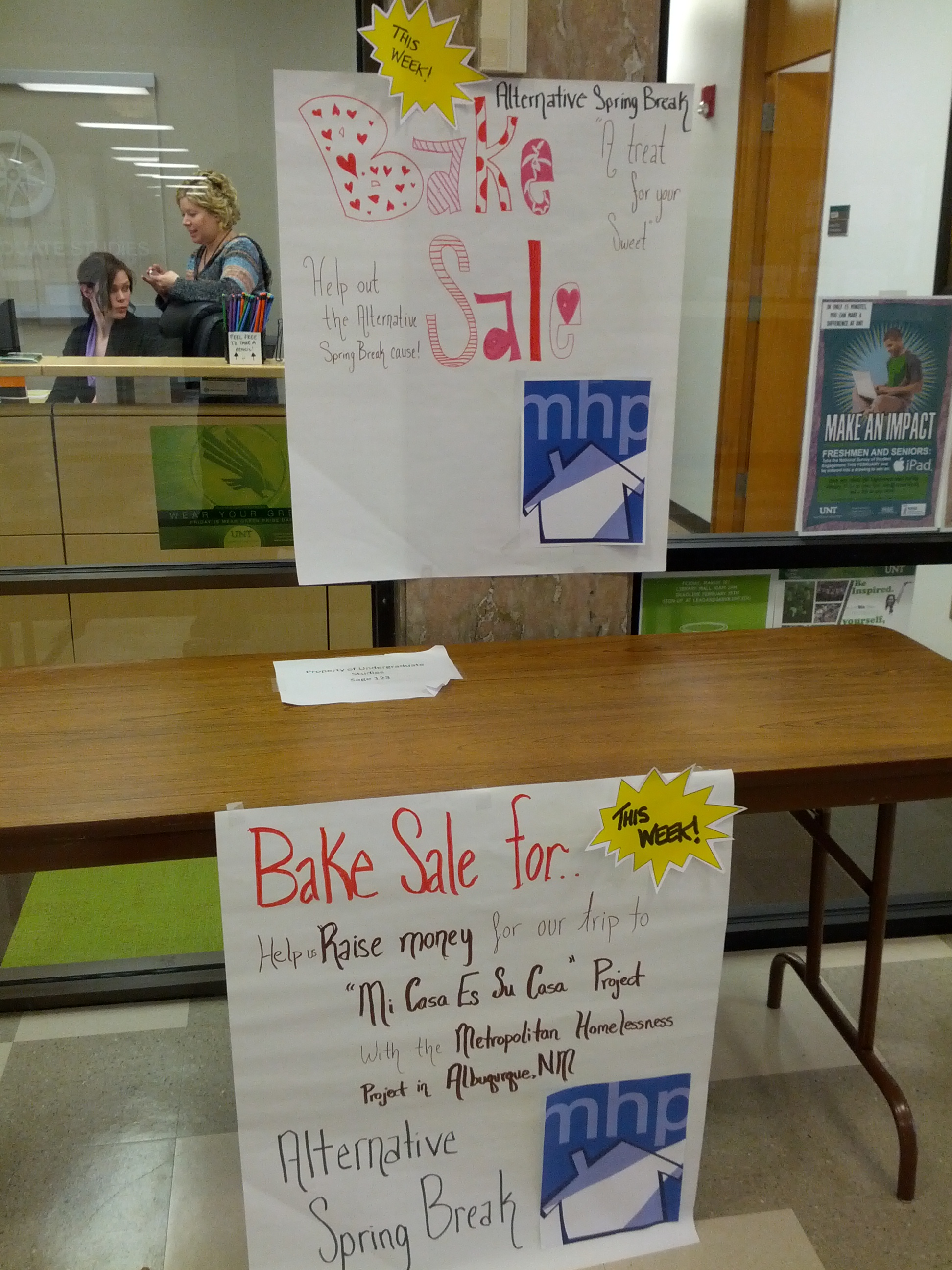
So far we had a moderately successful bake sale last week, selling “Treats for Your Sweet”… (yours truly even baked in her “spare” time)…

bake sale

And recently I encouraged the group to “LAUNCH” a Student Launcher website (formerly known as AlumniChoose), to crowd-source funds via their own social networks.

Screen Shot 2013-02-21 at 10.52.47 PM

If you would like to help fund part of the students’ travels, meals, or house-warming gifts for the new tentants, please feel free to contribute what you can to the launched #asbABQ13 funding raising site:  http://StudentLauncher.org/9cab 

Bonus: If you help fundraise, we ensure that you can follow along with our efforts and adventures. We promise to share photos and updates about our trip, and the progress we make with the Mi Casa Es Su Casa project.

Reviewing our Strengths

The last part of our trip prep has been about building our team and getting to know one another. Kudos to Irene & Becca, the #asbABQ13 site leaders, who have done a great job bringing everyone together and planning a large chunk of the trip. At our last group meeting, we debriefed about our top 5 strengths from StrengthsQuest during our last meeting. It was great to learn about what others will bring to our service project.

strengthsquest2

Here are my top 5 Strengths:

Input

“You are inquisitive. You collect things…because it interests you…to add more information to your archives…each new location offers novel artifacts and facts. So you keep acquiring and compiling and filing stuff away. It’s interesting. It keeps your mind fresh. And perhaps one day some of it will prove valuable.”

Dead on. I blame my academic background in history for my documentation, archival, recording, and research approach to things. Travel and adventures might also contribute to my desire to collect these memories and moments – I take photos, tweet, save, and then some.

Strategic

“…enables you to sort through the clutter and find the best route. It is not a skill that can be taught. It is a distinct way of thinking, a special perspective on the world at large…“What if?” Select. Strike.”

When you have a lot of things going on at the same time – you sort of have to be.

Individualization

…intrigued by the unique qualities of each person. You are impatient with generalizations or “types”…focus on the differences between individuals…a keen observer of other people’s strengths, you can draw out the best in each person…helps you build productive teams.

It’s true. I don’t like boxes, compartments, labels, or single identities. Everyone is a beautiful and unique snowflake, and I want to get to know them better. Blanket statements and group designations don’t fly with me.

Activator

“Only action can make things happen. Only action leads to performance. Once a decision is made, you cannot not act…action and thinking are not opposites…you believe that action is the best device for learning. You make a decision, you take action, you look at the result, and you learn…You must put yourself out there…you will be judged not by what you say, not by what you think, but by what you get done…”

This probably is connected to my Strategic strength. See my #oneword2013 => ACTION Need I say more. Less talk, more do. This #asbABQ13 is right up my alley.

Futuristic

“…The future fascinates you…it will always be inspirational to you…When the present proves too frustrating and the people around you too pragmatic, you conjure up your visions of the future and they energize you. They can energize others…often people look to you to describe your visions of the future…”

Am I alone on this one? I am guessing that my current research focus and scholarly work help to fuel the fire of this one. I am okay with that – who doesn’t want to have a crystal ball? Let’s take a look at my archives from my Input strength, and look to what is on the horizon. So far, I can predict a great Alternative Spring Break trip. 🙂