

Reflections, StudentAffairs

Finding our Strengths(Quest) with Alternative Spring Break #asbABQ13

MHP logo

This Spring Break, I will be accompanying 9 undergraduate students from University of North Texas (UNT) as we road trip west to work with the Mi Casa Es Su Casa – Metropolitan Homelessness Project in Albuquerque, NM (#asbABQ13). We are one of the many UNT Alternative Spring Break trips created for students who want to give back to their community and participate in a service learning project while away from academics. Our trip is a new location; however I believe that we will be primarily be working to set up new spaces for those who are without a home.

Part of our efforts before the trip has involved getting to know one another, and raise funds to support our groups trip.

So far we had a moderately successful bake sale last week, selling “Treats for Your Sweet”… (yours truly even baked in her “spare” time)…
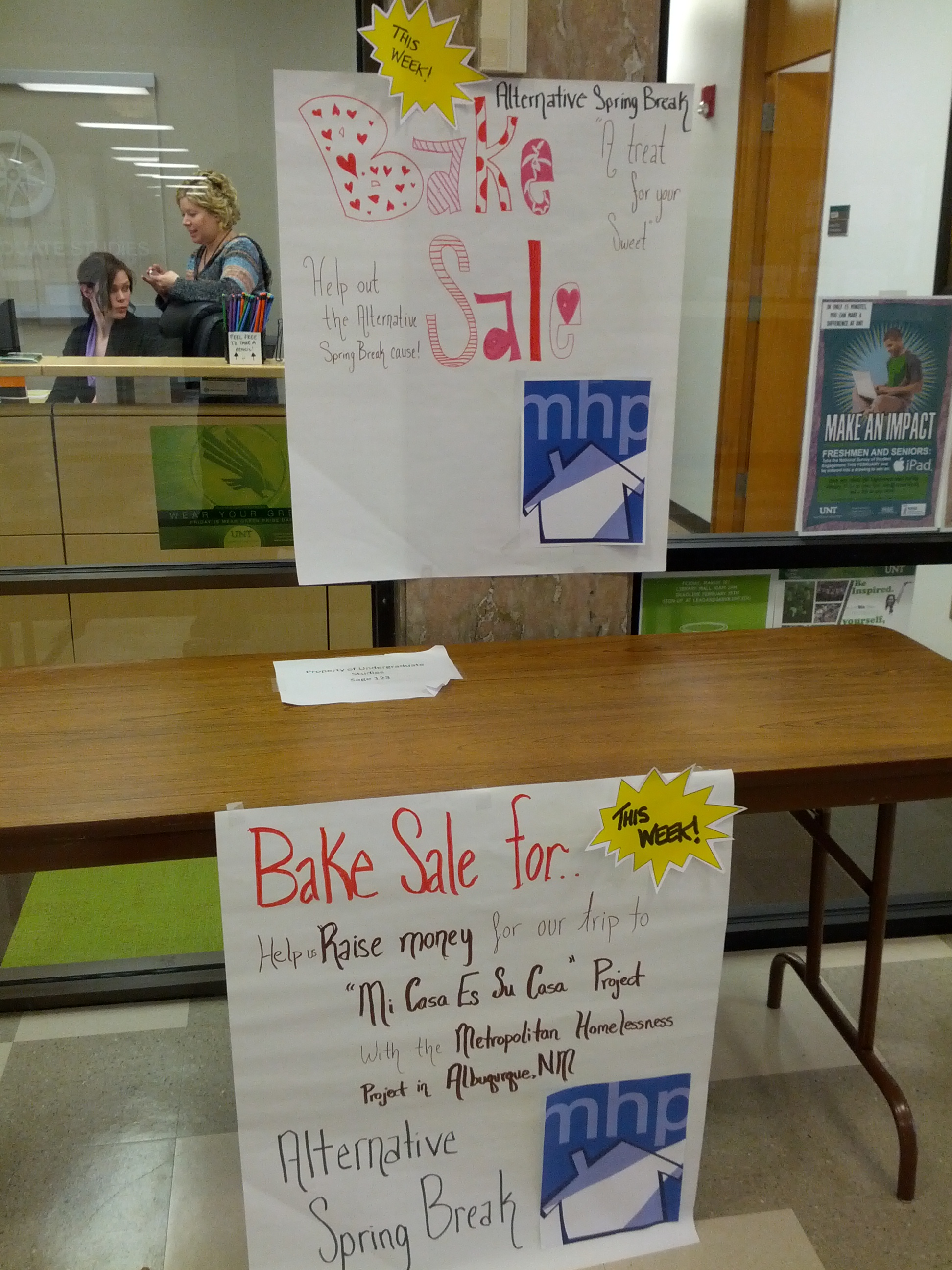
bake sale

And recently I encouraged the group to “LAUNCH” a Student Launcher website (formerly known as AlumniChoose), to crowd-source funds via their own social networks.

Screen Shot 2013-02-21 at 10.52.47 PM

If you would like to help fund part of the students’ travels, meals, or house-warming gifts for the new tentants, please feel free to contribute what you can to the launched #asbABQ13 funding raising site:  http://StudentLauncher.org/9cab 

Bonus: If you help fundraise, we ensure that you can follow along with our efforts and adventures. We promise to share photos and updates about our trip, and the progress we make with the Mi Casa Es Su Casa project.

Reviewing our Strengths

The last part of our trip prep has been about building our team and getting to know one another. Kudos to Irene & Becca, the #asbABQ13 site leaders, who have done a great job bringing everyone together and planning a large chunk of the trip. At our last group meeting, we debriefed about our top 5 strengths from StrengthsQuest during our last meeting. It was great to learn about what others will bring to our service project.

strengthsquest2

Here are my top 5 Strengths:

Input

“You are inquisitive. You collect things…because it interests you…to add more information to your archives…each new location offers novel artifacts and facts. So you keep acquiring and compiling and filing stuff away. It’s interesting. It keeps your mind fresh. And perhaps one day some of it will prove valuable.”

Dead on. I blame my academic background in history for my documentation, archival, recording, and research approach to things. Travel and adventures might also contribute to my desire to collect these memories and moments – I take photos, tweet, save, and then some.

Strategic

“…enables you to sort through the clutter and find the best route. It is not a skill that can be taught. It is a distinct way of thinking, a special perspective on the world at large…“What if?” Select. Strike.”

When you have a lot of things going on at the same time – you sort of have to be.

Individualization

…intrigued by the unique qualities of each person. You are impatient with generalizations or “types”…focus on the differences between individuals…a keen observer of other people’s strengths, you can draw out the best in each person…helps you build productive teams.

It’s true. I don’t like boxes, compartments, labels, or single identities. Everyone is a beautiful and unique snowflake, and I want to get to know them better. Blanket statements and group designations don’t fly with me.

Activator

“Only action can make things happen. Only action leads to performance. Once a decision is made, you cannot not act…action and thinking are not opposites…you believe that action is the best device for learning. You make a decision, you take action, you look at the result, and you learn…You must put yourself out there…you will be judged not by what you say, not by what you think, but by what you get done…”

This probably is connected to my Strategic strength. See my #oneword2013 => ACTION Need I say more. Less talk, more do. This #asbABQ13 is right up my alley.

Futuristic

“…The future fascinates you…it will always be inspirational to you…When the present proves too frustrating and the people around you too pragmatic, you conjure up your visions of the future and they energize you. They can energize others…often people look to you to describe your visions of the future…”

Am I alone on this one? I am guessing that my current research focus and scholarly work help to fuel the fire of this one. I am okay with that – who doesn’t want to have a crystal ball? Let’s take a look at my archives from my Input strength, and look to what is on the horizon. So far, I can predict a great Alternative Spring Break trip. 🙂

Higher Education, Social Media

Guiding Social Media at Our Institutions [ARTICLE]

Remember last fall when Tanya Joosten (@tjoosten), Lindsey Harness (@LindseyHarness) and I asked for your input on how your institution guides social media? No? Too long ago to remember? 🙂 Well regardless, we appreciated those who could respond as it helped us gather information on what we are (or are not) doing to direct social media use in higher education.

The results from the research are in, and published! Here is the recently published, peer-reviewed article for the Society for College and University Planning (SCUP).

Access the article in PDF form here.

This article expands on Chapter 6 from Social Media for Educators to understand how higher education is guiding social media use. Through our open-ended questions, we learned more about how institutions are supporting and guiding social media. Often we see social media used a broadcast medium and there has also been a shift to designate new roles or responsibilities to support its use on campus.

Thanks to the SCUP Change-Disruption Mojo for featuring some of the findings as this week’s topic, specifically to Alexandria Stankovich (@thinkstank) for sharing both sides of the issue:

  • Concerns: monitoring online behavior, identity thief, privacy, FERPA/FIPPA, maintaining university image, control, ownership, required trainings

  • Benefits: interaction and engagement beyond the formal learning environment

Want to learn more about the research and/or article findings?

Key takeaways:

  • Social media is often used as a “broadcast channel”
  • We should engage and develop a culture through the use of social media tools
  • Institutions need fluid access to information regardless of the technology
  • Simplicity principle to build capacity for the social web
  • We need to develop models of effective practice for LEARNING!
  • Trust the faculty you hire – they have some great ideas
  • Recognize that learners are MORE than sponges
  • Match technology with task & building digital literacy opportunities
  • Is social media in your strategic plan? Is social media or technologies part of your learning outcomes on campus? THIS is where your efforts need to be
  • Institutional encouragement is needed for collaboration ON YOUR CAMPUS to identify how to best guide social media models & effective practices
“The pedagogical benefit of social media use beyond its application as a motivational technique continues to be unaddressed by many universities.”

This study was just the tip of the iceberg. There is definitely more research on learning, social media use, and higher education to be done. Time to get at it! Back to the dissertation proposal grind…

Reference:

Joosten, T., Pasquini, L. A., & Harness, L. (2013). Guiding social media at our institutions. Society for College and University Planners – Integrated Planning for Higher Education, 41(2), 1-11.

AcAdv

2013 Technology in Advising (#AcAdv) Use in #HigherEd [SURVEY]

Dear Academic Advising Professionals, Faculty & Administrators in Higher Education,

The division of Undergraduate Studies at the University of North Texas (UNT) is hosting the 2013 Technology in Advising Use in Higher Education survey to assess how technology in academic advising is being utilized in colleges and universities around the globe. The NACADA Technology in Advising Commission sponsored study is designed to examine the current use and perception of technology in advising among academic advising professionals, faculty advisors, and advising administrators in higher education.

#AdvTech Use in #HigherEd Survey

If you agree to participate, you will be asked to respond to a 20-question survey, which will take approximately 15-20 minutes to complete.  The questions will ask for your opinion of technology in advising use at your college and/or university institution, and your own perception about how technology is supporting the field of academic advising as a whole. Your responses are completely confidential and no individual participant will ever be identified with his/her answers.

SURVEY: 2013 Technology in Advising Use in Higher Education or cut and paste the following URL link into a web browser: http://bit.ly/AdvTechSurvey2013

This survey will close on Monday, March 4th at 11:55 pm CST.

If you have any questions or comments, please free to contact me. On behalf of the Global Community for Academic Advising (NACADA) and the advising profession, I would like to thank you for your time and input. Please pass this survey along to other advising faculty, professionals, and administrators at your college and/or university.

Thank you,

Laura Pasquini (@laurapasquini)

NACADA Technology in Advising Commission Chair 2011-2013

Academic Counselor, Office for Exploring Majors – Undergraduate Studies, UNT

This blog post is cross-posted at The Official NACADA Blog.

PhD, Professional Development, Reflections, SocioTech

Finding a Research “Home” with #SocioTech at #iConf13

As a College of Information student, the learning technology department compliments a number of research areas emphasized within our iSchool and at the 2013 iConference. Andrew Miller (@findandrew), Leila Mills, Mark Evans and I proudly represented UNT as one of the 12 finalists for the Social Media Expo hosted by FUSE Labs of Microsoft Research at the iConference this year. After conducting our ethnographic study on the Denton Local Food System (LFS), we submitted a research paper, video, poster, and created an online space for the LFS community to share information, house knowledge and connect to local happenings within the community at FeedDenton.org.
#iConf13 Social Media Expo Finalists
  Social Media Expo poster @ 2013 iConference (#iConf13) with @findandrew

What I enjoyed most about attending the conference was the refreshing opportunities to engage about research methodology and conceptual frameworks that apply to my scholarly interests. It felt like I was coming “home” when talking shop with various academics and graduate students during the conference. The best part might have been the pre-conference session:  Sociotechnical Systems Research workshop (#CNFWSP2). This is where I was able to connect to other #sociotech researchers, and learn more about areas of inquiry coming out of the iSchools and various disciplines.

The pre-conference was a full day of fun that housed various speakers, discussions, and sharing of directions in sociotechnical research, including

  • critical study and comparative study
  • considerations for multi-scale ethnographic research
  • artifacts that change communication in organizations
  • impacts of human and non-human delegation
  • shifts from visible to invisible networks (part of ANT)
  • organization as a constant communication
  • sustainable information practices
  • action-based research for informatics improvement
  • participation, community resilience, plurality, design

Later in the day, Steve Sawyer, conducted a master class to present various sociotechnical systems (STS) perspectives, which drew upon theories from Actor-Network to social construction. Everything is relational as new forms of social organization is occurring with new technical arrangements all around us. We talked about #sociotech in practice, specifically how to situate the phenomena (conceptual & empirical framing) and conceptualize sociotechnical systems (identify characteristics of the social, technical and interactions) by looking at this STS conceptual space mapping from Steve.

Untitled
This post is just the tip of the iceberg, as I have a number of notes, ideas, references, and research peers to turn to thanks to this workshop. I was not surprised to run into some of the #sociotech usual suspects in #iConf13 sessions such local communities, learning environments, or ethnographic studies of online communities. I appreciated the comments and dialogues brought to both the paper and notes sessions (I preferred the workshop space in the notes session better), and I am motivated to dig back into my own research and dissertation grind.

Want to read more about the 2013 iConference proceedings or connect to a few sociotechs? Here you go:


Reference:

Miller, A. J., Pasquini, L. A., Mills, L. A., & Evans, M. (2013). Towards a methodology of virtually augmenting a knowledge sharing community of practice: A case study of the local food system of Denton, Texas. iConference 2013 Proceedings (pp. 1095-1101). doi:10.9776/13527

G*STEP

Using Verbs for Specific Learning Outcomes

Verb Wheel

Student learning outcomes is a very common term in education. For many of my k-12 colleagues we have used this term from graduate course work, to teaching practicum, and for curriculum planning. The challenge in writing student learning outcomes happens when you have to find actionable items and SPECIFIC methods for learning assessment.

Last week I attended “Writing student learning outcomes and the GSTEP teaching template:  How they inform your teachingfor the G*STEP program presented by Shana Cole & Nancy Fire from CLEAR.

We talked about components of a teaching strategy, which included:

A. Context for your teaching strategy
B. Selecting learning challenges to address with your teaching strategy
C. Objectives for this experience
D. Foundational knowledge necessary for students to participate in teaching strategy
E. Step by step planning
F. Ground rules (if needed for you strategy)
G. Assessment: How do you plan to assess the effectiveness of your learning strategy?
H. Anticipated Challenges: Indicate how you plan to deal with any of these challenges that may apply. Describe.
I. Journal Reflection

The three level model for student learning outcome development, which included the following levels:

  1. Goal
  2. General Learning Outcomes (GLOs)
  3. Specific Learning Outcomes (SLOs)

The last step – Specific Learning Outcomes (SLOs) – is where we focused our attention. Specific learning outcomes are highly measurable and possess detailed requirements. As an instructional designer who is often involved in program evaluation or course design, I appreciated the cross-disciplinary conversations on how to meet various subject matter content issues with the needs of the learner. A helpful resource to keep us on the same page and to guide our SLOs discussion was the Bloom’s Taxonomy verb wheel. This was a practical tool that helped to focus our planning and here were some of the key points I gleaned from the overall workshop:

  • be clear, specific & measurable
  • identify what the students should be able to do as a result of a learning experience
  • display evidence that learning has occurred at a specified competency level
  • focus shifts from what “I will teach” to “what students will learn”
  • define content, expectations, assessments & creates constructive data i.e. data, percentage, and understanding of student learning

For student learning outcomes to work they have to connect to the learning. A great way to assess your expectations of your SLOs is to share these with other educators,  both inside and outside your discipline or subject matter expertise. Student learning outcomes need to be written at a general level to ensure clear communication, and limit subjective language. By using SLOs you are able to modify course objectives, assess curriculum design, and measure how your instruction impacts learners. By creating 3-7 overall goals in your course, you will want to consider at least 3-5 specific learning outcomes to measure each goal. These goals will help address your teaching strategy and how you assess your learner’s progress.

How do your specific learning outcomes (SLOs) fit into your entire course planning and content delivery?