Learning Technologies

Happy Digital Learning Day! #DLDay – Top 10 Learning Web Tools of 2012

Happy Digital Learning Day (#DLDay)!
digital-learning2 (1)

To celebrate digital learning day today, I thought it would be a good idea to share my belated Top 10 Learning Web Tools list from 2012. As I have read other lists (here and here), I have been meaning to share useful tools that have helped me learn this last year. You may have heard me say “it’s not the tool” but rather how you use the tool – so I thought I would share my top tools that I have put to use for my own productivity and learning.

  1. Twitter – This is my active stream of information that allows me to track on conversations either via search, hashtags or through my Twitter lists. I value Twitter to find information, learn about news/trends, collect articles, read blog posts, and, most importantly, engage with peers on a daily basis. My evolving personal learning network (PLN) is definitely at the top of my learning list.
  2. Google Docs/Drive I have found Google Drive EXTREMELY useful in 2012, as I am often seen with my Chromebook in tow. Daily I can be found using Google Drive, as I typically take notes during a lecture/meeting, brainstorm storm agenda items, crowdsource ideas, collect information (via a Google forms), or store resources i.e. PDFs, presentations, and database files.
  3. Dropbox – Not all of my collaborators of research, work and writing use Google Docs, so I tend use Dropbox as my “go to” cloud storage and sharing with MS Word. I often move in between spaces and devices (mobile, PC, Chromebook, & Mac) both on campus and at home, so Dropbox is easy enough to save and return to any working projects or assignments. As a frequent flyer for with an edu account, I have accrued 23.22 GB of space through referrals, use, and a Dropbox quest. My Dropbox allows for easy work flow, specifically for storing conference presentations, collecting articles for a literature review, archiving tweets through IFTTT, downloading my mobile photos, holding my lesson plans, and editing manuscripts with co-authors.
  4. Google Search – When in doubt…Let Me Google That For You. I would say that Google is typically used as my initial search for information, news, and quick finds probably because I am often working in Google Drive (see #2) and using Google Chrome (see #7). I have learned benefits of refining my power searching skills, and also not having this as my only outlet for knowledge acquisition.
  5. Google Scholar Although I increasingly use the UNT Libraries – Find Online Articles Search more often these days, I can say that Google Scholar has been a helpful tool for finding data, collecting statistics, locating peer-reviewed journal articles, collecting my literature review materials, and retrieving other scholarly resources.
  6. Google + Hangouts The reason I value Google Plus is for the Hangouts. Both for a meeting space or “On Air” live recording, this forum has proven well for meetings, conference calls, presentations, demonstrations, peer-review process, and general catch up with colleagues. I do still use Skype; I have a greater preference for using a video conference space that has live notes, free group (up to 10) calls, connection to my Google Drive, and, of course, the ability to infuse ridiculous Google Effects when meetings run on too long. Side note: I  am curious to see what happens with the Google Plus Communities. I have recently been invited to a few, and I can see some potential with this feature in Google Plus.
  7. Google Chrome As a mobile learner and avid Chromebook-er, I would say that Google Chrome is a user-friendly web browser for productivity and workflow. I appreciate the streamline interface, search ability, extensions  and applications from the Chrome Web Store {which compliments my Android phone apps as well}. Also, it is quite compatible with Google Drive, Google + Hangouts, and easily transferable from my office to home computing life.
  8. WordPress I may have been exhausted from reflecting during my Masters’ program; however I think that having my own space and place for reflection has helped me in 2012. For a fellow researcher, I candidly explained why I blog and more about my blogging history; however I used my blog more this year to document my doctoral progress and process my own educational experiences. Thanks for being an easy space to draft, publish, and share these thoughts, WordPress.
  9. Delicious Although I use Scoopit, Storify, and Paper.li a great deal, I can say that Delicious is still my top curation tool. Since 2007, I have been collecting and organizing resource into my delicious account. When I share a URL on Twitter it automatically archive the link to my delicious account via packrati.us. This is great to return back to my tags and stacks to find notes, information, statistics, or articles that I can use for presentations and publications. Also I appreciate others in my Delicious network who stayed loyal to this tool (even after a few changes) and socially bookmark useful resources.
  10. Flickr This social photo sharing site has provided me with a lot of inspiration and ideas. Whether I have used creative common-licensed images for presentations and blog posts, or just as a tool to document my own PhD adventures, I appreciate being a member of the Flickr community. I often capture a photo of a presentation slide, make a note from class, or document an image on the go to house them on Flickr for future reference and referral.

For 2013, I plan on taking Jane Hart’s (@C4LPT10 Tools Challenge to find out how to use new tools to help for my own professional learning, research, and development as an educator/trainer. For those of you who want to join in the fun, check out the Top 100 Tools for Learning 2012 for inspiration to explore. Happy learning!

Higher Education, Social Media, StudentAffairs

Reflecting on Values & Identity from #Dalton13

Over the past few days at the 2013 Dalton Institute, I have been encouraged to think about the cross-section of how our cultural norms, use of technology, and institutional practices intersect to support students. Educational reform for higher education is not new; however it was refreshing to have a group of graduate students, faculty, scholars, and practitioners to be part of a thoughtful collective to think deeper about these challenges.

Although the institute’s focus was self-promotion, social media, and student development, it was great to hear a number of conversations emerge about the disruptive forces and potential opportunities to embrace change in Student Affairs. The philosophical narratives and analysis of technology’s impact on identity was enriched by listening to personal perspectives and such varied experiences.

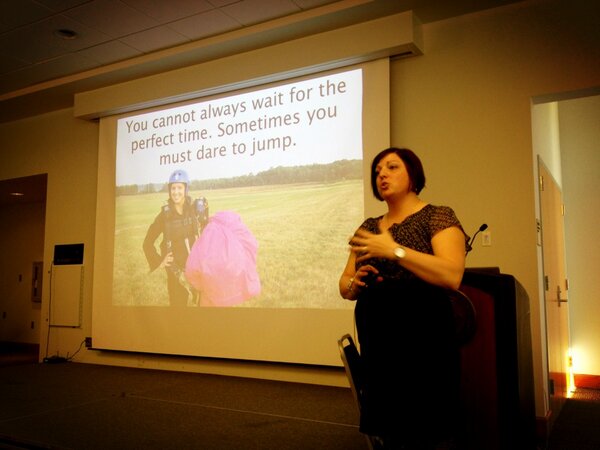
Dare to Jump

Photo c/o @DaltonInstitute {Thanks @vanessaballer!}

As the final keynote of the institute, I gave my “triple threat” perspective as a student, instructor, and professional in higher education. My goal was to share ideas and practices to develop a richer learning experiences; specifically ones that I have valued as an active scholar. So, doing my best to follow the amazing #dalton13 featured speakers – I shared my own narrative, critiques, and insights on how emerging technology can support and challenge student development. I gave some tangible examples and ideas of how to move beyond the gadget, application, or “next big tech thing” by considering ways educators can be actively pushing their learners. I talked about everything from exploration to collaboration, specifically by empowering students to be part of the solution to our institutional challenges.

My #Dalton13 Keynote – Notes & Then Some! (thanks for the photos & tweets #dalton13 backchannel!)

I appreciated the conversations (although some were far too brief!) around identity and student values that  I had with a number of #Dalton13 attendees, especially the FSU HESA graduate students. Although a number of ideas were shared at the institute, I am still left thinking and reflecting about these key questions:

  • How are student values demonstrated in a digital environment?
  • Can educators have an impact on the character development of learners?
  • Is student development really impacted by technology? How so?
  • Does there need to be a shift in how we support our student population on campus?
  • How can our graduate programs do a better job of challenging and supporting scholar-practitioners with “self-promotion” questions?
  • Will higher education cultural norms and institutional practices be changed, or will we be left behind?
#phdchat, PhD, Professional Development

Have Conferences, Will Travel

Apparently when it rains, it pours – for conference proposal acceptances, that is. Since this semester is light on course work, heavy on dissertation proposal research, and I have a amazingly supportive supervisor/department, I will be fortunate enough to be able to attend a few conferences this term.

Laura Pasquini Where is Shee

Here is the rundown for my tentative CONFERENCE travel schedule:

Dalton Institute 2013 http://studentvalues.fsu.edu/2013-Dalton-Institute
Florida State University, Tallahassee, FL  January 30-February 2nd   Follow: #dalton13 Invited Keynote: Student Development 2.0: Optimizing Social Media to Connect Your Campus

AHRD Conference http://www.ahrd.org/ 
Washington, DC   Feb 13-17, 2013
Abstract paper: “A Review of Theoretical Frameworks Explaining Formal Mentoring Relationships”; Thanks to my co-author Mariya Gavrilova-Aguilar who will be presenting

iConference 2013  http://www.iconference.ischools.org/iConference13/2013index/
@iSchools & UNT Host, Fort Worth, TX   February 12-15, 2013  Follow:#iconf13   Our #UNT Social Media Expo team (Andrew Miller, Leila Mills, Mark Evans & I) qualified for the grant from Microsoft Research FUSE Labs on our paper: “Towards a Methodology of Virtually Augmenting a Knowledge Sharing Community of Practice: A Case Study of the Local Food System of Denton, Texas”

South by Southwest (SXSW) Education Conference & Festival http://sxswedu.com/
Panel Discussion: Social Media in Higher Ed – where are we going? with @Bcroke, @tjoosten, & @bradpopiolek
Austin, TX  March 4-7, 2013  Follow: #sxswEDU


Emerging Technologies for Online Learning – Sloan C http://sloanconsortium.org/conference/2013/et4online/welcome
Las Vegas, NV   April 9-11, 2013   Follow: #et4online                               @et4online Conference Planning committee; graduate student instigator


Futures of Academic Publishing: UNT’s 4th Symposium on Open Access https://openaccess.unt.edu/symposium/2013

May 30-31, 2013   Dallas, TX


NACADA 2013 International Conference http://www.nacada.ksu.edu/Events-Programs/Events/International-Conference.aspx
Maastricht, Netherlands   June 5-7, 2013
Workshop: Communication 2.0 Plans: Effectively Engaging Students Online
*Possible poster and panel session involving the #AdvTech survey and Social Media in Higher Education research.*


10th Annual Sloan Consortium – Blended Learning Conference & Workshop http://sloanconsortium.org/conference/2013/blended/welcome 

Milwaukee, WI    July 8-9, 2013


Invited Workshop: Supporting Blended Learner’s Need to Develop Social and Connected Skills Through Digital Pedagogy

Let me know if you will be attending, presenting, or frequenting any of the above conferences. I expect to meet up with the usual [professional/scholarly] suspects I collaborate with, and I look forward to new colleague connections and learning during this conference season.

#phdchat, PhD

I’m Qualified… to Work on My Dissertation Proposal

Today I received the “official” paperwork letting me know that I am qualified to move onto the dissertation/thesis phase of my PhD. At the end of the Fall 2012 semester I defended my ATPI Portfolio, as part of my comprehensive or qualifying exams, and became a PhD Candidate.

This semester (much to my faculty advisor‘s surprise) I am not enrolled in any courses at UNT. The goal for this term is to concentrate on completing my dissertation proposal for a successful defense by the end of April 2013, if not before to be eligible for scholarship and/or other opportunities. Other than a few publications/projects, conference travel, and editing for the Learning and Performance Quarterly, you will probably see my nose deep in research methodology as I fine tune my literature review. Stay tuned…

Professional Development, Reflections

#oneword2013 = ACTION

It’s that time of year… time to consider the #oneword2013. I think I embodied my #oneword2012, fantabulous, so I thought I might as well give #oneword2013 a go. 2013 has a great deal in store for me – there are a number of projects, deadlines, objectives, and initiatives I want to accomplish this year. My one word will move beyond TO DO lists, goals, New Years’ resolutions, or even wishes [sorry Daruma doll!].

Our goal is set for 2013 @FiachraM.Here's to our scholarly work & having our Daruma doll to remind us of our focus.
My #oneword2013 is ACTION! This word will remind me to be active and engaged in what I am doing. A little less conversation, a little more action. This means you should be seeing more verbs in my blog posts, such as researching, writing, moving, publishing, dancing, exploring, adventuring, trying, doing, completing, graduating, and challenging.

I have also decided to use the word ACTION to push me beyond my comfort zone. It’s time to visit new places, to try new things, and to enhance my learning and professional development. Whether it’s a road trip to a new location or learning a new sport (that involves a few bumps & bruises) – then why not? It’s a year for ACTION. Just do it!
Let's ride
What’s YOUR #oneword2013? Add yourself to the list.