BreakDrink, CTCX, Social Media, StudentAffairs

#CTCX No. 71: Tech News, Reddit & Updates

On Monday (10/22/12), the @BreakDrink Campus Tech Connection (#CTCX) discussed the latest technology gadget announcements, privacy on the Interwebz and challenges with Reddit, and diving into social media guidance in an upcoming assessment. Here is the video podcast:

And here are the show notes via Storify for your reading and linkage pleasure.

For those of you interested in giving your #SocialMedia Guidance in Education — please take some time to provide myself and Dr. Tanya Joosten (a.k.a. @tjoosten) feedback and information about “Guiding social media at YOUR institution” in a current survey: https://milwaukee.qualtrics.com/SE/?SID=SV_9HmS8C37kqKWyOh This SURVEY will take about 30 minutes to complete, and will close by Sunday, October 28, 2012 at midnight PST. Thanks!

This blog post is cross-posted at BreakDrink.com

Book Review

#BookReview – Brain Gain: Technology and the Quest for Digital Wisdom

A late add to my #summerreading list was Marc Prensky’s Brain Gain: Technology and the Quest for Digital Wisdom. With the start of the semester underway, I finally found some time to review this book. 

Added to my #summerreading list...

The premise of Prensky’s new book looks at how technology is changing and enhancing our minds with digital wisdom:

“Human culture and context is exponentially change for almost everyone. To adapt to and thrive in that context, we all need to extend our abilities. Today’s technology is making this happen, and it is extending and ‘liberating’ our minds in many helpful and valuable ways. Our technology will continue to make us freer and better — but only if we develop and use it wisely” (Prensky, 2012, p. 2).

Prensky shares how technology will “change our minds” to learn new things and produce new thoughts. With our gadgets and technological capabilities, we are able to extend our minds, heighten our cognitive surplus, increase our thinking powers and improve our thought process and concentration. As Albert Einstein stated “a new type of thinking is essential if mankind [and womankind] is to survive and move to higher levels” (Prensky, 2012, p. 35). It might be time to outsource some of our brains limitations, including memory, storage, accuracy, complexity and prediction, to a technological source. Prensky believes that by using technology we have an advantage to be “better thinkers who make wiser decisions and choices” (2012, p. 52). Much of our decision-making can come from the symbiosis of the mind and technology.

Although technology is often viewed in a negative light, this book identifies ways we enhance our “digital wisdom” via technology. Prensky defines wisdom as “the ability to find practical, creative, contextually appropriate and emotionally satisfying solutions to complicated human problems” (2012, p. 45). In contemplating the arguments against this idea of being wise with technology, the author introduces several fallacies, including:

  1. “Human” as Being Special and Always Better
  2. “Genuine”
  3. Longer Always Being Better
  4. Privacy Always Being Better
  5. Depth and Always Being Better
  6. Slower Being Better
  7. “One Thing at a Time” Being Better
  8. “Brain Science” Providing All , or Even Enough, Answers
  9. Relying on “Tried and True” Solutions in New Contexts
  10. “Reflection” Being Slow
  11. “Expertise” Meaning “Knowledge and Analysis of Data” and of Expertise Coming Only from Professionals
  12. Short Attention Spans
  13. “Limited Capacity” and the Need for In-Person/Online Trade-offs
  14. The “Cultural Now”
  15. “Wisdom” as Coming Only from Humans

Throughout this book (especially in Chapter Three) there are a number of examples of digital wisdom to demonstrate how the mind and technology function well with one another. Also scattered throughout the text, there are a number of references to other great technology-focused reads – many I have on my “to read” list or just added. Here are a couple of suggestions you might like shared by Prensky:

The book continues to share examples of digital cleverness and digital stupidity, with suggestions and examples on how we all can be smarter with our technology software, hardware and digital presence. Prensky continues to share how to cultivate digital wisdom in our personal life, at work and finally in education:

“Cultivating digital wisdom means being intellectually curious and active, continually expanding one’s online universe rather than sticking with the same things, and continually bringing more of the new world into our lives” (2012, p. 182).

Although Prensky touches on his former definition of “digital natives,” he digresses to move towards the need for educators to get comfortable with developing wisdom in classrooms with technology. The skills identified with digital wisdom and technology include collaboration, teamwork, decision-making, taking risks, making ethical and moral decisions, employing scientific deduction, thinking laterally and strategically, problem solving, and dealing with foreign environments and cultures (Prensky, 2012). The final chapters discuss the real dangers, things to be wary of, acknowledging problems to fix them, and evolution of the human as being impact by technology and singularity.

Overall, I think much of this book summarizes the impact of technology and our brain power with gadget and tech consumption. Prensky presents a decent summary and tries to synthesize how our thinking, actions and learning have changed – by curating and compiling examples and theories in a digestible way for the reader. Although the concepts are not novel, I think a number of readers will appreciate the concepts put forth around digital wisdom and technology.

Reference:

Prensky, M. (2012). Brain gain: Technology and the quest for digital wisdom. New York, NY: Palgrave Macmillan.

**Full disclosure: This book was sent to me by the Palgrave Macmillian publishing group to review on my blog. Thank you for the read. **

Book Review, Higher Education, K-12, Open Education, PLN

10 Principles for the Future of Learning

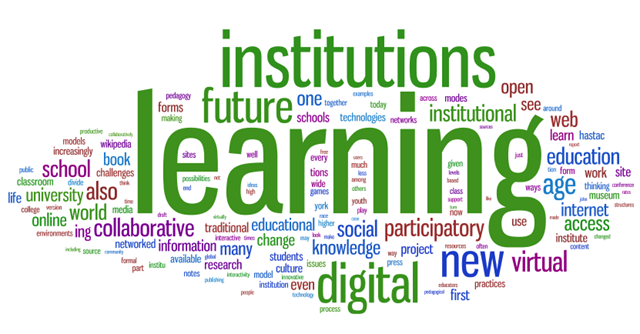
While working on some late night treadmill mileage, I decided to catch up on documents and books I have been collecting on my Kindle. Last week I read The Future of Learning Institutions in a Digital Age, which was a precursor to The Future of Thinking: Learning Institutions in a Digital Age book published by the John D. and Catherine T. MacArthur Foundation. Although this material is a bit dated, I think that some of the pedagogy still applies for educational development.

Image c/o Martin Hawksey (and his musings on this text as well). 

In the first collaborative project, the authors share ten principles to support the future of learning. Davidson and Goldberg (2009) presented these pillars of institutional pedagogy to help institutions rethink learning and meet the challenges that lie ahead for both K-12 and higher education:

  1. Self-Learning – discovering and exploring online possibilities
  2. Horizontal Structures – how learning institutions enable learning; from learning that to learning how; from content to process
  3. From Presumed Authority to Collective Credibility – shifting issues of authority to issues of credibility; understand how to make wise choices
  4. A De-Centered Pedagogy – adopt a more inductive, collective learning that takes advantage of our era and digital resources
  5. Networked Learning – socially networked collaborative learning stressing cooperation, interactivity, mutuality and social engagement
  6. Open Source Education – seeks to share openly and freely in the creation of culture and learning; provides a more collective model of interchange
  7. Learning as Connectivity and Interactivity – digital connection and interaction to produce sustainable, scaffolding ensembles
  8. Lifelong Learning – there is no finality to learning; learning is part of society and culture
  9. Learning Institutions as Mobilizing Networks – networks enable flexibility, interactivity, and outcome; new institutional organizations reliability and innovation
  10. Flexible Scalability and Simulation – new technologies allow for collaboration beyond distance or scale for productive interactions that warrant educational merit

Reference: Davidson, C.N. & Goldberg, D.T. (2009). The future of learning institutions in a digital age. Cambridge, MA: The MIT Press.

#ugstJOUR

Digital Community Development with #ugstJOUR

This Fall semester I am co-teaching the UGST 1000 – First Year Seminar class which is partnered with the Introduction to Mass Communication (JOUR 1210) and U.S. History I (HIST 2610) in a Learning Community at UNT. This section of the First Year Seminar will be connected and engaged on campus, in the community, and online. The plan is to connect students to helpful resources, people, learning opportunities, and places that best support their major/career decisions, while developing their digital identity, and grow their learning networks:

Last Fall, our class experimented with Tumblr for reflections, but I have decided to return to my tried and true avenues for blogging and communication – WordPress and Twitter. To thread our class learning network, my students are sharing their blog reflections and will be tweeting with the hashtag #ugstJOUR. The class will use #ugstJOUR to tag and link their questions, comments, blog posts, assignments, and more throughout the semester. BYOD will be encouraged and utilized for this class.

Here is the WordPress and Twitter section of my class syllabus:

WordPress (WP) Posts:  Throughout the semester you will be asked to reflect about class topics, assignments and other happenings having to do with major/career exploration.  Rather than using a paper journal or requiring you to turn in a reflection, we would like you create your own WordPress blog to share your journey with the class.   Each WP post should have a minimum of 350 words, and posts are due by 11 pm on the date which are listed on the class schedule.  This assignment will be graded as follows:

A = a response that is well-written at the level of both the sentence and the paragraph; it addresses with precision all the required elements and utilizes theory to develop a creative solution to the issue/topic
B = a response whose sentence and paragraph-level writing is good but not distinguished; it addresses with some degree of specificity the required elements and a creative solution to the issue/topic
C = a response whose sentence and paragraph level writing is average and not particularly clear; it addresses a potentially interesting point with the issue/topic being addressed but without precision
D = a poorly written and superficially conceived approach to the issue/topic
F = a work with barely coherent response to the issue/topic or not meeting the word minimum

About WordPress. WordPress blog accounts are free and can be created by visiting http://wordpress.com. If you are able to write in a word document, then you should be okay to write blog posts. For more information, be sure to read the instructions at the end of this syllabus. By default, all posts to WordPress are public and open for everyone to see.  Since we hope that our class is a sharing and connected community, we would like to keep all blogs public. If there are topics or posts that you do not want to share with the class or world at large, please feel free to post these privately to share with only the instructors. Just be sure to provide us with the password so that I may read them for grading purposes. Additionally, when creating posts for WP, you are free to express yourself in any way you see fit.  While every class-assigned post (you are free to post more than is required) must include some form of written explanation, you are totally free to include pictures, videos, audio, etc. In fact, I encourage this.  Because these are blog posts and personal reflections, I will not be asking you to create bibliographies or citation pages, but do be aware that it is good netiquette to link back to the sites that provided your material.  You can find the Official UGST 1000.003 WordPress blog at http://ugstjour.wordpress.com/. For help go to: HOW TO: Set Up a WordPress Blog.

About Twitter: We will be using Twitter (https://twitter.com/) as a forum to engage in conversation inside and outside of our class meetings. Twitter is a form of communication where you can share short, 140-character messages with others. During the semester, you can follow the class twitter handle @ugstJOUR [https://twitter.com/ugstJOUR] and we will be using the hashtag #ugstJOUR to connect our messages.  You can sign up for a free Twitter account, upload a picture and create your own bio. Regular questions and prompts will be given to respond with using the #ugstJOUR hashtag, and you will be required to respond to others tweets as well. For help go to: HOW TO: Set Up a Twitter Account.

Be sure to follow the class  #ugstJOUR WP Blog and Twitter handle @ugstJOURThis two spaces will be used during the semester for general class announcements, campus updates, information sharing, helpful resources and they will serve as a model for your own blogging and tweeting experiences. Also be sure to follow your fellow #ugstJOUR blogs & Twitter accounts. This learning network will be a great space for you to connect, post, communicate & share both inside and outside of our class meeting times.

AcAdv, nacada, NACADA Tech

The @NACADA TechTalk Series – #AdvTech in 140 Characters Or Less

The @NACADA TechTalk Series is sponsored by the NACADA Technology in Advising Commission. These free, online webcasts were designed to introduce advising professionals and faculty to ideas and suggested practices for using technology in advising. **Join the Twitter backchannel & conversation using the #AdvTech hashtag**

Here is the NACADA TechTalk program run down for the week with descriptions in 140 characters or less and the archived recording, notes & more from each session:

Monday, August 6 – The Speech that was Never a Blog Post: Trends and Future for Technology in Advising

Join @NACADA President @uoadvdir as she shares future #AdvTech trends in #HigherEd that will impact your campus & advising #AcAdv
object width=”640″ height=”480″>

Tuesday, August 7 – What the Tweet?: @AcAdvChat & the #AcAdv Community Using Twitter for Professional Development

Have u followed @AcAdvChat on Twitter? @peacox , @HowardSJ & @BilMorrill will share the conversation & community that is #AcAdv Chat #advtech

Wednesday, August 8 – Advising Technology Mythbusting: Guidance and Challenges for Using Social Media on Campus

Communications 101 + #SocialMedia Strategy + Privacy Concerns + #AdvTech Mythbusting = Web #AcAdv Tips from @julieclarsen@EricStoller

Thursday, August 9 – Advising Reflections & Sharing: Blogging to Support our Profession & Student Learning Outcomes

Blogs are for sharing, reflection & more! Listen to #AcAdv @jbarkemeyer , @sally_garner & @EstherChung2 tell their #AdvTech blogging tales.

Friday, August 10 – Technology Adoption & Life Cycle: From Implementation to Evaluation of Technology in Advising

So you have an #AdvTech idea? @gsteele1220 & @cschwenn have a plan for that! Come learn about #AcAdv tech life cycle from start to finish.

THANK YOU FOR ALL WHO CONTRIBUTED TO THE NACADA TECHTALK SERIES!

What an amazing and fun time we had. I hope you find the above resources helpful, and be sure to let us know what Technology in Advising issues you want to learn more about if we offer more NACADA TechTalks in the future.