#HEdigID

#HEdigID Chat No. 2: Openness in Higher Education

As it is Open Education Week, I thought it was a good idea to talk about openness in higher education for the March Higher Education Digital Identity (#HEdigID) Twitter chat.

Openness has the power to build capacity among our higher education institutions/organizations and empower professionals to enhance what we do each day. For me, personally, sharing is not just caring. Being an open educator has afforded me the opportunity to cross-train, meet interesting colleagues working on creative projects, discover new ideas or insights for teaching, collaborate on practice and scholarship, and shape how I support/advise my learners. There are a number of benefits for being open, as either an academic or professional in higher ed; however, I am not naive to some of the problems, issues, and challenges with openness within the field.

With openness also comes tension for individuals and organizations. Sometimes your philosophy of being “open” and connected may not always align with your discipline, department, or institution. Being a digital, open educator might not be the cultural norm. Also, you might not be sure of the implications (positive or negative) might be for being open with teaching, scholarship, or practice. Researchers might be concerned with sharing findings before the publication is complete. Practitioners may be concerned with someone else stealing their idea/project and seeing it misused or misrepresented by another peer. In networked spaces, other concerns arise as our public intellectual selves are often entwined with our digital lives:

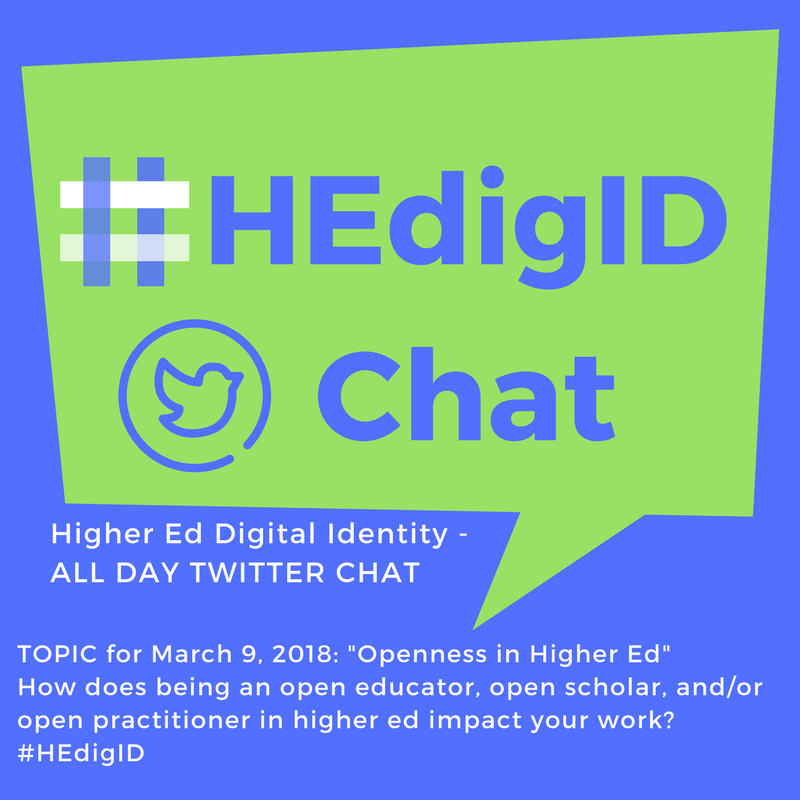
To come to terms with some of tension between the affordances and challenges of being open, this month’s Higher Ed Digital Identity (#HEdigID) Chat on Friday, March 9th is organized to discuss this TOPIC: “Openness in Higher Education”
What does it mean to be “open” as a professional in higher education? There is an increasing expectation to share and publicize our research, practice, and work beyond the bubble of academe. “The result: We are all of us dipping our toes into the role of the public intellectual. And there are dangers lurking in those virtual waters — dangers that we all need to keep in mind when we respond to our Facebook friends and Twitter followers.” Perhaps, I have let some of the plot lines of Black Mirror creep into my thoughts on being open and public in academia. I cannot deny that openness has offered me support and introduced me to a thoughtful community I value both personally and professionally. As you can see, I’m still working this one out. So, why not have a bit of a chat about this very topic?

How does being an open educator, open scholar, and/or open practitioner in higher education impact your work? What does it mean to be a public, open intellectual online today?

Here are some of the QUESTIONS I will be tweeting out over the course of the Friday (March 9th) ALL-DAY #HEdigID Twitter chat:

  1. Share how you are “open” with your work in higher ed. How do you share open knowledge, research, teaching, learning or practices?
  2. What are some of the benefits for being an open educator, scholar, and/or practitioner in higher education?
  3. Do you think open scholarship or open practice WILL/CAN shift how we WORK in higher education? How does being OPEN influence how we research, advise, teach, and support learners in #highered?
  4. What issues do academics and practitioners face, when being “open” in higher education? What challenges emerge when your teaching, research, or practice is OPEN?
  5. How do you think openness will or could shape tenure, promotion, and career advancement in higher ed? (e.g. Open Education Resources, Open Access, Open Data, etc.)
  6. For those higher ed professionals who are just getting started with being OPEN, what RESOURCES are available? Please list and share (e.g. articles, websites, blogs, etc.).
  7. How does being “open” influence graduate preparation (masters, doctoral, etc.) or early career professionals in your field or discipline? This might be related to digital scholarship and open practices on the social web (e.g. blogs, Twitter, etc.)
  8. Final Thought (FT): What aspects of “OPEN” would you like to learn more about or have more training with to improve your open practice in higher ed?

What questions or assumptions do you have about openness, in terms of your own digital identity and work practice in higher ed? Feel free to answer any of these questions, as these will roll out my Thursday, March 8 evening until the afternoon of March 9, 2018. This SLOW style Twitter chat is designed to allow more higher ed colleagues and friends to join in the conversation to account for different geographic regions, multiple time zones, busy schedules, and more

Join us on Friday, March 9, 2018 to discuss these questions and more! You can participate by:

  • Tweeting a response using this hashtag on Twitter: #HEdigID

  • Draft a longer response in the open OPEN Google Doc: http://bit.ly/hedigid2

  • Take any (or all) of these questions to create your OWN response via a blog post, video/audio reflection, or doodle. 🙂

Finally, I’m always keen for suggestions. What QUESTIONS/PROMPTS would you like to ask during this next chat? Please share in the Google doc above or comments below. Tweet you all soon!
Updated 03.12.18:

#HEdigID Chat Transcript, No. 2: Openness in Higher Ed (03.09.18)

#HEdigID, Open Education, OpenAccess, Professional Development

#OEweek: Openness in Higher Ed

Being a networked practitioner and scholar in higher education does require some level of openness. We are seeing colleagues share their work and perhaps even a bit about themselves online. Being an open higher ed professional (e.g. staff, faculty, or graduate student) does take some willingness to share a bit of what you do in the area of teaching, research, and service. Today academics and professionals on campus operate in a world that is more open, with regards to how we are networked and sharing with technology. Connectivity is a vital part of scholarship and practice, teaching/learning in digital environments, and how we work in higher education. Researchers and early career scholars require access to digital databases, online repositories, academic journals, and effective teaching/learning tools. Practitioners and administrators are finding value in open educational resources to scaffold student support services, improve instructional design, and enhance organizational planning. It is through transparency and accountability, that a growing number of scholars and practitioners openly contribute to their discipline, share practices about their functional area, find connections and collaborations with peers, and, most importantly, share public knowledge beyond the university/college.

Open Education Week (#OEweek) is this week, March 5-9, 2018. For more information, events, and resources: https://www.openeducationweek.org/

By participating and sharing in the OPEN, we are all contributing Open Education Resources (OER) and participating in The Open Movement.  Here are just a few (of the many) ways “openness” is impacting higher education:

Join the conversation on Friday, March 9, 2018 for the

Higher Education Digital Identity Chat (#HEdigID) No. 2: Openness in Higher Education

#HEdigID

#HEdigID Chat No. 1: Being A Higher Ed Professional Online

Friday, February 9, 2018 — is the FIRST of a series of conversations on Twitter I hope to instigate, support, and contribute to this year: Higher Education Digital Identity (a.k.a. #HEdigID) Chat.  As I’ve previously blogged, I think it’s about time to properly discuss the impacts and ramifications of being a higher education professional (e.g. staff, faculty, graduate students, etc.) online. Over the last decade, I’ve seen my postsecondary peers  “grow up” digitally, e.g. on social networks, linked platforms, and media spaces. There are a number of connected communities and brilliant friends who I’ve met online first that I’ve had the opportunity to chat, collaborate, conspire, and create with over the years. That being said, being digitally engaged does not come without challenges, issues, or considerations for being on social/digital platforms (I’m looking directly at YOU, data, privacy, and surveillance monsters).

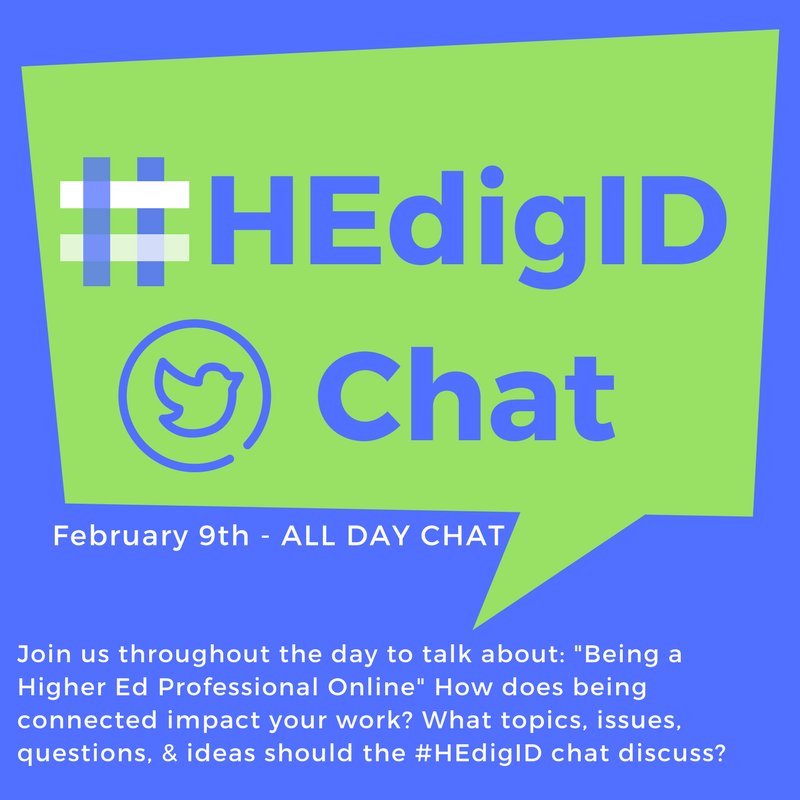
I’ll be the moderator (MOD) for today’s (Feb. 9th) #HEdigID Chat to initiate this conversation and identify SPECIFIC TOPICS and ISSUES we might want to dig into further over the next few months. I’ll pose a few prompts and questions using the hashtag #HEdigID (with the images) to stir the chat pot, but I welcome any and all campus colleagues to add their own to the discussion.

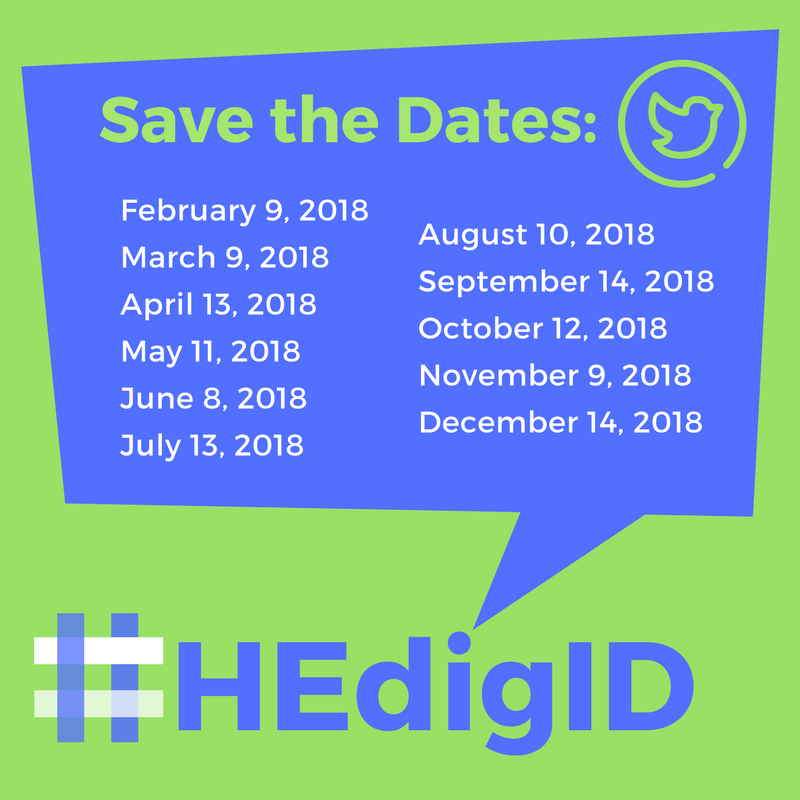
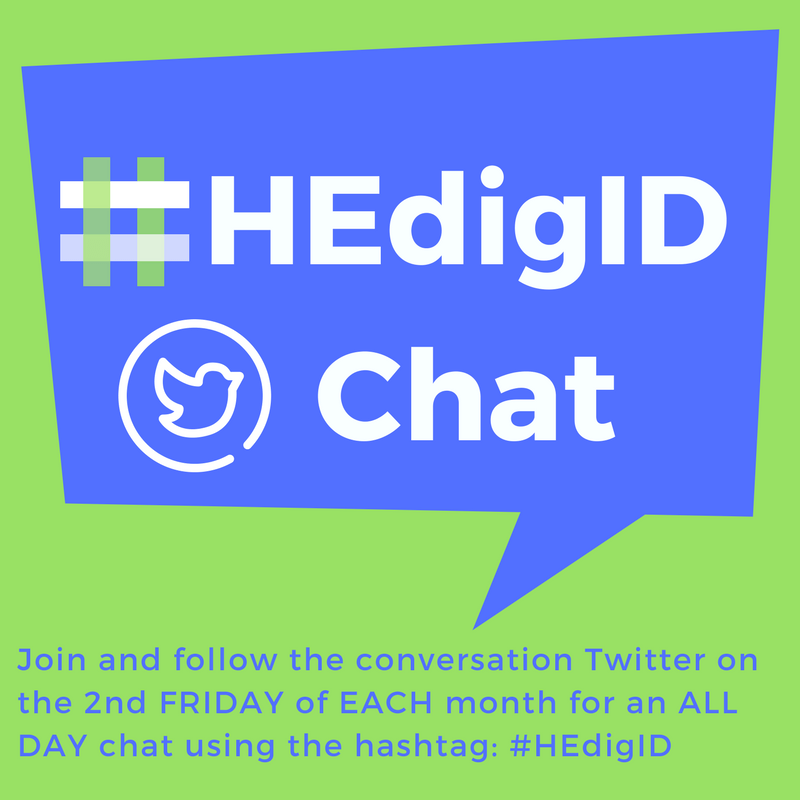
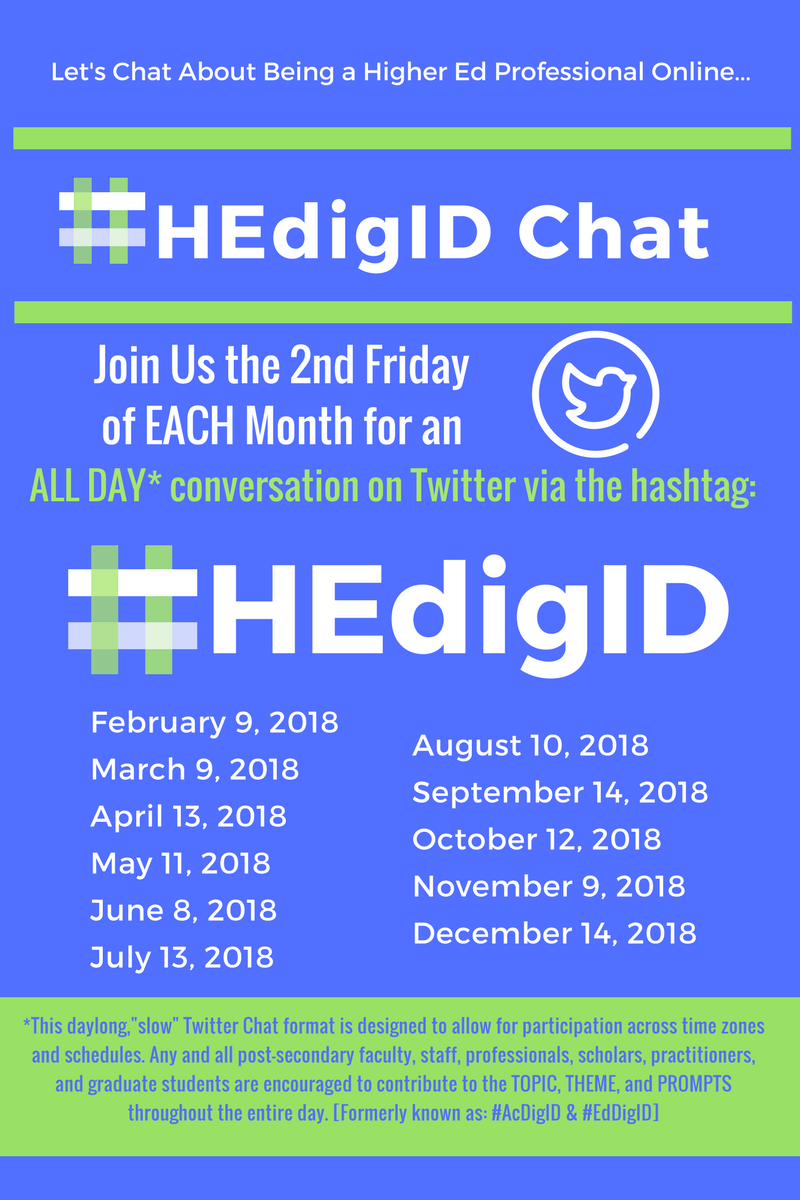
If you can’t be on Twitter TODAY (2/9), no need to fear. We will connect on the SECOND FRIDAY of EACH month this year to have an open conversation about being a higher ed professional who is connected, networked and/or digitally engaged. Here’s the #HEdigID schedule, if you would like to #SaveTheDates:

March 9, 2018 August 10, 2018
April 13, 2018 September 14, 2018
May 11, 2018 October 9, 2018
June 8, 2018 November 9, 2018
July 13, 2018 December 14, 2018

Any and all post-secondary faculty, staff, professionals, scholars, practitioners, administrators, graduate students, and leaders (really anyone in higher ed) are encouraged to JOIN and CONTRIBUTE to the Twitter conversation. There will be a TOPIC, THEME, and PROMPTS to guide the Twitter Chat over the course of the day. This “SLOW” Twitter Chat (all day) is designed to encourage and allow our colleagues from across the pond, time zones, and busy work schedules to join in the dialogue.

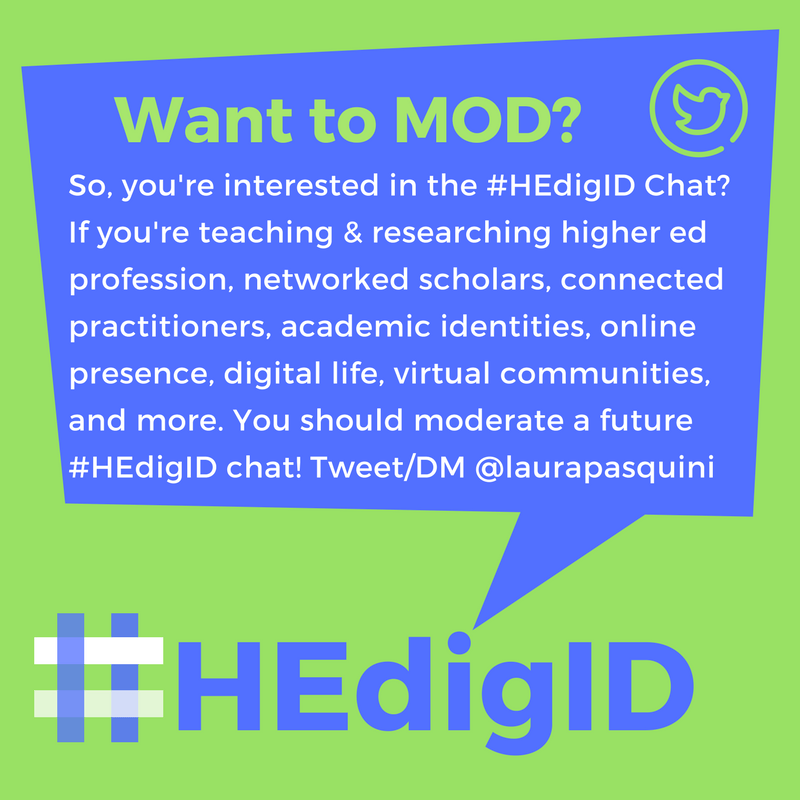
I will moderate (MOD) the first one or two #HEdigID chats; however, I am also quite open to others who want to MOD and/or contribute an IDEA or TOPIC we should dig into online. I plan to tap a few shoulders of other colleagues who are involved in teaching, research, and service scholarship in the area of networked scholarship/practice and online digital identity and presence to lead a future #HEdigID Chat TOPIC.Are you interested in being a MOD? Let me know — DM me on the Twitters, comment below, or find my email on the “about” page. Chat with y’all soon via #HEdigID!

UPDATED — here is the TRANSCRIPT Archive of the conversation and sharing from the first discussion via the hashtag #HEdigID in an open Google spreadsheet:

#HEdigID Chat Transcript, No. 1: On Being Online in Higher Ed (February 9, 2018)

#AcDigID, #EdDigID, #HEdigID

#HEdigID Twitter Chat: Let’s Talk About Our Networked, Digital Life, Higher Ed.

For the last couple of  years, I have been talking, researching and engaging with colleagues to figure out what it means to be a networked practitioner and/or scholar in higher ed. Based on a recent workshop and Twitter conversation (#acdigid chat), it is clear that being online feels different in 2018 than it did back in 2008 when I first started to really connect to other professionals in digital, social networks.  In an editorial I wrote for Inside Higher Ed last year, I ask questions about what it means to have a digital persona in academia, specifically these ones (slightly modified):

  • How does being part of a digital learning network support learning and development for higher ed professionals?
  • How are faculty and staff shaping their online identity and presence to share professional values, work, etc.?
  • How can does a networked community expand knowledge to enhance our roles on campus and the work we do?
  • Why might others higher ed professionals want to network with peers to scaffold their own career goals?

As these digital networks have scaled past the “social-media-is-just-a-fad” stage and they now influence more of our society in our daily lives. That being said, I think educators are considering how to be more thoughtful and consider HOW, WHERE, and IF, they should “be” in these public and open spaces. A number of college/university practitioners, scholars, and administrators have seen benefits to “working out loud” and being public intellectual in postsecondary. That being said, the repurposing of social media and digital platforms, has come with minimal institutional guidance and limited sociotechnical support (Pasquini & Evangelopoulos, 2017) and does appear to have ramifications for our personal/professional lives. A number of interviews with higher ed colleagues have just begun to identify the benefits, challenges, and future considerations for higher ed networked practices. And, of course, in talking to researchers, student affairs educators, early career researchers, academic advisors, senior administration, instructional designers, and other colleagues — it seems that we have even more questions and the need to continue these conversations among ourselves.

In a recent Twitter poll I put out this month, I tossed out the idea to host a SLOW (all day) Twitter chat ONE DAY per month for 2018. It seems like a few of you (at least 15) in higher ed, are interested in discussing your digital identity and “being online” or connected as a professional:

https://platform.twitter.com/widgets.js

So, let me introduce to you the…

Higher Ed Digital Identity Chat (#HEdigID)

We will connect on the SECOND FRIDAY of each month this year to have an open, honest conversation about being a higher ed professional who is connected and digitally engaged. Here’s the schedule, if you would like to #SaveTheDate:

February 9, 2018

August 10, 2018

March 9, 2018

September 14, 2018

April 13, 2018

October 9, 2018

May 11, 2018

November 9, 2018

June 8, 2018

December 14, 2018

July 13, 2018

Any and all post-secondary faculty, staff, professionals, scholars, practitioners, administrators, graduate students, and leaders (really anyone in higher ed) are encouraged to JOIN and CONTRIBUTE to the Twitter conversation. There will be a TOPIC, THEME, and PROMPTS to guide the Twitter Chat over the course of the day. This “SLOW” Twitter Chat (all day) is designed to encourage and allow our colleagues from across the pond, time zones, and busy work schedules to join in the dialogue. I am happy to moderate (MOD) the first few #HEdigID chats; however, I am also quite open to others who want to MOD and/or contribute an IDEA or TOPIC we should dig into online. Let me know!