PhD

Thriving… Not Just Surviving in Your Ph.D.

Today is the start of the UNT Learning Technologies (#untLT) Doctoral Fall Writing Boot Camp (October 17-18, 2014). This program has been developed by our department to support our doctoral researchers in their dissertation progress. Currently a number of doctoral researchers are writing and working in the LT Agora with snacks, support, and relevant available resources.
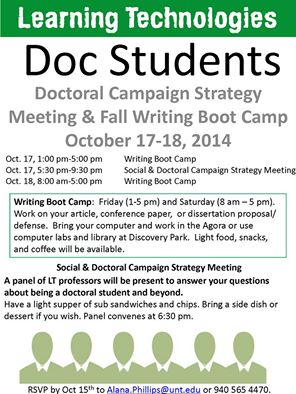
DocStudents

I am looking forward to joining the “Doctoral Campaign Strategy Meeting” tonight on a panel this evening with our faculty, including Drs. Cox, Ennis-Cole, Knezek, Tyler-Wood, and J. Wircenski. (Drs. Allen and Warren will participate remotely if they are able). This Q & A session will provide some advice and give some ideas for not only how to “survive” but also thrive in doctoral research regardless of the phase.

This presentation is a remix of @drjeffallen ‘s wisdom/advice

I like to use the phrase thrive not survive, to for the doctoral process. There are a number  a number of supportive strategies and ideas to get to the PhD finish line, including:

  • Making a habit of WRITING & scheduling only #ShutUpAndWrite session
  • Social, emotional & mental support
  • Identifying champions in your department, on campus & in your discipline
  • Outlining the major professor-advisee working relationship – needs & expectations
  • Using the advice of your committee wisely
  • Organizing your research materials & literature review effectively
  • Mapping out your data collection process
  • Attending to your personal-wellness & well-being
  • Connecting to a cohort of scholars in your personal learning network
  • Giving up something, to get something to finish your dissertation
  • Understanding how you work best
  • Consulting & using the resources available
  • Focusing your efforts wisely

Want to learn more? I will be sure to post notes and advice from our panel of professors and doctoral researchers who attend. What is YOUR advice on how to THRIVE in a doctoral program and through the dissertation process? Please share!

UPDATE (post-panel):
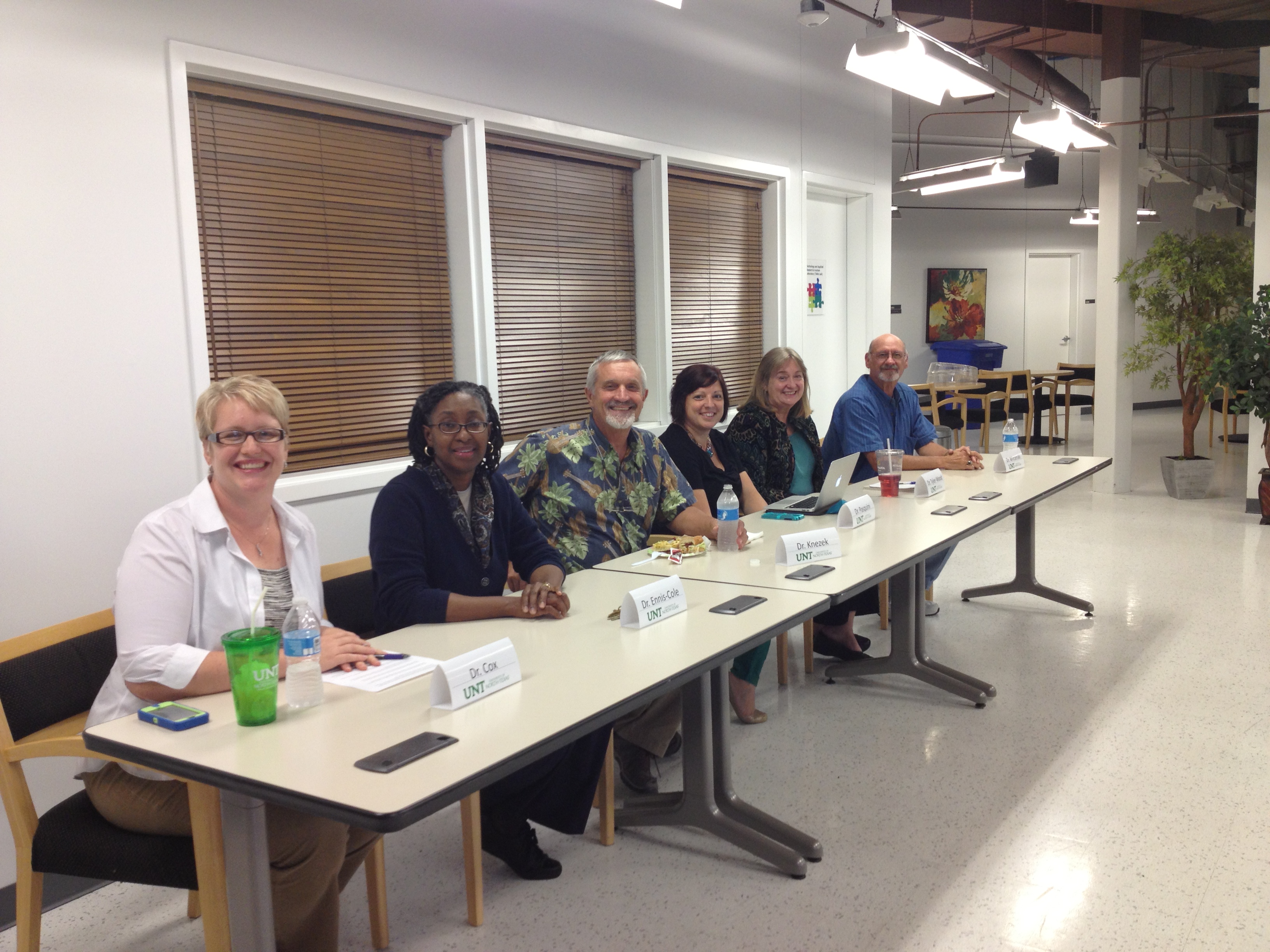
Doctoral Strategy Panel - Group Photo

From left to right: Drs. Cox, Ennis-Cole, Knezek, Pasquini, Tyler-Wood, and Wircenski.

networkedscholar

Once A Networked Scholar… Always One? #scholar14


Social media is my thing (so I’ve heard). Really, the THING about social media is the SOCIAL. Throughout my personal, professional and academic career, I have touted the value of my personal learning network on Twitter. I give credit to this 140-character medium as it daily contributes to my literature review, data collection, and connected engage in my discipline.

I am not alone in the love of Twitter and scholarship. Other academics have identified value in Twitters’s role for scientific publication and power of dissemination when shared among the network of scholars. In contrast, there is a dark side to being in this particular space (“they” say). I shared this article earlier in the stream today, “To tweet or not to tweet: academic freedom and social media” – if you have not read it,  you should. This article is one of MANY that calls into question the use and impact of social media networks in academia. As an early career researcher, I am interested in learning more about the impacts to the field and the influence digital scholarship has for teaching, learning, service and research scholarship. {More on this research and work… to come.}

csfzzj3z-1412558503


I have a number of questions that need answers on the networked/digital scholar topic:

  • How will social networks shape tenure and promotion?
  • What issues do academics face, when being active in social media spaces?
  • What challenges will emerge with the use of transmedia for research and learning in post-secondary education?
  • Will digital scholarship impact and shift how tenure and promotion?
  • What other influences should be considered for impact factors and scholarly contributions?
  • How does the digital influence our own doctoral programs & preparation?
  • How digital influence truly effect impact factors for research? Should it?
  • What information do we know about “the networked scholar”?

These are just a few of my questions. I have more. I signed up for George’s (@veletsianos) Networked Scholar (#scholar14) MOOC to continue this dialogue and bat around a few ideas with other interested scholars. I am looking forward to continuing my meanderings on my blog and, of course, on the Twitters => #scholar14 Won’t you join in the discussion and banter as well? http://networkedscholars.net/

Social Media

The State of Social Media @ #edu14

State of #SocialMedia in Higher Ed (2)

Looks like EDUCAUSE 2014 (#edu14) is just around the corner.

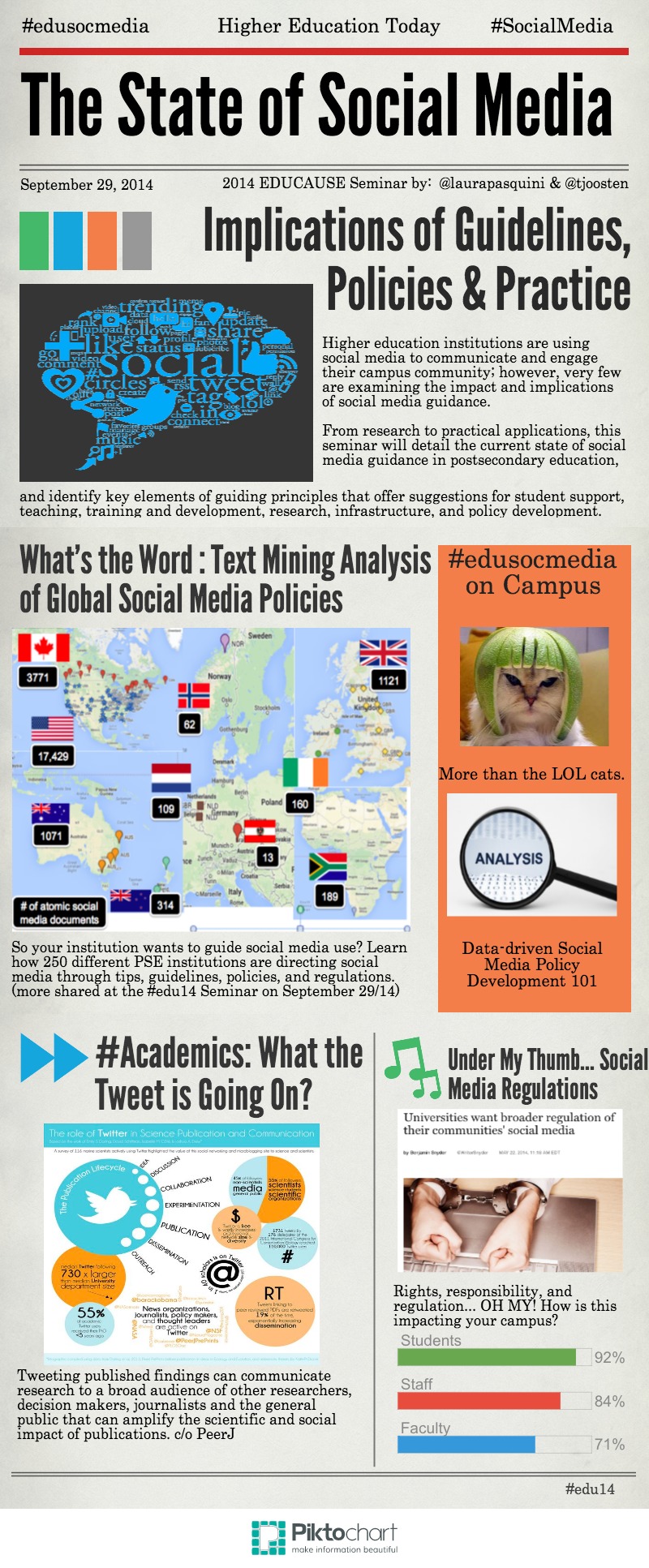
I am heading out to Orlando on Sunday and will be sharing my dissertations research at the #edu14 Virtual Seminar with Tanya Joosten (@tjoosten) on Monday, September 29, 2014. Interested in learning more about it? Sign up (HERE) for the online, half-day seminar to help with your social media planning:

Seminar 2A – The State of Social Media Guidance: Implications of Guidelines, Policies, and Practice in Higher Education (separate registration required)

Higher education institutions are using social media to communicate and engage their campus community; however, very few are examining the impact and implications of social media guidance. From research to practical applications, this seminar will detail the current state of social media guidance in postsecondary education and identify key elements of guiding principles that offer suggestions for student support, teaching, training and development, research, infrastructure, and more.

OUTCOMES
Participants will be able to:

  1. Articulate current higher education social media guidelines and policy document trends, categories, themes, and patterns emerging from research
  2. Identify practical components for effective social media guidelines for campuses
  3. Create meaningful guidelines and policies to positively impact teaching, learning, research, and development at your institution

Since I am only at #edu14 for a short stint,  I plan on making the most of my time. Here is my quick hit list of sessions that are in line with my research agenda:

If I was staying longer at #edu14, I would most likely attend these sessions:

Will you be at EDUCAUSE 2014? What is your focus and objective for attending this year? More importantly, will we be able to have a bit of a chat around these issues. I hope so. See you @ #edu14!

Conference, Professional Development

Have Conferences, Will Travel – Fall 2014 Edition

With the start of the academic semester comes a series of conferences. I’m grateful for the conference survival guides and other helpful conference hacks shared by my PLN. Due to limited travel funds and time, I had to decline a few conferences; however I will be sure to follow along the Twitter backchannel (I am looking at you #HEWeb14 and #SMSociety14).

In considering the cost of professional development at many conferences, I have learned to get more involved to help fund this sort of travel.

jure

Image c/o @jure

Here are a few ways to get involved and learn how to fund your own conference travel with your professional affiliations:

  • Volunteer at the conference – check-in desk, hospitality, and more! Ask to volunteer!
  • Apply to present a Pre-Conference workshop – often you are eligible for comped registration and/or bonus honorarium to travel.
  • Get involved with conference planning – join the conference steering committee or planning group. It gets you networked and often offers a discount for registration and/or accommodations
  • Get invited – See if invites are available for featured talks, workshops or edu sessions. Tap into your network and share what you are working on.
  • Stay with a friend – I have housed and been housed at a number of conference locations just to avoid the steep hotel costs. Bunk up, or find a local off the conference beat.
  • Apply for a travel grant – This might be at your own institution, through the professional organization, or other entity.
  • See what’s local – You will be surprised to learn a number of different conferences, workshops, and other P.D. that is happening in your own neck of the woods OR online. 🙂
  • Present virtually! – Limited travel? See if the conference offers virtual papers, workshops or posters and submit your CFP! If you’re in the #edtech realm, you will likely find this a popular option to travel.

Here is my quick conference list for the Fall 2014 term:

Where are you traveling this academic term? Will our conference travel cross paths? How have you creatively spread your travel funds? Please share. 🙂

LPQ, LPQuarterly

Hot Off the Digital Press: @LPQuarterly 2(3)

With the start of the new academic year, we are pleased to be distributing the new issue of the Learning and Performance Quarterly (LPQ) journal – Volume 2, Issue 3. On behalf of the editorial team, I hope this edition will inform scholars, practitioners and leaders in the learning and performance field.

LPQ_Facebook_Banner

The Learning and Performance Quarterly (ISSN 2166-3564) is a peer-reviewed, open access journal from the Center for Knowledge Solutions at the University of North Texas. The journal takes a broad look at current developments and research that involves innovative learning, training, human resource development, and performance management across academic and professional disciplines.

Learning and Performance Quarterly
Vol 2, No 3 (2014), Table of Contents

Editorial
——–
A New Academic Year, New Learning and Performance Understandings (1)
Laura A. Pasquini,      Tekeshia Zimmerman,     Jeff M. Allen

Invited Articles
——–
Integrated Approach To Building Intercultural Competence (2-15)
Katherine H. Rosenbusch

Research Articles
——–
The Influence of Wiki on Team Effectiveness in a Graduate Research Class (16-34)
Lin Xu, Jessie Cutler,  Jie Xiao,       Holly M. Hutchins

Erikson’s Development Crises: Applying Developmental Theory to Adult Learning (35-48)
Jose Victor Lineros,    Mark E. Fincher

Book Review
——–
Book Review: The Innovator’s DNA (49-50)
Robin James Mayes
______________________________________________
Do you have an article you want to submit?  Our call for proposals is OPEN! Submit your manuscripts to the journal TODAY!

You can review the previous article submissions in the LPQ Archives. We are seeking manuscript submissions for the following categories:

  • Research Articles – Qualitative/Quantitative
  • Concept/Theory Papers
  • Literature Reviews
  • Case Studies
  • Book or Media Reviews
  • Invited Articles
  • Editorials

If you have any questions about potential article submissions, or you are interested in contributing to the Learning and Performance Quarterly editorial team (peer-reviewing, copy editing, layout, etc.) please reach out to myself or the other LPQ Editors.

Thanks for reading,

Dr. Laura A. Pasquini, Editor (@laurapasquini)
Tekeisha D. Zimmerman, Assistant Editor (@TekeishaZ)
Dr. Jeff M. Allen, Managing Editor (@drjeffallen)
~~~~~~~~~~~~~~~~~~~~~~~~~