Book Review, edusocmedia, Learning and Performance, Professional Development, Training & Development

#BookReview: The New Social Learning, 2nd Edition #NewSocialLearning

The first edition of this book, The New Social Learning, was published 5 years ago. I read and have a copy of it on my bookshelf; however, we know that emerging and connected technologies have continued to flourish and influence our organizations. The social technology landscape has changed since 2010. There are a number of new platforms, additional functionalities and communication channels, an increase of utilization and adoption by our organizations, and a much greater acceptance of social media being applied for learning and development. Marcia Conner and Tony Bingham have recently published an updated version of this book with The New Social Learning: Connect. Collaborate. Work, 2nd Ed.* The latest edition provides a number of excellent case studies for how social media is being implemented in workplace learning, development, and performance.
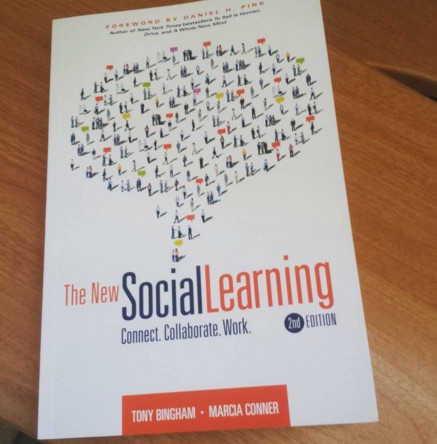
SocialLearningBingham and Conner (2015, p. 8) define social learning as the “joining with others to make sense of and create new ideas…[it] is augmented with social media tools that bridge distance and time, enabling people to easily interact across workplace, passion, curiosity, skill or need. It benefits from a diversity in types of intelligence and in the experiences of those learning.” What is really “new” about this type of social learning with emerging technologies is the impact these platforms and tools have to the experience. “Social tools leave a digital audit trail, documenting our journey – often an unfolding story – and provide a path for others to learn from” (Bingham & Conner, 2015, p. 9). Social media facilitates the empowerment of learning among your networked peers beyond the limitations of geography or time.  I appreciate how the authors identify what is NOT the new social learning (e.g. informal, e-learning, MOOCs, just for knowledge workers, in contrast to formal learning/education), and how this type of learning is meant to augment, not replace, training, knowledge management, and communication practices in our organizations. As technology has accelerated change in the workplace, Bingham and Conner (2015, p. 18-19) see the opportunity to implement a new social learning strategy based on these changes in work:

  • The accelerated pace of change requires agility. Consider agile values for the workplace.
  • Our technologies go where we go without any boundaries. Not all can be controlled, contained, or developed from within an organization.
  • Our shifting workplace demographics change expectations, with regards to generations, gender, culture.
  • People desire personal connection to communicate, collaborate, and share.

Although the authors share a number of success stories about individuals and organizations who are engaged in social media to enhance learning, they do offer potential critiques and considerations for governance of social tools. By including applied examples and practice to social learning theory, this book identifies suggested approaches and considerations for implementation of a new social learning program as outlined by its table of contents (TOC):

  1. Reach Out and Connect – Introduction to the book topic and focus (download the TOC and part of Chapter 1 here: http://www.thenewsociallearning.com/)
  2. Embark on the Journey – Setting goals and planning for the “new social learning”
  3. Transition and Engage – Strategic steps for implementation of social media for learning
  4. Never Give Up – Reminders, challenges, suggestions, and issues to consider
  5. Analyze Insights and Returns – Suggested methods and areas to evaluate and measure
  6. In-Person Learning Reimagined – Opportunity to engage in F2F social learning from the springboard of social tools
  7. Appendix: Social Media Governance – Examples of a few corporate policies and guidelines to consider for your organization

Chapter 5 provided excellent considerations on how to analyze and understand stakeholders when considering a social (media) learning approach. This section outlines this lightweight analysis to help quantify social and digital tool adoption. As I tend to work with non-profits, K-12, higher education, and professional/trade associations, I modified the descriptions and questions from this section of Bingham and Conner’s (2015, pp. 206-252) book to focus the analysis for learning and development organizations:

  • Analysis 1 – Perspective: Do you have a sense of how people in your organization feel about the company/institution, each other, their clients, etc.? What if you could better map the perspective of your stakeholders? What is your priority with a new social learning approach? It will be critical to analyze patterns of attitudes, feelings, conversation tone, and individual voices in your organization by reviewing the unstructured data created by social and digital platforms.
  • Analysis 2 – Engagement: How important is it to have a large majority of your organization fully engaged in their work and/or learning? Are your stakeholders aware of the organization’s vision, mission, and purpose? What does it mean to have engaged educators and/or learners in your organization, with regards to online participation, generative production, and choices for collaboration?
  • Analysis 3 – Connectedness:  How do you want individuals in your organization to know each other or, at least, have a method by which they can get to know what skills and knowledge everyone brings to the table? Have you conducted an organizational network analysis yet? Do you have a method for sharing information, managing knowledge, and directing your organizational stakeholders to resources and/or other people?
  • Analysis 4 – Fiscal Fitness: Are you concerned that social (media) will be of little value to your organization? Are you afraid there is no way to measure the value many assure you is there with social media for learning? What is the ROI for social learning? Sometimes there might not be direct counts; however bench-marking our own performance indicators will help with identifying new opportunities to balance the reward-risk ratio. Outcomes of social learning might be noticed in the side effects, i.e., increased employee morale, a decline in sick days, or a growth in collaborative team projects.
  • Analysis 5 – Impact: How do you know what you are doing is actually making an impact to your organization? How have social (media) tools improved or supported your own learning and development? Is there a change in behavior, opinions, attitudes, and experiences of your stakeholders? Do you notice an increase in productivity or improved learning outcomes?
  • Analysis 6 – Influence: Do you know how collaboration and communication change measures of authority and the effect it has on who is “seen” to provide real value? Influence can come from a position of authority; however, it might also is socially and informally created with our digital, network tools. Involving all stakeholders to participate and identifying impactful messaging from leadership will be critical for open communication. You might not realize how pluralistic ignorance can impede social change in your organization.
  • Analysis 7 – Attention: Do you know how your own stakeholders can dramatically multiply the value of their own and their colleagues’ knowledge? Are your stakeholders paying attention to key messages and less attention to distracting noise? What are the key trends and movements in your organization on these social channels? Do you have a pulse of the conversation and needs on these platforms? Believe it or not, there is life without email.
  • Analysis 8 – Capacity: How do you want to expand the social learning methods and platforms you use to understand and maintain the critical skills needed for your organization? How can you analyze and foster leadership, interests, knowledge, content, or geographic distribution, for your social learning approach?
  • Analysis 9 – Change: How can you best understand your organization’s culture and the impact social approaches will have on transforming learning and development? How will you conduct a learning culture audit that includes the assessment of social media platforms for learning? How will you communication the transformation of your learning approach to the organization?
  • Analysis 10 – Fill the Holes:  How can you help others in your organization imagine a future and stimulate exploration of topics and ideas that might not fit into an existing structure? Can you conduct a personal network assessment to identify who in your organization might help to “fill in the missing holes” for your social learning approach? How might you analyze and review the real-time experience on your social media platforms?

Reference:

Bingham, T., & Conner, M. (2015). The new social learning: Connect. Collaborate. Work., 2nd Edition. Alexandria, VA: ATD Press.

*Full disclosure: The @NewSocialLearn book was sent to me by @ATD Press to read and post a review on my blog. Thank you for the read – it was enjoyed. 
#AcWri, #AcWriMo

Accountability for Writing with #AcWriMo

Academic Writing Month (#AcWriMo) is a month-long academic write-a-thon that happens every November. Are you in it, to win it? I am!

acwrimo-unsw

Thanks to @CharlotteFrost for setting up the 1st #AcWriMo in 2011 (she’s also the founder and director of @PhD2Published) to coordinate a collaborative peer effort around accountability for academic writing.  After the first #AcWriMo ended, many embraced the #AcWri hashtag to continue a the discussion & discourse around academic writing (Follow: @AcWri). The PhD2Published blog shares ideas and inspiration for #AcWriMo – to follow these tips via the blog, follow the Twitter account, or “like” the Facebook page.

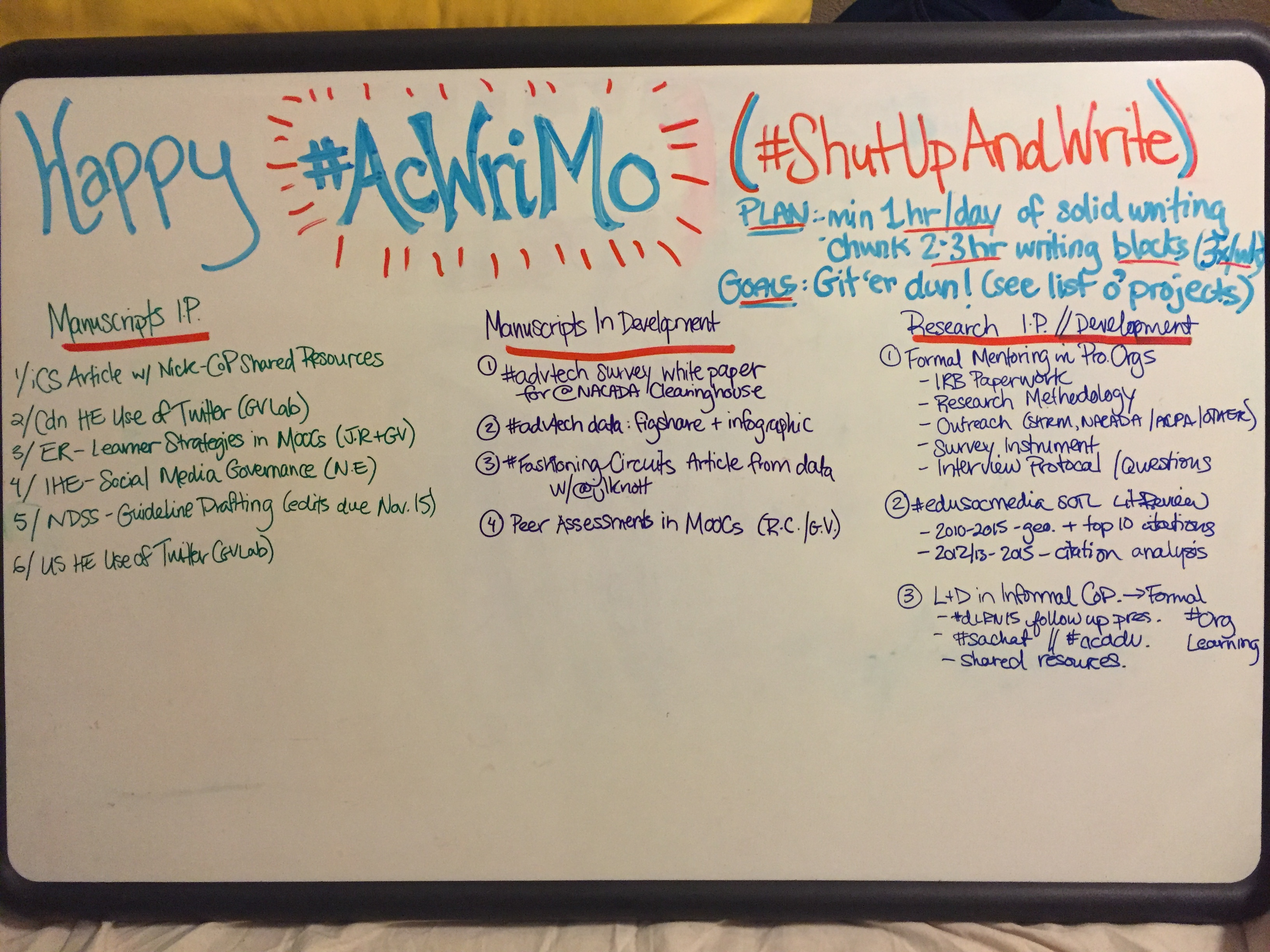
I’ve done #acwrimo in the past during my dissertating phase, so I know it works. This is a great peer community to help keep writing in check and supports my #acwri progress. This year I’ve set my #AcWriMo goals for November to wrap up a few writing and research projects. My priority is the green list, as these are active manuscripts in progress and need to be submitted before the month’s end. Then I’ll move right to publications in development, and future research ideas to tease out. Ask me how it goes this month – PLEASE!

22742710956_3dd118705a_oGood news. As of day 3, I am already finished with green list #1 – first draft of this manuscript is being edited and sent to the editors before the week is done. I have also made some progress on the Research I.P. for the IRB application and Research design on mentoring thanks to a meeting with collaborators this evening.

It might be day 3, but it’s NOT TOO LATE TO JOIN IN the #AcWriMo 2015 challenge => here are the 6 basic rules from the @PhD2Published blog:

  1. Set your writing goal(s) & plan. This can be in words, hours, or end products. You decide. (Check out the PhDometer app or 750 Words site to help you measure!)
  2. Make it public. Make it known. SIGN UP and let your goals & plan be known on the AcWriMo 2015 Sign-Up Form and then return to edit daily your progress. Peer pressure can do wonders! Check out WHO is participating from around the world on the #AcWriMo Map.
  3. Draft a writing strategy. Plan how to accomplish your goals. Organize your schedule for your uninterrupted #ShutUpAndWrite time. PLAN TO WRITE IN ADVANCE!
  4. Share your writing progress. Post it publicly. Twiter, blog, Facebook, Instagram — share with the hashtag #AcWriMo how things are going AND track your daily progress on the community #AcWriMo PUBLIC Accountability spreadsheet.
  5. Keep the #AcWriMo -tivation going. Don’t slack off. Write like it matters. Push yourself to reach your goals — chunk out projects, writing sections, and manuscripts to GIT ‘R DUN!  December will be here sooner than you think…
  6. Declare your results. Update the spreadsheet or whatever space you are keeping track of your writing progress — then let the #AcWriMo community know about your writing results at the end of the month. It helps to share and be accountable in the open — it is also a chance to get support, cheers, and feedback along the way.

So what are you waiting for? It’s time to get your academic writing ON! See you out there, #AcWriMo!

#AcWriMo, Higher Education, K-12, Learning, Learning and Performance, Learning Technologies, Online Learning, Professional Development, Research, Training & Development

What *IS* Innovation? Tell us. The CFP for OLC Innovate 2016 (#OLCinnovate) is OPEN!

What *IS* innovation?

This is the FIRST question the Online Learning Consortium (OLC) co-chairs, Karen VignarePaige McDonald and I, asked each other as we started to organize the *NEW* OLC Innovate Conference (#OLCinnovate). Innovation is a BIG word. It means so many different things, to so many different people. Before putting out the call and promoting the #OLCInnovate conference (happening April 20-22, 2016 in  New Orleans, LA), we thought carefully about who we wanted to join the planning team and how to design a conference experience to live up to the “hype” of the word INNOVATE. This conference was formed to merge the best ideas of blended learning (from #blend15) and emerging technologies for online learning (from #et4online); however we expect this meeting in NOLA — OLC Innovate 2016 — to be SO MUCH MORE! Thanks to our AMAZING #OLCInnovate Steering Committee (Tw-shout outs HERE and HERE) we support to hash out what innovation means for the program tracks, developed thoughtful session types for program delivery/format, and, we hope, this conference will model the learning design we all strive for at our institutions and organizations.

logo_516x227

So WHY should you attend #OLCinnovate 2016? [What’s in it for me? you ask.]

  • Advancing learning requires continuous visionary leadership from all disciplines
  • Connecting with multiple stakeholders (i.e. learners, educators, administrators, trainers, researchers, administrators, faculty, policy-makers, designers, and industry leaders) to strategize about the evolving needs at our institutions and organizations
  • Sharing learning and development ideas for all levels – K-12, higher education, & industry
  • Implementing solution-based approaches to learning design, support, and structure
  • Researching and developing evidence-based practices for learning is now more critical than ever.

Our #OLCinnovate planning team thinks this conference is a great opportunity to bring ideas, perspectives, research, and practices to the table to truly support innovation in education. The program tracks are structured around areas we all face with learning and development in K-12, higher education, and industry:

  • Workforce Innovation – connections from K-12 to higher ed to the workforce, curriculum to meet industry needs, partnerships for learning & work
  • Structural Innovation – systemic challenges, organization of education, learning spaces, partnerships between educators & technology solutions
  • Pedagogical Innovation – course & program approaches, methods, design, assessment models, etc.
  • Challenging Barriers to Innovation – digital divide, OER, Open Access, sharing evidence, ethical research collaborations, opportunities and areas for learning growth
  • Propose Your Own Topic – Tell us what YOU think innovation IS or what is missing!

Extend_OLCinnovate_Dec2

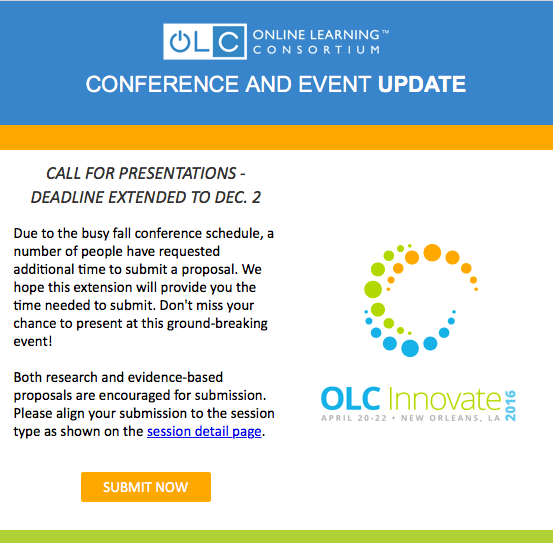
The call for proposals (CFP) is OPEN until November 9 December 2, 2015 

Program Format (Session Types) include:

  1. Conversations That Work – why have a panel, when you can facilitate a discussion on the topic with others in the room? Think of questions, discussion prompts, and ideas you want to chat about for this 45-minute session.
  2. Emerging Ideas – Forget the “traditional poster session” we want you to share your practice, research, and work-in-progress ideas in 10-15 minutes to get ideas, feedback, and suggestions during this networking event with both on-site & virtual attendees.
  3. Innovation Labs – 5-minute chat about the concept/idea; 20-minute demonstration; 20-minute applied skills for learning, technology, research, design, or other.
  4. Research Highlights & Trends – 15-minute presentation on your original research; abstract due in November; final, full paper due January 31, 2016 with the potential to be invited to a special issue of the Online Learning journal.
  5. Workshops – these are interactive 90-minute sessions with valuable take-away learning outcomes for participants (free to all conference participants).
  6. Education Sessions – a 45-minute lecture about an idea/concept with 5-10 minutes for Q & A at the end.

There are a number of helpful tips provided on the CFP page; however if you have questions or needs, I would be happy to support you with your proposal development/submission. It is getting the right PEOPLE and VOICES to the table that adds value to any learning and development experience. Please help us invite of institutional stakeholders from education (K-12 and higher ed), and industry (technology, design, L & D, and corporate training) to #OLCinnovate. Share this blog post with your peers, and tell me who the #OLCinnovate planning team should reach out to or invite. Thanks!

SUBMIT A PROPOSAL FOR OLC INNOVATE 2016!

Upcoming announcements of other #OLCinnovate program features, speakers, highlights, and are coming soon… stay tuned for more updates!

Open Education, OpenAccess

Open Access Beyond #OAWeek: Reading Round-Up

Last week (October 19-25, 2015) was International Open Access Week (#OAweek) with the overarching goal for accessible scholarship, research, and educational content.

oalogo

Did you know about #OAweek? How did you mark or celebrate being open? In my efforts to play catch up and support open access, open educational resources (OER), open data, and openness for collaboration, here’s a rundown post about the latest happenings around OPENnness.

The Welcome Trust celebrated 10 years of Open Access and to mark #OAweek the Electronic Frontier Foundation (EFF), marked the week of open access by highlighting Collaboration in the Open:

“Open access is the practice of making research available online, for free, ideally under licenses that permit widespread dissemination. This year’s theme for Open Access Week is ‘open for collaboration’ …both in academia and beyond—enables a kind of collaboration that can scale very quickly.

When research is closed, no one can access it unless they (or, more often, the institutions where they work or study) can afford expensive journal subscriptions or online libraries. When research is open, anyone can access it, study it, and use it, regardless of their budget or institutional affiliation.

Open access also opens the door to a type of collaboration that wouldn’t exist otherwise. Authors that publish their research in an open access journal—or deposit it in an open access repository after publication—invite others to use it and transform it in ways that they might not have even imagined. The work can become part of a larger project, expanding the body of public knowledge even more.”

If you have not read Martin Weller‘s book, The Battle for the Open, this might be a good time to download your OPEN COPY to understand the growing issues and obstacles we face in the world of openness and higher education. [Here’s a previous plug and my take on the book.]

Screen Shot 2015-10-27 at 3.48.09 PM

To honor #OAweek (belated) I present you an OPEN round-up of reads I’ve wrangled from this past month (and perhaps beyond) about open access (publishing, learning, resources, data, repositories, etc). I’m sure I’ve missed a few things, so please share other articles, resources, and updates about the open in the comments. Cheers!

Making Open Access work: Clustering analysis of academic discourse suggests OA is still grappling with controversy.

Stephen Pinfield discusses this article: “to provide an overview of one of the most important and controversial areas of scholarly communication: Open Access publishing and dissemination of research outputs. It identifies and discusses recent trends and future challenges for various stakeholders in delivering Open Access (OA) to the scholarly literature.”

Check out the Free online #webinar on The Impact of Open Education @Edtechie via @Ignatia Webs

This free webinar, which is being promoted by the ALT Open Education Special Interest Group, will explore findings of the OER Research Hub, which has been investigating the impact of open educational resources. btw, the OER Research Hub is a source of wonderful, innovative OER-work, really worth exploring!

Opening Up Open Access: Moving beyond business models and towards cooperative, scholar-organized, open networks. via @kfitz

This issue of credit usually gets discussed in the U.S. in terms of the things that “count” for promotion and tenure, but recent developments in Europe and the U.K. make the question of counting all the more literal, as the continued financial support of entire departments can hinge on a quantified assessment of those departments’ productivity, and the nature of “productivity” is all too narrowly defined.

SPARC Launches Open Access Evaluation Tool 

“the launch of the Open Access Spectrum (OAS) Evaluation Tool, which provides a concrete, quantifiable mechanism to independently analyze publications’ policies.

The OAS Evaluation Tool generates an “Openness” score that is straightforward, easy to understand, and free. The program provides critical information to authors, libraries, research funders, government agencies, and other interested parties. It can be used to help determine compliance with funder policies, institutional mandates, and researchers’ individual values. It also offers a unique opportunity for publishers to independently validate their journals’ degree of openness and compliance with funder and campus policies.”

HowOpenIsIt? Guide from PLOS

The “HowOpenIsIt?®” Open Access Spectrum (OAS) guide standardizes Open Access terminology in an easily understandable, comprehensive resource created by PLOS, the Scholarly Publishing and Academic Resources Coalition (SPARC) and the Open Access Scholarly Publishers Association (OASPA). The guide defines core components of Open Access derived from the articulation of basic tenets in the 2002 Budapest Open Access Initiative (BOAI).

Academics have found a way to access insanely expensive research papers—for free 

When content is not accessible and open, the scholars revert to the hashtag #icanhazpdf: “many people are becoming increasingly frustrated with a business model—where work is produced by academics, edited by their peers, and often funded by the taxpayer—is hidden behind a paywall.

Exploring the publishing model of the Open Library of Humanities: A view from Latin America

 Francisco Osorio provides a brief overview of what sets this journal project apart from the rest and how the new funding model offers an economic, social and technological platform for the humanities and social sciences to transition to open access. At the heart of the matter is the forms of communication in humanities and social sciences as distinctive from the natural sciences.

Open access papers ‘more likely to be cited on Twitter’ 

Much to no one’s surprise: “open access journals and articles have a ‘big advantage’ when it comes to being shared on Twitter compared with those behind a paywall.”

What does Academia_edu’s success mean for Open Access? The data-driven world of search engines and social networking.

[Academia.edu is] “the ‘largest social-publishing network for scientists’, and ‘larger than all its competitors put together’ – clearly raises a number of questions for the open access movement. After all, compared to the general sluggishness (and at times overt resistance) with which the call to make research available on an open access basis has been met.”

The Future of figshare (for open data sharing)

figshare has strived to engender a strong sustainability model that would allow us to continue to improve our free offering. With our continued successes, alongside file sizes and research outputs increasing year on year, we’re going to be removing our premium accounts leaving only one tier of account

OECD report on students, computers and learning: making the connection [REPORT]

Are there computers in the classroom? Does it matter? Students, Computers and Learning: Making the Connection examines how students’ access to and use of information and communication technology (ICT) devices has evolved in recent years, and explores how education systems and schools are integrating ICT into students’ learning experiences.

Open Education Resources in Canada via the IRRODL

Canada’s important areas of expertise in open educational resources (OER) are beginning to be built upon or replicated more broadly in all education and training sectors. This paper provides an overview of the state of the art in OER initiatives and open higher education in general in Canada, providing insights into what is happening nationally and provincially. There are growing examples of OER initiatives from several Canadian institutions offering free courses to Canadians and international learners.

Is it time for Canada to implement a unified open strategy for higher education? asks @clintlalonde

From Clint’s UBC/SFU Open Access week forum talk on this question [I concur with your response, Clint.]: “yes, having a unified national strategy on all things open is likely a good idea for the simple fact that it gets all the various strands of open – open access, open education, open source software, open pedagogy, open data –  in the same room. And any reason to bring people together to talk about their commonalities is a good thing.”

Openly Licensed Educational Resources: Providing Equitable Access to Education for All Learners via the US Federal Government

Open education advances key national priorities, including supporting shared economic prosperity, strengthening civil society, and investing in human development. Over the next year, the U.S. Government will continue efforts to expand and accelerate the use and availability of openly licensed educational materials worldwide. In addition, we will begin to model the transition to openly licensed educational materials at scale in U.S. K-12 schools.  We look forward to engaging with the national and global community to identify opportunities for open licensing to accelerate educational equity for all learners regardless of their financial situations or geographic locations.

Community Call from ALT: Open Education Technology and Practice

ALT is piloting a monthly ‘Community Call’ where we speak to ALT Members about their work. For our first call we speak with Lorna Campbell who is an advocate for open education, technology and practice.

Institute for Open Leadership Applications via Creative Commons – Due October 30, 2015

Earlier this year, Creative Commons and the Open Policy Network hosted the first Institute for Open Leadership (IOL). The IOL is a training and support program to empower new leaders interested in crafting and implementing an open licensing policy within their discipline. We had adiverse cohort of 14 fellows who came together for a week in January, 2015 in San Francisco. The fellows worked with mentors and each other to hone their open policy project ideas. Since then they’ve working within their institutions and fields to implement their open policy plan.

The impact of open textbook adoption on the learning outcomes of higher ed students

In some educational settings, the cost of textbooks approaches or even exceeds the cost of tuition. Given limited resources, it is important to better understand the impacts of free open educational resources (OER) on student outcomes. Utilizing digital resources such as OER can substantially reduce costs for students. The purpose of this study was to analyze whether the adoption of no-cost open digital textbooks significantly predicted students’ completion of courses, class achievement, and enrollment intensity during and after semesters in which OER were used.

A Librarian’s Guide to OER in the Maker Space

Because of their capacity to stimulate creativity, OER are the perfect complement to the maker space movement. The maker movement shares a philosophy with the open source movement by fostering creativity, collaboration, and personalization in schools. The integration of OER into well-planned, well-designed maker spaces brings together physical and virtual interests and activities and expands learning opportunities.   Maker spaces are especially well suited for OER because they demonstrate inquiry-based learning and allow students some autonomy to direct their learning.

The Real Threat of OER via David Wiley (@opencontent)

Publishers continue to believe that “free” is the main threat posed to their business models by OER. Perhaps that is because pricing is a threat they understand and know how to counteract. However, the core idea of openness – to generously grant others the broad range of permissions that enables them to innovate in any manner they can imagine – that is the real threat OER pose to commercial publishers. While the prices for commercial materials may eventually approach affordability, publishers are structurally unable to grant faculty the broad set of copyright permissions necessary to truly empower them. Their business models forbid it.

 The arXiv cannot replace traditional publishing without addressing the standards of research assessment [in open repositories]. via @JanvadeHe

So why has the arXiv become so important for researchers in these particular fields? Why is it that it is now more or less standard that any active researcher in these areas will deposit a close to final version of their publications in the archive? Part of it can be explained by the increasing prominence of Open Access and related developments in academic publishing. But that can only explain a small part of the success of the arXiv. The main reason of its success, in my opinion, is a specific feature of these research areas: the very long lead time between submission and publication in a journal of papers in those fields, and hence the historic prominence of “preprints” and “reports.”

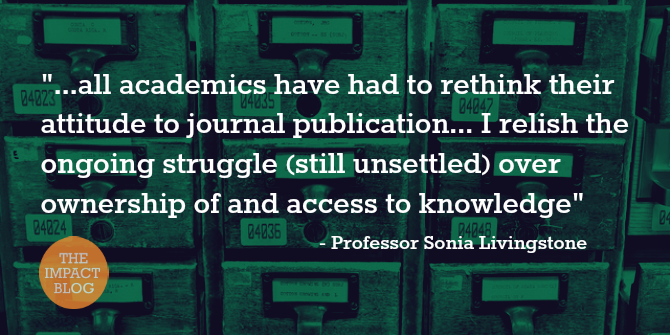
The benefits of Open Access Repositories – Q & A with Professor Sonia Livingstone shares her thoughts on the LSE’s institutional repository, LSE Research Online (LSERO)

oa-week-sonia-pablo

Honest and reliable Open Access Journals in Open and Distance Education from Rob Farrow at the @OER_Hub

Higher Education, Professional Development, Reflections

Digesting #dLRN15: Making Sense of Higher Ed

In the midst of the death of higher ed headlines,the  disruption of HE,  and all the higher ed is broken rhetoric tossed out, a few of us took a pause last week to discuss how to deal with the issues and challenges facing the post-secondary education sector at #dLRN15. I felt fortunate to be able to connect with a number of colleagues to talk behind the buzzwords, and dig into a the real issues challenges our colleges and universities face. It’s time and there is a need to take time for making change in higher education (thanks for the prompt post, @KateMfD). I am not sure that “change” was made, but I am proud to be part of the discussion and momentum that will move some of it forward.

pre-con QaMany thanks to the conference organizers for bringing a few smart kids around the table to discuss the following issues:

  • Ethics of collaboration
  • Individualized learning
  • Systemic impacts
  • Innovation and work
  • Sociocultural implications

The panels, sessions, and keynotes left me with more questions than answers – and that is a good thing. Beyond the formal program, the sidebar chats over coffee/snacks/pints were not to be dismissed As Mike Caufield said, I will need to process discussions had at #dLRN15 for weeks. There were some deep discussions into complex issues that could not be dealt with in just two days.

In our pre-conference meeting, each group picked a question/issue based on the themes the conference was focused on (see above). One the groups developed a question that resonated with me the most:

keyquestionWe always want to push forward with big change and innovative ideas in higher ed, but really do we sometimes forget to recognize the incremental changes occurring within our institutions? How do we acknowledge the slow movements and progress we make in HE or that it is an on-going process of change? There are many micro-movements occurring within our learning spaces to help us evolve. I know there are a number of amazing things happening within our colleges and universities — sometimes it’s these slow contributions that make the difference and we often fail to recognize this gradual progress. Slow and steady does win the race.

FinalPanel

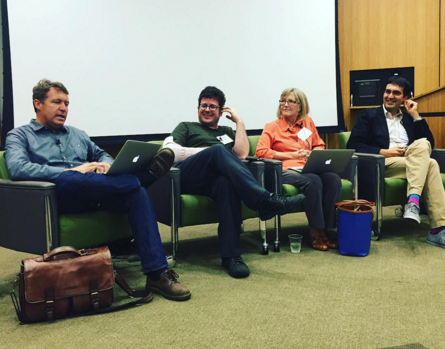
Ethics of Collaboration & Closing Remarks: Random Dude, Mike, Barbara & George

Fast-forward to the end of the conference, after a number of thoughtful conversations, this final panel reminded all of us of the call to action => to provide evidence for higher ed to shift. George Siemens asked us to utilize research to fuel the fight around the issues raised. Beyond collaboration, what are we really going to do with what we’ve talked about now? It’s great to hear that we are not alone in our discussions however we need empirical evidence to support the change ahead in higher education. I appreciated how this panel spoke about getting beyond the dichotomies and encouraged us to think about research in collaboration with our students and work. We really need to listen to our students and amplify their story/voice in the research we do. It’s easier to move and change when there is already momentum for systemic change, and perhaps #dLRN15 titled the scale for a few. There are a number of challenges and questions from #dLRN15 to consider with our research in higher education, including:

  • What were the foundational assumptions and purpose we thought about at the #dlrn15 ?
  • How do the threads of the conference fit together in a framework to support advancing higher ed? 
  • What does it mean to have a US-centrist focus in higher education? How does it impact HE on a global scale? Does it?
  • Was there enough systems-level research or research on systems change at #dLRN15?
  • Is there a need for systematic-change at all levels to advert change in higher ed?
  • How can higher ed research impact practitioner-based work?
  • Is research is the lever for change for us? And does empirical evidence have the potential to change the higher ed system?
  • How can we create a true design jam process — where research is reviewed and reflected?
  • Why should we trust the researchers?
  • We are able to get learners to the institution, but just not to get them through
  • economics of higher education — and the future of higher ed
  • Do we have enough divergent thoughts or ideas shared? Is this an echo chamber or do we need to invite others into the room/discussion for HE? 

This conversation (thankfully) is not over. Here’s a snapshot of my #dLRN15 Reading List with reflections and then some. Let’s keep this conversation and momentum going.