Digital Literacy, Needs Assessment, Networked Practice, privacy, Reflections, technology

My Digital Audit: Where Do I Want to Be Online?

Do you know how much we weave social media platforms and online technology companies into our daily lives? Would it be possible to not live with Google, Facebook, Apple or other technology companies? It’s been something I have been thinking about for a while (like others), and often how much do we test these questions in the wild. If you have not seen the technology blocking experiment conducted by @Gizmodo‘s reporter, Kasmir Hill, you should. Kahsmir tries to take on and live without the technology giants, Amazon, Facebook (which includes owned companies, Whatsapp & Instagram), Google, Microsoft, and Apple. Impressive, right? But is it impossible? Even if you don’t plan to say, “Ciao!,” to these platforms this “Goodbye Big Five” investigation and hands-on reporting will inform you about how much we let these companies invade (most) of our lives, take our money, use our data, and capture our attention.

It is far too easy to sign up or sign on to websites, apps, and platforms with a simple click. No need to read those terms of service agreements. Nah! Also, all you need is my email, mobile phone number or one of those big tech accounts to sign up (e.g. Facebook, Google or Twitter), than why not join? Apps and social media platforms want to make our online user experiences fluid and seamless — which also allows the same platforms and apps to track your digital movement and access your personal data through your connected accounts.

Image c/o Vitor Sá: https://www.flickr.com/photos/virgu/12496426/

For the past 6 years, I have been doing an alright job of tracking of my digital life and auditing where/how I am online. I use a simple spreadsheet to itemize the account name, log in, information, connected accounts, purpose, and more for this digital audit. If interested, here’s a blank spreadsheet you can copy/download to use as you review your apps and online accounts yourself:

Digital/Web Audit TEMPLATE

That being said, it has been a while since I have given it a proper review to include where my personal data lies and maybe the social media apps, online accounts, and forgotten sign-ins that I have not really examined as closely. It is no longer easy to use JustDelete.me and a delete button to remove your data from online accounts. Our existence online is more complex and often woven into one another between the platforms we use and the shifts in these mediums. Maybe I have grown up a bit, but so have these digital platforms, and I’m not so sure they have matured into the tech adults I would like them to be. Here are a few platforms concerns with and why I’m considering closing a few of my own social media spaces, just to name a few:

Beyond policies, practices, and costs, I was trying to determine where I want to “live” online and what it means now that some of these platforms have merged or have experienced new management change. Back in January, I facilitated a workshop about managing your digital identity and being a professional online in higher education. Some of the big questions I challenge participants to reflect about as they consider their online self and where they want to be include:

  1. Why do I want to share my knowledge and expertise? What interests me about “being” online and maybe even connected to my peers?
  2. Where do you want to be online? How do I want others to find and connect with me?
  3. What digital/social platforms would be best for how and what I want to share? Where will I find my professional networks online?

I shared how my own digital presence or “being” online has evolved. Although I used to be in a log of social and digital spaces, that is not the case anymore. A number of platforms have been deactivated (RIP Google Reader & Delicious). While others might have been just a platform to test out or try on. That being said, if something does not resonates with me or find a purpose in my digital life, than I’m okay to say goodbye. So, if any digital space or online place does not “bring you joy” (hat tip to the digital #MarieKondo practice), maybe it’s time to bid farewell. Here is the main focus of my personal digital and data audit:

Where do I want to be online?

Some of my digital self review has been going on for a while, but this year is the year to finish and probably shut down a few social media platforms and online accounts for good. Permanently. It’s time to simplify my streams and declutter my social (media) life. I have started the process and initiated the review of the audit spreadsheet to determine what accounts are active and to itemize what is happening online. Here are a few things I did to start this digital and data audit of me:

  1. Unsubscribe: I used Unroll.me to start the initial clean up and unsubscribe of email lists, advertising, listservs, and duplicate groups/listservs from all my email accounts (personally/professionally).
  2. Revoke/Remove Connections: By logging into your social media platforms, online apps, and digital accounts, you might see you have granted 3rd party access to other applications/users/accounts — remove said things.
  3. Identify the Accounts Where Your Personal Information Lies: Using the various emails, I used Deseat.me to get a list of my accounts and apps that I have signed up for to identify and delete the ones I am not using OR to add these to my digital/web audit spreadsheet to track. This method offers a GDPR message template (thanks, EU GDPR!) to send a template email to the platform administrator to remove yourself from online and social media accounts. This might (and does) require follow up messaging, emails, and sometimes confirmation contracts to remove your information and personal data from certain accounts. It might take some time to get responses and confirmations for deleting yourself from various platforms, communities, or online programs (I know. I am in week 4 of this process.)
  4. Download Your Personal Data: For the accounts and platforms you are thinking about deleting, consider downloading your account data. This might be an archive of activity, posts, etc (e.g. Facebook). Or it could be a files, images, and other items within each account (e.g. Flickr). Part of this download may require you to determine storage elsewhere, such as, in another cloud-based service OR external hard drive (or both). Figure out the how much of data and your use of it, to determine your next steps.
  5. Delete Yourself: Depending on your goals, you may just want to wipe your accounts online to remove all that is there. There are a few guides to get yourself off the grid to get you started. Deseat.me will remove your data and delete some of your accounts, but you will need to visit each account/platform you have to manually complete the deletion process. Check out these suggestions for finding/deleting accounts from the Internet, a list of “how to” delete yourself from social media platforms, and suggestions for deleting (or locking down) your Facebook and Instagram accounts.
The above is just a start — but I thought I’d share what I’ve been working on, ironically, offline and online to audit my digital and data self. Let me know if you have suggestions, resources, or ideas for this review process. I would love to hear how your own audit, review, and reflections are going if you are pondering the same thing.
#AcDigID, #EdDigID, #HEdigID, Social Media, SocioTech

Networked Practice: My Book List

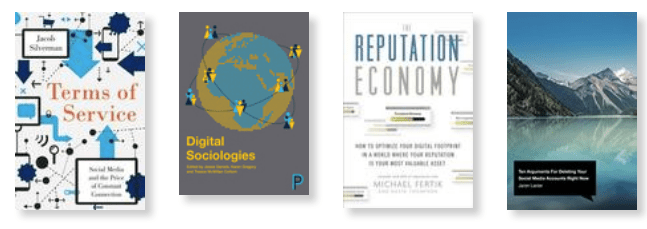
For some of my own research and review, I have been accumulating a variety of books to my reading list for the networked practice study. Some deal with living online, being connected, and even understanding how communities, networks, and groups thrive (or the opposite) in the digital. For the month of January, I have been taking stock and reflecting on my own networked practice. Recently I facilitated an online workshop to support higher education faculty and staff think more about their digital presence and how to manage their own reputations online. Now my current students are thinking about how they will craft their digital identity online and engage with industry leaders, future co-workers, and engage with professionals in their occupational fields. I have enjoyed having conversations to consider what online reputation means, examining how/where our personal data exists, and understanding that “being” online means so much more in 2019.

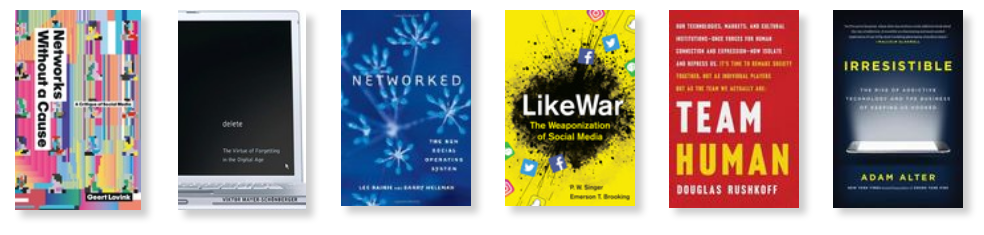
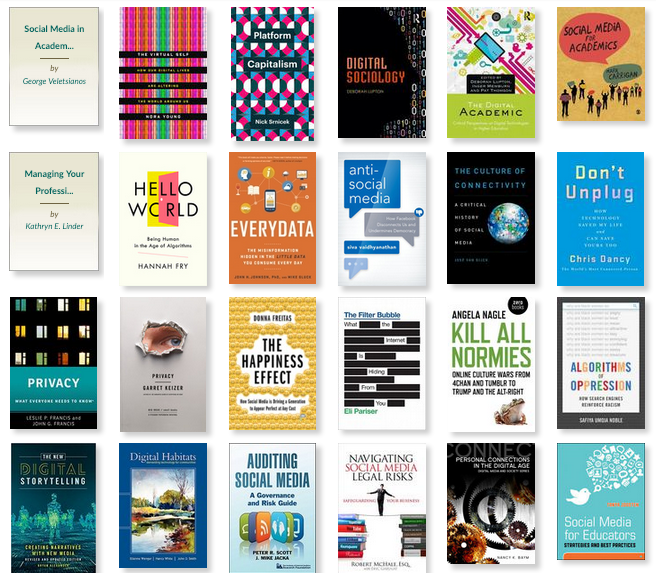
Creating, crafting, and/or presenting our professional best self digital is quite complicated and complex — just like the individuals behind the profile. As usual, I continue to think about my digital imprint and I have begun to audit where I “live” online. [This process is taking a while, so I’ll share about this audit and review in another post when I am closer to wrapping it up.] as I start to audit my own life on social media platforms and other digital accounts. Of course, I continue to read and review what others are thinking about this process — being networked, living digital, cyber reputations, and online personas — who are connected and linked to peers and communities. Here are a few of the reads and resources I have recommended lately for higher education professionals (e.g. staff, graduate students, faculty, administrators, instructional designers, instructors, early career researchers, etc.):

Beyond this list, I am more than happy to share what I have “READ” and is accumulating on my “Networked Practice” reading list on GoodReads (some reviews included):

I suppose my attention is drawn to the ideas of self-presentation, reputation, and lived lives on social media platforms (and other digital spaces we don’t fully control). At the moment, I’m “CURRENTLY READING” the following books — thanks public and university library!:

My “WANT TO READ” book list is never short, but here are a few that I have either sitting on my home shelf to read (literally) around networked practices. I have no doubt I will add (or have added) to this list, especially as I hope to read these in February.  I welcome your recommendations for living a networked life, being a connected scholar, and being involved digital communities of practice:

What are you reading these days around networked practice? Do you have recommendations for those of us who live a networked, connected professional life? This could be about online personas, digital reputation, networked groups/communities, impacts of social media at work, and more. Share any recommendations you have, and if you’re GoodReads — be sure to connect with me, so I too can be inspired by the books you’re reading.

Reflections

2019 Intentions: The Finish Line

With a new year (and new semester), comes a time for planning and organizing what lies ahead. The new start to a year offers us space to reflect and take stock. Whether you decided to take a networked sabbatical or are in a digital detox right now, I know that being away from a screen the last few weeks has given me time and space to think about 2019. Now, I didn’t completely unplug over the holidays (podcasts & connecting to family/friends, duh!), but I did make sure to live in the analog by writing in a journal, reading real books, sketching ideas, and living the beach life.  It was nice to break from all things connected, as it gave me space to have a think about what’s on the horizon.

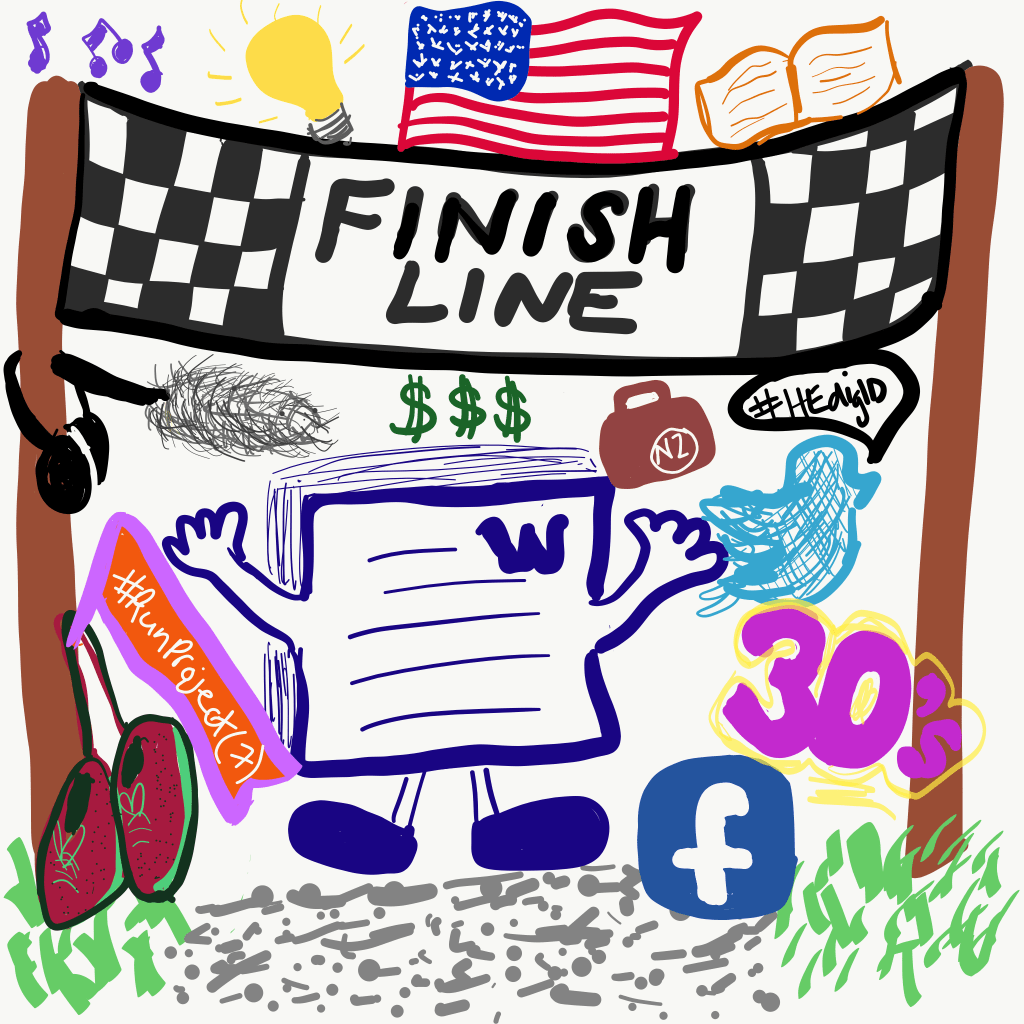
Typically the new year encourages many think about t how we want to use our time (or even take more of our time back) and improve ourselves in 2019 (here’s a list of 50 things to be your best you, if you’re still thinking about it). For me, I am saying goodby to new years resolutions and my #OneWord statements, and hello to goals and intentions! For 2019, I’m in training (metaphorically & literally) to see a few projects cross a finish line. I’m treating this year like I do for the races I run. There’s a finish line (a.k.a. completion) and I’m putting a concentrated effort to seeing my life projects, work initiatives, and personal goals reach the end before 2019 times out.

These are ALL THE THINGS I want to FINISH. This includes projects and initiatives I want to accomplish, wrap-up, remove, test out, delegate, abandon, perform, and sunset. In my professional life, I have new things I want to create, to do this I will need to finish current course re-design contracts, multiple research projects, team grants, and collaborative creative works. In my personal life, I am looking forward to racing in the #RunProject series, saying goodbye to my 30’s, learning new songs to sing/play on ukulele/guitar, personal digital audits & data deletions, writing/editing fictional stories, learning from the masters, planning travel adventures, #adulting stuff (wills, investments, and business opportunities… oh my!), and, oh yeah, Uncle Sam says I’m eligible to apply for citizenship – so there’s that.

So, as you can tell I have just a few things I want to see cross that finish line this year. To accomplish this I’ll continue with my the semester, monthly, and weekly planning in my #GetToWork book AND with daily tasks via Todoist. But this definitely calls for a long-term strategy that maps out how I’ll reach these goals. Good thing I am not alone with my big, audacious goal setting in 2019. In listening to a recent episode Quarterly Strategic Planning (from The Radial Self-Trust podcast channel hosted by Katie Linder), reading about other ideas on quarterly plans, and having a think about what I need to get done, I decided to make the time to organize what needs to get done in chunks (my version of quarterly personal planning) this year. By breaking up these projects, I can prioritize work and the time/attention it needs for completion.

Here is how I started with to map out my “project training plan” to reach the 2019 finish line goals & intentions:

  1. Create a vision or master plan: write down everything that has been pending, needs to be finished, and left incomplete.
  2. Outline domains or themes for your visionary ideas: categorize your intentions into buckets to group your project planning and figure out how you will start to craft your goals and prioritize this work.
  3. Identify goals (you know the SMART ones): outline actions and items that identify a project, initiative, or item is consider to be complete/finished.
  4. Select ways to track and measure your progress:  create systems to account for progress on these goals; this can be done daily, weekly, monthly, and quarterly time periods
  5. Design systems and strategies for success: identify time in your calendar where you’ll most likely work on a particular task, dedicate space(s) for focus/creativity, find accountability where/when needed, and add incentives/rewards built into this structure for each goal accomplished.

A few of my 2019 goals/intentions have specific timelines and some of these are already set in motion — especially the ones that require accountability from others and set deadlines. Now I’ll just need to add to my “Finish Line” Spotify playlists (e.g. Brain Food, The Social Network, and Alternative 90s) to enhance productivity. I welcome recommendations for more music. Always.

#HEdigID

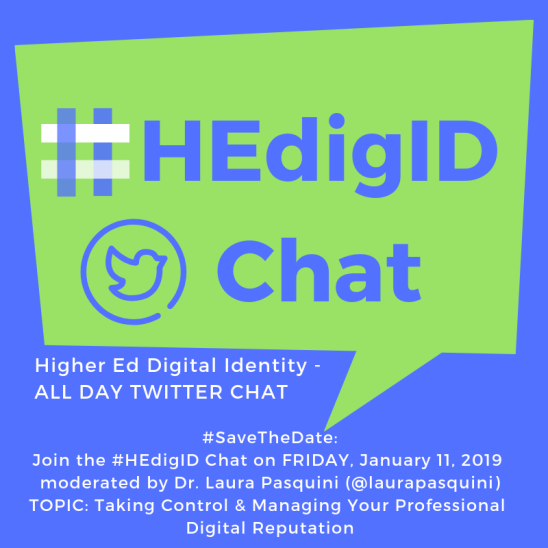
#HEdigID Chat No. 12: Taking Control & Managing Your Professional Digital Reputation

Why hello 2019! You just crept up on me. Sorry for the abrupt hello, but I’ve been hiding out, working, and chilling out a bit offline during the holiday break and before the start of the new term. There’s a few things I have been thinking about and more intentions (not resolutions) I have been reflecting on in my digital hiatus (I’ll share more in a blog post soon, I promise).

But I interrupt non-digital solitude for today, I am hosting a Higher Ed Digital Identity (#HEdigID) chat for a workshop I am facilitating with the Online Learning Consortium. Today’s (January, 11 2019 ) #HEdigID Chat topic is: Taking Control & Managing Your Professional Digital Reputation. Join us for the ALL DAY Twitter conversation using the hashtag: #HEdigID

If you’re not tweeting, you can still SHARE and CONTRIBUTE to the same questions/prompts listed in this open Google doc: http://bit.ly/hedigid12

INTRO: A #HEdigID POLL for this Friday’s (Jan. 11th) Twitter Chat: Academics & #highered professionals should NOT make time OR SHOULD make time for #socialmedia – YOU DECIDE! #academia #sachat #HE

https://platform.twitter.com/widgets.js

TWITTER POLL: https://twitter.com/laurapasquini/status/1083067217913229312

  1. What digital spaces and social media platforms are you most “present” on these days, OR do you want to become more active on? Where online can others connect and engage with #highered professionals (staff, faculty & administrators), in general? Share and list where you are most active these days online and why:
  2. What online communities and/or networked spaces do you follow and find others to connect with? This could be to learn from, share knowledge, swap teaching resources, or to disseminate your own scholarship. Feel free to share those you follow on Twitter (people & hashtags), online groups, podcasts, blogs your read, and other networks you engage with digitally for your work in #highered [PLEASE LIST BELOW]
  3. The best way to take control of your digital reputation is to craft it. How do you want to present yourself online? What will you choose to disclose and share about yourself? [e.g. research interests, institutional affiliations, teaching experience, hashtags you follow, fun facts, website, & more!] How do you manage & maintain control of your digital identity? Also, let us know WHO in #highered has helped to model &/or mentor your own digital identity.
  4. As we manage and take control of our digital identity and connect to these online communities, what are some of the BENEFITS and OPPORTUNITIES of being a #networkedscholar or connected #highered professional to share about your work? Tell us what you have gained/learned from being connected.
  5. Using digital spaces and social media to share about our professional work in #highered forces us to differentiate between our ‘private’ and ‘public’ lives. The reality is, this is much more complex as we share online. As we use different platforms and social media channels, some of this gets mixed up and lines are blurred. What CHALLENGES or RISKS concern you most about being a ‘public intellectual’ in #HE?
  6. Final Thoughts (FT): What is one piece of advice that you give #highered professionals OR that you want to know more about for managing your online identity & a digital reputation?

Join the discussion and share your thoughts on professional reputation management online:

  • Answering the questions by tweeting your response with the hashtag: #HEdigID

  • Responding anonymously or with your own name in IN this OPEN Google Doc: http://bit.ly/hedigid12

  • Use any of these questions to draft your own personal reflection and response (e.g. blog post, video, audio, drawing or offline discussion)

Reflections

My State of Create 2018

It’s the end of the year as we know it … and I feel fine.

Well, I feel pretty good, or I do now that I’ve spent some time wrapping up projects and a few tasks this last week. I have been thinking back to the goals, projects, and initiatives I’ve been working on personally and professionally in 2018. Last week, the #HEdigID chat offered a space for reflection and review of 2018 goals and things we still might need to work on in 2019.  Taking time to pause and take stock is important. I like to do this at the end of each academic semester (e.g. student grades/data, course evaluations, and my own feedback forms for learning), and also to figure out what has been my priority over the course of the year as well.

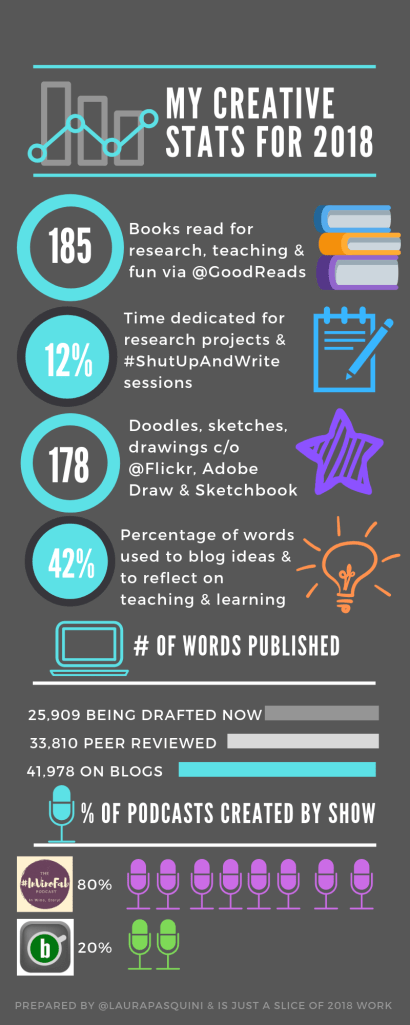
For 2018, I thought it would be fun to compile some of my statistics of things I have been making, producing, and creating — that may or may not “count” for what I’ve accomplished. I know that some websites and platforms offer insights into the number of posts, comments on blogs, image likes, and more – but I wanted to figure out what I have been working on in a variety of communities, digital spaces, and efforts across a variety of spaces and places (both online and offline). It can’t be all photo collages of inspiration, selfies, and achievements — per my #bestnine2018 of Instagram. There are so many other things that go beyond the typical data metric of a social media “like” or favorite, so I thought it was time I collected and reviewed this information as well. Here’s a slice of what I’ve been making and creating this year in this infographic:

I think some of the doodles, edits, revisions, and reads don’t always get noted in a typical performance review — but it helps to give me some perspective as to where I have been spending my time outside of my role, research projects, and design work to understand what has been my focus and priority this year for creativity. It was interesting to see what has been my focus and it gives me an idea of what I can look back at if I decide to reflect again on these items in 2019. How has 2018 been creative for you? What sort of maker stats would you collect to share your innovations, ideas, and initiatives that are more creative? Let me know!