Open Education, OpenAccess

Open Access Beyond #OAWeek: Reading Round-Up

Last week (October 19-25, 2015) was International Open Access Week (#OAweek) with the overarching goal for accessible scholarship, research, and educational content.
oalogo

Did you know about #OAweek? How did you mark or celebrate being open? In my efforts to play catch up and support open access, open educational resources (OER), open data, and openness for collaboration, here’s a rundown post about the latest happenings around OPENnness.

The Welcome Trust celebrated 10 years of Open Access and to mark #OAweek the Electronic Frontier Foundation (EFF), marked the week of open access by highlighting Collaboration in the Open:

“Open access is the practice of making research available online, for free, ideally under licenses that permit widespread dissemination. This year’s theme for Open Access Week is ‘open for collaboration’ …both in academia and beyond—enables a kind of collaboration that can scale very quickly.

When research is closed, no one can access it unless they (or, more often, the institutions where they work or study) can afford expensive journal subscriptions or online libraries. When research is open, anyone can access it, study it, and use it, regardless of their budget or institutional affiliation.

Open access also opens the door to a type of collaboration that wouldn’t exist otherwise. Authors that publish their research in an open access journal—or deposit it in an open access repository after publication—invite others to use it and transform it in ways that they might not have even imagined. The work can become part of a larger project, expanding the body of public knowledge even more.”

If you have not read Martin Weller‘s book, The Battle for the Open, this might be a good time to download your OPEN COPY to understand the growing issues and obstacles we face in the world of openness and higher education. [Here’s a previous plug and my take on the book.]
Screen Shot 2015-10-27 at 3.48.09 PM

To honor #OAweek (belated) I present you an OPEN round-up of reads I’ve wrangled from this past month (and perhaps beyond) about open access (publishing, learning, resources, data, repositories, etc). I’m sure I’ve missed a few things, so please share other articles, resources, and updates about the open in the comments. Cheers!

Making Open Access work: Clustering analysis of academic discourse suggests OA is still grappling with controversy.

Stephen Pinfield discusses this article: “to provide an overview of one of the most important and controversial areas of scholarly communication: Open Access publishing and dissemination of research outputs. It identifies and discusses recent trends and future challenges for various stakeholders in delivering Open Access (OA) to the scholarly literature.”

Check out the Free online #webinar on The Impact of Open Education @Edtechie via @Ignatia Webs

This free webinar, which is being promoted by the ALT Open Education Special Interest Group, will explore findings of the OER Research Hub, which has been investigating the impact of open educational resources. btw, the OER Research Hub is a source of wonderful, innovative OER-work, really worth exploring!

Opening Up Open Access: Moving beyond business models and towards cooperative, scholar-organized, open networks. via @kfitz

This issue of credit usually gets discussed in the U.S. in terms of the things that “count” for promotion and tenure, but recent developments in Europe and the U.K. make the question of counting all the more literal, as the continued financial support of entire departments can hinge on a quantified assessment of those departments’ productivity, and the nature of “productivity” is all too narrowly defined.

SPARC Launches Open Access Evaluation Tool 

“the launch of the Open Access Spectrum (OAS) Evaluation Tool, which provides a concrete, quantifiable mechanism to independently analyze publications’ policies.

The OAS Evaluation Tool generates an “Openness” score that is straightforward, easy to understand, and free. The program provides critical information to authors, libraries, research funders, government agencies, and other interested parties. It can be used to help determine compliance with funder policies, institutional mandates, and researchers’ individual values. It also offers a unique opportunity for publishers to independently validate their journals’ degree of openness and compliance with funder and campus policies.”

HowOpenIsIt? Guide from PLOS

The “HowOpenIsIt?®” Open Access Spectrum (OAS) guide standardizes Open Access terminology in an easily understandable, comprehensive resource created by PLOS, the Scholarly Publishing and Academic Resources Coalition (SPARC) and the Open Access Scholarly Publishers Association (OASPA). The guide defines core components of Open Access derived from the articulation of basic tenets in the 2002 Budapest Open Access Initiative (BOAI).

Academics have found a way to access insanely expensive research papers—for free 

When content is not accessible and open, the scholars revert to the hashtag #icanhazpdf: “many people are becoming increasingly frustrated with a business model—where work is produced by academics, edited by their peers, and often funded by the taxpayer—is hidden behind a paywall.

Exploring the publishing model of the Open Library of Humanities: A view from Latin America

 Francisco Osorio provides a brief overview of what sets this journal project apart from the rest and how the new funding model offers an economic, social and technological platform for the humanities and social sciences to transition to open access. At the heart of the matter is the forms of communication in humanities and social sciences as distinctive from the natural sciences.

Open access papers ‘more likely to be cited on Twitter’ 

Much to no one’s surprise: “open access journals and articles have a ‘big advantage’ when it comes to being shared on Twitter compared with those behind a paywall.”

What does Academia_edu’s success mean for Open Access? The data-driven world of search engines and social networking.

[Academia.edu is] “the ‘largest social-publishing network for scientists’, and ‘larger than all its competitors put together’ – clearly raises a number of questions for the open access movement. After all, compared to the general sluggishness (and at times overt resistance) with which the call to make research available on an open access basis has been met.”

The Future of figshare (for open data sharing)

figshare has strived to engender a strong sustainability model that would allow us to continue to improve our free offering. With our continued successes, alongside file sizes and research outputs increasing year on year, we’re going to be removing our premium accounts leaving only one tier of account

OECD report on students, computers and learning: making the connection [REPORT]

Are there computers in the classroom? Does it matter? Students, Computers and Learning: Making the Connection examines how students’ access to and use of information and communication technology (ICT) devices has evolved in recent years, and explores how education systems and schools are integrating ICT into students’ learning experiences.

Open Education Resources in Canada via the IRRODL

Canada’s important areas of expertise in open educational resources (OER) are beginning to be built upon or replicated more broadly in all education and training sectors. This paper provides an overview of the state of the art in OER initiatives and open higher education in general in Canada, providing insights into what is happening nationally and provincially. There are growing examples of OER initiatives from several Canadian institutions offering free courses to Canadians and international learners.

Is it time for Canada to implement a unified open strategy for higher education? asks @clintlalonde

From Clint’s UBC/SFU Open Access week forum talk on this question [I concur with your response, Clint.]: “yes, having a unified national strategy on all things open is likely a good idea for the simple fact that it gets all the various strands of open – open access, open education, open source software, open pedagogy, open data –  in the same room. And any reason to bring people together to talk about their commonalities is a good thing.”

Openly Licensed Educational Resources: Providing Equitable Access to Education for All Learners via the US Federal Government

Open education advances key national priorities, including supporting shared economic prosperity, strengthening civil society, and investing in human development. Over the next year, the U.S. Government will continue efforts to expand and accelerate the use and availability of openly licensed educational materials worldwide. In addition, we will begin to model the transition to openly licensed educational materials at scale in U.S. K-12 schools.  We look forward to engaging with the national and global community to identify opportunities for open licensing to accelerate educational equity for all learners regardless of their financial situations or geographic locations.

Community Call from ALT: Open Education Technology and Practice

ALT is piloting a monthly ‘Community Call’ where we speak to ALT Members about their work. For our first call we speak with Lorna Campbell who is an advocate for open education, technology and practice.

Institute for Open Leadership Applications via Creative Commons – Due October 30, 2015

Earlier this year, Creative Commons and the Open Policy Network hosted the first Institute for Open Leadership (IOL). The IOL is a training and support program to empower new leaders interested in crafting and implementing an open licensing policy within their discipline. We had adiverse cohort of 14 fellows who came together for a week in January, 2015 in San Francisco. The fellows worked with mentors and each other to hone their open policy project ideas. Since then they’ve working within their institutions and fields to implement their open policy plan.

The impact of open textbook adoption on the learning outcomes of higher ed students

In some educational settings, the cost of textbooks approaches or even exceeds the cost of tuition. Given limited resources, it is important to better understand the impacts of free open educational resources (OER) on student outcomes. Utilizing digital resources such as OER can substantially reduce costs for students. The purpose of this study was to analyze whether the adoption of no-cost open digital textbooks significantly predicted students’ completion of courses, class achievement, and enrollment intensity during and after semesters in which OER were used.

A Librarian’s Guide to OER in the Maker Space

Because of their capacity to stimulate creativity, OER are the perfect complement to the maker space movement. The maker movement shares a philosophy with the open source movement by fostering creativity, collaboration, and personalization in schools. The integration of OER into well-planned, well-designed maker spaces brings together physical and virtual interests and activities and expands learning opportunities.   Maker spaces are especially well suited for OER because they demonstrate inquiry-based learning and allow students some autonomy to direct their learning.

The Real Threat of OER via David Wiley (@opencontent)

Publishers continue to believe that “free” is the main threat posed to their business models by OER. Perhaps that is because pricing is a threat they understand and know how to counteract. However, the core idea of openness – to generously grant others the broad range of permissions that enables them to innovate in any manner they can imagine – that is the real threat OER pose to commercial publishers. While the prices for commercial materials may eventually approach affordability, publishers are structurally unable to grant faculty the broad set of copyright permissions necessary to truly empower them. Their business models forbid it.

 The arXiv cannot replace traditional publishing without addressing the standards of research assessment [in open repositories]. via @JanvadeHe

So why has the arXiv become so important for researchers in these particular fields? Why is it that it is now more or less standard that any active researcher in these areas will deposit a close to final version of their publications in the archive? Part of it can be explained by the increasing prominence of Open Access and related developments in academic publishing. But that can only explain a small part of the success of the arXiv. The main reason of its success, in my opinion, is a specific feature of these research areas: the very long lead time between submission and publication in a journal of papers in those fields, and hence the historic prominence of “preprints” and “reports.”

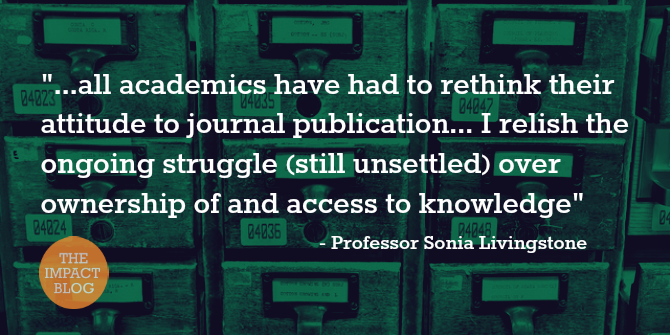
The benefits of Open Access Repositories – Q & A with Professor Sonia Livingstone shares her thoughts on the LSE’s institutional repository, LSE Research Online (LSERO)
oa-week-sonia-pablo

Honest and reliable Open Access Journals in Open and Distance Education from Rob Farrow at the @OER_Hub

DETA, Online Learning, Research

Developing a Research Model for Online Learning: @UWMDETA Wants Your Feedback!

The National Research Center for Distance Education and Technological Advancements (DETA) has been busy since the DETA Summit at #ELI15. Besides building a framework for inquiry, formulating measures, #DETAToolkits, and establishing research designs and instrumentation, the DETA team has been working on developing a research model for online learning — and they WANT YOUR FEEDBACK!

The DETA team reminds us that the field of distance education research is not new, but we do need to come together to consider how we examine, support, and thrive in online learning:

In distance education, a common language or ground has not yet been established.  Although existing scholarship attempts to establish an identity for teaching and learning on the fringe or margins (see Moore, 2013), such as distance education, there is still much work to be done.  It is common in other disciplines to struggle with finding this common ground as well (e.g., Corman and Poole, 2000).  Yet, unlike many other disciplines that have models illustrative of the phenomenon of interest or research models that guide the design of research, distance education has seen little traction in this area.  A cohesive approach to researching distance education from a transdisciplinary lens is pertinent.        

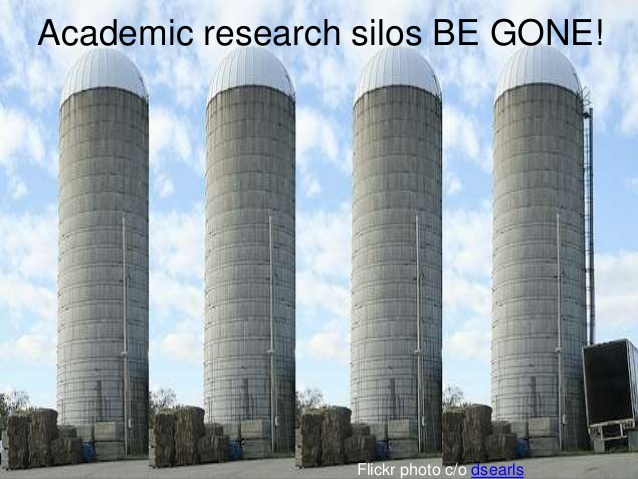
The lack of common language and work being conducted in disciplinary silos has led to a disregard or lack of acknowledgment of previous developments in the field.  Furthermore, the disconnect many times between the fast moving development of practice and redundant research of already proven practices is less than helpful to developing distance education. 

The function of the proposed online learning research model is “to facilitate cross-institutional distance education research efforts as a strategy for ensuring quality in teaching and learning for all students.”

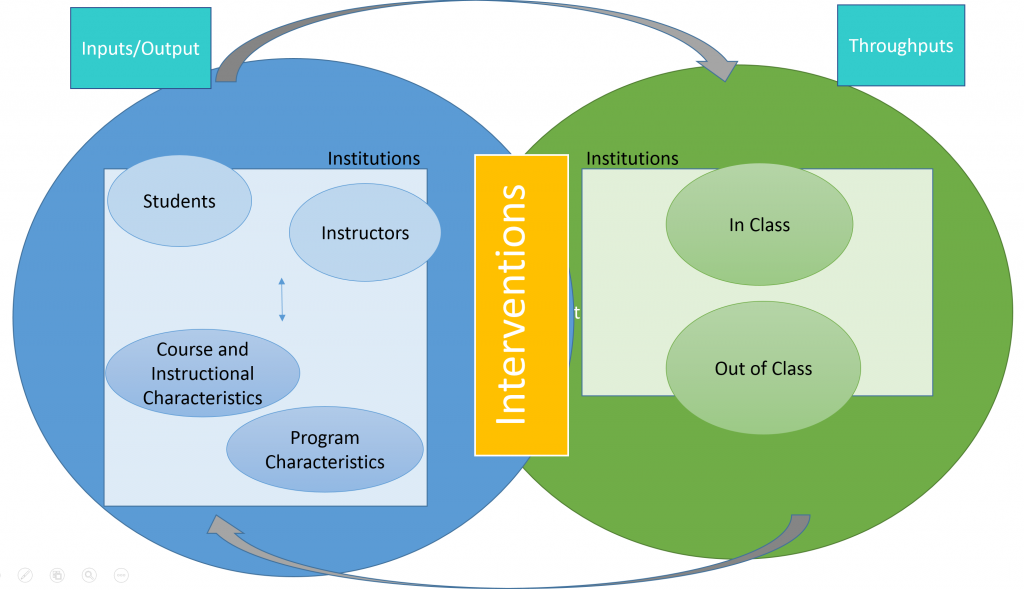
DETA Research Model (Proposed)

The research model document publicly is available online the DETA website for you to view. Please take a gander and comment. Your input will not only help the DETA team, it will also support many of us who research, work, teach, learn, manage, and then some online in higher education. In the proposed research model for online learning four components include (1) inputs and outputs, (2) process, (3) context, and (4) interventions.  I was interested in the three facets that describe the relationship between and among the components of the research model, including:

  1. Cyclical: Learning is conducted in cycles. It might be in a semester system, a certificate program design, or through a series of short courses. In thinking about this, it will also be important to identify attributes of the student, instructor, course, and program that feed into this cycle of learning.
  2. Transactional: Both students and instructors engage and are a part of the learning exchange. The learning process requires efforts and contributions on both end, i.e. design of a course could influence completion rates, learning interactions, course dynamics, and the feedback loop for online learning.
  3. Structurational: As instructors and staff design, develop, and modify online learning the courses, instructional methods, and program characteristics are a direct result of human action, which in turn, facilitate and constrain student interactions in online learning.

For each of these areas, I have made a few notes and questions for the DETA team — but I don’t want to influence your  feedback before you provide your own comments/questions/suggestions  on this research model. Please take a moment to review the proposed research model and complete a very brief FEEDBACK form embedded into this website at the bottom of the page and/or address any questions you have to the DETA Team:

http://uwm.edu/deta/research-model/

References

Corman, S. R., & Poole, M. S. (2000). Perspectives on organizational communication: Finding common ground. Guilford Press.

Moore, M. G. (Ed.). (2013). Handbook of distance education. Routledge.


Online Learning

Content Curation: Copyright, Fair Use, and Creative Commons

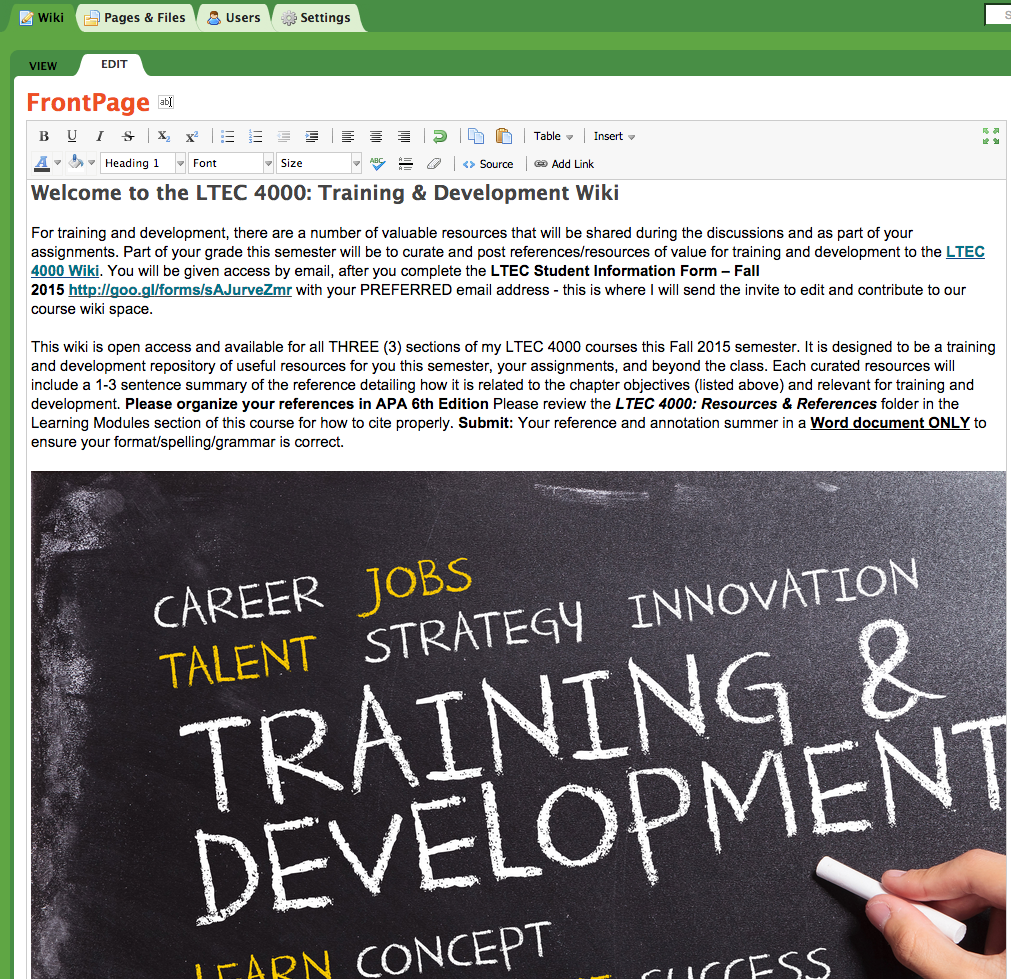
In planning my courses this term, the textbook for my LTEC 4000 course will be OPTIONAL. With a wealth of training and development resources digitally available online, in databases, from many professional organizations, and in our library system, I decided to have my three sections of my class be rhizomatic in their learning. (Thanks for modeling this learning approach for a few years now, Dave.) Learning is more than consumption. By encouraging my students to curate their own knowledge, I hope it will help  contextualization how these course objectives are applicable for the world of work. This semester LTEC4000 will aggregate training and development content in a wiki. Here’s to giving ownership to the learning process through research inquiry, critical thinking, and content contribution. Wish me luck!

LTEC4000_wikiIn thinking about digital curation and online literacy, I want my students to consider how they share, remix, and adapt content they discover for training and development. In the course, I hope this wiki content will scaffold project development this semester; however I think it’s important to discuss copyright, fair use, and intellectual property as they might apply some their training and development academic work to their own workplace.

Here are few of definitions (listed below) and I am gathering resources to share with my students around copyright and attribution. Let me know if you have further suggestions/resources to share. Thanks!
Adventures in copyright//embedr.flickr.com/assets/client-code.js

Copyright

The Basics of Copyright [Video; 6:19 minutes]. This is an introductory video  in copyright law, specifically about how to share copyrighted material at work while still respecting the rights of the content creators. Will you require permission before using materials? Do you ask permission before using protected content?

  • Copyright law applies to all works – print & electronic
  • Protected: Books, magazines, online articles, songs, screens plays, choreography, art,  software, work, software, podcasts, and photos
  • Not Protected: Ideas, facts & data; government items
  • Know the facts about copyright, not the myths
  • Get permission if required (when in doubt get permission)
  • Just because you found it online, & it is publicly available does not mean it is free to use
  • Not sure? Just ASK: legal council at your workplace or an information professional (in the College of Information) or at UNT Libraries for advice.
  • UNT Copyright Resources https://copyright.unt.edu/
  • CLEAR Copyright Guide for Instructors http://clear.unt.edu/copyright

Fair Use

Fair Use from copyright.gov: 

“Fair Use is a legal doctrine that promotes freedom of expression by permitting the unlicensed use of copyright-protected works in certain circumstances. Section 107 of the Copyright Act provides the statutory framework for determining whether something is a fair use and identifies certain types of uses—such as criticism, comment, news reporting, teaching, scholarship, and research—as examples of activities that may qualify as fair use.” fair use classroom poster draft

Specifically, there are four requirements for fair use of materials:

    1. The purpose is for nonprofit, noncommercial educational use (typical cases).
    2. The nature of the copyrighted work is consistent with the proposed use.
    3. The amount and substantial of the original work involved some small uses can be considered an infringement, that is, a small portion involves the core idea in the copyrighted work.
    4. The effect of using the copyrighted work is not likely to deprive the copyright holder of sales or market interest.

  Creative Commons
Creative Commons  

Wanna Work Together? from Creative Commons on Vimeo.

Creative Commons copyright licenses and tools allow for content to be shared beyond the traditional “all rights reserved” setting and decide on the best form of attribution for their work. The goal is to refine how copyright works and allows content creators to CHOOSE if they want to retain copyright while letting others copy, distribute, and make use of part of their work. Creative Commons licenses provide:

everyone from individual creators to large companies and institutions a simple, standardized way to grant copyright permissions to their creative work. The combination of our tools and our users is a vast and growing digital commons, a pool of content that can be copied, distributed, edited, remixed, and built upon, all within the boundaries of copyright law.

To enhance your learning and training materials, you  might want to find creative commons and public domain images. Certain social media sites, such as Flickr Creative Commons, even offer users content with specific attribution for use. There is even a Creative Commons Search to aggregate even more content to share, use and remix, including media, images, video, audio, music, photography, and web resources. Want to learn more about Creative Commons? Check out UNT CLEAR‘s Creative Commons Guide.

networkedscholar, Research

Being A Networked Scholar

Using social media and being a networked scholar allows provides you with an online, research presence and connects you to academics inside and outside your field. The power of open, social networks, allows academic to connect to research and researchers across disciplines. Consider all the ways you can collaborate and share in social media. A growing number of scholars have adopted and joined these online scholarly communities to meet other like-minded scholars, solicit for research support, share project progress, and disseminate findings beyond a conference publication or journal article. A core value of open, online networked scholarship is it is “a place where scholars can congregate to share their work, ideas and experiences” (Veletsianos, 2013, p. 648).  There are a number of researcher identification and citation tools connected to social media sites and scholarly metrics. Teaching and research information are being distributed and shared across platforms and communities.

elearn14-digital-scholarship-21-638

“It is a critical time to rethink how research is produced, distributed, and acknowledged.”

(Pasquini, Wakefield, Reed & Allen, 2014, p. 1567).

As I investigate workplace learning and performance, it has been helpful to blog and bounce ideas off on others on Twitter. I have used Mendeley to work on literature reviews, Google+ hangouts for research team meetings, Google documents for collaborative writing/research, searched Academia.edu or ResearchGate to access publications, and posted academic results to SlideShare. These are just a few ways I like to “show my work” and work in the open as a scholar. Being social and online allows me to reflect on my academic teaching and research scholarship experiences, and it has connected me to a great number of academics who I learn and research among.

If you or another academic colleague are thinking about how social media and networks can impact your teaching, research, and service scholarship, then here are a few insights George & I shared via Royal Roads University post on networked scholarship.

Network with colleagues

Higher education faculty and academics are adopting social media in growing numbers. A 2011 survey, for example, found that 45 % of higher education respondents use Facebook for professional, non-classroom purposes. Joining social media networks allows scholars to connect with colleagues, offer resources and discuss issues of professional interest.

Solicit feedback and reflect on your research and teaching

Academics increasingly share their work online, often engaging in activities that impact practice. Academic-focused social networking sites, such as Academia.edu and Mendeley, and general interest sites such as Twitter and SlideShare provide scholars with places to distribute, discuss and expand on their research and teaching.

Reach multiple audiences

In sharing in open social networks, scholars enter into an interdisciplinary territory and often break down barriers between academic disciplines. Not only are the traditional walls of the academy thinner online, but academic work could reach broader audiences, such as practitioners and journalists.

Cultivate your identity as a scholar

Social media and online networks allow scholars to manage their online identity, track their citations, identify their spheres of influence and connect with colleagues. These tools support different ways in which knowledge can be produced, shared, negotiated and acknowledged. Learn more about a few of these tools here and here.

Become more open

Using social media and online social networks means being a tad more open, and that’s good for all of us. Openness is the practice of sharing resources and materials (e.g., syllabi, lectures, research papers) in a way that allows others to retain, reuse, revise, remix and redistribute them. Social media and online social networks often support an ethos of openness, enabling academics to share their work more frequently. A more open approach to scholarship allows knowledge and education to flow more freely and to be used more widely.

What advice do you give early career researchers and academics who are just getting started with social media?

I am not naive to say that being a networked, social scholars does not have any issues. What challenges do you see in being part of the “open” and involved in networked scholarship? Let me know. A follow-up blog post on this particular question and issue to come…

References:

Pasquini, L., Wakefield, J., Reed, A. & Allen, J. (2014). Digital Scholarship and Impact Factors: Methods and Tools to Connect Your Research. In Proceedings of World Conference on E-Learning in Corporate, Government, Healthcare, and Higher Education 2014 (pp. 1564-1569). Chesapeake, VA: Association for the Advancement of Computing in Education (AACE). Retrieved June 1, 2015 from http://www.editlib.org/p/148918.

Veletsianos, G. (2013). Open Practices and Identity: Evidence from Researchers and Educators’ Social Media Participation. British Journal of Educational Technology, 44(3), 639-651.

A version of this blog post is cross-posted on the Royal Roads University website.

Conference, Higher Education, StudentAffairs

Technological Advancements & Considerations for Student Affairs at #ACPA15

This week I will be in Tampa, FL for the 2015 ACPA Convention (Follow #ACPA15 chat on Twitter). Besides getting a chance to warm up from the chilly winter weather, I am looking forward to connecting with a number of student affairs (SA) professionals and faculty who will be attending. This year’s convention holds a number of informative and interactive sessions in the program to support professional development and scholarly research for SA educators. I have a few meetings (#ACPAdigital and #ACPA16, I’m looking at you!); however I am really looking forward to catching up with a number of colleagues who will be in attendance. I suspect a number of hugs and high fives will happen soon.

ACPA Tampa 2015Part of my time in the next couple of days will be spent with the fine folks I have been fortunate to work with on the ACPA Digital Task Force (#ACPAdigital).

digital_report

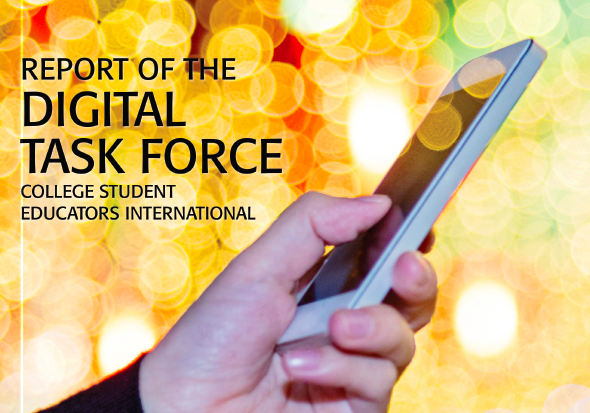
The association established #ACPAdigital to make recommendations on how student affair educators can best advance the application of digital technology in higher education, specifically through informed scholarship and practice. Being charged with reviewing how ACPA will be a leader in the field, this task force was divided into four working subgroups:

  • Proven Practices
  • Knowledge and Skills
  • Research and Scholarship
  • Informed and Responsible Engagement with Social Technology

While serving on the #ACPAdigital task force this year, I can personally say, the efforts made to evaluate and assess  and how current educators shape student development for digital learning has been impressive. As I review the 49-page report we are sharing with the ACPA leadership this week, I am looking forward to the conversations we will have about our findings, recommendations, questions and proposed research agenda. It is critical that student affairs and learner support entities in post-secondary education consider how technological advancements will impact the work we do with students in face-to-face, blended, and online learning environments. This groups needs to be at the table for discussions on distance education and workforce preparation considerations. I am excited to be part of the discussion and push to move in this direction with student affairs. To learn more about this report and #ACPAdigital’s work, be sure to review the task force website:  http://digitaltaskforce.myacpa.org/

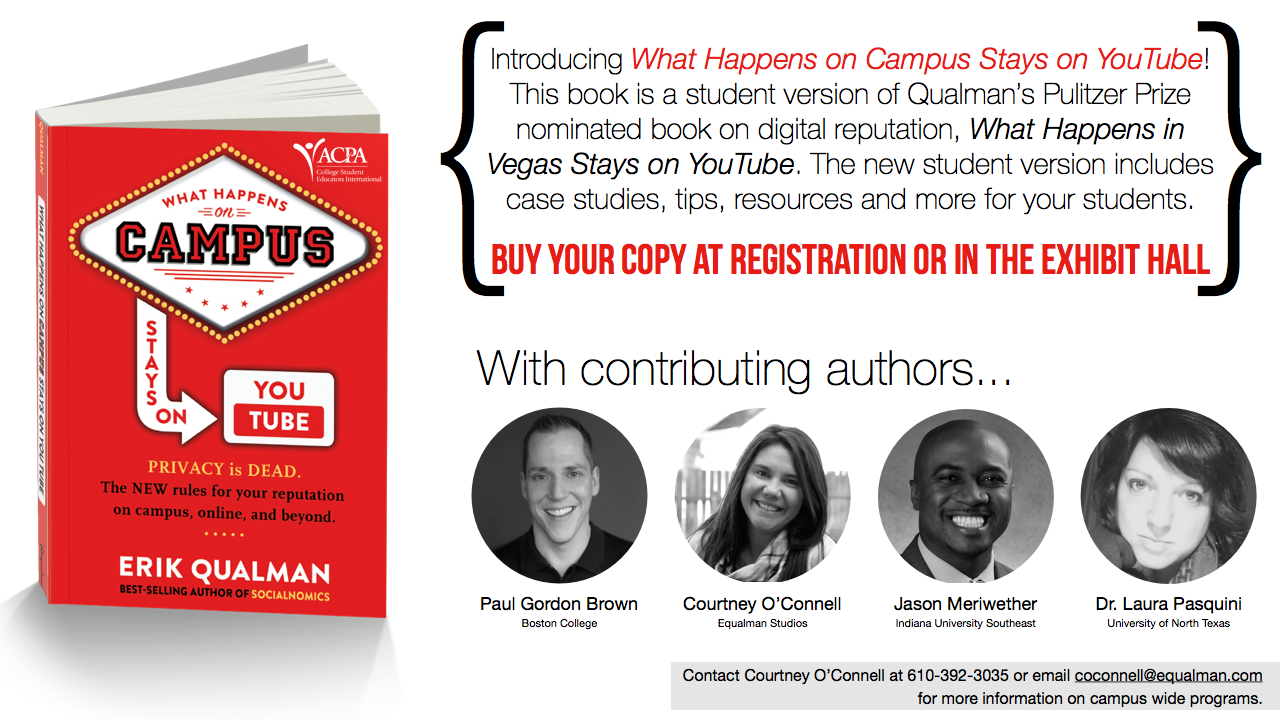
As a member of the Informed and Responsible Engagement with Social Technology (IREST) group, I was part of the collaborative author team who contributed to updating Erik Qualman’s What Happens in Vegas Goes on YouTube. The last few months of swapping ideas, sharing resources, discussing issues, and making edits with Paul, Jason, Courtney, and Erik has been great – and we’re so pleased that we are able to share our efforts this week at #ACPA15:

campus book launch ad.003

The ACPA co-branded book, What Happens on Campus Stays on YouTube, is designed to have your students reflect on their digital identity, with regards to their college experience and future personal/professional development. For #ACPA15, early release copies of book will be available for sale ($11.99) and the official launch on Amazon/public sale will be in April 2015. If you want to get a sneak peek of the book before everyone else, get your copy at the ACPA Booth in the Expo Hall or join our #SAreads event happening on Saturday (3/7) from 12:30-1:30 pm at the #ACPATrendingNow round tables in the Marketplace with Courtney and myself. If you are interested in bulk orders for your curriculum or campus, please be sure to reach out to Courtney O’Connell so she can discuss options best for your institutional needs.

Will you be found at the harbor front this week for #ACPA15? Let me know – I would love to have a chat and catch up. See you soon!