#AcWri, OpenAccess

SPARC Addendum & Author Rights for Publishing #OpenAccess

As part of the international open access week last fall, I attended the #SPARC Addendums and Author Rights Workshop facilitated by Kris Helge from the UNT Libraries. As an author and editor for a journal, this session reminded me about the critical stakeholders and expectations for the scholarly publishing process and the need to consider my own author agreements before signing away my work. I am fortunate enough to work and study at an institution who supports Open Access,and #OpenAccess publications.

I am also excited that other academic journals (e.g. JALN) are joining the #OA movement; however there are a number of peer-reviewed, academic publications who hold traditional publisher agreements and copyright limitations close to their heart. If you are an academic, scholarly author, or early career researcher and you have NOT heard about SPARC … then this blog post is for you!

mainheader

After a brief review of copyrights and “traditional publishing agreements,” the workshop reminded me about of the importance of reading author agreements CAREFULLY and THOROUGHLY. A number of authors and early career researchers are just excited to get the chance to publish, that they rarely considering they are agreeing to transfer ALL OF THEIR COPYRIGHTS TO THE PUBLISHER. As researchers, we need to value our intellectual property and have a conversation with the publisher and inquire if any of the publishing agreement is negotiable.

Cue the SPARC Addendum

SPARC. or the Scholarly Publishing and Academic Resources Coalition, advocates for collaboration among authors, publishers, and libraries to correct imbalances found in the academic publishing system.

For a more balanced approach for author and publisher agreements you might want to consider the SPARC Addendum. This is a FREE, legal document that modifies the publisher’s agreement and allows authors to keep specific copyrights related to intellectual property (e.g. articles).  The author is able to retain their desired publishing rights with limited restrictions, and the publisher retains non-exclusive rights to publish and distribute your work. Overall, it allows authors to consider the access of their research, placement of writing into an electronic repository, and get the proper attribution when your work is utilized.

Want to know more about SPARC and #OpenAccess publishing resources? Check them out :


Reference:

Helge, K. (2012, October 24). SPARC Addendums and Author Rights Workshop. 2012 International Open Access Week @ UNT.

#phdchat, Learning Technologies

CFP: Emerging Technologies for Online Learning Conference #et4online

The 6th Annual International Symposium for Emerging Technologies for Online Learning (#et4online) from April 9-11, 2013 (Planet Hollywood Resort – Las Vegas, Nevada) wants YOU to submit a conference proposal. Proposals are DUE by 11 pm CDT on December 10, 2012

The Emerging Technologies for Online Learning International Symposium, a joint Symposium of Sloan Consortium and MERLOT, is designed to bring together individuals interested in the review and evaluation of emerging technologies’ impact on online teaching and learning.

The 2013 Emerging Technologies Symposium chairs know technology for learning is shifting quickly:

“New discoveries in technology happen rapidly and far too frequently. It is difficult to keep up with every new release or innovation.  Advances in technology often become the vehicle for new ways to learn or enhance learner opportunities in our classrooms. As educators we progress forward, gaze back, and aim to bring the best of old and new to create an optimal environment to our students. However daunting this mission is, we tackle the problems and learn best from those who are already building the bridges and taking on the tasks we want to try. The field is advanced by those who share, scrutinize, and study. We invite you to contribute to the progress by presenting and attending this year’s symposium and encouraging your colleagues to join our efforts.” 

The #et4online steering committee is interested in interactive sessions that engage and inform participants for the following areas:

  • Higher Education and K-12 Faculty
  • Future professors and graduate students
  • Educational technology leaders
  • Students
  • Instructional designers
  • Instructional technologists
  • Academic administrators

Sessions can be targeted to all attendees and or specified (novice, intermediate, or expert) levels of proficiency. The committee would like to see a wide range of involvement from various presenters/facilitators – this includes proposed sessions from graduate students TOO!

The #et4online symposium will accept presentations that offer attendees “real solutions,” pioneering practices, and future trends, specifically submissions which emphasize evidence-based practice and the impact of topic tracks on teaching practices and student learning outcomes using a range of research methodologies (e.g. case study, longitudinal comparisons, within group comparisons, quasi-experimental, etc.) and rigorous approaches to the analysis of supporting data, qualitative or quantitative. Here are the #et4online symposium tracks and research areas:

Here is the presenter FAQs and Webinar Recording from 11/29  to help you with your proposal submission: 5 Tips on How to Submit a Successful Conference Proposal

There will be a wide range of emerging technologies for online learning trends, talks, sharing, and more! What happens at #et4online in Vegas will NOT stay in Vegas. And that’s a good thing! Follow @et4online for more updates as well!

LPQ

Published: Learning and Performance Quarterly 1(3)

The third issue of the Learning and Performance Quarterly (LPQ) speaks to the area of facilitation, teams and mobile support systems. This issue discusses theoretical building blocks for researchers that have a renewed interest in teams and their support. The reemergence of this area of study is important as we move further into the age of social media, personal learning networks and global information exchange. Thank you to our authors, editors, and peer reviewers for their contributions to the Learning and Performance Quarterly, Volume 1, Issue 3.

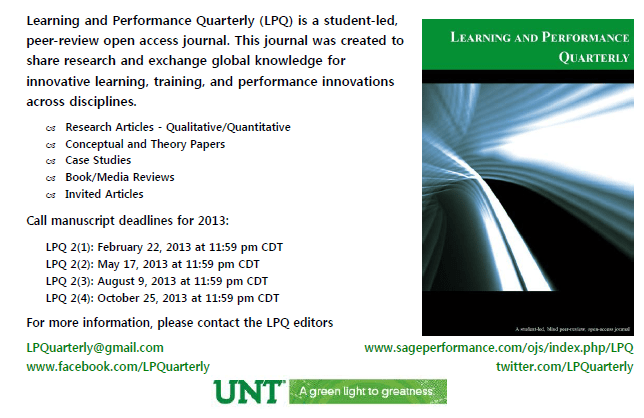
The Learning and Performance Quarterly (LPQ) is an online, open access peer-review journal designed to make research available to the public and to support a greater exchange of global knowledge. The call for submissions for 2013 is now open – here are the deadlines for manuscripts for Volume 2:

Submission can be made online through the LP Quarterly website. For detailed submission guidelines and instructions on how to make a submission please visit Author Guidelines.

Happy reading,

Laura A. Pasquini & Dr. Jeff Allen, Founding Editors
Learning and Performance Quarterly
Like us on Facebook
Follow us on Twitter @LPQuarterly
Email: LPquarterly@gmail.com

#phdchat, ATPI, PhD, Professional Development, Reflections

ATPI Doctoral Portfolio Reflection

This weekend will involve the usual researching, writing, and editing of projects – however I have one more item to polish up before it’s time to be thankful in the U.S. – my doctoral portfolio.

For the Applied Technology & Performance Improvement Doctorate (ATPI) program, the doctoral portfolio is a new requirement for us young, budding scholars. Rather than sit in a room for two 8-hour days or respond to a set of questions over a period of time, ATPI doctoral students will need to complete our departments Ph.D. portfolio to officially become a Doctoral Candidate and move forward with dissertation work. Some students in our program are still opting to take the comprehensive exam route while they still can, only because the requirements include research, teaching, and service scholarship experience that is akin with academics who might be seeking tenure/promotion. I think that this portfolio makes sense, professionally it helps to document my PhD Journey and encourages students to gain scholarship experience before being launched into a dissertation or even the academic job search.

Here are the ATPI Doctoral Portfolio Requirements [DRAFT] that I have been using to guide my portfolio development. {I say draft as this document is subject to change since our department will have myself and another student defend in December for the 1st time.}

I promise to share my ATPI doctoral portfolio, after I review it and put the finishes touches on it. I learned a great deal from our “dry-run” on Friday, and I was reminded about some of the key things to highlight in my 15-minute presentation. I am also pleased to say that I will be sharing my digital PhD journey (blogging, tweeting, and then some) with my doctoral committee for my portfolio defense. My faculty advisor and another committee member thought it would be valuable to discuss my philosophy and experience as an open educator/scholar/researcher.

In thinking about how to “show case” some of this, I am looking through my blog for musings and what I have been up to over the last 3 years of my doctoral course work. So far my TechKNOW Tools Wordle reflects this:

TechKNOW Tools Blog Wordle

I also know that my digital footprint can be found in my Google Docs (or now Drive), YouTube channel, Dropbox, shared on my SlideShare account, posted on my Flickr account in photos, and even among my 23, 926 tweets (good thing I auto-send these into Delicious with hashtags for easy searching). Time to mine my own digital data, review what I’ve created, and compile my professional development and scholarship.

Grad Students & PhD Friends: How do you track your progress? Professional development? Teaching, service, and research scholarship? Please share!

MGMT 6860, Reflections

Considering the Impact of Work Design

Work Design is the “study, creation, and modification of the composition, content, structure, and environment within which jobs and roles are enacted… concerns who is doing the work, what is done at work, and the interrelationship of the different work elements, and the interplay of job and role enactment with the broader task, social, physical, and organizational context” (Morgeson & Humphrey, 2008, p. 47).

In thinking about the world of work – how often do you consider the design or composition of your work? Jobs are typically organized in similar positions with regards to work tasks performed or a set of activities to serve the organization. In thinking about job design, Morgeson and Humphrey (2008) identify this as the “content and structure of jobs that employees perform.” Those who research job design tend to review the tasks and activities performed on a regular basis, and also consider the team design and role requirements within teams.

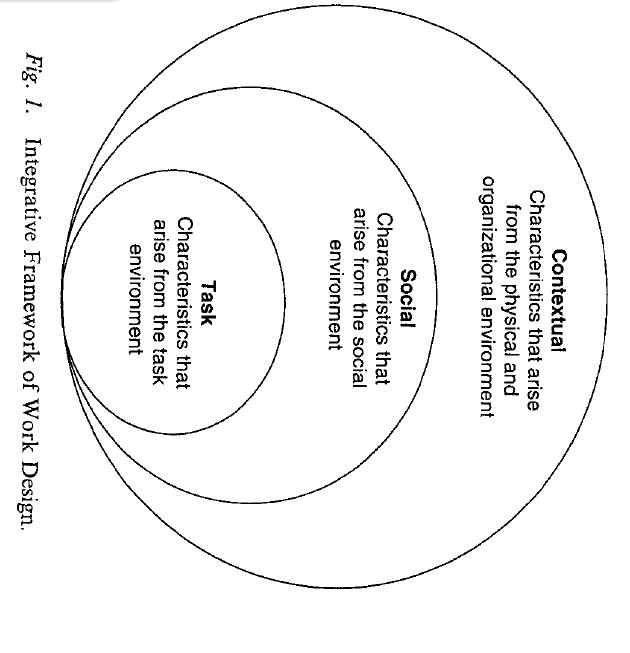
Since a number of jobs are combined and collaborative, it might be more helpful to consider an Integrative Model of Work Design. Morgeson and Humphrey’s (2008) model will identify various work and worker characteristics – specifically those work attributes that includes task, social, and contextual sources.

1) Task Characteristics: autonomy, worker control, skill variety, task identity, task significance, feedback from the job, task variety, job complexity, information processes, specialization, problem solving. Worker characteristics include job knowledge, technical skills, self-management, cognitive ability, task experience, proactive personality, and needs for achievement

2) Social Characteristics: social support, feedback form others, interdependence,, interaction outside the organization, team experience, need for affiliation, and hardy personalities

3) Contextual Characteristics: physical demands, work conditions, ergonomics, equipment use, boundary spanning (interaction within the organization but outside one’s department/team), organizational support, workspace, virtuality of work (communication), consequence of facility, physical ability, propensity to trust, organizational experience

Future research considerations for work design could include:

  •  key theoretical perspectives on fit is the needs-supplies/demands-abilities duality
  • gravitational hypothesis: workers “gravitate” towards and stay in jobs that they are both capable of performing and fit with their individual differences
  • conceptualizing individual attributes at the team level takes an additive approach – studying team vs. individual composition models
  • role vs. team composition approach: how role holder characteristics impact performance rather than putting the focus only on individuals
  • understand the impact that learning  and knowledge-based organizations should consider for work design
  • influence of the following attributes: self-regulation, social-facilitation, workload sharing, convergence, etc
  • impact for informal work redesigns – job crafting – that emerges out of work experience and organizational change
Reference: 

Morgeson, F.P. & Humphrey, S.E. (2008). Job and team design: Toward a more integrative conceptualization of work design. In J. Martocchio (Ed.). Research in Personnel and Human Resource Management (Vol. 27, pp. 39-91). United Kingdom: Emerald Group Publishing.