G*STEP

Using Verbs for Specific Learning Outcomes

Verb Wheel

Student learning outcomes is a very common term in education. For many of my k-12 colleagues we have used this term from graduate course work, to teaching practicum, and for curriculum planning. The challenge in writing student learning outcomes happens when you have to find actionable items and SPECIFIC methods for learning assessment.

Last week I attended “Writing student learning outcomes and the GSTEP teaching template:  How they inform your teachingfor the G*STEP program presented by Shana Cole & Nancy Fire from CLEAR.

We talked about components of a teaching strategy, which included:

A. Context for your teaching strategy
B. Selecting learning challenges to address with your teaching strategy
C. Objectives for this experience
D. Foundational knowledge necessary for students to participate in teaching strategy
E. Step by step planning
F. Ground rules (if needed for you strategy)
G. Assessment: How do you plan to assess the effectiveness of your learning strategy?
H. Anticipated Challenges: Indicate how you plan to deal with any of these challenges that may apply. Describe.
I. Journal Reflection

The three level model for student learning outcome development, which included the following levels:

  1. Goal
  2. General Learning Outcomes (GLOs)
  3. Specific Learning Outcomes (SLOs)

The last step – Specific Learning Outcomes (SLOs) – is where we focused our attention. Specific learning outcomes are highly measurable and possess detailed requirements. As an instructional designer who is often involved in program evaluation or course design, I appreciated the cross-disciplinary conversations on how to meet various subject matter content issues with the needs of the learner. A helpful resource to keep us on the same page and to guide our SLOs discussion was the Bloom’s Taxonomy verb wheel. This was a practical tool that helped to focus our planning and here were some of the key points I gleaned from the overall workshop:

  • be clear, specific & measurable
  • identify what the students should be able to do as a result of a learning experience
  • display evidence that learning has occurred at a specified competency level
  • focus shifts from what “I will teach” to “what students will learn”
  • define content, expectations, assessments & creates constructive data i.e. data, percentage, and understanding of student learning

For student learning outcomes to work they have to connect to the learning. A great way to assess your expectations of your SLOs is to share these with other educators,  both inside and outside your discipline or subject matter expertise. Student learning outcomes need to be written at a general level to ensure clear communication, and limit subjective language. By using SLOs you are able to modify course objectives, assess curriculum design, and measure how your instruction impacts learners. By creating 3-7 overall goals in your course, you will want to consider at least 3-5 specific learning outcomes to measure each goal. These goals will help address your teaching strategy and how you assess your learner’s progress.

How do your specific learning outcomes (SLOs) fit into your entire course planning and content delivery?


#phdchat, Learning Technologies

CFP: Emerging Technologies for Online Learning Conference #et4online

The 6th Annual International Symposium for Emerging Technologies for Online Learning (#et4online) from April 9-11, 2013 (Planet Hollywood Resort – Las Vegas, Nevada) wants YOU to submit a conference proposal. Proposals are DUE by 11 pm CDT on December 10, 2012

The Emerging Technologies for Online Learning International Symposium, a joint Symposium of Sloan Consortium and MERLOT, is designed to bring together individuals interested in the review and evaluation of emerging technologies’ impact on online teaching and learning.

The 2013 Emerging Technologies Symposium chairs know technology for learning is shifting quickly:

“New discoveries in technology happen rapidly and far too frequently. It is difficult to keep up with every new release or innovation.  Advances in technology often become the vehicle for new ways to learn or enhance learner opportunities in our classrooms. As educators we progress forward, gaze back, and aim to bring the best of old and new to create an optimal environment to our students. However daunting this mission is, we tackle the problems and learn best from those who are already building the bridges and taking on the tasks we want to try. The field is advanced by those who share, scrutinize, and study. We invite you to contribute to the progress by presenting and attending this year’s symposium and encouraging your colleagues to join our efforts.” 

The #et4online steering committee is interested in interactive sessions that engage and inform participants for the following areas:

  • Higher Education and K-12 Faculty
  • Future professors and graduate students
  • Educational technology leaders
  • Students
  • Instructional designers
  • Instructional technologists
  • Academic administrators

Sessions can be targeted to all attendees and or specified (novice, intermediate, or expert) levels of proficiency. The committee would like to see a wide range of involvement from various presenters/facilitators – this includes proposed sessions from graduate students TOO!

The #et4online symposium will accept presentations that offer attendees “real solutions,” pioneering practices, and future trends, specifically submissions which emphasize evidence-based practice and the impact of topic tracks on teaching practices and student learning outcomes using a range of research methodologies (e.g. case study, longitudinal comparisons, within group comparisons, quasi-experimental, etc.) and rigorous approaches to the analysis of supporting data, qualitative or quantitative. Here are the #et4online symposium tracks and research areas:

Here is the presenter FAQs and Webinar Recording from 11/29  to help you with your proposal submission: 5 Tips on How to Submit a Successful Conference Proposal

There will be a wide range of emerging technologies for online learning trends, talks, sharing, and more! What happens at #et4online in Vegas will NOT stay in Vegas. And that’s a good thing! Follow @et4online for more updates as well!

Social Media, StudentAffairs

Guiding #SocialMedia in Our Institutions [SURVEY]

Many of you might know I am interested in researching, working, teaching and socializing with social media in higher education — so it is only fitting that I want to assess HOW social media is being used within organizations. Dr. Tanya Joosten (@tjoosten) and I are collaborating to research this topic further; however WE NEED YOUR INPUT.  Please share your insights/experiences for Guidance for Social Media at your Institution [SURVEY] before Sunday, October 28, 2012 12 am PST

COMPLETE THE SURVEY HERE => Guiding social media in our institutions

Study Focus:

To better understanding what our institutions need to consider in guiding social media use, specifically around the questions which address student support, teaching, training and development, research, policy, infrastructure, and more. Please consider contributing to this study to help advance social media use and development at our institutions – AND both Tanya and I would greatly appreciate YOUR input. Thanks!

Study Description:  The purpose of this research study is to examine institutional support for the implementation for social media. Approximately 200 subjects will participate in this study.  If you agree to participate, you will be asked to complete a survey that will take approximately 30 minutes to complete.  The questions will ask you for your opinion on institutional support for the use of social media.

Risks / Benefits:  Risks to participants are considered minimal.  There will be no costs for participating, nor will you benefit from participating other than to further research. 

Confidentiality:  Your responses are completely confidential and no individual participant will ever be identified with his/her answers.  Data from this study will be saved on a password-protected computer for one year.  Only Primary Investigators and UWM Learning Technology Center staff will have access to the information.

Voluntary Participation:  Your participation in this study is voluntary.  You may choose to not answer any of the questions or withdraw from this study at any time without penalty.  Your decision will not change any present or future relationship with the University of Wisconsin Milwaukee.

Who do I contact for questions about the study:  For more information about the study or study procedures, contact Tanya Joosten at tjoosten@uwm.edu.

A few tips and more information about the survey:

  • Please answer any of the questions for which you have an answer.
  • If there are questions you cannot answer,  please skip those questions.
  • Due to the broad and general nature of the survey, we understand that there may only be a limited number of questions each respondent can answer.
  • This survey structure has a number of open-ended questions that require a response, URL link, or ideas about social media at your institution.
  • When possible, please forward the survey to others in your institution AND outside your institution that may be able to answer these questions.
LPQ

CFP: The @LPQuarterly Volume 1, Issue 4 EXTENDED: DUE November 5, 2012

The Learning and Performance Quarterly (LPQ) is an online, open access peer-review journal designed to make research available to the public and to support a greater exchange of global knowledge. We have recently been invited to publish in the EBSCO research database, and our publication is growing both in author contributions and readership. Articles in support of innovative learning and performance across disciplines from developing and proven scholars are welcome for the last call for 2012 – here is the more information about the call for manuscripts.

CALL FOR SUBMISSIONS:
Learning and Performance Quarterly, Volume 1, Issue 4

The Learning and Performance Quarterly (LPQ) is currently accepting submissions for the second issue. Deadline for submissions is Friday, October 26 at 5 pm CDT. DEADLINE EXTENDED to Monday, November 5, 2012 at 11:59 CDT. Submission of manuscripts can be made online through the LP Quarterly website. For detailed submission guidelines and instructions on how to make a submission please visit Author Guidelines.


TYPES OF MANUSCRIPTS ACCEPTED
Research Articles :
Papers that are concerned with the various approaches to learning and performance impact. These papers should discuss the literature related to the approach employed and include a measure of the learning and performance impact of the approach employed.

Case Studies:
Case studies that highlight a particular learning, training, performance or instructional setting in which learning and performance resources were used to address a particular challenge. They present a discussion of the challenge from current literature, what was done to solve or explore it, and the results of the project. They often offer suggestions for others interested in addressing similar challenges.

Concept/Theory Papers:
Papers that present new concepts or contribute to existing theory for learning and performance. This should offer a discussion of the literature related to the concept/theory along with a discussion of the major issues for future research needed to validate the concept/theory.

Book Reviews:
Book reviews of publications 2011 or later will be accepted to highlight a issues and resources relevant for learning and performance and offer a suggested solution or direction. The position is supported with both a logical argument and a review of the pertinent literature. Preference will be given in the review process to book review essays that comment on two or more related books.  Book review essays should not exceed 3,800 words and should include city, state, publisher, and year of the book’s publication.  An abstract of 150 words or less and keywords are required for book review essays.  Reviews of single books should not exceed 1,900 words.  At the beginning of the text please include title, author, publisher, city, date, and page numbers of the book(s) under review.

CALL FOR LEARNING AND PERFORMANCE QUARTERLY REVIEWERS
Interested in reviewing articles for the LPQ Journal? The LPQ journal is looking for reviewers to conduct peer reviews and evaluations of submissions.
Please identify your reviewing interests, substantive areas of expertise, and preferred research methods when completing the LPQ journal registration online.

We look forward to receiving your submissions. Please pass this post onto other colleagues and researchers who might be interested in publishing, reviewing or editing for the Learning and Performance Quarterly journal.

Thank you,

Laura Pasquini & Dr. Jeff Allen, Founding Editors
Learning and Performance Quarterly
Like us on Facebook
Follow us on Twitter @LPQuarterly
Email: LPquarterly@gmail.com

Book Review, Higher Education, K-12, Open Education, PLN

10 Principles for the Future of Learning

While working on some late night treadmill mileage, I decided to catch up on documents and books I have been collecting on my Kindle. Last week I read The Future of Learning Institutions in a Digital Age, which was a precursor to The Future of Thinking: Learning Institutions in a Digital Age book published by the John D. and Catherine T. MacArthur Foundation. Although this material is a bit dated, I think that some of the pedagogy still applies for educational development.

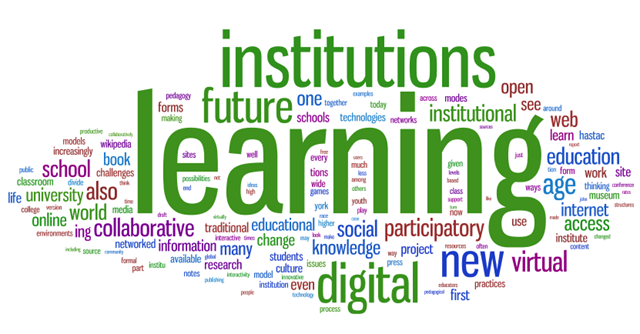
Image c/o Martin Hawksey (and his musings on this text as well). 

In the first collaborative project, the authors share ten principles to support the future of learning. Davidson and Goldberg (2009) presented these pillars of institutional pedagogy to help institutions rethink learning and meet the challenges that lie ahead for both K-12 and higher education:

  1. Self-Learning – discovering and exploring online possibilities
  2. Horizontal Structures – how learning institutions enable learning; from learning that to learning how; from content to process
  3. From Presumed Authority to Collective Credibility – shifting issues of authority to issues of credibility; understand how to make wise choices
  4. A De-Centered Pedagogy – adopt a more inductive, collective learning that takes advantage of our era and digital resources
  5. Networked Learning – socially networked collaborative learning stressing cooperation, interactivity, mutuality and social engagement
  6. Open Source Education – seeks to share openly and freely in the creation of culture and learning; provides a more collective model of interchange
  7. Learning as Connectivity and Interactivity – digital connection and interaction to produce sustainable, scaffolding ensembles
  8. Lifelong Learning – there is no finality to learning; learning is part of society and culture
  9. Learning Institutions as Mobilizing Networks – networks enable flexibility, interactivity, and outcome; new institutional organizations reliability and innovation
  10. Flexible Scalability and Simulation – new technologies allow for collaboration beyond distance or scale for productive interactions that warrant educational merit

Reference: Davidson, C.N. & Goldberg, D.T. (2009). The future of learning institutions in a digital age. Cambridge, MA: The MIT Press.