BreakDrink, CTCX, Social Media, StudentAffairs

#CTCX No. 71: Tech News, Reddit & Updates

On Monday (10/22/12), the @BreakDrink Campus Tech Connection (#CTCX) discussed the latest technology gadget announcements, privacy on the Interwebz and challenges with Reddit, and diving into social media guidance in an upcoming assessment. Here is the video podcast:

And here are the show notes via Storify for your reading and linkage pleasure.

For those of you interested in giving your #SocialMedia Guidance in Education — please take some time to provide myself and Dr. Tanya Joosten (a.k.a. @tjoosten) feedback and information about “Guiding social media at YOUR institution” in a current survey: https://milwaukee.qualtrics.com/SE/?SID=SV_9HmS8C37kqKWyOh This SURVEY will take about 30 minutes to complete, and will close by Sunday, October 28, 2012 at midnight PST. Thanks!

This blog post is cross-posted at BreakDrink.com

BreakDrink, CTCX

The @BreakDrink Campus Tech Connection #CTCX No. 70: Ginkgotree

There are a number of conversations about challenges, changes and disruptions to higher education. Recently, Ginkgotree, the “Tumbler for textbooks,” got me thinking more about my curriculum content and sharing for my courses.
Teaching with a course pack just got a whole lot simpler with the new Ginkgotree app. http://www.ginkgotree.com/
Ginkgotree launched last week to allow instructors the ability to customize and develop their learning material using a wide variety of multimedia and curriculum content. On Monday’s (10/8/12) BreakDrink Campus Tech Connection (#CTCX) show, we were able to get a LIVE show and tell to preview the new instructional resource from Scott Hasbrouck (@scotthasbrouck), Ginkgotree CEO & “Everything Hacker.”
Here are a few of the interesting features that might appeal to educators in higher education (and possibly K-12 as well):
1. Teaching from your own curriculum – instructors have the ability and control of designing their own course curriculum that meets the needs of their learning objectives and materials. Through an easy licensing service provided by Ginkgotree, instructors have the ability to use content from all over the web including journal articles, YouTube videos, images, and other content on the web. One this course pack is developed, instructors have the ability to share a private link to students to start the learning.
2. Do you have an aged textbook to add?  Ginkgotree allows you to utilize some of your favorite text material, even the ones that have been highlighted, annotated and difficult to retrieve in the past by using high quality scanners to digitize your print text and share legally with learners.
3. Give your students the best opportunities to learn – Remember when you wondered if your students even bought or even opened the textbook for your course? SOON instructors will be able to track learner progress and engagement through course pack analytics. Ginkgotree also has the ability to offer public and private notes, ask questions, and tag your content with keywords to make it easier for both the instructor and student to navigate.
4. Reduce the cost for your learners – Students pay a flat rate of $10/month for unlimited courses, plus any applicable copyright fees (usually 15 cents per page) for their books. Rather than spending $250 per textbook, average costs of textbooks range from $45-55. For instructors it is “Free. Always. Forever.”
I think Ginkgotree has an interesting model and can definitely contribute to the evolution of higher education and learning as we know it. Perhaps it is time to consider how we compile and share learning content with our students. Go on. Sign up. Play around with it yourself. Let me know what you think.
LPQ

CFP: The @LPQuarterly Volume 1, Issue 4 EXTENDED: DUE November 5, 2012

The Learning and Performance Quarterly (LPQ) is an online, open access peer-review journal designed to make research available to the public and to support a greater exchange of global knowledge. We have recently been invited to publish in the EBSCO research database, and our publication is growing both in author contributions and readership. Articles in support of innovative learning and performance across disciplines from developing and proven scholars are welcome for the last call for 2012 – here is the more information about the call for manuscripts.

CALL FOR SUBMISSIONS:
Learning and Performance Quarterly, Volume 1, Issue 4

The Learning and Performance Quarterly (LPQ) is currently accepting submissions for the second issue. Deadline for submissions is Friday, October 26 at 5 pm CDT. DEADLINE EXTENDED to Monday, November 5, 2012 at 11:59 CDT. Submission of manuscripts can be made online through the LP Quarterly website. For detailed submission guidelines and instructions on how to make a submission please visit Author Guidelines.


TYPES OF MANUSCRIPTS ACCEPTED
Research Articles :
Papers that are concerned with the various approaches to learning and performance impact. These papers should discuss the literature related to the approach employed and include a measure of the learning and performance impact of the approach employed.

Case Studies:
Case studies that highlight a particular learning, training, performance or instructional setting in which learning and performance resources were used to address a particular challenge. They present a discussion of the challenge from current literature, what was done to solve or explore it, and the results of the project. They often offer suggestions for others interested in addressing similar challenges.

Concept/Theory Papers:
Papers that present new concepts or contribute to existing theory for learning and performance. This should offer a discussion of the literature related to the concept/theory along with a discussion of the major issues for future research needed to validate the concept/theory.

Book Reviews:
Book reviews of publications 2011 or later will be accepted to highlight a issues and resources relevant for learning and performance and offer a suggested solution or direction. The position is supported with both a logical argument and a review of the pertinent literature. Preference will be given in the review process to book review essays that comment on two or more related books.  Book review essays should not exceed 3,800 words and should include city, state, publisher, and year of the book’s publication.  An abstract of 150 words or less and keywords are required for book review essays.  Reviews of single books should not exceed 1,900 words.  At the beginning of the text please include title, author, publisher, city, date, and page numbers of the book(s) under review.

CALL FOR LEARNING AND PERFORMANCE QUARTERLY REVIEWERS
Interested in reviewing articles for the LPQ Journal? The LPQ journal is looking for reviewers to conduct peer reviews and evaluations of submissions.
Please identify your reviewing interests, substantive areas of expertise, and preferred research methods when completing the LPQ journal registration online.

We look forward to receiving your submissions. Please pass this post onto other colleagues and researchers who might be interested in publishing, reviewing or editing for the Learning and Performance Quarterly journal.

Thank you,

Laura Pasquini & Dr. Jeff Allen, Founding Editors
Learning and Performance Quarterly
Like us on Facebook
Follow us on Twitter @LPQuarterly
Email: LPquarterly@gmail.com

Book Review, Higher Education, K-12, Open Education, PLN

10 Principles for the Future of Learning

While working on some late night treadmill mileage, I decided to catch up on documents and books I have been collecting on my Kindle. Last week I read The Future of Learning Institutions in a Digital Age, which was a precursor to The Future of Thinking: Learning Institutions in a Digital Age book published by the John D. and Catherine T. MacArthur Foundation. Although this material is a bit dated, I think that some of the pedagogy still applies for educational development.

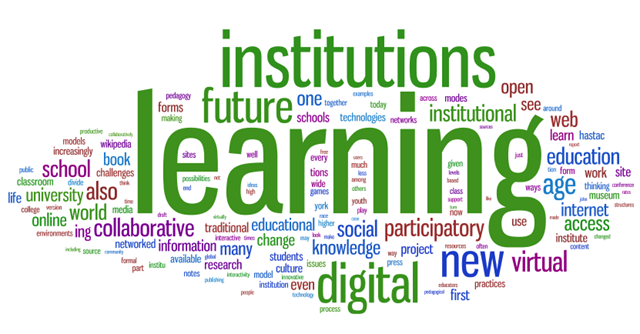
Image c/o Martin Hawksey (and his musings on this text as well). 

In the first collaborative project, the authors share ten principles to support the future of learning. Davidson and Goldberg (2009) presented these pillars of institutional pedagogy to help institutions rethink learning and meet the challenges that lie ahead for both K-12 and higher education:

  1. Self-Learning – discovering and exploring online possibilities
  2. Horizontal Structures – how learning institutions enable learning; from learning that to learning how; from content to process
  3. From Presumed Authority to Collective Credibility – shifting issues of authority to issues of credibility; understand how to make wise choices
  4. A De-Centered Pedagogy – adopt a more inductive, collective learning that takes advantage of our era and digital resources
  5. Networked Learning – socially networked collaborative learning stressing cooperation, interactivity, mutuality and social engagement
  6. Open Source Education – seeks to share openly and freely in the creation of culture and learning; provides a more collective model of interchange
  7. Learning as Connectivity and Interactivity – digital connection and interaction to produce sustainable, scaffolding ensembles
  8. Lifelong Learning – there is no finality to learning; learning is part of society and culture
  9. Learning Institutions as Mobilizing Networks – networks enable flexibility, interactivity, and outcome; new institutional organizations reliability and innovation
  10. Flexible Scalability and Simulation – new technologies allow for collaboration beyond distance or scale for productive interactions that warrant educational merit

Reference: Davidson, C.N. & Goldberg, D.T. (2009). The future of learning institutions in a digital age. Cambridge, MA: The MIT Press.

PhD, Virtual Communities

Actor-Network Theory in Education

Give Me Some Theory... #LitReview

Actor-Network Theory has recently been referred to by Law (2007, p. 595) as  the ‘diaspora’ of

“tools sensibilities and methods of analysis that treat everything in the social and  natural worlds as a continuous generated effect of the webs of relations within which they are located. It assumes that nothing has reality or for outside the enactment of those relations.”

Further research in this theory helps scholars and researchers discover new approaches to a number of educational issues. In considering educational research, with regards to schools, universities/colleges, community agencies, corporate training organizations, and professional affiliations, ANT merges knowledge as situated, embodied and distributed.

Fenwick and Edward (2010) share how ANT challenges a number of assumptions that lie in educational conceptions of development, learning , agency, identity, knowledge and teaching. ANT identifies rich interconnections in both social and cognitive activity. As shared in the book, Neyland (2006, p. 45) has the ability to contribute to educational understanding of:

“mundane masses (the everyday and the humdrum that are frequently overlooked), assemblages (descriptions of things holding together), materiality (that which does or does not endure), heterogeneity (achieved diversity within assemblage), and flows/fluidity (movement without necessary stability).”

For those interested in reading the book in more detail, you will appreciate how Fenwick and Edward (2010) utilize ANT in education as a source of research practices, to consider:

  1. Concepts, approaches, and debates around ANT as a resource for educational research.
  2. Showcase studies in education that have employed ANT methods and comparing ANT approaches in other disciplines/fields.
  3. After ANT developments that challenges presumptions and limitations of ANT research.

Reference:

Fenwick, T. & Edwards, R. (2010). Actor-network theory in education. New York, NY: Routledge.

Law, J. (2007). Making a mess with method, in W. Outhwaite & S.P. Turner (Eds.). The Sage Handbook of Social Science Methodology, Beverly Hills, CA: Sage. pp. 595-606.

Neyland, D. (2006). Dismissed content and discontent: an analysis of the strategic aspects of actor-network theory, Science, Technology and Human Values, 31(1); 29-51.