Higher Education, MOOC

The State of #OnlineLearning in the US [REPORT]

The 11th annual survey and report of online learning in U.S. higher education was recently released:

Grade Change: Tracking Online Education in the United States”*

=> DOWNLOAD A FREE COPY HERE

Background: From previous studies and reports of online learning in the US, there is a strong belief that  online education is a critical component of post-secondary education institutions’ long-term strategy. In surveying a number of higher education entities, it is apparent that the development in online learning has shown a small but steady increases over the past decade. This report also teases out how PSE institutions are providing online education – blended, hybrid, and others as they experiment with different models of online learning pedagogy.

Screen Shot 2014-01-19 at 10.08.16 AM

The respondents from more than 2,800 post-secondary education institutions in the US, attempted to answer the following overarching questions about online learning in higher ed:

  • Is Online Learning Strategic?
  • Are Learning Outcomes in Online Comparable to Face-to-Face Learning?
  • How Many Students are Learning Online?
  • How are Massive Open Online Courses (MOOCs) faring?

Key findings and highlights from the report: 

  • Around 5.5 (NOT 7.1) million higher education students are taking at least 1 online course (Read more: HERE and HERE)
  • The % of academic leaders rating the learning outcomes in online education as the same or superior to those as in face-to-face instruction, grew from 57% in 2003 to 74% in 2013
  • The 6.1 % growth rate represents over 400,000 additional students taking at least 1 online course
  • The number of students taking at least 1 online course continued to grow at a rate far in excess of overall enrollments, but the rate was the lowest in a decade
  • 90% of academic leaders believe that it is likely or very likely that a majority of all higher education students will be taking at least one online course in 5 year’s time
  • Only 5 % of higher education institutions currently offer a MOOC, another 9.3 % report MOOCs are in the planning stages
  • Less than one-quarter of academic leaders believe that MOOCs represent a sustainable method for offering online courses

For more on the study design, survey administration, analysis,  and report production, check out The BABSON Survey Research Group: http://www.onlinelearningsurvey.com/

*The survey is designed, administered and analyzed by the BABSON Survey Research Group, with data collection conducted in partnership with the College Board, and is sponsored in part by Pearson and the Sloan Consortium

Update – 1/19/14 @ 6:45 pm:

It appears the BABSON survey numbers seem to be off from the IPEDS data for students who have completed online courses – 7.1 vs. 5.5 million. Thanks for the update, Kevin. Here’s a useful article to read.

#phdchat, Job Search, PhD

The Vitae: Brewing Academic Experience for Your CV

A key part of the academic application is the vita. Since I mentioned I’m on the job market, a number of peers have asked me, what does my curriculum vitae (CV) look like? My response – it depends. It depends on the type of position – academic or nonacademic – and the institution. For the most part, I have a standard CV that I tailor for my applications and will update as I review my  academic job search spreadsheet o’ fun this week.

Screen Shot 2013-11-26 at 10.56.41 PM

Besides the cover letter, the vitae is probably the most important document for your academic job search. The vitae provides a detailed, yet distinct, review of your academic experiences and background that is chronological, skill-based, and in a combination of formats.

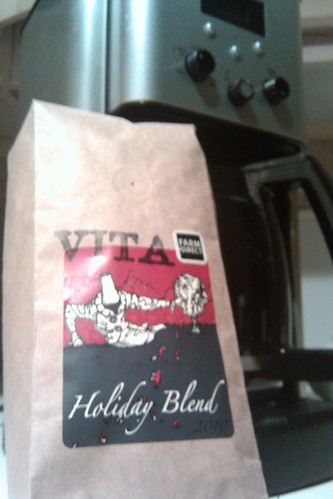
Viva Vita Java

The CV is a presentation of you on paper (for the most part) that highlights your expertise and development as a scholar. Although the organization resembles a resume, a vitae does not have length restrictions and it focuses on your academic experiences (you may want to include non-academic information if it strengthens your CV, and this information is relevant and specific for your discipline):

A typical CV includes:

  • Your Information (e-mail, address, mobile, website, etc.)
  • Education (undergraduate and graduate school)
  • Dissertation information & faculty advisor (title, expected graduation, if ABD)
  • Areas of research (or teaching) interest
  • Publications – peer-reviewed and relevant non academic publications
  • Grants, honors & awards
  • Teaching scholarship – link to teaching portfolio if applicable
  • Related work experience & positions (academic & non-academic; paid & unpaid)
  • Names of references (phone and email)

Format, style, and visual presentation of the CV is really up to you; however I recommend reviewing vitae examples, and getting other faculty or scholars in your discipline to review it. A few helpful tips on the curriculum vitae from Barnes (2007) includes:

  1. List your publications on the first page – show how you are already contributing to the literature in your discipline.
  2. Separate academic from nonacademic publications – distinguish between peer-reviewed articles, book reviews, & nonacademic publications.
  3. Separate publications from presentations – differentiate writing from teaching.
  4. Provide lists in chronological order – most recent first and move backward in time for easy reading & review.
  5. Include works in progress – identify if it is in review, accepted, and dates.
  6. Avoid filler – be confident and concise in your details.
  7. Include honors and grants immediately following publications – introduce most recent achievements & that you are able to acquire funding sources.
  8. Include related and nontraditional employment – consider the position and what experiences are relevant for your applications, perhaps you should industry, university administrative role(s) on your CV.
  9. Include postdoctoral experiences in the “education” section of the vita.
  10. Include service-related experiences – leadership role in a department, committee work or organized a conference helps to make you look like a more rounded candidate.

Format and style for your CV is a personal choice. You may wish to organize your CV differently for research-focused vs. teaching institutions vs. nonacademic roles vs. positions. There are a number vitae examples to review herehere, here, and here. I would also recommend looking at faculty profile pages for vita examples at the departments/institution you are applying to, and be sure to review CVs from scholars whose work you follow in your field. More often than not, CVs examples are posted online (pros & cons of this) and shared – as it also shares academic scholarship and experiences.

Ask your faculty advisor, current faculty, and respected researchers for advice. Many would be happy to support your academic search, and gladly review your CV — plus a few may want to have a copy of this document if they will serve as your reference. Get support with editing and fine tuning your vitae. Another set of eyes, and feedback from an outside perspective will help you improve your CV.  Good luck with your applications — I’m off to edit and update my own.

Reference:

Barnes, S. L. (2007). On the market: Strategies for a successful academic job search. Lynne Rienner Publishers.

BreakDrink, CTCX

Delicious Until the Last Sip… Goodbye @BreakDrink!

It’s been a while coming, but a couple of days ago Papa BreakDrink, Jeff Jackson, pulled the plug on BreakDrink.com. I am sad to see it go, but I am happy for what it was. This side project brought together a collaborative spirit of sharing and discussion around topics in Student Affairs and Higher Education, specifically “dedicated to providing alternative forms of professional development.” For the experiences, interactions, and laughs – I am fortunate to have had the pleasure. Thanks BreakDrink Family & Campus Tech Connection (#CTCX) listeners/friends.  [p.s. There are a number of our shows sitting in the archives should you want to take a listening walk down memory lane or check it out for the first time.]

Screen Shot 2013-11-20 at 11.56.53 PM

 Over the last few years a number of new (social media) spaces and places have appeared for Student and Academic Affairs professionals to flock to for trends, issues, news, learning, and connection. It might be my lack of interest in competing in the higher ed market place to be “the next big thing” online, or just a shift in personal and/or academic priorities – but it is time to say farewell to BreakDrink.com.
breakdrink_icon I would like to sincerely thank Jeff Jackson for instigating @BreakDrink, and inviting me via a Twitter DM to join the fun with Jeff Lail & then Bruce Mann. From thoughtful discussions, interesting debates, lively podcast interviews, snarky comments, new online training initiatives, mentoring relationships, and growing friendships – I say a fond goodbye to the BreakDrink family and friends. This community of practice has been a solid part of my informal/alternative professional development plan. From this beginning, I have continued to research and work in this area of higher education, and I am grateful to those who lit this spark.
I owe a great deal to many who are accomplices to the BreakDrink experience,  (see Jeff’s Pull the Plug Post) by contributing as podcasters, bloggers, creatives, brainstormers, and then some – I’m looking at you Julie Larsen. As we close this chapter of our lives, I am proud to say that I am leaving BreakDrink with some new tech skills, a broader understanding about things in the Student Affairs and Ed Tech realm, a new support professional network, and a few amazing people in my life. Here’s to our continued friendship, learning and sharing, BreakDrink Family! Until the next podcast or blog post… Laura Pasquini, for @BreakDrink #CTCX is signing off from BreakDrink.com! {Cue the closing music.}
Dissertation, PhD, Social Media

Your Higher Ed Website + Search: “Social Media Guidelines” or “Social Media Policy” = A Database for My Dissertation Research

Yes. I know that this may be my  LONGEST blog post title ever. I created it for one reason. It is the equation which will help me move my research forward for my dissertation.

featuredimages_socialmedia

You may recall a previous request for this from an earlier blog post: Gathering #SocialMedia Guidelines from #HigherEd. So, basically what I’m saying is…

I NEED YOUR HELP! => Submit Your Social Media Guidance Please!

My dissertation research methodology (good ol’ Chapter 3) will involve text mining analysis for reviewing all these many social media guidelines (policies, strategies, beliefs, regulations, etc. included) I am gathering right now. The caveat for this type of research is –  I need to build a large enough database of documents to examine and evaluate. BONUS: After collecting all of these documents, I will share this Social Media Guidance database AND my research findings for you here: http://socialmediaguidance.wordpress.com/

As of today (4:30 pm CT), I have collected approximately 176 Social Media Guidance documents from 13 different countries. Hoo-ray!

Check to see if your institution is listed below, and if it is not – please SEARCH YOUR COLLEGE OR UNIVERSITY WEBSITE to see if you might just happen to have social media guidelines, a policy, a directory, and/or anything that might be related to social media. Thank you!

#phdchat, Book Review, Higher Education, PhD

I’m “On the [Job] Market”: The Application Process

As academic job postings and other employment opportunities are becoming available, I decided it was time to prepare my own application materials and announce that I’m ON THE JOB MARKET. It should be no surprise to many as I am ABD (not a title), and I have been diligently working on my dissertation— so there is really no better time for a job search.

Well I was going to save this for holiday reading...but it looks like I'm On The Market NOW #phdchat I’ll be honest. I’m quite accustomed to the thrill of the job hunt (I am in my 3rd position of employment, since I have moved to Texas 5 years ago); however the academic job search has upped the ante. My future career planning involves a potential re-location (either in the US or abroad) and new career beginnings (either as a junior faculty member, research or other), which means this job search and application process is being treated like a job itself.

To prepare for my job search and career planning…

I have been talking to many researchers in the field, administrators in higher education, companies who seek my support, current faculty (off and on campus), mentors, and peers over the past year [Thank you for these discussions and talks – you know who you are]. More than not, many are quite open to offer advice, share professional experiences, edit my application materials, provide a reference, or send potential job postings my way (hint, hint). In my spare time, I have been reading Barnes’ (2007) “On the Market: Strategies for a Successful Academic Job Search,” specifically,  Chapter 4: The Application Process. This section of the book includes great questions to ask and think about before the application process, and examples of deciphering what academic job postings mean to decide what I want. Here are some current, pre-application questions I am currently pondering:

  • What type of position am I most interested in?
  • What sort of institution or organization do I want to work for?
  • Where do I want to live?
  • Do I want to apply for administrative or faculty track positions?
  • Who will write my reference letters?
  • Will my academic search focus on research or teaching institutions?
  • What is my best academic “fit” for department?
  • Do I want to look beyond higher education & academia?
  • Who will I connect to discussion the application process?
  • What is my timeline and schedule for applications?
  • How will I best organize a joint career search with my partner in crime?

Fortunately, most of my academic application requirements are “works in progress” from my doctoral program and portfolio requirements (Thanks #untLT department!) these past few years. My current objectives are to edit and prepare materials I have for my academic job search and application, including:

  1. Cover Letter
  2. Curriculum Vita
  3. Letters of Recommendation
  4. Writing Samples and Other Supporting Documents
  5. Teaching Portfolio (Dossier)
  6. Social Media Spaces & Places
  7. Application Schedule – to track applications & submissions

This chapter also includes helpful templates for CV’s and cover letter formats. I plan on re-tooling and modifying my current application materials based on position type and job description, so a review of these examples were helpful. Here are a few suggestions for cover letter writing items to include – 17 elements for the academic cover letter:

17 elements of the academic cover letter. #phdchat

Do you have academic job search advice? Tips on the application process? Considerations for the academic research and faculty positions? Potential openings I might be interested at your institution? Let me know. Academic job search advice is welcome.


Reference:

Barnes, S. L. (2007). On the market: Strategies for a successful academic job search. Lynne Rienner Publishers.