Conference, edusocmedia, Higher Education, Reflections, StudentAffairs

Have You Thought About Your Digital Self Lately?

While working on today’s workshop for the National Conference on Student Leadership (NCSL), I was listening to the recent Higher Ed Live broadcast with Ed & Josie talking “Engaging the Digital Generation” (an NDSS book they edited, and I contributed to — I promise to follow up on a blog post on this topic later). I was not surprised, but often wondered why student affairs (SA) and higher ed folks often go directly to technology:

//platform.twitter.com/widgets.js

Why do practitioners in higher education, student affairs, and students services always go to the “tool” question first? Why do we want to know what’s “hot” with the digital, social technologies? Is it easier to think about a specific app, device, or platform? Why don’t we ask about the challenges or issues the technology is solving?  A wise supervisor once told me: Study problems, not things. The “thing” I’m thinking about are technology tools and platforms.

I am more interested how our campus stakeholders engage and interact with social and digital tools. What is their motivation and how are these online networks being utilized? Perhaps we should challenge professionals in higher education to start thinking about their own presence. I think it’s a good idea to reflect on our own contributions and social traces we are leaving in digital spaces and places [Hence why Paul & I are are studying just that: https://networkedcommunityofpractice.wordpress.com/] .  I really like the Visitors & Residents Continuum (White & Le Cornu, 2011) concept, which is also shared by Dave White (and colleagues from OCLC & Jisc) via a few resources and videos. Visitors tend to leave no social traces in the digital world. If you are Resident you are visible, active, and leave a part of you online in many spaces and places. If you have not heard of this concept, here’s a quick overview of the mapping process for visitor and resident in a personal and institutional (professional) context:

I think more thought and reflection into HOW and WHY we use these online networks and digital apps are needed. Here’s a start of my own visualization of my visitor and resident spaces & places — more will be added this afternoon during my NCSL Professional Workshop:
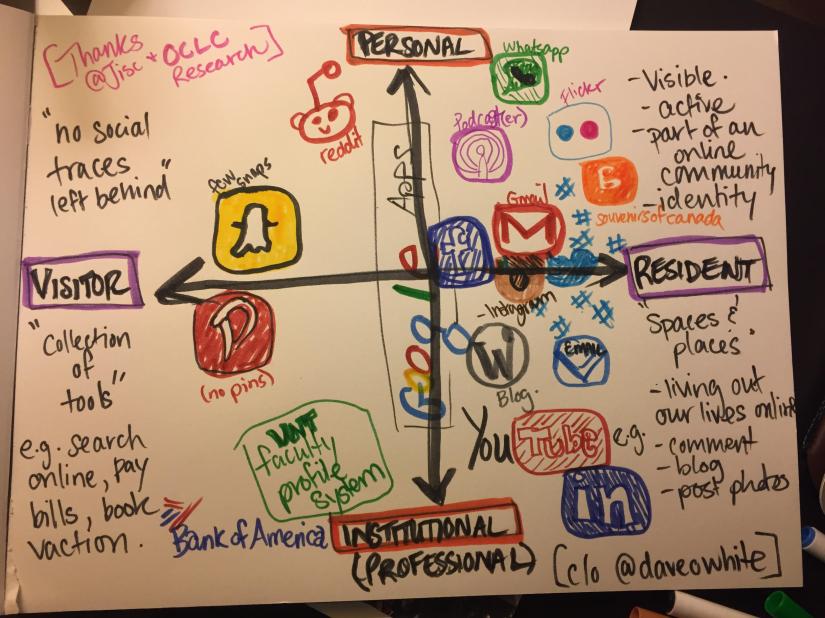
v_r_map_pasquiniHave you mapped your own V-R continuum lately? It’s an interesting process to think about and visualize. If so — please share and/or blog about it! To further this idea, what are the digital skills we need to hone within higher education? Here are a few suggestions organized on a metro map around digital skills:
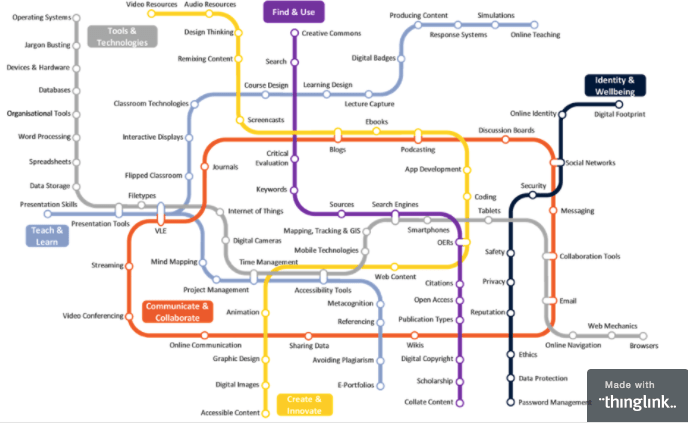
digitalskillsframework

//www.thinglink.com/card/707638257155833857

This digital skills framework map was a solid start, but it definitely needs to be added to – what are your thoughts on this topic? How are you engaging and interacting with these spaces and places? What do we need to learn and bring to campus when it comes to digital understandings of self? How are you thinking about your resident vs. visitor self online? Show and share!

Reference:

White, D. S., & Le Cornu, A. (2011). Visitors and Residents: A new typology for online engagement. First Monday, 16(9).

#3Wedu, Conference, wine, women, WomenWhoWine.edu

The #3Wedu Podcast No. 11: Women Advancing the Future of IT in Higher Ed

Every individual has a responsibility in an organization to enhance the understanding of the value of women leading, create structures to help women overcome gender barriers they may experience, and identify strategies to support women’s progress along their leadership path. Women bring heterogeneity that can benefit the workplace. To avoid groupthink and bring more diversity to our organizations, we need to consider putting more women into leadership roles to improve performance and productivity. Each of our higher education institutions has an organization culture that can empower or limit women’s ability to lead at various levels. These cultures consist of assumptions and values (see Schein’s model of organizational culture) that are sometimes decades old. Many times organizational structures have been developed by men and their actions potentially inhibiting women leading in various ways.

3wedu_no11_unl

The #3Wedu: Women Who Wine in Education will be trying a new format and location as we join host our podcast and keynote panel today (November 7th) from 3:25-4:55 at the University of Nebraska-Lincoln IT Leadership Conference. In an effort to share our panel discussion we hope to stream this session via YouTube LIVE and, of course, we will do our best to keep the Twitter backchannel banter going here: #3wedu.

Opportunity that Scales:

WOMEN ADVANCING THE FUTURE OF INFORMATION TECHNOLOGY  IN HIGHER EDUCATION

women_it_highered

Tune in LIVE between 3:25-4:55 pm CT as we will stream our keynote panel TODAY, November 7, 2016 here:

Through changing our behaviors, activities, communication, and environments, we can potentially alter the culture with these micro level modifications. Implementing practices to facilitate the growth of women leaders while creating an embracing culture that is pertinent for leadership development. Let’s talk about it. This isn’t a women’s issue; this is everyone’s issue.

A version of this blog post is cross-posted at The #3Wedu Podcast website.

AcAdv, ACPA, ACPAdigital, Blended Learning, Higher Education, Learning, Learning Technologies, Online Learning, Professional Development

Academic Support In A Digital Age

Although you might not advise or support students in an online degree program, there are increasing efforts for teaching and learning technology. Learning delivery and design does impact how we support our students, and we mediate much of our work in higher education using digital tools and platforms. That being said, any adoption of technology should be led with informed decisions on modifying pedagogical methods (Bates, 2015), which is directly related to our advising models and programs we offer in the post-secondary.

Our students want the same flexibility, access, and online support they often receive from instruction and other services they use. When learning with technology, our students are accustomed to having access to student support or other features alongside their online/blended coursework; however, the digital student success side is frequently an afterthought for these technology determinations. We need to have more student success and academic advising programs consider the best technology to provide advising content and service delivery (Steele, 2015) for a more learner-centered approach.

digital DNA

Digital DNA by Adriana Varella and Nilton Malz 

Whether you are leveraging technology to optimize your student support services or your campus is transitioning to either a blended or online learning model, there is both a need and desire to improve technology for academic advisors and student support practices in higher education (Pasquini & Steele, 2015). During your planning, it will be critical for your institution to ask the following questions before selecting technology-mediated environments for advising and learner support: 

  • What technologies is your institution currently utilizing for academic advising or student support?
  • How does your division or unit on campus decide on the most appropriate mode of technology delivery? [Will this be a campus-wide decision?]
  • What factors should be determined when designing technology in advising program and/or student support functional area?
  • What other strategies and structural support might benefit your campus in preparing  staff as they support learners digitally?  (e.g. training, skill development, etc.)

Join me as I discuss this further next Wednesday, September 14th from 12-1 pm EDT for the ACPA Commission for Academic Support in Higher Education (CASHE) Presents Webinar: “Selecting Technology for Advising and Supporting Your Students.” During this online event, I will be sharing a few evidence-based ideas and practical resources to help your advising team address these questions. This webinar will introduce your campus planning group to a few strategies and structures as they select technology for advising and student support. Sign up for this FREE webinar sponsored by ACPA CASHE here: http://goo.gl/tR8THa 

References

Bates, A. W., (2015). Chapter 9: Modes of delivery. In Guidelines for designing teaching and learning for a digital age. Open Text BC.

Pasquini, L. A., & Steele, G. (2016). Technology in academic advising: Perceptions and practices in higher education. figshare. Retrieved from https://dx.doi.org/10.6084/m9.figshare.3053569.v7

Steele, G. (2015). Using Technology for Intentional Student Evaluation and Program AssessmentNACADA Clearinghouse of Academic Advising Resources. 

#3Wedu, Podcast

The #3Wedu Podcast No. 8: Happy #HigherEd New Year!

Today is the last day of August. With this and labor day weekend just ahead, it really feels like the end of summer. Now it’s back to school time! I would say summer flew by — but really, that would be a lie. I think I made the most of the summer to work on research projects, write a manuscript or two with the fantastic #AcWriSummer group, teach a couple of classes online, visualize publications, and stoke the fire for grant & research ahead! Of course, I took a break to enjoy lake life, hiking, and road trips (See #GirlsGoneEast on Instagram).

In higher education, I have always viewed each semester as a “fresh start” in our academic cycle. With the fall semester here, this term, in particular, brings about new beginnings for many students, staff, and faculty on campus. In the first week of our academic semester, I enjoy reading about my students’ hopes, dreams, and aspirations they share on my student information forms. It often makes me sit back and think about what I want to get out of the course or work ahead in the term as well.

happy-new-year-1063797_1280

Image by cocoparisienne  available under under Creative Commons license.

Hopes. Dreams. Aspirations. This is our topic for The #3Wedu Podcast, as shared by Nori on The #3Wedu Blog. Join us TODAY (8/31) as we reflect on previous milestones, thank our mentors, and recap past learning experiences. Then share with us what YOU want to do in the new school year, as we ponder our own #highered new year goals.

Grab your favorite grape soda, and raise your glass for The #3Wedu Podcast: Episode No.8 today, Wednesday, August 31st, 2016 at 3 pm PST // 5 pm CDT // 6pm EST:

#3Wedu, Career, Podcast, Professional Development

The #3Wedu Podcast No.7: Job Start Up in Higher Ed

TODAY, Wednesday, July 13th at 3 pm PST//5 pm CST//6 PM EST the #3Wedu Podcasters will discuss issues around getting started and establishing yourself in a new position in higher ed. In previous #3Wedu podcast episodes, we’ve discussed issues that a number of women face as they move throughout their career, including (but not limited to): the double bind, importance of supporting one another, mentoring, the value of care work, and removing organizational barriers for women. This next podcast we dig into the following questions, not in any particular order:

  • What are the things you should do just before and after you start a new job? This may include salary negotiations, benefits, culture and fit.
  • How should you plan your professional development funding? Suggestions and ideas for opportunities for learning and growth in your career.
  • Do you agree with this study or think we have to be “warm” to advance in your career?: To Seem Confident Women Have to be Seen as Warm 
  • We were thrilled to have Mary Niemiec as our special guest for our “Wine Box” rant, rave & review.

Flickr photo c/o lamenta3

Join us TONIGHT with the following show notes http://bit.ly/3wedu7  and by tuning into the LIVE broadcast here:

This blog post is cross-posted at EdTechIsGorgeous and The #3Wedu Podcast blog.