astd, MGMT 6860, Needs Assessment, Training, UGST1000

Learning Goal Orientation & Motivation with Course Delivery Modes

Determining the course delivery mode for learners is important. Learning goal orientation (LGO) delivery modes can either enable or create barriers to motivation to learn and course/training outcomes. Have you thought about how the technology-enhanced instruction is supporting or challenging your learners? I have been thinking about this a great deal this semester as I weave face-to-face meetings in my seminar session with online/blended/connected projects and assignments.

Klein, Noe, and Wang (2006) conducted a quasi-experiment with 600 undergraduate students to compare blended learning and classroom delivery in three consecutive, ten week terms over the course of a full academic year. Unlike other blended learning or classroom comparison studies, the authors aim was to understand why or under what conditions one method may be more effective than the other and identify variables based on motivation theory to investigate how and why blended learning may be more effective than classroom instruction.

A Conceptual Model: Motivation for Learning Goal Orientation (Klein, Noe & Wang, 2006)

This model integrates training motivation theory, which is based on the Colquitt, LePine, and Noe (2000) meta-analytic path analysis of 20 years of training research and Brown and Ford’s (2002) input-process-output (IPO) model of learning.

Klein, Noe, and Wang (2006) tested the following hypothesis in their study:

1)      Motivation to learn – predictor of course outcomes and is influenced by both individual and situational characteristics (Colquitt et al., 2000; Noe, 1986; Tannenbaum & Yukl, 1992).

2)      Instructional characteristics – reduced motivation in distance learning courses include distractions and interruptions; level of interaction among the learners and between the instructor and learners, and increased learner control over the pace of instruction based on self-determination theory (Gange & Deci, 2005).

3)      Learner characteristics – LGO chosen can have a strong effect on learning and the allocation of effort during learning (Fisher & Ford, 1998); interest in the strongest and most consistent relationship with motivation to learn and course outcomes; challenges may encourage some learners to persist while be a barrier for other learners

4)      Perceived barriers and enablers – can impact motivation to learn and influence transfer of learning; attitudes examines towards use of new technology and availability of personal/technical support

5)      Course outcomes – goal to have robust positive relationships between motivation to learn and course outcomes that impact the cognitive learning (Kraiger,  Ford & Salas, 1993) and effective learning goal orientation (LGO)

6)      Mediating role of motivation to learn – expected relationships between the IV (delivery mode, LGO, and perceived barriers and enables) and the DV (course outcomes); specifically Sitzmann et al. (2006) found that blended learning was 13% more effective than classroom knowledge for teaching declarative knowledge, whereas White (1997) found distance learners engaged in greater metacognition than classroom learners; Other mediators: constraints, lack of choices, self-regulated learning, varied learner motivation

While reading this article for the training and development section of my HRD seminar, there are some limitations to comparing undergraduate learning to training – but this piece did present some interesting findings and suggested research for the future. Here are the results shared by Klein, Noe, and Wang (2006) from this study:

  • Learners in the blended learning condition, learners high in domain-specific LGO, and learners who perceived external features as enablers rather than barriers had higher motivation to learn
  • Barriers/enablers partially mediated the effects on LGO on motivation to learn
  • Motivation to learn was significantly related to course satisfaction, metacognition, and course grades
  • Motivation to learn mediated the relationships between the delivery mode, metacognition, relationship between LGO and course grades, and perceived barriers/enablers and course satisfaction


References:

Brown K.G. & Ford J.K. (2002). Using computer technology in training. In Kraiger, K. (Ed.).Creating, implementing, and managing effective training and development (pp. 192–233). San Francisco: Jossey-Bass.

Colquitt J.A., LePine J.A., &Noe R.A. (2000).Toward an integrative theory of training motivation: A meta-analytic path analysis of 20 years of research. Journal of Applied Psychology85, 678–707.

Gagne, M.& Deci, E.L. (2005). Self-determination theory and work motivation. Journal of Organizational Behavior. 26, 331–362.

Klein, H.J., Noe, R.A. & Wang, C. (2006). Motivation to learn and course outcomes: The impact of delivery mode, learning goal orientation, and perceived barriers and enablers. Personnel Psychology, 59, 665-702.

Kraiger, K., Ford, J.K., & Salas, E. (1993). Application of cognitive, skill-based, and affective theories of learning outcomes to new methods of training evaluation. Journal of Applied Psychology, 78, 311–328.

Sitzmann, T.M., Kraiger, K., Stewart, D.W., & Wisher, R.A. (2006). The comparative effectiveness of web-based and classroom instruction: A meta-analysis. Personnel Psychology, 59, 623–664.

Tannenbaum, S.I. & Yukl, G. (1992). Training and development in work organizations. Annual Review of Psychology, 43, 399–441.

White, C.J. (1997). Effects of mode of study on foreign language learning. Distance Education18, 178–196.

MGMT 6860, Reflections

Considering the Impact of Work Design

Work Design is the “study, creation, and modification of the composition, content, structure, and environment within which jobs and roles are enacted… concerns who is doing the work, what is done at work, and the interrelationship of the different work elements, and the interplay of job and role enactment with the broader task, social, physical, and organizational context” (Morgeson & Humphrey, 2008, p. 47).

In thinking about the world of work – how often do you consider the design or composition of your work? Jobs are typically organized in similar positions with regards to work tasks performed or a set of activities to serve the organization. In thinking about job design, Morgeson and Humphrey (2008) identify this as the “content and structure of jobs that employees perform.” Those who research job design tend to review the tasks and activities performed on a regular basis, and also consider the team design and role requirements within teams.

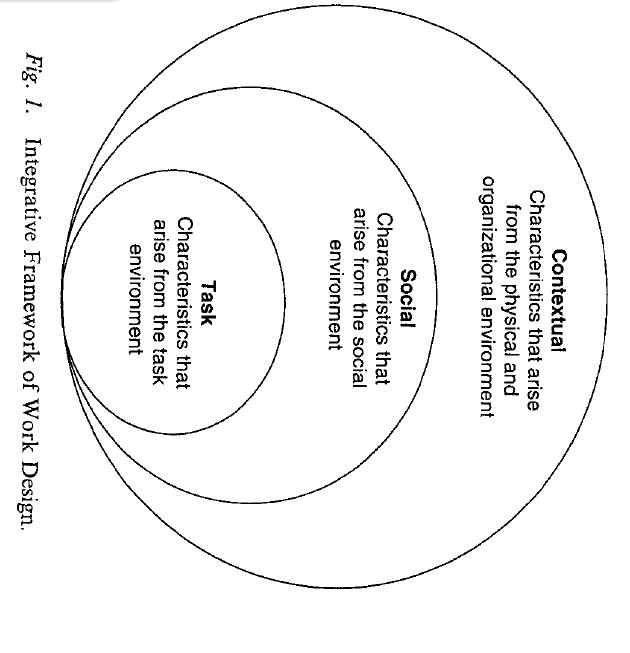
Since a number of jobs are combined and collaborative, it might be more helpful to consider an Integrative Model of Work Design. Morgeson and Humphrey’s (2008) model will identify various work and worker characteristics – specifically those work attributes that includes task, social, and contextual sources.

1) Task Characteristics: autonomy, worker control, skill variety, task identity, task significance, feedback from the job, task variety, job complexity, information processes, specialization, problem solving. Worker characteristics include job knowledge, technical skills, self-management, cognitive ability, task experience, proactive personality, and needs for achievement

2) Social Characteristics: social support, feedback form others, interdependence,, interaction outside the organization, team experience, need for affiliation, and hardy personalities

3) Contextual Characteristics: physical demands, work conditions, ergonomics, equipment use, boundary spanning (interaction within the organization but outside one’s department/team), organizational support, workspace, virtuality of work (communication), consequence of facility, physical ability, propensity to trust, organizational experience

Future research considerations for work design could include:

  •  key theoretical perspectives on fit is the needs-supplies/demands-abilities duality
  • gravitational hypothesis: workers “gravitate” towards and stay in jobs that they are both capable of performing and fit with their individual differences
  • conceptualizing individual attributes at the team level takes an additive approach – studying team vs. individual composition models
  • role vs. team composition approach: how role holder characteristics impact performance rather than putting the focus only on individuals
  • understand the impact that learning  and knowledge-based organizations should consider for work design
  • influence of the following attributes: self-regulation, social-facilitation, workload sharing, convergence, etc
  • impact for informal work redesigns – job crafting – that emerges out of work experience and organizational change
Reference: 

Morgeson, F.P. & Humphrey, S.E. (2008). Job and team design: Toward a more integrative conceptualization of work design. In J. Martocchio (Ed.). Research in Personnel and Human Resource Management (Vol. 27, pp. 39-91). United Kingdom: Emerald Group Publishing.

Social Media, StudentAffairs

Guiding #SocialMedia in Our Institutions [SURVEY]

Many of you might know I am interested in researching, working, teaching and socializing with social media in higher education — so it is only fitting that I want to assess HOW social media is being used within organizations. Dr. Tanya Joosten (@tjoosten) and I are collaborating to research this topic further; however WE NEED YOUR INPUT.  Please share your insights/experiences for Guidance for Social Media at your Institution [SURVEY] before Sunday, October 28, 2012 12 am PST

COMPLETE THE SURVEY HERE => Guiding social media in our institutions

Study Focus:

To better understanding what our institutions need to consider in guiding social media use, specifically around the questions which address student support, teaching, training and development, research, policy, infrastructure, and more. Please consider contributing to this study to help advance social media use and development at our institutions – AND both Tanya and I would greatly appreciate YOUR input. Thanks!

Study Description:  The purpose of this research study is to examine institutional support for the implementation for social media. Approximately 200 subjects will participate in this study.  If you agree to participate, you will be asked to complete a survey that will take approximately 30 minutes to complete.  The questions will ask you for your opinion on institutional support for the use of social media.

Risks / Benefits:  Risks to participants are considered minimal.  There will be no costs for participating, nor will you benefit from participating other than to further research. 

Confidentiality:  Your responses are completely confidential and no individual participant will ever be identified with his/her answers.  Data from this study will be saved on a password-protected computer for one year.  Only Primary Investigators and UWM Learning Technology Center staff will have access to the information.

Voluntary Participation:  Your participation in this study is voluntary.  You may choose to not answer any of the questions or withdraw from this study at any time without penalty.  Your decision will not change any present or future relationship with the University of Wisconsin Milwaukee.

Who do I contact for questions about the study:  For more information about the study or study procedures, contact Tanya Joosten at tjoosten@uwm.edu.

A few tips and more information about the survey:

  • Please answer any of the questions for which you have an answer.
  • If there are questions you cannot answer,  please skip those questions.
  • Due to the broad and general nature of the survey, we understand that there may only be a limited number of questions each respondent can answer.
  • This survey structure has a number of open-ended questions that require a response, URL link, or ideas about social media at your institution.
  • When possible, please forward the survey to others in your institution AND outside your institution that may be able to answer these questions.
BreakDrink, CTCX, Social Media, StudentAffairs

#CTCX No. 71: Tech News, Reddit & Updates

On Monday (10/22/12), the @BreakDrink Campus Tech Connection (#CTCX) discussed the latest technology gadget announcements, privacy on the Interwebz and challenges with Reddit, and diving into social media guidance in an upcoming assessment. Here is the video podcast:

And here are the show notes via Storify for your reading and linkage pleasure.

For those of you interested in giving your #SocialMedia Guidance in Education — please take some time to provide myself and Dr. Tanya Joosten (a.k.a. @tjoosten) feedback and information about “Guiding social media at YOUR institution” in a current survey: https://milwaukee.qualtrics.com/SE/?SID=SV_9HmS8C37kqKWyOh This SURVEY will take about 30 minutes to complete, and will close by Sunday, October 28, 2012 at midnight PST. Thanks!

This blog post is cross-posted at BreakDrink.com

BreakDrink, CTCX

The @BreakDrink Campus Tech Connection #CTCX No. 70: Ginkgotree

There are a number of conversations about challenges, changes and disruptions to higher education. Recently, Ginkgotree, the “Tumbler for textbooks,” got me thinking more about my curriculum content and sharing for my courses.
Teaching with a course pack just got a whole lot simpler with the new Ginkgotree app. http://www.ginkgotree.com/
Ginkgotree launched last week to allow instructors the ability to customize and develop their learning material using a wide variety of multimedia and curriculum content. On Monday’s (10/8/12) BreakDrink Campus Tech Connection (#CTCX) show, we were able to get a LIVE show and tell to preview the new instructional resource from Scott Hasbrouck (@scotthasbrouck), Ginkgotree CEO & “Everything Hacker.”
Here are a few of the interesting features that might appeal to educators in higher education (and possibly K-12 as well):
1. Teaching from your own curriculum – instructors have the ability and control of designing their own course curriculum that meets the needs of their learning objectives and materials. Through an easy licensing service provided by Ginkgotree, instructors have the ability to use content from all over the web including journal articles, YouTube videos, images, and other content on the web. One this course pack is developed, instructors have the ability to share a private link to students to start the learning.
2. Do you have an aged textbook to add?  Ginkgotree allows you to utilize some of your favorite text material, even the ones that have been highlighted, annotated and difficult to retrieve in the past by using high quality scanners to digitize your print text and share legally with learners.
3. Give your students the best opportunities to learn – Remember when you wondered if your students even bought or even opened the textbook for your course? SOON instructors will be able to track learner progress and engagement through course pack analytics. Ginkgotree also has the ability to offer public and private notes, ask questions, and tag your content with keywords to make it easier for both the instructor and student to navigate.
4. Reduce the cost for your learners – Students pay a flat rate of $10/month for unlimited courses, plus any applicable copyright fees (usually 15 cents per page) for their books. Rather than spending $250 per textbook, average costs of textbooks range from $45-55. For instructors it is “Free. Always. Forever.”
I think Ginkgotree has an interesting model and can definitely contribute to the evolution of higher education and learning as we know it. Perhaps it is time to consider how we compile and share learning content with our students. Go on. Sign up. Play around with it yourself. Let me know what you think.