BreakDrink, CTCX

The @BreakDrink Campus Tech Connection #CTCX No. 70: Ginkgotree

There are a number of conversations about challenges, changes and disruptions to higher education. Recently, Ginkgotree, the “Tumbler for textbooks,” got me thinking more about my curriculum content and sharing for my courses.

Teaching with a course pack just got a whole lot simpler with the new Ginkgotree app. http://www.ginkgotree.com/
Ginkgotree launched last week to allow instructors the ability to customize and develop their learning material using a wide variety of multimedia and curriculum content. On Monday’s (10/8/12) BreakDrink Campus Tech Connection (#CTCX) show, we were able to get a LIVE show and tell to preview the new instructional resource from Scott Hasbrouck (@scotthasbrouck), Ginkgotree CEO & “Everything Hacker.”
Here are a few of the interesting features that might appeal to educators in higher education (and possibly K-12 as well):
1. Teaching from your own curriculum – instructors have the ability and control of designing their own course curriculum that meets the needs of their learning objectives and materials. Through an easy licensing service provided by Ginkgotree, instructors have the ability to use content from all over the web including journal articles, YouTube videos, images, and other content on the web. One this course pack is developed, instructors have the ability to share a private link to students to start the learning.
2. Do you have an aged textbook to add?  Ginkgotree allows you to utilize some of your favorite text material, even the ones that have been highlighted, annotated and difficult to retrieve in the past by using high quality scanners to digitize your print text and share legally with learners.
3. Give your students the best opportunities to learn – Remember when you wondered if your students even bought or even opened the textbook for your course? SOON instructors will be able to track learner progress and engagement through course pack analytics. Ginkgotree also has the ability to offer public and private notes, ask questions, and tag your content with keywords to make it easier for both the instructor and student to navigate.
4. Reduce the cost for your learners – Students pay a flat rate of $10/month for unlimited courses, plus any applicable copyright fees (usually 15 cents per page) for their books. Rather than spending $250 per textbook, average costs of textbooks range from $45-55. For instructors it is “Free. Always. Forever.”
I think Ginkgotree has an interesting model and can definitely contribute to the evolution of higher education and learning as we know it. Perhaps it is time to consider how we compile and share learning content with our students. Go on. Sign up. Play around with it yourself. Let me know what you think.
Learning Community, PLN

Building Communities of Practice in Higher Ed

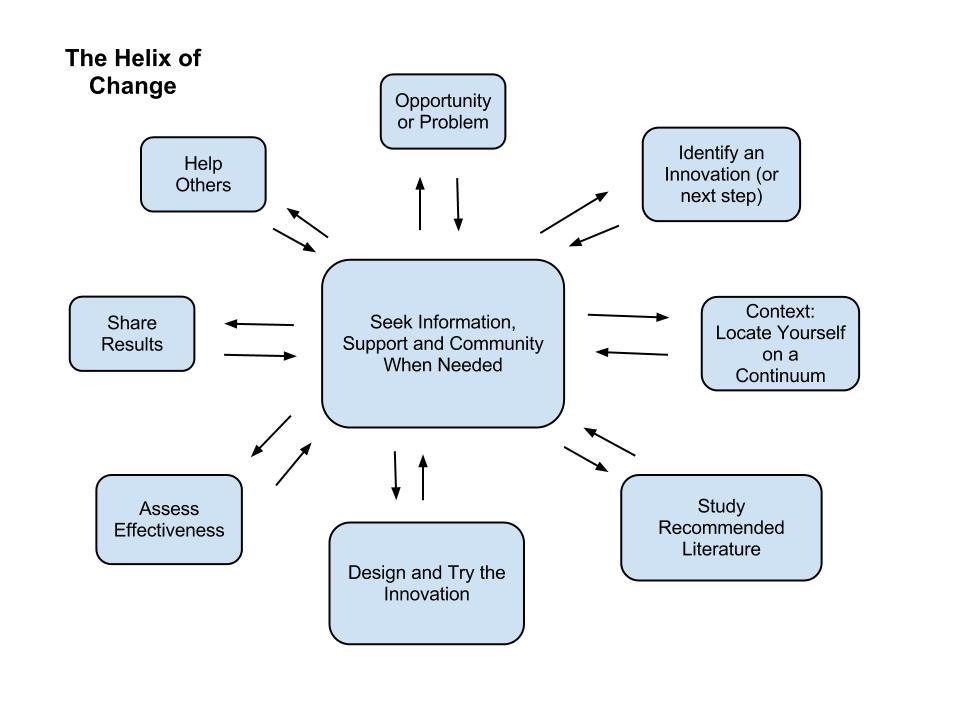
A couple of weeks ago, Dr. Milton Cox from Miami University, met with a group of students, staff and faculty to share ideas on how to build effective communities of practice at UNT known as Collaborative Learning Communities (CLC).  In his lecture and our discussion, Dr. Cox shared suggestions on how to “mind the gap(s)” in higher education and consider the broken spaces between our current disciplines, departments and silos on campus.  The process of connecting to establish a community of practice (in his example, faculty learning communities) it is to connect faculty and their institutions to think beyond their department, discipline and separate goals for the campus.
Image c/o Dr. Milton Cox
It is all to common to see department loyalty being rewarded and interdisciplinary activity questioned in higher education. There are also disconnects between student development and academic affairs priorities. For higher education to move forward it will be critical for faculty and staff to engage students in new ways of learning and scholarly activity. Although many students want to see the sage on the stage, to just consume information, it will be increasingly critical for our learning institutions to encourage inquiry-based learning and promote self-regulated scholarship.
One way to close the education gap and challenges in higher education, is to consider forming communities of practice (CoP) that work together. There are a number of students, staff and faculty need to collaborate to discuss civic engagement, learning communities, and pedagogical shifts to our higher education curriculum. Dr. Cox introduced the concept of Faculty Learning Communities (FLCs), which tend to be more structured than the organic CoP, and they are voluntary, structured, and at least a yearlong commitment from the members. Here are some other suggested practices for setting up FLCs:
  • size: 8-12 faculty, professionals, Administrators, TAs, students
  • voluntary membership by application
  • Affiliate patterns: consultants, mentors, student associates
  • multidisciplinary and from different departments
  • encourage participant curiosity
  • allow for richness of innovations
  • permitted relief from dysfunctional units
As we connected and discussed ideas around our own Collaborative Learning Communities (CLCs), we found sharing ideas could help work towards resolving institutional challenges and support the strategic goals for our campus. As our CLCs gather and collaborate, I am looking forward to connecting, brainstorming, and creating initiatives that will enhance what we do on campus.
Along with this idea for collaborative learning communities, Sue Beckingham, Jeff Jackson, Eric Stoller and I hope to discuss this topic as a #sxswEDU panel in 2013 => Communities of Practice in Higher Education as we hope to answer the following questions:
  1. How can communities of practice and learning networks play a critical role in meeting the challenges of higher education across the globe?
  2. As professional and personal learning networks (PLNs) develop, how can these informal entities support and contribute to the future of higher education?
  3. What are some actionable items and issues that higher education communities of practice can take on both at the local and global level

References:

Cox, M. & Richlin, L.  (2004). New Directions for Teaching and Learning:  Building Faculty Learning Communities.  Vol. 97.  San Francisco: Jossey-Bass.

Wenger, E. (2002) Communities of practice. Encyclopedia of the Social Sciences. Volume 1.5, Article 5. Elsevier Science, Amsterdam. 
G*STEP, Professional Development

G*STEP: Graduate Student Teaching Excellence Program

As part of the “Professional Development” section for my portfolio requirements (in lieu of comprehensive exams, I will defend a professional portfolio in order to become a PhD. Candidate before the semester over – I will blog about this in the near future), I am completing a variety of professional workshops, pre-conferences, colloquiums, and training events in my field to enhance my doctoral course work. I was just accepted to the Graduate Student Teaching Excellence Program (G*STEP) program, with approximately 85 other University of North Texas graduate students, who will complete the G*STEP certificate over the next 12 months.

As indicated by the image, the goal of the G*STEP program is to initiate mentoring, encourage personal growth, and support effective teaching and learning practices for graduate students. This non-credit certificate program was developed by the Toulouse Graduate School, the Center for Learning Enhancement, Assessment, and Redesign (CLEAR),the Provost’s office, Undergraduate Studies, UNT Libraries, and the UNT Program of Higher Education to promote effective teaching in higher education at UNT.

UNT would like to reach their FOUR BOLD GOALS for teaching effectiveness, which can be grouped into these three key factors:

  1. Providing organized and clear instruction that contributes to understanding and promotes learning
  2. Creating a learning environment that is inclusive, respectful and engaging
  3. Guiding and encouraging self-directed learning resulting in a wider understanding and contribution to the learning process.

Although I already have teaching experience, in both the K-12 and higher education classroom, I thought the G*STEP program would improve my instructional craft, enhance my pedagogical methods, and connect me to other graduate students in various disciplines – to learn about their teaching practices, challenges and resources. The only cost to the program is purchasing Teaching Tips: Strategies, Research, and Theory for College and University Teachers and committing my time/effort to the program for the duration of the twelve months.  As I plug through the online modules (8 total) and face-to-face meetings (6 total), I will be sure to share my contributions, reflections and progress here.

#AcWri, #phdchat

Reasons to #AcWri and Writing Considerations

For tonight’s class (yay for Fridays!) I will be sharing the basic concepts from Rocco and Hatcher’s (2011) publication – The Handbook of Scholarly Writing and Publication – as I outline chapter 1. This book was part of my #summerreading list. I picked it up to read advance for ATTD 6480: Research Methods class, and consider how to hone my own writing and publishing practice. Much of this book offers basic ideas and structure for suggested scholarly writing practices. Stay tuned, as I am sure that I will share a few other nuggets of #AcWri tips from time to
time.

Here are some basic writing tips from Chapter 1:

  • Make projects from opportunities
  • Meet deadlines – yours and others
  • Keep your commitments
  • Organize & prioritize your projects => To Do lists & Tracking of Your Work
  • Write down ideas – ALWAYS
  • Outline your writing projects in progress
  • Take notes when you read/research
  • Identify at least ONE journal to submit to
  • Review journal articles where you want to submit
  • Learn the style & preferred manuscript structure
  • Rejection = helpful review comments & suggestions

Reference:

Rocco, T.S. & Hatcher, T. (2011). The handbook of scholarly writing and publishing. San Francisco: Wiley/Jossey-Bass.

LPQ

CFP: The @LPQuarterly Volume 1, Issue 4 EXTENDED: DUE November 5, 2012

The Learning and Performance Quarterly (LPQ) is an online, open access peer-review journal designed to make research available to the public and to support a greater exchange of global knowledge. We have recently been invited to publish in the EBSCO research database, and our publication is growing both in author contributions and readership. Articles in support of innovative learning and performance across disciplines from developing and proven scholars are welcome for the last call for 2012 – here is the more information about the call for manuscripts.

CALL FOR SUBMISSIONS:
Learning and Performance Quarterly, Volume 1, Issue 4

The Learning and Performance Quarterly (LPQ) is currently accepting submissions for the second issue. Deadline for submissions is Friday, October 26 at 5 pm CDT. DEADLINE EXTENDED to Monday, November 5, 2012 at 11:59 CDT. Submission of manuscripts can be made online through the LP Quarterly website. For detailed submission guidelines and instructions on how to make a submission please visit Author Guidelines.


TYPES OF MANUSCRIPTS ACCEPTED
Research Articles :
Papers that are concerned with the various approaches to learning and performance impact. These papers should discuss the literature related to the approach employed and include a measure of the learning and performance impact of the approach employed.

Case Studies:
Case studies that highlight a particular learning, training, performance or instructional setting in which learning and performance resources were used to address a particular challenge. They present a discussion of the challenge from current literature, what was done to solve or explore it, and the results of the project. They often offer suggestions for others interested in addressing similar challenges.

Concept/Theory Papers:
Papers that present new concepts or contribute to existing theory for learning and performance. This should offer a discussion of the literature related to the concept/theory along with a discussion of the major issues for future research needed to validate the concept/theory.

Book Reviews:
Book reviews of publications 2011 or later will be accepted to highlight a issues and resources relevant for learning and performance and offer a suggested solution or direction. The position is supported with both a logical argument and a review of the pertinent literature. Preference will be given in the review process to book review essays that comment on two or more related books.  Book review essays should not exceed 3,800 words and should include city, state, publisher, and year of the book’s publication.  An abstract of 150 words or less and keywords are required for book review essays.  Reviews of single books should not exceed 1,900 words.  At the beginning of the text please include title, author, publisher, city, date, and page numbers of the book(s) under review.

CALL FOR LEARNING AND PERFORMANCE QUARTERLY REVIEWERS
Interested in reviewing articles for the LPQ Journal? The LPQ journal is looking for reviewers to conduct peer reviews and evaluations of submissions.
Please identify your reviewing interests, substantive areas of expertise, and preferred research methods when completing the LPQ journal registration online.

We look forward to receiving your submissions. Please pass this post onto other colleagues and researchers who might be interested in publishing, reviewing or editing for the Learning and Performance Quarterly journal.

Thank you,

Laura Pasquini & Dr. Jeff Allen, Founding Editors
Learning and Performance Quarterly
Like us on Facebook
Follow us on Twitter @LPQuarterly
Email: LPquarterly@gmail.com