Book Review

#BookReview – Brain Gain: Technology and the Quest for Digital Wisdom

A late add to my #summerreading list was Marc Prensky’s Brain Gain: Technology and the Quest for Digital Wisdom. With the start of the semester underway, I finally found some time to review this book. 

Added to my #summerreading list...

The premise of Prensky’s new book looks at how technology is changing and enhancing our minds with digital wisdom:

“Human culture and context is exponentially change for almost everyone. To adapt to and thrive in that context, we all need to extend our abilities. Today’s technology is making this happen, and it is extending and ‘liberating’ our minds in many helpful and valuable ways. Our technology will continue to make us freer and better — but only if we develop and use it wisely” (Prensky, 2012, p. 2).

Prensky shares how technology will “change our minds” to learn new things and produce new thoughts. With our gadgets and technological capabilities, we are able to extend our minds, heighten our cognitive surplus, increase our thinking powers and improve our thought process and concentration. As Albert Einstein stated “a new type of thinking is essential if mankind [and womankind] is to survive and move to higher levels” (Prensky, 2012, p. 35). It might be time to outsource some of our brains limitations, including memory, storage, accuracy, complexity and prediction, to a technological source. Prensky believes that by using technology we have an advantage to be “better thinkers who make wiser decisions and choices” (2012, p. 52). Much of our decision-making can come from the symbiosis of the mind and technology.

Although technology is often viewed in a negative light, this book identifies ways we enhance our “digital wisdom” via technology. Prensky defines wisdom as “the ability to find practical, creative, contextually appropriate and emotionally satisfying solutions to complicated human problems” (2012, p. 45). In contemplating the arguments against this idea of being wise with technology, the author introduces several fallacies, including:

  1. “Human” as Being Special and Always Better
  2. “Genuine”
  3. Longer Always Being Better
  4. Privacy Always Being Better
  5. Depth and Always Being Better
  6. Slower Being Better
  7. “One Thing at a Time” Being Better
  8. “Brain Science” Providing All , or Even Enough, Answers
  9. Relying on “Tried and True” Solutions in New Contexts
  10. “Reflection” Being Slow
  11. “Expertise” Meaning “Knowledge and Analysis of Data” and of Expertise Coming Only from Professionals
  12. Short Attention Spans
  13. “Limited Capacity” and the Need for In-Person/Online Trade-offs
  14. The “Cultural Now”
  15. “Wisdom” as Coming Only from Humans

Throughout this book (especially in Chapter Three) there are a number of examples of digital wisdom to demonstrate how the mind and technology function well with one another. Also scattered throughout the text, there are a number of references to other great technology-focused reads – many I have on my “to read” list or just added. Here are a couple of suggestions you might like shared by Prensky:

The book continues to share examples of digital cleverness and digital stupidity, with suggestions and examples on how we all can be smarter with our technology software, hardware and digital presence. Prensky continues to share how to cultivate digital wisdom in our personal life, at work and finally in education:

“Cultivating digital wisdom means being intellectually curious and active, continually expanding one’s online universe rather than sticking with the same things, and continually bringing more of the new world into our lives” (2012, p. 182).

Although Prensky touches on his former definition of “digital natives,” he digresses to move towards the need for educators to get comfortable with developing wisdom in classrooms with technology. The skills identified with digital wisdom and technology include collaboration, teamwork, decision-making, taking risks, making ethical and moral decisions, employing scientific deduction, thinking laterally and strategically, problem solving, and dealing with foreign environments and cultures (Prensky, 2012). The final chapters discuss the real dangers, things to be wary of, acknowledging problems to fix them, and evolution of the human as being impact by technology and singularity.

Overall, I think much of this book summarizes the impact of technology and our brain power with gadget and tech consumption. Prensky presents a decent summary and tries to synthesize how our thinking, actions and learning have changed – by curating and compiling examples and theories in a digestible way for the reader. Although the concepts are not novel, I think a number of readers will appreciate the concepts put forth around digital wisdom and technology.

Reference:

Prensky, M. (2012). Brain gain: Technology and the quest for digital wisdom. New York, NY: Palgrave Macmillan.

**Full disclosure: This book was sent to me by the Palgrave Macmillian publishing group to review on my blog. Thank you for the read. **

#phdchat, ATPI, Learning Technologies, LPQ, Reflections

LT Forum Interview – About My PhD Experience So Far…

The LT Forum is a place for students, staff and faculty in the Department of Learning Technologies at the University of North Texas to share news, announcements and updates. Here is an interview I did for them over the summer, that I forgot to cross-post here. Thanks to for inviting me to share my thoughts Jenny Wakefield.

« on: June 02, 2012, 01:24:32 PM »

We have many talented doctoral students in The Department of Learning Technologies. Our hope is to be able to interview and showcase these PhD learners here in the LT Forum as each reaches milestones through-out their journey towards their graduation. Reading about other students’ successes may boost that extra energy needed for others to push themselves forward and learning about challenges may help guide others. We also want to spotlight our students so that new learners come join our team and travel with us in the Learning Technologies – a great place to be! [Jenny Wakefield.]Our third interview is with Laura Pasquini, Doctoral Student in the APTI program:

Laura Pasquini – PhD Learner in ATPI

JW: Tell me a little bit about what made you decide to enroll in the ATPI program and pursue a PhD/EdD. (When did you enroll? How long have you been working towards your exam and course completion?)

LP: In looking for a graduate program that suited my scholar-practitioner interests in higher education, I thought that the Department of Learning Technologies at UNT was best suited for my talents and interests. After completing a course in Fall 2009. I decided to join the ATPI program in Spring 2010, as I liked the interdisciplinary approach and learning model that was built into the curriculum. As an ATPI doctoral student approaching completion, I appreciate the ability to study in the field of applied technology, human resource management, organizational change/theory, and educational research while connecting with faculty and leaders in the field. The end of 2012 marks the end of my course work and movement into being a PhD candidate. I am fortunate to be one of the first ATPI doctoral students to complete the NEW ATPI portfolio (instead of the comprehensive exam) by November, and after my last ATTD class with Dr. Nimon this Fall I will be ready to propose my doctoral dissertation and move on to being a doctoral candidate. The tentative plan is to be complete the ATPI doctoral program and graduate around May 2014.

JW: Who is your major professor?

LP: Dr. Jeff Allen is my major professor. It has been great collaborating and learning from one another. I appreciate the ability to work with and contribute to research, publications, and opportunities in the LT department. He has been a great faculty advisor who knows how to challenge and support my professional/academic needs.

JW: What has been the most challenging parts of your studies so far?

LP: Balance. I am a student, staff, and instructor at the University of North Texas. My role as an Academic Counselor/Instructor with the Office for Exploring Majors, Undergraduate Studies supports undecided students with their major/career choices and academic journey; whereas I am often found on campus, late in class, or researching/writing for another project. Besides working on courses, I have found great values in collaborating with other authors on publications, connecting in the field with other educators, and meeting corporate leaders. Besides working on courses, I have been busy with contributing to professional associations and journals with research, publications, and presentations. This year I have taken on the role as the editor for the Learning and Performance Quarterly (LPQ) which is a student-led, blind peer-review open-access online journal. We just published our first issue on May 22, 2012 and I’m looking forward to working with our reviewers and editors on the second issue over the summer.

JW: Tell us a little bit about your journey so far. What are challenges you’ve had to overcome? Have you had any pleasant surprises, aha-moments you’d like to share?

LP: I am originally from Toronto/Niagara Falls, Canada, so it took me a little while to adjust to the climate and the ways of Texas. I have been fortunate to meet some hospitable friends and colleagues who have helped my transition to the Lone Star state. So far I have really enjoyed my PhD journey. I have appreciated the projects, classes, discussions, and, most importantly, the connections with peers from UNT and in the learning technology field. I think that learning is an ongoing process, and developing as a researcher and academic is a continual experience. I have learned to celebrate the accomplishments and milestones along the way, and to be open to any feedback and new ideas I am exposed to along the way.

JW: What presentations have you attended/presented at? Tell us a little bit about one of them. Anything in particular that comes to mind? Advice for others?

LP: I have been fortunate to present research, papers, and theoretical sessions at a variety of professional associations and conferences over the last few years. Some have been collaborative and others have been a great learning experience where I have engaged with participants in meaningful discussions about shared research experiences.

LP: Over the last year I have been fortunate to be asked to share ideas and thoughts around connected learning and social practices for professionals as an invited speaker a few conferences/meetings. Last fall I was invited to talk to the University of Hawaii System Advising group at their annual workshop in Honolulu, HI about “Why Advising Networks Matter” and how holistic, community models of connected advising practices best support our learners. I just returned from Helena, MT where I was invited to be the opening keynote speaker for the Mountain MoodleMoot. During this talk I shared strategies for developing learning curriculum and ideas to support social learning with Digital Pedagogy to Engage. Both talks offered me opportunities to share my research ideas and practical experiences with social, connected learning; but more importantly it allowed me to connect with colleagues to discuss how these ideas can be applied to provide solutions for issues in education.

JW: What publications and/or creative works have you published?

LP: In collaborating with a few authors from our campus and other locations in the US, I have experience publishing book chapters, monograph chapters, and conference proceedings around topics in technology for advising, collaborative learning, and innovative practices for performance and learning. I am currently working on a few manuscripts for peer-reviewed journals. If you want to see my publications, I have current publications shared on my Mendeley account. Besides formal publications, I am often reflecting and sharing thoughts about my research on my blog or podcasting with the BreakDrink.com Student Affairs and Higher Education community on the Campus Technology Connection podcast.

JW: Have you decided on your dissertation topic and if so what was it? If so, what made you decide on this topic?

LP: I am currently culling through my literature review and narrowing my dissertation topic – which should be finalized over the break in coursework this summer. My current research thread and interests are in the areas of collaborative learning environments and personal learning networks, specifically how these networks and environments impact learning, training, and development in organizations. What interested me in these topics was personal experience connecting and learning in both formal and informal learning networks – specifically with peer-to-peer learning and mentoring in professional organizations. I hope to share some insights and values to how alternative forms of learning, training, and mentoring can impact professional development and career growth.

JW: Have you been studying full-time or also been working? How do you feel about combining PhD studies and working full-time (if you did)? What are things to potentially keep in mind?

LP: As I shared above, I have been working full-time as well as working on my doctoral studies, research, and publications. I will say that it is quite busy and challenging; however with some effective time management and organization it is not impossible to accomplish your academic goals. I am grateful to have supportive peers, colleagues, faculty, and family who continue to motivate and push me along my PhD journey. Although it is not impossible, I will say that it takes a great amount of energy, effort, and time to commit to doctoral research and academic professional development.

JW: Any recommendations you would like to share with the rest of us on the journey towards a PhD/Ed.D? 

LP: Stay the course. It seems like a long journey to the end of the PhD/Ed.D, but I think that there are some valuable experiences and rewards along the way. Embrace the challenges and opportunities that you have as a doctoral student beyond the course/program requirements. You can help shape your degree and academic experience, so be sure to make the most of it by getting involved, getting connected, and embrace new learning experiences that you stumble upon along the way.

JW: Anything else you would like to add?

LP: Thanks for asking me to share my thoughts about the Learning Technologies department and ATPI doctoral program. For those of you who want to follow along my PhD journey, I can often be found tweeting or reflecting on my blog. Get connected and share your experiences with me: http://about.me/laurapasquini

Book Review, Higher Education, K-12, Open Education, PLN

10 Principles for the Future of Learning

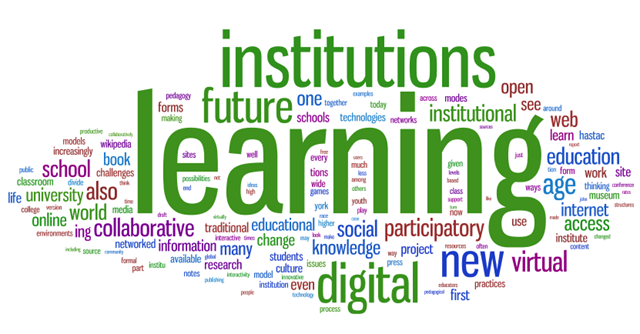
While working on some late night treadmill mileage, I decided to catch up on documents and books I have been collecting on my Kindle. Last week I read The Future of Learning Institutions in a Digital Age, which was a precursor to The Future of Thinking: Learning Institutions in a Digital Age book published by the John D. and Catherine T. MacArthur Foundation. Although this material is a bit dated, I think that some of the pedagogy still applies for educational development.

Image c/o Martin Hawksey (and his musings on this text as well). 

In the first collaborative project, the authors share ten principles to support the future of learning. Davidson and Goldberg (2009) presented these pillars of institutional pedagogy to help institutions rethink learning and meet the challenges that lie ahead for both K-12 and higher education:

  1. Self-Learning – discovering and exploring online possibilities
  2. Horizontal Structures – how learning institutions enable learning; from learning that to learning how; from content to process
  3. From Presumed Authority to Collective Credibility – shifting issues of authority to issues of credibility; understand how to make wise choices
  4. A De-Centered Pedagogy – adopt a more inductive, collective learning that takes advantage of our era and digital resources
  5. Networked Learning – socially networked collaborative learning stressing cooperation, interactivity, mutuality and social engagement
  6. Open Source Education – seeks to share openly and freely in the creation of culture and learning; provides a more collective model of interchange
  7. Learning as Connectivity and Interactivity – digital connection and interaction to produce sustainable, scaffolding ensembles
  8. Lifelong Learning – there is no finality to learning; learning is part of society and culture
  9. Learning Institutions as Mobilizing Networks – networks enable flexibility, interactivity, and outcome; new institutional organizations reliability and innovation
  10. Flexible Scalability and Simulation – new technologies allow for collaboration beyond distance or scale for productive interactions that warrant educational merit

Reference: Davidson, C.N. & Goldberg, D.T. (2009). The future of learning institutions in a digital age. Cambridge, MA: The MIT Press.

#phdchat, ATPI

What’s Your Research Methods Worldview?

This is the question we tackled in my Friday night class (Yes. It’s on Friday night from 5:30-8:20 pm = Awesome). #ATTD6480: Research Methods is one of my final courses in my doctoral program designed to help graduate students create an empirical research article and/or develop our dissertation proposal. I am looking forward to it – so far we started to talk about our preferred research methods and potential topics for the semester.

Cartoon image c/o Sheldon Comics

This was our opening activity. We had to read this cartoon and respond to this question: Are you more drawn to qualitative or quantitative research? Why?

My response is that I dabble in both areas. For areas of study and research, I really do need to take a mixed method approach. In class, I identified with the pragmatism and constructivism worldview philosophy for research. In looking around the table, I am fortunate to be the only one applying mixed methods based on my experiences in research, work and collaborating with some great authors. As a researcher, I seek to understand rather than test a theory (postpositivism), and I am usually looking to generate practical, real-world solutions with my research. Here is a quick breakdown of four world views of research from Creswell (2009, p. 6):

Postpositivism
Determinism
Reductionism
Empirical observation and measurement
Theory verification
Constructivism
Understanding
Multiple participant meaning
Social and historical construction
Theory generation
Advocacy/Participatory
Political
Empowerment Issue-oriented
Collaborative
Change-orientated
Pragmatism
Consequences of actions
Problem-centered
Pluralistic
Realist-world practice oriented

Where in the world does your research lie? What sort of research methods do you prefer? What strategies of inquiry do you apply for your qualitative, quantitative or mixed methods approach? I will continue to share ideas from this class and my first official qualitative class (#ANTH 5031: Ethnographic & Qualitative Methods) over the course of the semester. I welcome your research methods, applications and resources.

Reference:
Creswell, J.W. (2009). Research design: Qualitative, Quantitative, and Mixed Methods Approaches. Thousand Islands, CA: SAGE Publications Inc.
#ugstJOUR

Digital Community Development with #ugstJOUR

This Fall semester I am co-teaching the UGST 1000 – First Year Seminar class which is partnered with the Introduction to Mass Communication (JOUR 1210) and U.S. History I (HIST 2610) in a Learning Community at UNT. This section of the First Year Seminar will be connected and engaged on campus, in the community, and online. The plan is to connect students to helpful resources, people, learning opportunities, and places that best support their major/career decisions, while developing their digital identity, and grow their learning networks:

Last Fall, our class experimented with Tumblr for reflections, but I have decided to return to my tried and true avenues for blogging and communication – WordPress and Twitter. To thread our class learning network, my students are sharing their blog reflections and will be tweeting with the hashtag #ugstJOUR. The class will use #ugstJOUR to tag and link their questions, comments, blog posts, assignments, and more throughout the semester. BYOD will be encouraged and utilized for this class.

Here is the WordPress and Twitter section of my class syllabus:

WordPress (WP) Posts:  Throughout the semester you will be asked to reflect about class topics, assignments and other happenings having to do with major/career exploration.  Rather than using a paper journal or requiring you to turn in a reflection, we would like you create your own WordPress blog to share your journey with the class.   Each WP post should have a minimum of 350 words, and posts are due by 11 pm on the date which are listed on the class schedule.  This assignment will be graded as follows:

A = a response that is well-written at the level of both the sentence and the paragraph; it addresses with precision all the required elements and utilizes theory to develop a creative solution to the issue/topic
B = a response whose sentence and paragraph-level writing is good but not distinguished; it addresses with some degree of specificity the required elements and a creative solution to the issue/topic
C = a response whose sentence and paragraph level writing is average and not particularly clear; it addresses a potentially interesting point with the issue/topic being addressed but without precision
D = a poorly written and superficially conceived approach to the issue/topic
F = a work with barely coherent response to the issue/topic or not meeting the word minimum

About WordPress. WordPress blog accounts are free and can be created by visiting http://wordpress.com. If you are able to write in a word document, then you should be okay to write blog posts. For more information, be sure to read the instructions at the end of this syllabus. By default, all posts to WordPress are public and open for everyone to see.  Since we hope that our class is a sharing and connected community, we would like to keep all blogs public. If there are topics or posts that you do not want to share with the class or world at large, please feel free to post these privately to share with only the instructors. Just be sure to provide us with the password so that I may read them for grading purposes. Additionally, when creating posts for WP, you are free to express yourself in any way you see fit.  While every class-assigned post (you are free to post more than is required) must include some form of written explanation, you are totally free to include pictures, videos, audio, etc. In fact, I encourage this.  Because these are blog posts and personal reflections, I will not be asking you to create bibliographies or citation pages, but do be aware that it is good netiquette to link back to the sites that provided your material.  You can find the Official UGST 1000.003 WordPress blog at http://ugstjour.wordpress.com/. For help go to: HOW TO: Set Up a WordPress Blog.

About Twitter: We will be using Twitter (https://twitter.com/) as a forum to engage in conversation inside and outside of our class meetings. Twitter is a form of communication where you can share short, 140-character messages with others. During the semester, you can follow the class twitter handle @ugstJOUR [https://twitter.com/ugstJOUR] and we will be using the hashtag #ugstJOUR to connect our messages.  You can sign up for a free Twitter account, upload a picture and create your own bio. Regular questions and prompts will be given to respond with using the #ugstJOUR hashtag, and you will be required to respond to others tweets as well. For help go to: HOW TO: Set Up a Twitter Account.

Be sure to follow the class  #ugstJOUR WP Blog and Twitter handle @ugstJOURThis two spaces will be used during the semester for general class announcements, campus updates, information sharing, helpful resources and they will serve as a model for your own blogging and tweeting experiences. Also be sure to follow your fellow #ugstJOUR blogs & Twitter accounts. This learning network will be a great space for you to connect, post, communicate & share both inside and outside of our class meeting times.