Higher Education, Social Media, StudentAffairs

How Social Is YOUR Student Handbook, Higher Ed?

Today I contributed to a webinar about student handbooks in higher education for Paperclip Communications. In thinking about my own student experience and searching for other suggested practices, the key question I asked was…Where can I find YOUR student handbook?” Can you answer that question?

Often times college and university policies, procedures, responsibilities, and codes of conduct are buried on the institutional website, masked in “legalize,” and typically struggle to be shared with the target population – the students. I shared a few suggested practices for usability, access, web design, and using social (media) sharing for student codes of conduct. If you missed out, don’t worry – there’s an open & shared Google Doc for that:  http://bit.ly/studenthandbooks

 
I think our institutions need to consider compliance, codes of conduct, and informed legal practices – but more importantly, they need to put these student rights and responsibilities into action. Making our student handbooks social and engaging helps to educate our students, communicate to others at our institution (faculty, staff, etc), and it sets the tone for developing community standards on campus. I recommended involving students in the process of the student handbook development and getting their insight into sharing this information to understand what their needs are, where thy find information, and questions/challenges they have about your student handbook.

Here’s just one example of how UNT Housing & 720 is being proactive with the UNT student handbook information:


How do YOU share information, policy, and guidelines at your institution? Do you have a Facebook Page? Blog? Twitter Account? Please share HOW you share about student rights & responsibilities.

ATPI, PhD

My ATPI Portfolio & Presentation: Look Ma’, Now I’m A PhD Candidate!

After an early morning presentation and Q & A about my ATPI Doctoral Portfolio – I am now a doctoral candidate in the ATPI Program (here’s the NEW PhD Portfolio Requirements). I am now able to start my dissertation hours in the Spring 2013 semester. Yay!
Vizify S

Professional Overview

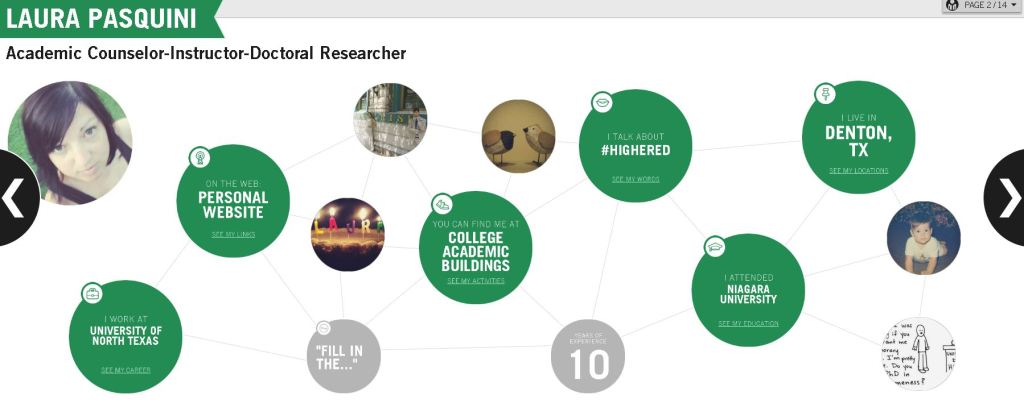
The Applied Technology and Performance Improvement (ATPI) doctoral program has supported my growth as a scholar, professional, and consultant. Throughout my interdisciplinary course work in Applied Training and Development, Management, and Educational Psychology and Research, I have been able to develop and enhance my critical thinking, improve upon my research analysis and research perspective over the last three years of my doctoral program. Beyond the degree course work, the ATPI faculty and the Department of Learning Technologies has supported my efforts towards presenting, publishing scholarly works, improving my instructional skills, and augmenting my service scholarship. My ATPI doctoral portfolio will demonstrate my scholarly development and illustrate my contributions to the learning, computing, and performance field.

During my last three years as a doctoral student, I have sought and participated in a number of research opportunities and academic experiences to support my development as a scholar. Through my involvement in collaborative graduate writing groups, professional associations, and academic partnerships with faculty, I have improved upon my scholarly research, honed my writing craft, and advanced my editorial skills. My publications include the topics of formal and informal learning, personal learning networks, learning and performance innovation, and technology needs assessment and implementation to be utilized for education. Beyond research and publications, I have been invited to consult, train, and speak to a number of public and private learning organizations nationally and internationally about my research interests, learning pedagogy, and instructional design.

As the founding student editor for the Learning and Performance Quarterly (LPQ), an open access, peer-reviewed journal within the Department of Learning Technologies, I have gained a vast amount of insight in reviewing manuscripts, working with a diverse editorial board, supporting online distribution, and partnering with a number of contributing authors and academics. Both reviewing and editing for the LPQ and other academic journals, has improved my research and how I critically analyze academic publications. Being the editor has also not only challenged me to consider style and format, but has compelled me to assess other research methodologies.

As a connected and open learner, I have attempted to apply knowledge from the classroom and knowledge from scholars in the field of learning and performance. My ten years’ of experience in the field of Student and Academic Affairs in education has come from employment in the United Kingdom, France, Canada, and the United States. My professional experiences in education include teaching (higher education and K-12) , academic advising, tutoring services, supplemental instruction, career advising, campus activities, first year experience curriculum, orientation programs and housing and residence life. With my education, I haveattempted to integrate my student and academic affairs experiences with my scholarly objectives. In doing so, I have shared my eclectic learning and PhD journey via a variety of social spaces. You can often find me blogging, tweeting, taking photos, or sharing my research developments and professional experiences online. Being an open and digital scholar has presented me with a number of opportunities you will see presented in my ATPI portfolio.

Currently, I am an academic counselor and instructor with the Office for Exploring Majors where I help undergraduate students explore their major and career goals. In this position, I have had the opportunity to work collaboratively with various departments on the UNT campus to integrate assessment with program design, create innovative learning initiatives, and provide training and development for our staff and faculty. As a member of the Global Community for Higher Education (NACADA) and connecting with learning technology associations, such as EDUCAUSE and the Sloan Consortium, I have had the opportunity to enhance my mix my service scholarship disciplines to consider new models for learning and performance. As an active member and leader within my professional affiliations, my service has valuable developmental experiences, including mentoring relationships, planning conferences, consulting contracts, and supporting research for the organizations.

My professional goal is to secure a tenure-track faculty position at a research university while consulting for training and development on the side. I have had a number of excellent experiences in higher education in the area of advising, teaching, and service and I believe that I will be a talented candidate for any institution seeking a dedicated research scholar. There are a number of complimentary research opportunities in the field of learning technology, and I would expect to remain involved in research, consulting, and learning in higher education as it evolves in the future.

My research interests lies in the understanding of informal, online learning networks for professional developments and how these digital communities of practice influence and impact professional and trade associations, such as American Society for Training & Development (ASTD) and the International Society for Technology in Education (ISTE). I am interested specifically in analyzing how social media and online applications affect the formal processes and the structure of training and development.

#phdchat, Learning Technologies

CFP: Emerging Technologies for Online Learning Conference #et4online

The 6th Annual International Symposium for Emerging Technologies for Online Learning (#et4online) from April 9-11, 2013 (Planet Hollywood Resort – Las Vegas, Nevada) wants YOU to submit a conference proposal. Proposals are DUE by 11 pm CDT on December 10, 2012

The Emerging Technologies for Online Learning International Symposium, a joint Symposium of Sloan Consortium and MERLOT, is designed to bring together individuals interested in the review and evaluation of emerging technologies’ impact on online teaching and learning.

The 2013 Emerging Technologies Symposium chairs know technology for learning is shifting quickly:

“New discoveries in technology happen rapidly and far too frequently. It is difficult to keep up with every new release or innovation.  Advances in technology often become the vehicle for new ways to learn or enhance learner opportunities in our classrooms. As educators we progress forward, gaze back, and aim to bring the best of old and new to create an optimal environment to our students. However daunting this mission is, we tackle the problems and learn best from those who are already building the bridges and taking on the tasks we want to try. The field is advanced by those who share, scrutinize, and study. We invite you to contribute to the progress by presenting and attending this year’s symposium and encouraging your colleagues to join our efforts.” 

The #et4online steering committee is interested in interactive sessions that engage and inform participants for the following areas:

  • Higher Education and K-12 Faculty
  • Future professors and graduate students
  • Educational technology leaders
  • Students
  • Instructional designers
  • Instructional technologists
  • Academic administrators

Sessions can be targeted to all attendees and or specified (novice, intermediate, or expert) levels of proficiency. The committee would like to see a wide range of involvement from various presenters/facilitators – this includes proposed sessions from graduate students TOO!

The #et4online symposium will accept presentations that offer attendees “real solutions,” pioneering practices, and future trends, specifically submissions which emphasize evidence-based practice and the impact of topic tracks on teaching practices and student learning outcomes using a range of research methodologies (e.g. case study, longitudinal comparisons, within group comparisons, quasi-experimental, etc.) and rigorous approaches to the analysis of supporting data, qualitative or quantitative. Here are the #et4online symposium tracks and research areas:

Here is the presenter FAQs and Webinar Recording from 11/29  to help you with your proposal submission: 5 Tips on How to Submit a Successful Conference Proposal

There will be a wide range of emerging technologies for online learning trends, talks, sharing, and more! What happens at #et4online in Vegas will NOT stay in Vegas. And that’s a good thing! Follow @et4online for more updates as well!

LPQ

Published: Learning and Performance Quarterly 1(3)

The third issue of the Learning and Performance Quarterly (LPQ) speaks to the area of facilitation, teams and mobile support systems. This issue discusses theoretical building blocks for researchers that have a renewed interest in teams and their support. The reemergence of this area of study is important as we move further into the age of social media, personal learning networks and global information exchange. Thank you to our authors, editors, and peer reviewers for their contributions to the Learning and Performance Quarterly, Volume 1, Issue 3.

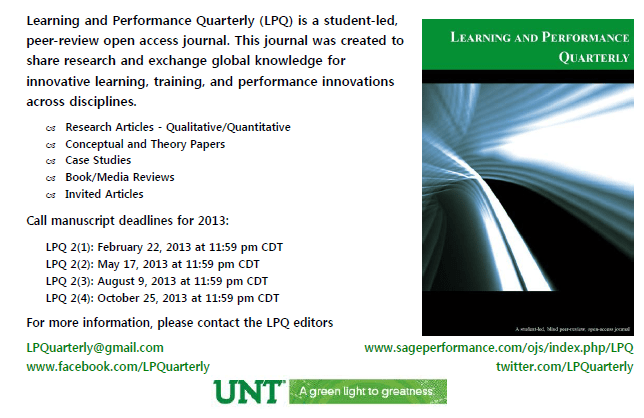
The Learning and Performance Quarterly (LPQ) is an online, open access peer-review journal designed to make research available to the public and to support a greater exchange of global knowledge. The call for submissions for 2013 is now open – here are the deadlines for manuscripts for Volume 2:

Submission can be made online through the LP Quarterly website. For detailed submission guidelines and instructions on how to make a submission please visit Author Guidelines.

Happy reading,

Laura A. Pasquini & Dr. Jeff Allen, Founding Editors
Learning and Performance Quarterly
Like us on Facebook
Follow us on Twitter @LPQuarterly
Email: LPquarterly@gmail.com

#phdchat, ATPI, PhD, Professional Development, Reflections

ATPI Doctoral Portfolio Reflection

This weekend will involve the usual researching, writing, and editing of projects – however I have one more item to polish up before it’s time to be thankful in the U.S. – my doctoral portfolio.

For the Applied Technology & Performance Improvement Doctorate (ATPI) program, the doctoral portfolio is a new requirement for us young, budding scholars. Rather than sit in a room for two 8-hour days or respond to a set of questions over a period of time, ATPI doctoral students will need to complete our departments Ph.D. portfolio to officially become a Doctoral Candidate and move forward with dissertation work. Some students in our program are still opting to take the comprehensive exam route while they still can, only because the requirements include research, teaching, and service scholarship experience that is akin with academics who might be seeking tenure/promotion. I think that this portfolio makes sense, professionally it helps to document my PhD Journey and encourages students to gain scholarship experience before being launched into a dissertation or even the academic job search.

Here are the ATPI Doctoral Portfolio Requirements [DRAFT] that I have been using to guide my portfolio development. {I say draft as this document is subject to change since our department will have myself and another student defend in December for the 1st time.}

I promise to share my ATPI doctoral portfolio, after I review it and put the finishes touches on it. I learned a great deal from our “dry-run” on Friday, and I was reminded about some of the key things to highlight in my 15-minute presentation. I am also pleased to say that I will be sharing my digital PhD journey (blogging, tweeting, and then some) with my doctoral committee for my portfolio defense. My faculty advisor and another committee member thought it would be valuable to discuss my philosophy and experience as an open educator/scholar/researcher.

In thinking about how to “show case” some of this, I am looking through my blog for musings and what I have been up to over the last 3 years of my doctoral course work. So far my TechKNOW Tools Wordle reflects this:

TechKNOW Tools Blog Wordle

I also know that my digital footprint can be found in my Google Docs (or now Drive), YouTube channel, Dropbox, shared on my SlideShare account, posted on my Flickr account in photos, and even among my 23, 926 tweets (good thing I auto-send these into Delicious with hashtags for easy searching). Time to mine my own digital data, review what I’ve created, and compile my professional development and scholarship.

Grad Students & PhD Friends: How do you track your progress? Professional development? Teaching, service, and research scholarship? Please share!