EdTech, Horizon Report

VOTE for #18: The Technology Test Kitchen #eli2015 #edtech #satech

The ELI Video Competition: 2015 NMC Horizon Report from EDUCAUSE and the New Media Consortium (NMC) is underway. I need your help to cast your VOTE for the Technology Test Kitchen – #18: Michigan State University.

All 23 videos from 18 different institutions are great! Each video focuses on one or two of the six 2015 technologies in the upcoming Horizon Report:

  • Bring Your Own Device (BYOD)
  • Flipped Classroom
  • Makerspaces
  • Wearable Technology
  • Adaptable Learning Technologies
  • Internet of Things

Take a gander a the other videos (each video are 2 minutes each) for what is happening on the ed tech horizon, but then give a digital HIGH FIVE to #18 in your ONLINE VOTE. 🙂

18. Michigan State University

Category: Makerspaces
Contact: Patrice Torcivia Prusko

What the heck is the Technology Test Kitchen (TTK)? {you ask}

  1. A makerspace for sharing innovative tools and new media
  2. An open collaborative environment for hands-on exploration
  3. An engaging way to connect with your colleagues over emerging technology

how it works

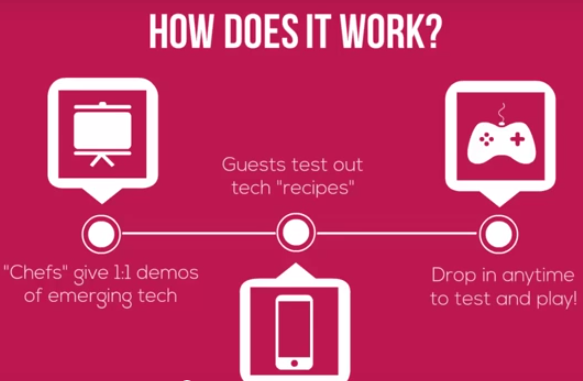
The TTK ideas was created to bring faculty, instructional designers, researchers, and conferences participants together to get a hands-on experience with a variety of learning technologies. In the Test Kitchen, there are a number of “chefs” (volunteers who love applying media to learning) who are typically available to talk about design, discuss a “recipe” a.k.a. a quick how-to guide for a platform. The kitchen encouraged participants to explore apps, brainstorm teaching strategies, sharing curriculum ideas, and experimenting with new media for learning – both hardware and software. The 1:1, hands-on sharing is shared to you by Creative Commons in this latest compilation TTK Recipe Book:

DOWNLOAD your own Technology Test Kitchen Recipe Book from  #blend14  and #ALN14 to try out some new recipes for learning! Like what you see, check out the next TTK maker space happening with at #et4online in April here in Dallas, TX!

Voting is open from Friday, January 30 – Tuesday, February 10, 5:00 p.m. PST. Winners will be announced at the ELI Annual Meeting, Tuesday, February 10 th (#EI2015). VOTE NOW! {Psst #18}

Professional Development, Training & Development

The 2015 #et4online Conference Preview

#et4online bannerThe Online Learning Consortium (formerly Sloan Consortium), MERLOT, and our Emerging Technologies steering committee wanted to give you a sneak peak of what lies ahead at #et4online, so we hung out to share details about the upcoming conference being held April 22-24, 2015 in Dallas, Texas.

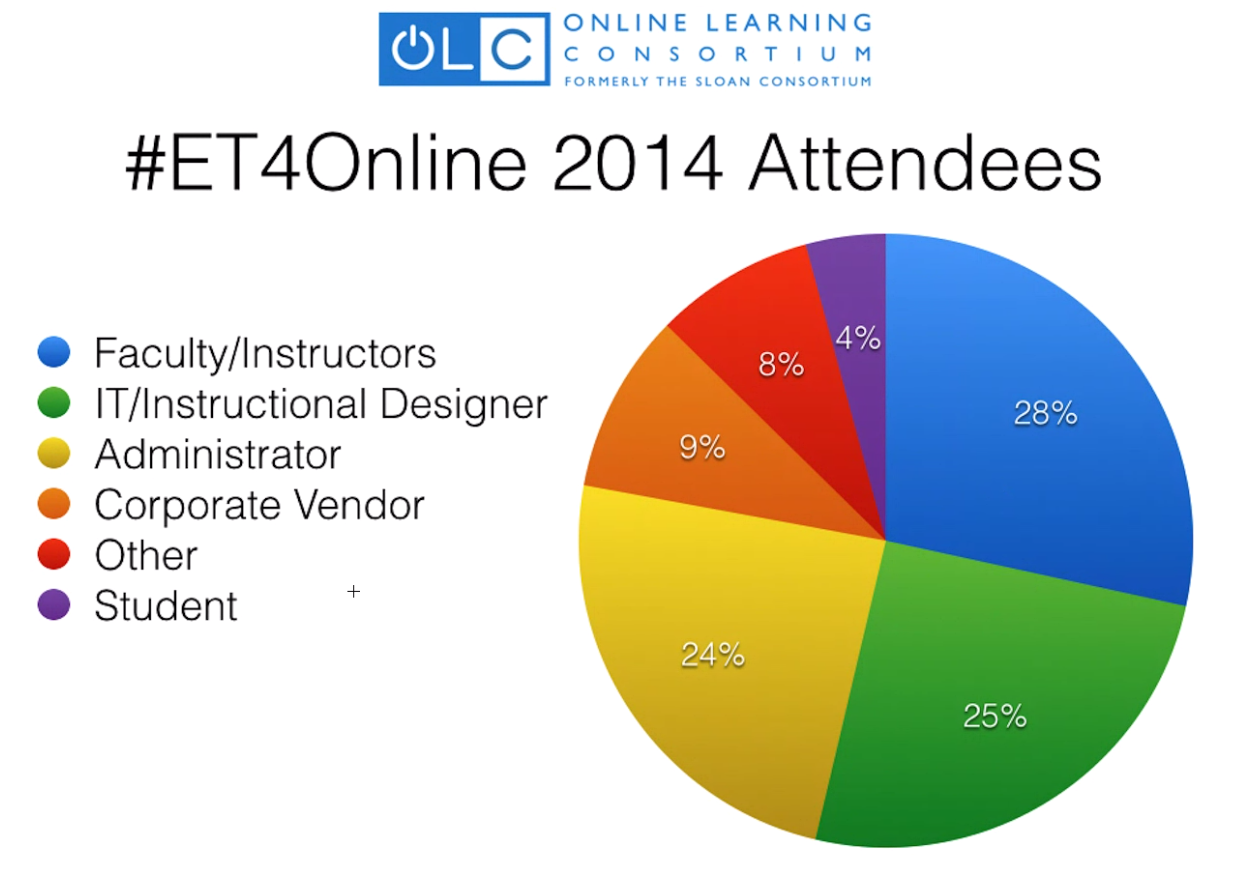
Who attends #et4online? (you might ask)

Who attends #et4online

Image c/o @brocansky

6 Reasons Why You Should Join Us for #et4online

Or hear what the #et4online Steering Committee Members have to say in today’s Google+ Hangout ON AIR (recorded):
Michelle Pacansky-Brock Conference Chair – @brocansky
Jason Rhode, Assistant Conference Chair – @jasonrhode
Jane Moore, MERLOT Program Chair – @janepmoore
Laura Pasquini, OLC Program Chair – @laurapasquini

Here are just a few of the MANY highlights for the #et4online program that we shared:

Interested in attending (virtual or on site)? Register TODAY! Early bird pricing ends on February 25, 2015. I hope to welcome a few of you to Dallas in April. Do you have questions about the conference or program? Want to know great places to find BBQ in Dallas? Want to get involved and volunteer? You know where to find me. I’d be happy to answer any/all questions. Hope to see you soon!

Book Review, Social Media

Book Review: The Etiquette of Social Media

At the end of last year, I was a lucky GoodReads.com winner of Leonard Kim’s (a.k.a. @MrLeonardKim) book – The Etiquette of Social Media: How to Connect and Respond to Others in the World of Social Media. As I teach a professional development class and write/research this topic, with regards to social media learning and performance, I thought this might be an interesting read to add to my shelf.
Thanks for the book @MrLeonardKimOur lives are more social and online. For those who say “in real life” or “IRL” – let me just tell you, social media is real life. There are less distinctions and divisions between our online and offline selves. That being said, there has been little provided to model good behaviors and polite encounters on social media platforms. Little Miss Manners ought to write a quick overview for social media; however I think that Leonard Kim got to it first with this book. There are a number of questions and situations that need to be addressed with individual use of social media, and Leonard Kim attempts to provide examples and strategies the following questions he introduces in this book:

  • Should we act however we want online?
  • Should we censor ourselves?
  • Are we supposed to act civilized on certain platforms but casual on others?
  • What happens if we encounter a bully [online]?
  • How do we start a conversation with a potential business partner, client or future employer?

When I read these questions, I immediately thought about the number of questions I am asked about using and interacting with social media on a regular basis:

  • Do I have to have a professional photo/avatar?
  • Should I include my full name on my social media platform or website URL?
  • Should I start a blog
  • Who should monitor our office social media account(s)? And how should this be done?
  • Should I have more than one profile to interact with my colleagues vs. students?
  • What social media spaces should I be active on to learn or network within the field?
  • Who can I go for help with my own social media development/use?

With in the influx of social media platforms and increasing amount of users within our professional online networks, there are a number of questions being added to both lists. This book was a light read, with some great points and examples for both my students and early career professionals/academics who frequent social media – or want to use it further learning and performance.

Kim’s book addresses the individual use of social media, and implications using these platforms might have in your personal and professional life. In other social media books, there is a directive for organizational content development, marketing, and/or business; however these text rarely mention how professional should interact and behave online. Kim offers examples of interactions and posts from common social media platforms, including Facebook, Twitter, LinkedIn and Quora. Although these tools might be used right now, he addresses acceptable behavior online in any forum and encouragers his readers to be nice and respectful. Other segments of this text address personal/professional goals that includes research, building a good reputation, being polite with interactions, connecting with others, and seeking out a mentor for advice. Many of these concepts can be applied to online communication and development; but really have a greater focus on professional growth and life objectives. In contrast, later chapters do detail the potential negative aspects for being active on social media, such as  negative comments, how to manage online attacks, and how to deal with cyber bullying.

The bonus final chapter identifies how to effectively reach out to a new contact and how to avoid awkward interactions with digital messages. This section is dedicated to supporting those who want to gain experience with effective “cold call” social media messages to potential peers, collaborators, employers, etc. To be honest, a number of my students could use the basics for effective e-mail drafting and see the examples provided in this chapter, including these common denominators for a successful message (Kim, 2014, p. 92):

  • Grammar is properly used.
  • Address the respondent by name.
  • Each message has a unique sense of personality, reflecting the messenger.
  • A heartfelt and genuine compliment is stated at the beginning.
  • Build common ground on points and based on initial research.
  • Show that you respect and value the time of the message recipient.
  • Provide a reason behind the message.

Overall, I appreciate how this book deals with social media and the individual use, specifically personal interactions and polite communication. For staff and faculty in higher education, Kim provides some helpful examples and useful facts throughout the book, and it is a quick read for your students.

Reference:

Kim, L. (2014). The etiquette of social media: How to connect and respond to others in the world of social media.
#TBT Blog

#TBT Blog Post #3: Resoluting. #oneword2015

In honor of the new year, I thought I would see how I resolved to do better in the past. I still agree with my earlier sentiments, as I will stick with reasonable goals and good behaviors for 2015 (like I have been working on in 2014). I typically have a few projects on the list, and over arching objectives for each year (and semester… and month). That being said – I have been more of a fan of the #OneWord idea to motivate and encourage the year ahead.

Last year my #oneword2014 was simplify. The purpose was not to have goals, but rather consider my process and space of where I worked and lived. I think I reached this objective, and I have trimmed down my life clutter. This year,  my #OneWord2015 is NOW to remind me to always be present. It is important to remember the past and, of course, plan for the future; however  it is often a challenge (for me, at least) to be present and in the moment — so I will use the word NOW to remind me.

By taking on the word now, I hope to be more thoughtful, and on-task with projects, research, writing, and teaching. I think it is critical to direct my attention to those who I am collaborating with for work, and family/friends in my life. The word now will serves as a mean to act intentionally and be present with those around me more. I also see the word “now” as a way to be. It is important to focus on what is directly in front of you, and to not always look down the road. There is much to be said to be content with what is happening and going on in my life. As a planner and with possible change (life, career, location, etc.), I know this will be a good challenge for me for 2015. Maybe I should have reverted back to my 2007 resolutions… wish me luck!

——

#TBT Blog Post #3:

Resoluting. [Blog post from 7th January 2007]

I am not one for resolutions. They never last. Goals are better. However this year I was inspired by Jeff’s Cheapest New Years Resolution post on his blog… or rather I wanted to create/post a few simple (yet clever) resolutions. Here’s what I came up with:

1. Catch up on missed “Lost” episodes (season 3).
2. Initiate more high fives.
3. Listen to one new song a day.

So far, so good. I watched the re-cap episode of “Lost” last night. I high-fived co-workers while watching Team Canada crush Russia to win the gold medal last Friday at the office. And I have enjoyed numerous new tunes on Pandora.com (thanks Jeff) to help with my listening pleasure.

Small and attainable objectives. It’s where it’s at, folks.

blogs, Reflections

2014: My Blog in Review

The WordPress.com stats helper monkeys prepared a 2014 annual report for this blog. Since WP put in the effort, I thought I would review my stats from the year — seems like the annual thing to do and all.

Here’s an excerpt:

The concert hall at the Sydney Opera House holds 2,700 people. This blog was viewed about 22,000 times in 2014. If it were a concert at Sydney Opera House, it would take about 8 sold-out performances for that many people to see it.

Who Views

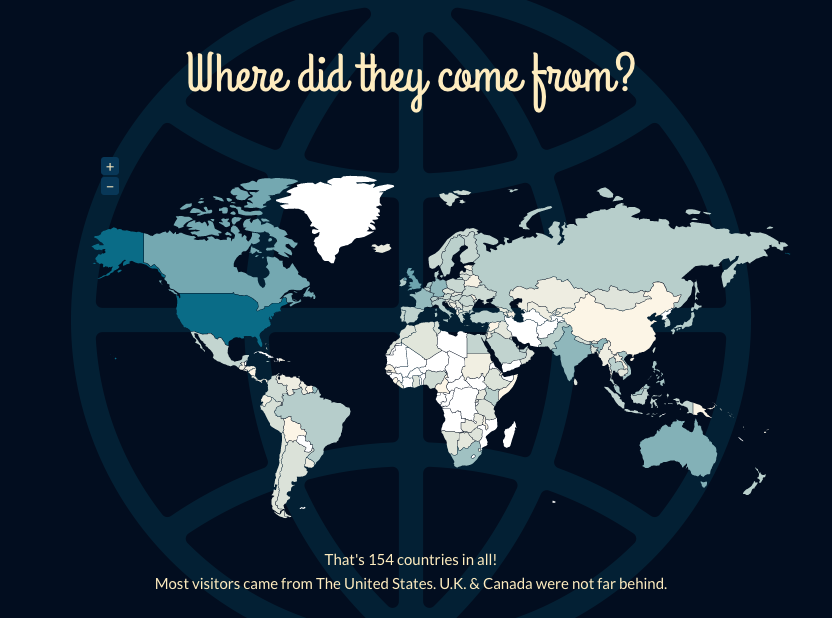
No surprise that America is my biggest audience — as that is where I live. I wonder how US-centric WordPress is in general, and how that impacts those who blog, write, share, and produce content here. I’ve been pondering content sharing online since that talk Laura Czerniewicz (@Czernie) gave on visibility and presence in scholarship in #scholar14.

“Some of your most popular posts were written before 2014. Your writing has staying power! Consider writing about those topics again.”

Maybe I was more interesting from 2010-2013? Or at least my post topics or titles were. Based on my click view stats from this year, compared to the last few years, my overall readership has decreased. Then again, it looks like I posted 48 blog posts total, which is down from from 59 post in 2013 and 62 posts in 2012. Perhaps I was a tad busy writing other things in 2014 (*ahem* Dissertation *cough*). It is no wonder why a number of readers decided to look back into the archives of this blog – top 5 hits included:

I am not concerned. I started and continue to blog to share ideas, reflect on learning and put a few things out there with regards to my own teaching, service and research scholarship. I blog for myself, and the community of practice who shares similar sentiments and values. It’s quality not quantity, right? I am honored to have a number of new followers and loyal subscribers from my PLN who read, respond, and engage.

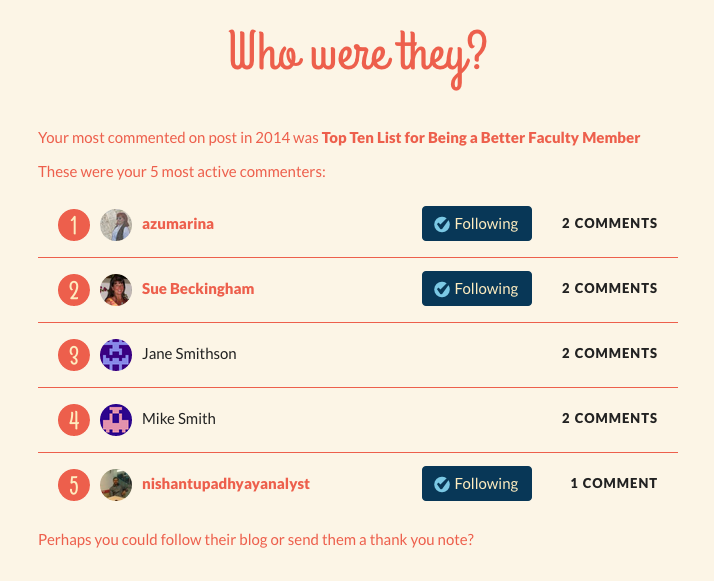
Top Commenters for 2014

I’d much prefer to get comments and thoughts shared on posts then just click views any day. Plus you never know what a blog post might lead to. Often it has been a new connection, collaborative writing, and even research fun – OH MY! {Yes – this even includes random meet ups and spontaneous dance/beach parties. True story.} Beyond my blog reflections, is where the real networked magic happens. These posts are really just a springboard to more learning, fun, and research.

If you care to learn more about the TechKNOW Tools stats from 2014, feel free to click here to see the complete report. Thanks to the many social platform links and even a shout out to Josie for referrals here. Happy blogging to all in 2015! Blog on.

p.s. Why the heck would I want to use the new WP editor? I much prefer the classic wp-admin mode ANY day for my blogging experience. Seriously.