Higher Education, Reflections, Teaching

Rethinking Office Hours

Office hours were designed to offer a space and place for learners to meet with their faculty. The practice of holding a “office hours” at every higher education campus, and even within a single department, varies drastically. Some institutions/departments set guidelines, whereas others see this as a service expectation that will automatically be assumed by the faculty member.

silly questions

Image c/o Flame @ KZK

The basic idea of faculty office hours was to carve out time to be available for your students. This set time each was is designated for the instructor to be in a physical, set space to offer support and assistance for courses, research, etc. In reality we know that only “a small number of students take advantage of office hours, [and] typically those who show up are not those who most need to be there (Weimer, 2015a). With increased use of technological communications, our students prefer to send a quick electronic message [email, learning management system (LMS) message, discussion board, text, tweet, etc.], to ask a question, seek advice, or get help.  So how do we “meet and reach” our students who are often juggling more than just school and cannot make the typical “office hour” on campus?  How do we make getting support more convenient for both the instructor and the student?

As an online instructor, I have experimented with a few approaches  the last couple of semesters. Although I work with online, adult learners – I think these strategies could also be useful for other faculty who instruct face-to-face (F2F) or blended learning environments.

A Few Ideas to Rethink Office Hours:

  1. Offer a standard “Office Hour” time slot at least 1-2x per week. This might be the day before assignments are due, or perhaps an evening hour after the typical 9-5 work day. You can indicate availability in your own office, by Skype/phone, IM, or via a web conferencing platform. You decide!
  2. Identify YOUR preferred mode of contact/communication. Let them know HOW and WHEN you will be checking and responding to their messages. Be sure to consider your own communication workflow – then share these expectations for your learners about your preferred protocol for related course communications.  Here are the best ways (in order) for students to contact me:
    • EMAIL: This is BY FAR the recommended method. My students know they will get a response from me within 24-48 hours by e-mail, and they are to include their course name, section, and ID in messages. This also allows me to track and keep a record of our conversations in a student file I save in Outlook.
    • Skype/Google Chat: A few of them have also utilized Skype/Google Chat for a quick instant message (IM) if I am Available (“green”) online.
    • Bb Learn Messaging/Email: I have decided to close the LMS messages on Bb Learn this term, to organize all incoming inquiries from students into my institutional email account.
    • Google Voice: I use a number set up here as my primary office number. Students have used it to leave web voicemails and/or text messages every now and then.
    • Twitter: I have also welcomed the odd Tweet here and there – but often these get tossed into another space for more than 140-characters. More so this is used to share news, information & articles via the course hashtags e.g. #LTEC4440, #LTEC4121, #LTEC4070 and #LTEC3010
  3. Require 1:1 meetings early in the semester (Weimer, 2015b). If possible, have a 1:1 meeting planning in your course schedule to discuss a final project/assignment. You can use this time to check in and allow your students to ask question. This introduces students to your “space” and often encourages them to follow up. Pro Tip: This takes time and organization for your own schedule. Only consider 1:1’s if you can manage it (30 students or less recommended), and if there is a specific purpose within your course design and learning objectives.
  4. Offer class meetings for group advising and support. Provide semi-regular meetings for your students. Ask your learners when a good class meeting time is via Doodle poll to help establish most available times during the semester to host these meetings. My courses often met in the evenings between 6-8 pm and online in a web conference platform (e.g. GoToMeeting, Zoom, etc.) room. These meetings were designed to offer information, updates, and a bite-sized instructional piece for my learners. In previous F2F courses, I had offered this sort of “meet up” after a campus event, in a seminar room, or even an off-campus coffee shop. For my graduate students in smaller classes, we would even conduct peer-review sessions in Google+ hangouts. Include an agenda for the meeting with the topics that will be covered and open discussion. Always solicit questions from your students in advance & leave time for Q & A at the end.
    • Pro Tip: Take questions you received from emails and include them into the class meeting advising sessions. Often learners might be afraid to ask during an open Q & A time, so “plant the question seed.” Students learn from other learner’s questions.
    • My incentives to attend our online (non-required) course meetings = advice on projects/assignments, helpful “how to” or demonstrations, and guest speakers (A BIG thanks goes out to Jess, Josie & Paul this term!).
    • Offer a recording and class notes for those who cannot attend, but want the supplemental information and resources.
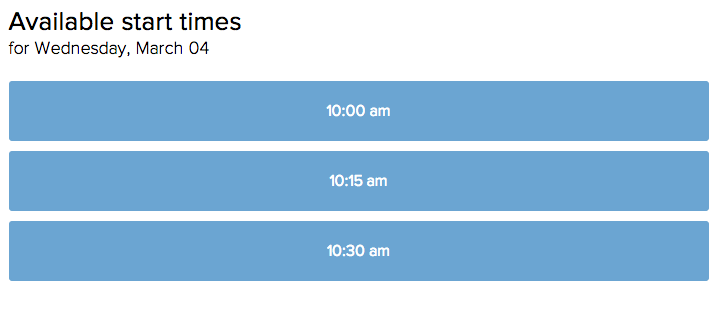
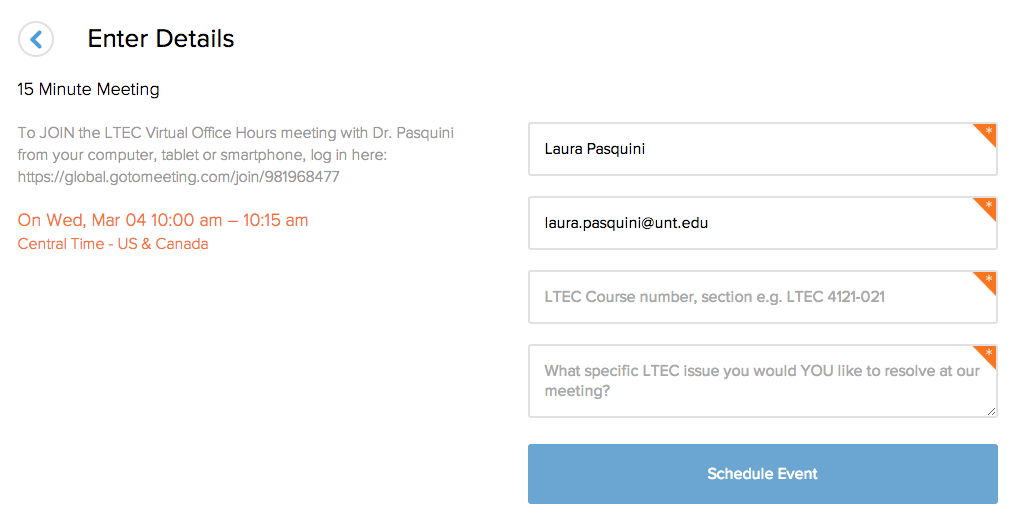
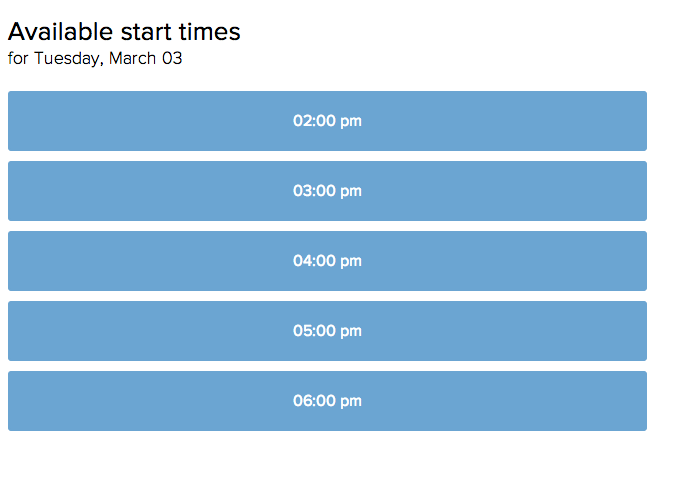
  5. Try offering “on demand” office hours. I use helpful scheduling websites with my Google Calendar to set up student meetings. Both youcanbook.me and calendly offer easy ways for learners to schedule 15-, 30- or 60-minute meetings, depending on my own personal work/travel schedule. Example of the calendly appointment scheduler below:

Step ONE
Screen Shot 2015-02-28 at 6.26.18 PM


Step TWOsched


Step THREE

book
 Step FOUR

Screen Shot 2015-02-28 at 6.51.51 PM

  • ProTip: Be sure have your students identify the purpose of the meeting. E.g. I ask, “What specific issue you would YOU like to resolve at our meeting?
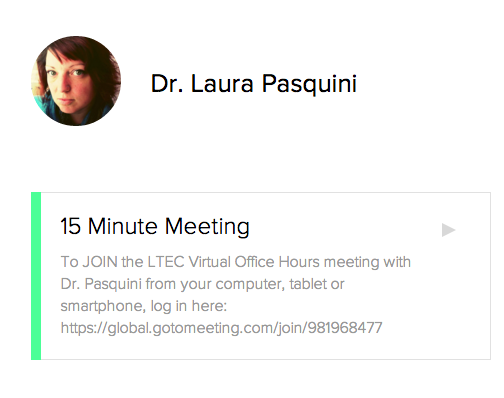
  • Dedicated meeting location: Since I lecture online, I decided to keep all my office hour meetings in a set GoToMeeting space that is standard for all my courses. This is included on the course syllabus, class announcements, and, most importantly, it is an accessible location – students can use their web or phone:

LTEC Virtual Office Hours with Dr. Pasquini” Please join my meeting from your computer, tablet or smartphone. https://global.gotomeeting.com/join/981968477

  • You can also dial in using your phone.United States (Long distance): +1 (213) 289-0012
    Access Code: 981-968-477 

I am still evaluating my own office hour approaches for my distance learners, so please feel free to share your strategies with me. How do you support your learners? What ways have you encouraged your students to connect with you for office hours? Do you have suggestions that I might want to consider for online office hours? Post your suggestions below!

References

Weimer, M. (2015a, February 17). Office hours alternative resonates with students. Faculty Focus. Retrieved from http://www.facultyfocus.com/articles/teaching-and-learning/office-hours-alternative-resonates-students/

Weimer, M. (2015b, February 18). Office hours redux. Faculty Focus. Retrieved from http://www.facultyfocus.com/articles/teaching-professor-blog/office-hours-redux/ 
HRD, Training, Training & Development

Does HR Influence Organizational Culture? #AHRD2015

Does the human resources (HR) function influence organizational culture?

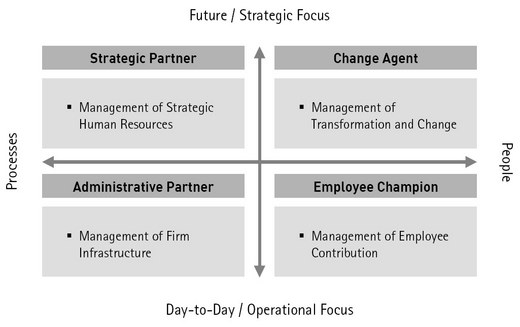
To review all four roles of Ulrich’s (1997) HR function model –  administrative expert, employee champion, change agent, and strategic partner – our 2015 AHRD abstract presents the results from our literature search to identify scholarly publications from 1997 until 2014.

ulrichs-matrix

In human resource development (HRD) research, organizational culture is “limited to the rational managerial perspective on culture, employees and organization” (Plakhotnik & Rocco, 2005, p. 97). The HR function impacts organizational culture, that is, the set of beliefs, values, assumptions, and perceptions that influence organization members; however a comprehensive review of the research further identified HOW organizational culture has been impacted by HR. This has also taken into consideration human resource management (HRM) and organizational development (OD), as strategic partners with HRD in discussing the HR function.

Copyright © 2015 Mariya Gavrilova Aguilar, A. Esther Joshua-Gojer, Denise R. Philpot, & Laura A. Pasquini

The critical importance of utilizing the HR function towards organizational culture influence, identified two key themes:

  • The role of the Human Resources function is evolving.
    • Performance is influenced by employees’ perceptions & interpretations of their organization
    • HRD can support change, changing organizational culture, connecting with organizational stakeholders, and approaches/strategies
    • OD activities focus on changing or improving organizational culture; limited research done how these activities actually impact organizational culture
  • The HR Function is a Change Agent.
    • A direct link between HR and social common structures such as climate and culture
    • Organizational effectiveness depends on its culture;  developed by various HRD measures incorporated in everyday organizational life

Implications for HRD and Practice

Organizational culture is positively affected by the HR function, specifically in the areas of recruitment, selection, training, development, performance appraisal, progressive discipline, and organizational diversity, and inclusion. This means that HRD scholars and practitioners will need to consider  to secure and develop talented employees through effective organization implementations and interventions. For the HR function to best support organizational culture, it will need to align its practices with the strategic organizational goals and develop innovative approaches.

References

Plakhotnik, M. S., & Rocco, T. S. (2005). Organizational culture: A literature review of the AHRD 1994-2005. Proceedings of the 2005 AHRD International Research Conference in the Americas. Miami, FL.

Ulrich, D. (1997). Human resource champions: The next agenda for adding value and delivering results. Boston, MA: Harvard Business Review Press.

edusocmedia, Social Media

How is social media being researched to support student development/success in higher education beyond the “classroom”?

I recently curated a  reading list of literature/research on social media and technology use, specifically outside the higher ed “classroom” for a colleague at Niagara University, Dr. John Sauter. For his Sociology of Higher Education course, John wanted to share readings that demonstrate how social media and technology are being utilized outside formalized learning, and provide more information beyond the Social Media Resources [from the WNY Advising group] the practical guides/strategies. A recent prompt from my #edusocmedia friend Ove, made me think that this short list should be shared and hopefully expanded upon – enter this blog post.

Screen Shot 2015-02-22 at 12.02.04 PMImage c/o mkhmarketing on Flickr

In searching online, you will find that there are no shortage of “how to” and “social media strategy” publications – which often bridge the marketing, communications, education, business, and student affair disciplines. A growing number of  bloggers also share suggestions for social media use, community development, and campus engagement; however  my focus was to find recent RESEARCH in post-secondary education that examined how social media and emerging technologies are impacting student life, support, and success outside the “classroom” (face-to-face, online & blended learning) environments.

To consider social media perceptions and use outside of formal learning environments, it is important to gain insight from recent studies around learning in higher education with technologies, including:

Junco, R., Heiberger, G., & Loken, E. (2011). The effect of Twitter on college student engagement and grades. Journal of computer assisted learning, 27(2), 119-132.

Junco, R. (2012). Too much face and not enough books: The relationship between multiple indices of Facebook use and academic performance.Computers in Human Behavior, 28(1), 187-198.

Junco, R., Elavsky, C. M., & Heiberger, G. (2013). PuttingTwitter to the test: Assessing outcomes for student collaboration, engagement and successBritish Journal of Educational Technology, 44(2), 273-287.

Junco, R. (2015). Student class standing, Facebook use, and academic performance. Journal of Applied Developmental Psychology, 36, 18-29.

Muñoz, C. L., & Towner, T. (2011). Back to the “wall”: How to use Facebook in the college classroom. First Monday, 16(12).

Roblyer, M. D., McDaniel, M., Webb, M., Herman, J., & Witty, J. V. (2010). Findings on Facebook in higher education: A comparison of college faculty and student uses and perceptions of social networking sites. Internet and Higher Education, 13(3), 134-140.

Rodriguez, J. E. (2011). Social media use in higher education: Key areas to consider for educators. MERLOT Journal of Online Learning and Teaching, 7(4).

Silius, K., Kailanto, M., & Tervakari, A-M. (2011). Evaluating the quality of social media in an educational context. International Journal of Emerging Technologies in Learning, 6(3), 21-27.

Wakefield, J. S., Warren, S. J., Alsobrook, M., & Knight, K. A. (2013). What do they really think? Higher education students’ perceptions of using Facebook and Twitter in formal higher education learning. International Journal of Social Media and Interactive Learning Environments1(4), 330-354.

**Shout out to Josie Ahlquist for also sharing a wealth of resources on her Reference List page related to this topic as well and more related to student development theory and youth culture in media!**

My focus for this class reading list, was to find recent (2011 forward) peer-reviewed publications that share implications and findings from research on how social media impacts support/success in higher ed beyond the instructional context. Yes. Student affairs, academic advisors, and the like, in student support areas of higher ed, ARE educators – however social media/technology use for learning without the weight of the grade “carrot” does impact and influence adoption/use. In looking around, I found a number of recent literature reviews and compilations that look at social media in higher education – here are a select few I thought I would share:

Davis III, C. H., Deil-Amen, R., Rios-Aguilar, C., & Gonzalez Canche, M. S. (2012). Social Media in Higher Education: A literature review and research directions.

Hew, K. F., & Cheung, W. S. (2013). Use of Web 2.0 technologies in K-12 and higher education: The search for evidence-based practice. Educational Research Review, 9, 47-64.

Lewis, B., & Rush, D. (2013). Experience of developing Twitter-based communities of practice in higher education. Research in Learning Technology21.

Rios-Aguilar, C., Canché, G., Sacramento, M., Deil-Amen, R., & Davis III, C. H. (2012). The role of social media in community colleges.

Tarantino, K., McDonough, J., & Hua, M. (2013). Effects of student engagement with social media on student learning: A review of literature. The Journal of Technology in Student Affairs.

Tess, P. A. (2013). The role of social media in higher education classes (real and virtual)–A literature reviewComputers in Human Behavior29(5), A60-A68.

For my own interest, I decided to conduct a preliminary literature search to determine “How is social media being researched to support student development/success in higher education beyond the “classroom”?  This is NOT a comprehensive list, but more of a primer to initiate a more comprehensive search for recent (2011 forward) scholarly publications involving research on this topic:

Al-Harrasi, A. S., & Al-Badi, A. H. (2014). The Impact Of Social Networking: A Study Of The Influence Of Smartphones On College Students. Contemporary Issues in Education Research (CIER), 7(2), 129-136.

Birnbaum, M. G. (2013). The fronts students use: Facebook and the standardization of self-presentations. Journal of College Student Development54(2), 155-171.

Chen, B., & Bryer, T. (2012). Investigating instructional strategies for using social media in formal and informal learning. The International Review of Research in Open and Distributed Learning, 13(1), 87-104.

Cheung, C. M., Chiu, P. Y., & Lee, M. K. (2011). Online social networks: Why do students use Facebook? Computers in Human Behavior, 27(4), 1337-1343.

DeAndrea, D. C., Ellison, N. B., LaRose, R., Steinfield, C., & Fiore, A. (2011). Serious social media: On the use of social media for improving students’ adjustment. Internet and Higher Education, 15, 15-23.

Fuller, M., & Pittarese, T. (2012, June). Effectively communicating with university students using social media: a study of social media usage patterns. In 45th Annual Conference June 10-14, 2012 (p. 46).

Graham, M. (2014). Social Media as a tool for increased student participation and engagement outside the classroom in higher education. Journal of Perspectives in Applied Academic Practice, 2(3).

Jacobsen, W. C., & Forste, R. (2011). The wired generation: Academic and social outcomes of electronic media use among university studentsCyberpsychology, Behavior, and Social Networking, 14(5), 275-280.

Lin, M. F. G., Hoffman, E. S., & Borengasser, C. (2013). Is social media too social for class? A case study of Twitter use. TechTrends, 57(2), 39-45.

Lou, L. L., Yan, Z., Nickerson, A., & McMorris, R. (2012). An examination of the reciprocal relationship of loneliness and Facebook use among first-year college students. Journal of Educational Computing Research, 46(1), 105-117.

Joosten, T., Pasquini, L. A., & Harness, L. (2013). Guiding social media in our institutions. Planning for Higher Education – Society for College and University Planners. 41(2), 1-11.

Mastrodicasa, J., & Metellus, P. (2013). The impact of social media on college students. Journal of College & Character, 14(1), 21-29.

O’Brien, O., & Glowatz, M. (2013). Utilising a social networking site as an academic tool in an academic environment: student development from information-sharing to collaboration and innovation (ICI). AISHE-J: The All Ireland Journal of Teaching and Learning in Higher Education, 5(3).

Pettijohn, T. F., LaPiene, K. E., & Horting, A. L. (2012). Relationships between Facebook intensity, friendship contingent self-esteem, and personality in US college students. Cyberpsychology, 6(1), 1-7.

Ternes, J. A. (2013). Using social media to engage students in campus life. (Doctoral dissertation, Kansas State University).

Sponcil, M., & Gitimu, P. (2013). Use of social media by college students: relationship to communication and self-concept.  Journal of Technology Research, 4, 1-13.

Wang, Z., Tcherneve, J. M., & Solloway, T.  (2012).  A dynamic longitudinal examination of social media use, needs, and gratifications among college students.  Computers in Human Beheavior, 28(5), 1829-1839.

If you have published any articles and/or have contributions for research in this area – please add to the list! Post any publication references in the comments or reach out to me to discuss further.  I suspect this quest will continue, and it will also need a few collaborators to be successful. Are you interested in digging into the research to learn more about HOW we are SUPPORTING students in higher education using social media beyond formalized learning structures?  Let’s talk – so we can move forward in understanding the research lay of the land.

EdTech, Higher Education, Online Learning

Research Wanted: Distance Education & Technology in US Higher Ed #DETAsummit

Last week, I was invited to join a group of educators, researchers, practitioners, leaders, and more before #eli2015 to discuss the state of online and blended learning at the DETA Summit (#DETAsummit), hosted by the National Research Center for Distance Education and Technological Advancements (DETA). With the primary role of the DETA Research Center “to promote student access and success through evidence-based online learning practices and learning technologies,” the morning’s agenda was full and the purpose of the DETA Summit meeting was to:

  • Gather key partners and research experts to generate of ideas
  • Brainstorm crucial issues in conducting research and developing coherency in the field of distance education
  • Discuss ideas relating to competency-based education, accessibility, and distance education support

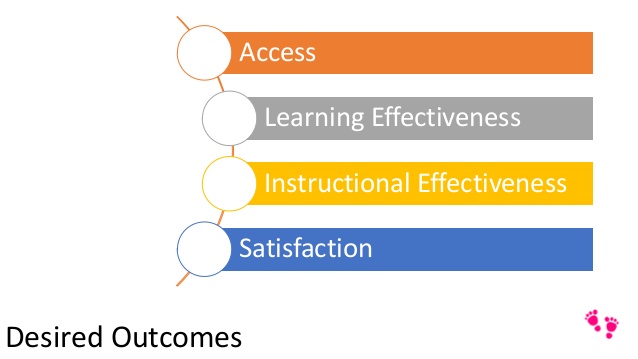
The DETA Research center has desired outcomes that focus on access, satisfaction and learning/instructional effectiveness – read more about these from the grant HERE:

Desired Outcomes

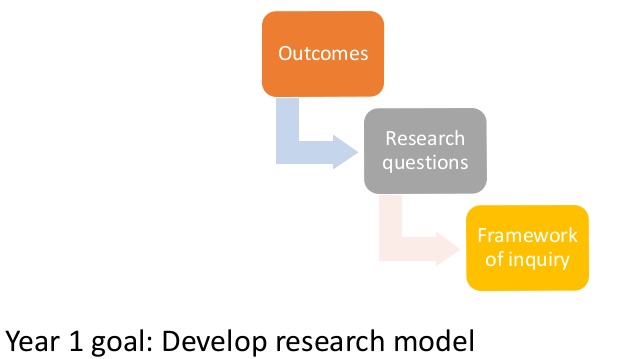
At the #DETAsummit a wide variety of folks gathered with interest to discuss what research should look like for technology and distance education. Looking around the room, it was like a tweet up of all online learning  levels of support, instruction, development, planning, and research from around the US.  The focus of the meeting was to work on the DETA Yea 1 goal: Develop a research model.

Research Model

In facilitating one of the many round tables discussions, our group swapped ideas about potential research questions that should be asked, common definitions under the distance education umbrella, standard variables to measure, known frameworks for inquiry, and shared models being used for online/blended learning assessment. Although we were only given about 3 hours in total, I think the entire room was buzzing with ideas and wanted to continue talking. The conversations were driven to list our top choices on large post-its and vote on top our top choices after seeing what other groups discussed [See post-it voting from my Flickr album]. For the short amount of time, I think the #DETAsummit  was a very productive, and we managed to gain some broader insight into what a research model could look like. With a mixed participant list, there were insights and questions  from varying perspectives and it was rather REFRESHING.

Based on the small group discussions and voting process, the research questions selected are:

  • What are the definitions of success from student’s perspective? | 33 | Wicked Hop
  • What patterns of behavior lead to increased student learning for different populations? | 26 | Safehouse
  • What are the different design components (content, interactivity, assessments) that impact student learning? | 29 | Rochambo
  • How can we define and measure student success beyond traditional outcomes (learning and competency)? | 25 | Benelux

If you are interested in distance education research (e.g. online learning, blended learning, hybrid pedagogy, etc.) I would suggest digging into the conversation and resources from the #DETAsummit. The DETA group is very open and transparent with their development process, as you can find our discussion notes shared in Collaborative Google Docs, listen/view the G+ Hangout Recording, and check out the Presentation Slides that give an overview of the day.

Congratulations to the DETA Team (who I now call the #DETAdivas) on a successful start to the work you have ahead. I look forward to following along with your progress on the grant, learning how your group utilize these research questions, and, hopefully, contributing to a better way to measure/assess online and blended learning.

DETAdivas

Want to stay connected to the research?

EdTech, Horizon Report, Learning Technologies

What’s On the Horizon [REPORT] – 2015 Higher Ed Edition

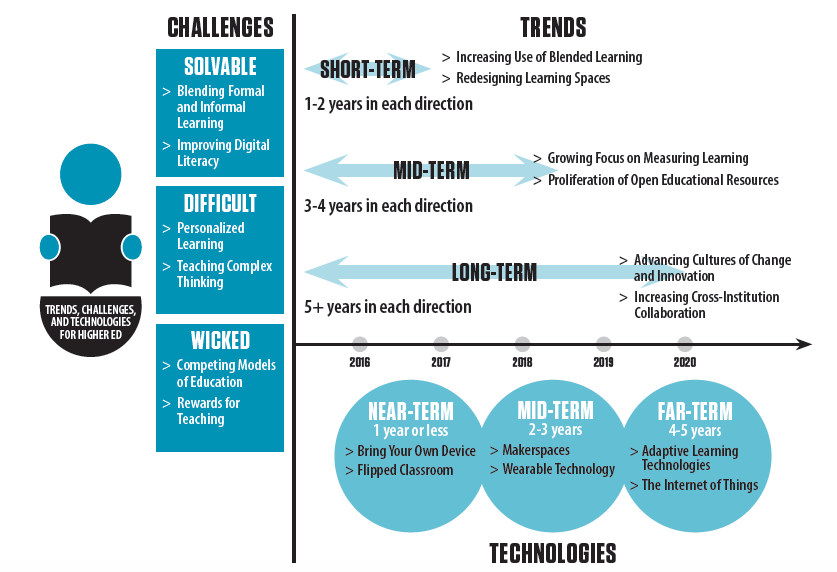
The New Media Consortium (NMC) just put out the NMC Horizon Report – 2015 Higher Education Edition last week to share what is ahead in technology and learning in post-secondary for the next few years. This report identifies the trends, challenges, and specific technologies we might see in higher ed over the next 1-5 years.


TopicsHR2015


Image c/o Johnson, Adams Becker, Estrada, & Freeman (2015)

Key trends expected to be adopted in educational technology in higher ed (from the report) include:

  • Evolution of online learning
  • Rethinking learning spaces – what our learning environments and mediums are
  • Increasing focus on open educational resources (FINALLY. Hello, OER!)
  • Rise of data-driven learning and assessment (the good, the bad & the ugly)
  • Agile approaches to change (Really? Where? Sign me up, Higher Ed!)
  • growing important of open communities and university consortia (Looking forward to this)

Significant challenges impeding ed tech adoption in the post-secondary education realm include:

  • Adequately defining and support digital literacy
  • Blending formal and informal learning
  • Complex thinking and communication
  • Integrating personalized learning
  • Competition from new models of education (dare I say MOOCs)
  • Relative lack of rewards for teaching (duh!)

Important developments in educational tech for higher ed include:

  • Bring your own device (BYOD) – I think it’s because we had to…
  • Flipped classroom
  • Makerspaces
  • Adaptive learning technologies
  • The Internet of things

If you work in learning technologies or distance education, much of this report is not “new” – however it gives some insights and examples of what is ahead in the post-secondary landscape. If you working in higher education, I suggest you DOWNLOAD and review your own copy. Not all these trends and predictions are surprising  – but it is always good to know what others are working on in the field of #edtech. Happy reading!

Reference

Johnson, L., Adams Becker, S., Estrada, V., & Freeman, A. (2015). NMC horizon report: 2015 higher education edition. Austin, Texas: The New Media Consortium.