Podcast

Behind the Podcast: How Do you Pod, #HigherEd Hosts/Producers?

There seems to be growing number of higher ed podcasts. These are podcasts produced for, by, and about different aspects of higher education. This might be about the life of a faculty member, academic writing, teaching, scholarship or a particular discipline. There are a number of postsecondary podcasts about student affairs, learner support, technology, marketing, admissions, and general things happening at colleges and universities. I know this as I have been analyzing a few of these lately (here: https://higheredpodcasts.wordpress.com/) and I’m preparing to help others create their own podcasts (i.e. students, staff, and faculty).

Confession time: I may have started podcasting with @BreakDrink in 2010; however, I am really learning how to podcast now. In a recent conversation with Jeff on the last episode of BreakDrink, we had a candid conversation about how we tinkered and cobbled together our past and current podcast episodes … and the things we learned along the way.

From live episodes on BlogTalkRadio  and YouTube Live (formerly Google+ ON AIR LIVE hangouts) to thinking about audio, editing, and then some now,  we break down what’s behind our podcasting curtain in episode #30. Jeff and I also reflect about the process of thinking about WHAT you want to talk about and the WHY would you podcast — because recording and EDITING takes some effort to make it sound quality. These are some of the MANY things I have been thinking of for this form of digital storytelling… and there is more to come.
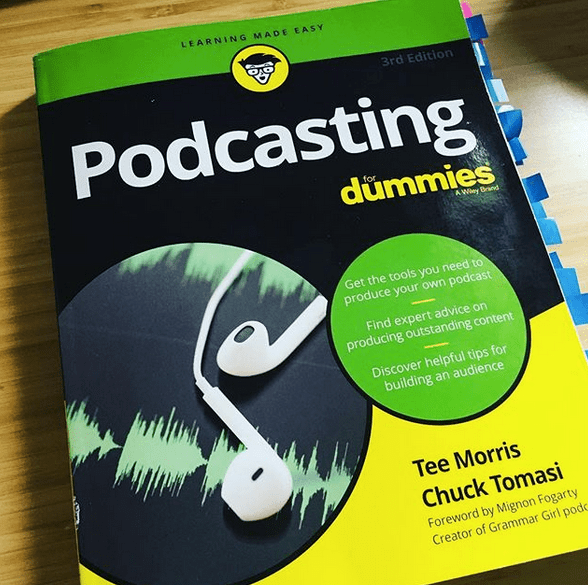
So much has changed in podcasting. There are so many MORE podcasts, different types, and others flooding into the audio market of narratives, interviews, panels, and promotion on the streams. There is SO much available to make a podcast that Podcasting for Dummies is on it’s THIRD edition (I know this, as I am studying and preparing my lessons with this text now!) and ways to share, host, and subscribe. There is NO shortage of “learn how to podcast” blog posts and websites that are a mix of hype, promise, and expensive equipment funded by search engine optimization, click ads, and empty promises to encourage you to buy into the hosts book, materials, etc. Some of this is good, and much of this is crap — as there are easier ways to start a podcast and play with this medium, if you are interested.

So… that being said, I thought I’d reach out to my own community to aggregate information from actual podcasts that I listen to in higher ed. I am doing this to share with campus stakeholders I’ll be working with over the next couple of months to share the work you do, how you do it, and, of course, promote YOUR podcast. My hope is to aggregate resources, promote your pods, and create a cohesive Creative Commons resource to share with my learners and YOU! This effort is to go “behind the podcast” (I miss you VH1) to understand how higher ed friends create and make their podcasts. I hope you can share resources, advice, and ideas for current/future pod producers, hosts, and makers. If you podcast or know someone who does in postsecondary education, please contribute to offer insights to peers about your technical troubleshooting and  audio experiments in the land of the pod here:

http://bit.ly/behindthepodcast
Here is the basic information I am hoping to aggregate in this open doc. It would be great to learn about the how, where, and what you podcast for your own higher ed pod AND feel free to add what you want based on these prompts:

  • Podcast (name):
  • Host(s):
  • Website or Where it Streams:
  • Social Media:
  • Describe your pod (brief description about the type of podcast/format):
  • Hardware (mic, earphones, etc.):
  • Software (recording, editing, etc.):
  • How do you host/produce your pod (in-person, Skype, etc.):
  • Where do you record (describe and/or post a photo) – share your #podcaststudio:
  • Hosting Services (Libsyn, Buzzsprout, SoundCloud, etc.):
  • Resources, reads and/or advice for podcast hosts/producers (things you’ve learned):

Thanks pod friends! I appreciate your help. #PodSaveHigherEd
#HEdigID

#HEdigID Chat No. 8: #SocialMediaLife These Days

Love it or hate it, social media is a part of our daily lives. It’s not a trend or fad that is going away. Social media is deeply embedded into our every day activities, how we communicate, how many find news and information, and it supports our relationships near and far. Almost everyone, young and old, are now active in various social media platforms due to the tethering there is to portable smart devices (phones, tablets, watches, and more) and increased access and availability to the Internet (WiFi, 4G, etc.).  After listening to the recent @mozilla IRL Podcast episode “Kids These Days” with Veronica Belmont, Manoush Zomorodi, and Alexandra Samuel, I was concerned about if the “kids” were alright — that is the teens AND adults who have report daily social media.

The two 2018 reports from the US are interesting to compare how we are thinking about our #SocialMediaLife whether we are young or old:


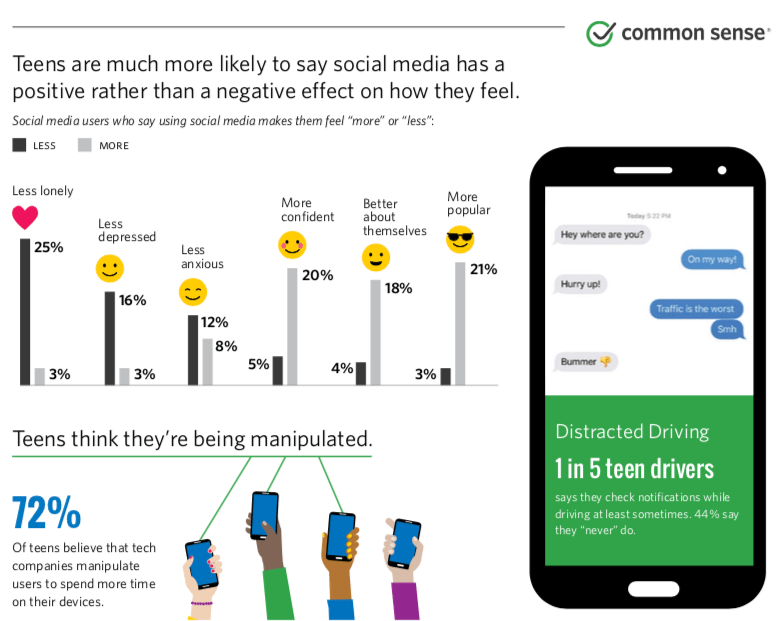
Social Media, Social Life: Teens Reveal Their Experiences (2018)via @CommonSense Media (n=1,141)

  • 89% of teens with a smartphone (ages 13-17)
  • 70% of teens who use social media multiple times a day
  • Snapchat (41%), Instagram (22%), and Facebook (15%) are the social media sites these teens use the most
  • 72% of teens believe that tech companies manipulate users to spend more time on their devices

Social Media Use in 2018 Report* via @PewResearch (n=2,002)

  • YouTube (73%), Facebook (68%), Instagram (35%), Pinterest (29%), Snapchat (27%), LinkedIn (25%), Twitter (24%), and Whatsapp (22%) of US adults say they use social media online or on their cellphone
  • A majority of adults visit Facebook (51%), Snapchat (49%), Instagram (38%), Twitter (26%), and YouTube (29%) on a daily basis

*That being said, I’m curious what the future report of adult social media use will be after learning about Facebook data scraping at congressional hearings, recent visits to congress by Twitter and Facebook, and questions if we should break up with these social media platform monopolies (e.g. Facebook, Instagram and Whatsapp). I suspect much has changed since this report was released in March 2018.

Much of the recent #SocialMediaLife of Teens shared in the recent Common Sense study is reflecting what I am learning about adults on these platforms as well. As Veronica said, “Teens. They’re just like us!” There is a growing concern about behaviors, practices, and social interactions among my peers who need role models and mentoring just as much as the youth. There are similar patterns and concerns about #SocialMediaLife I am learning about from higher ed professionals (faculty and staff), my adult learners (online and face-to-face students) and among my peers (friends, family, colleagues, etc.). There is no shortage of emotions, thoughts, reflections, and reactions to how we are now thinking about social media in our lives. Let’s unpack this recent report about teens to see how much different we actually feel about these social platforms in our day-to-day life. Join me for the open, online conversation, won’t you?

#HEdigID CHAT TOPIC: #SocialMediaLife These Days

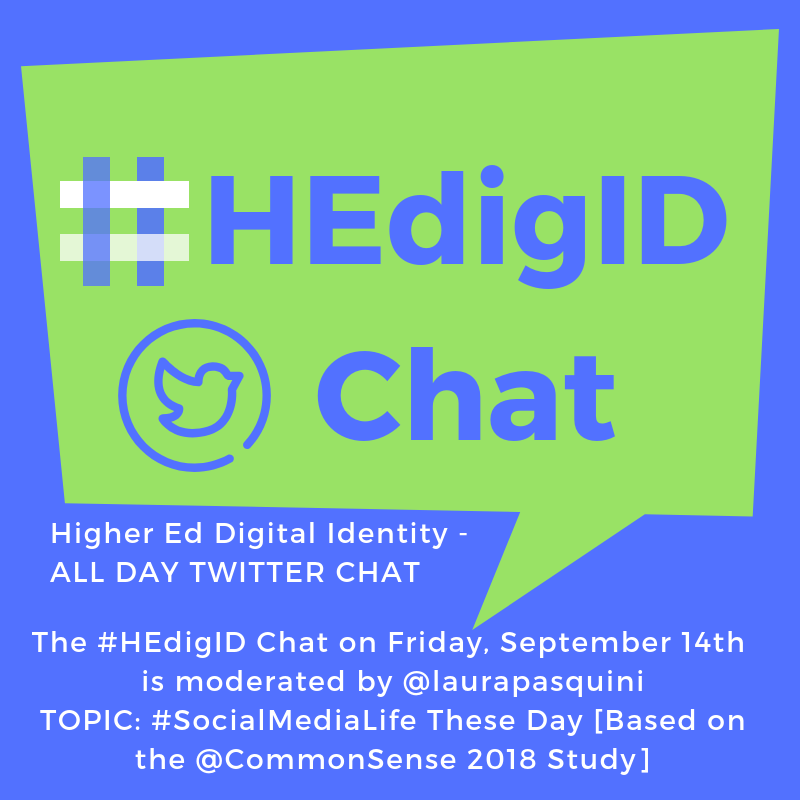
The next Higher Ed Digital Identity SLOW chat will be on Twitter with the hashtag: #HEdigID and #SocialMediaLife paired with this OPEN Google doc of questions: http://bit.ly/hedigid8

Learn more about the #HEdigID Chat and review the QUESTIONS in that will be posted on Twitter and in the Google doc the discussion ALL DAY on FRIDAY, September 14, 2018:

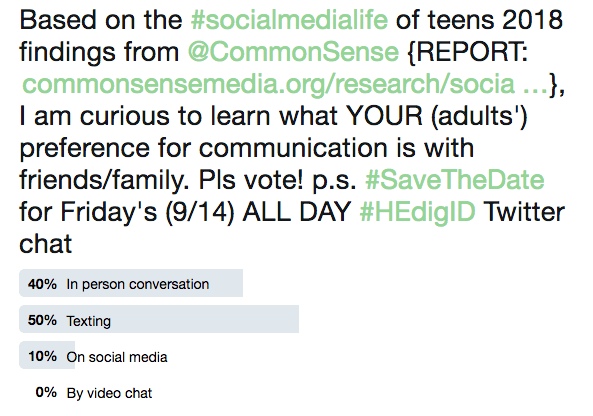
  1. What is your preferences for communication with family/friends? VOTE NOW HERE: Twitter Poll
  2. Related to #HEdigID Q1: Has using #socialmedia and your devices changed the way you communicate with friends, family, colleagues, etc.? Please share how your #SocialMediaLife or how technology has shaped the ways you interact and communicate with others.
  3. The @PewResearch report from March 2018 found that a majority of adults visit Facebook (51%), Snapchat (49%), Instagram (38%), Twitter (26%), and YouTube (29%) on a daily basis. Is this true for YOUR own practice? Please share your thoughts/use on these platforms now.
    • VOTE: Identify the ONE social media platform you use the MOST on a daily basis {Twitter Poll to be added}
  4. In looking at the @CommonSense #SocialMediaLife of Teens Study 2018 [https://www.commonsensemedia.org/research/social-media-social-life-2018], was there anything that stood out in this report that YOU want to talk about today? [Developing questions and prompts for the #HEdigID chat for later].
  5. “72% of teens believe that tech companies manipulate users to spend more time on their devices” @CommonSense What is your perspective on how your devices and these #socialmedia platforms strive to get your attention? How do you deal with this distraction? #socialmedialife
  6. “Teens are much more likely to say #socialmedia has a positive rather than a negative effect on how they feel (e.g. less lonely, depressed, anxious and more confidence, popular, etc.)” @CommonSense Does this resonate with YOUR feelings about your #SocialMediaLife? Please share.
  7. #HEdigID QUESTIONS & OPEN CHAT: To be determined (see question no. 4 and respond!)…

Join the discussion on #SocialMediaLife today:

  • Tweeting your response with the hashtag: #HEdigID

  • Answer IN this Google Doc: http://bit.ly/hedigid8

  • Use these questions to draft your own reflection OR response (e.g. blog, video, audio, drawing or discussion)


Update: Transcript from this #HEdigID chat can be found HERE

#HEdigID

#HEdigID Chat No. 7: Managing Digital Overload & Stress

It’s August, which means the start of Fall college/university semester is just around the corner. I’m not entirely sure if I am ready for summer to be over; however, I do know that one of my own goals before school begins was to make sure my digital life was in order and ready. Fortunately, the August Higher Ed Digital Identity (#HEdigID) Chat welcomes Paul Eaton (@profpeaton) as the guest moderator (MOD) for Friday’s (8/10) #HEdigID chat slow, all-day Twitter chat. Thanks to all who participated in the discussion last month. There was an active conversation over a few days for the #HEDigID no. 6 on Open Ed Practices in July, and a thoughtful and kind reflection from contributors/lurkers.

To reflect on our digital lives, Paul has prepared questions and prompts to encourage us to think about how to better manage our networked practices before it manages us. Here is more about the August #HEdigID chat topic, Managing Digital Overload & Stress:

Digital tools, platforms, applications, and hardware are often heralded for their ability to connect professionals, openly share resources and knowledge, and build communities of practice across geographic spaces.

Digital tools and social media spaces have ushered in new stressors for professionals in higher education.” ~ Paul Eaton

Some of these we know about anecdotally – the fear of missing out, the hidden expectation of constant connectivity, comparative stress such as imposter syndrome, or stress from online conflict. Other stresses of the digital age we may be less cognizant of – for example, bodily stress induced by consistent eye strain, sitting or typing on digital devices. There may even be good stress, as in the recent article from Meier (2018) on how the comparison can drive us to perform better.  The purpose of this month’s #HEdigID chat will be to examine the many ways digital tools, spaces, and places, contribute to stress in our lives (both good and bad), and how can we manage that stress effectively as professionals.

Reference:

Meier, A., & Schafer, S. (2018). The positive side of social comparison on social network sites: How envy can drive inspiration on Instagram. Cyberpsychology, Behavior, and Social Networking, 21(7). https://doi.org/10.1089/cyber.2017.0708

#HEdigID CHAT TOPIC: Managing Digital Overload & Stress

The next Higher Ed Digital Identity SLOW chat will be on Twitter with the hashtag: #HEdigID and within this OPEN Google doc: http://bit.ly/HEdigid7

Learn more about the #HEdigID Chat and review the QUESTIONS in that will be posted on Twitter and in the Google doc the next discussion on FRIDAY (August 10th):

  1. Today we are talking about Managing Digital Overload and Stress. Tell us who you are, what you do, and what brings you to the discussion?
  2. This is a big topic. What are some issues, questions, and concerns you would like to address around the topic of “Managing Digital Overload and Stress”?
  3. How do you define digital overload? In what ways does a digital overload manifest in your professional and/or personal life?
  4. How do you define digital stress? What are some ways or symptoms you feel that technologies and your online life impact your stress levels?
  5. Not all digital stress is bad – so how does being connected and online motivate the work you do in #highered?
  6. Let’s talk about managing your digital life and work. What are some strategies and practices have you implemented to deal with digital overload and stress?
  7. Let’s talk about tools for your digital life and work. What are some tools or resources you use to manage your digital life?

Join the discussion on managing your digital life by:

  • Tweeting your response with the hashtag: #HEdigID

  • Responding directly IN this Google Doc: http://bit.ly/HEdigid7 {the “HE” is capitalized}

  • Use these questions to draft your own personal reflection and response (e.g. blog post, video, audio, drawing or offline discussion)

Update: Transcripts from the #HEdigID chat from August 8th are HERE

#AcDigID, #EdDigID, #HEdigID, Research

HOW TO: Set Up Your ORCID

ORCID Logo image c/o the Wikimedia Commons

What Is an ORCID? https://orcid.org/

An ORCID is a unique 16 digit ID for researchers, academics, and scholars. The ability to set up an ORCID personal account is that it allows you to attach a specific digital identifier that distinguishes you from every other scholar, and it is free! I encourage most collaborators I research and write with to set up their own account, as this persistent digital ID is often used as an integration tool for a number of journals and grant applications. Plus it’s often used as to sign in to complete some academic conference proceedings and/or to peer review manuscripts for journals. Additionally, other key research protocols integrated into digital portals for scholarly work may also require an ORCID. Additionally, an ORCID account allows you to aggregate other digital professional activities or networks (e.g. ResearcherID, LinkedIn, etc.) and scholarly outputs into one online space to ensure your work is recognized and credited to you!

ORCID around the world from ORCID on Vimeo.

Having an ORCID will help:

  • Allows your work to be discoverable by others.
  • Provides a means to distinguish between you and other authors with identical or similar names.
  • Links together all of your works even if you have used different names over the course of your career.
  • Makes it easy for you & others to connect to research outputs (e.g. journal log in, grant funders, etc.)
  • Ensures that your work is clearly attributed to you.
  • Helps minimize repetitive data entering – when submitting manuscripts for publication or applications for grants – systems using ORCID will help pre-populate your contact details/information.

Where are ORCID in Use? 

  • By publishers in manuscript submission and data repositories.
  • By some professional societies to manage membership, authorship, and conferences.
  • By some funding agencies (e.g. NIH or SciENcv) to generate the required bio sketch.
  • By some metrics tools, such as Impactstory.org.  Add ORCID to you Impact Story profile to import your citation information – and view to see altmetrics displayed for your publications.
  • By researcher profile tools (e.g. ResearchGate, Mendeley, etc.).


SET UP YOUR ORCID:

  1. Start by Registering for an ORCID iD here: https://orcid.org/register
  2. If you have any questions or issues with this setup, be sure to visit the Create an iD: Website User site: http://support.orcid.org/knowledgebase/articles/171598-create-an-id-website-user

Here is a “how to” Video for ORCID registration c/o the Research Medical Library: 

#HEdigID, Open Education

#HEdigID Chat No. 6: Open Educational Practices with @SuzanKoseoglu #OEP #OER #OpenEd

It’s almost Friday, July 13th, which means it’s time to get ready for the monthly Higher Ed Digital Identity (#HEdigID) Chat! I am excited to expand the #HEdigID conversation to welcome Suzan Koseoglu (@SuzanKoseoglu) as a guest moderator (MOD) for this slow Twitter chat. In preparing for the #hedigid MOD -ing role, Suzan has developed a list of questions and prompts to facilitate this ALL DAY discussion on Open Educational Practices (#OEP) she details further:

There has been growing interest in digital Open Educational Practices (OEPs) in recent years as evidenced in the increasing number of research papers, reports and conference presentations on the topic and in the discourse on open practice in general. Although OEPs are mostly discussed in the context of OERs, mostly in terms of OER creation, adoption and use, it is actually a multidimensional construct which encompasses many different dimensions of open approaches and practices. These may include open scholarship, open learning, open teaching/pedagogy, open systems and architectures, and open source software.

“A focus on open practice is important because it shifts the focus of open educational initiatives and efforts from access to process: the process of learning, teaching, designing.” ~ Suzan Koseoglu

The process of co-construction, active and meaningful engagement. It is also a call to think deeply and critically about openness, a call for a deeper investigation into the relationship between technology and education, and the complex interaction between educational resources, methods of teaching, the institutional culture and available support mechanisms

To prepare for this conversation around open ed practices, here is a bit more information to review before the upcoming #HEdigID Chat:

#HEdigID Chat TOPIC: Open Educational Practices (#OEP)

This SLOW chat can be found on Twitter with the hashtag: #HEdigID and within this OPEN Google doc: http://bit.ly/hedigid6

Here are the QUESTIONS you will see appear on Twitter and in an open Google doc for the FRIDAY (July 13th) #HEdigID ALL-DAY discussion:

  1. Today we are talking about open educational practices (OEP). What questions or issues do you want to discuss related to this topic?
  2. What is open educational practice for you? How would you define it?
  3. Let’s build a thematic timeline of open practice collectively! When did you first engage in an open practice and why? – We’ll share the results soon at #HEdigID after the Twitter chat.
  4. TWITTER POLL:  Higher Education institutions recognize and reward open scholarship (e.g., OA publishing, open teaching, open sharing, networked learning) as a valid form of academic scholarship.  [VOTE: (a) I agree; (b) I don’t agree; or (c) I don’t know]
  5. How do open educational practices (OEPs) impact your digital identity?
  6. TBD based on responses to Q1

Join the discussion on open educational practices by:

  • Tweeting your response with the hashtag: #HEdigID

  • Responding directly IN this Google Doc: http://bit.ly/hedigid6

  • Use these questions to draft your own personal reflection and response (e.g. blog post, video, audio, drawing or offline discussion)


UPDATE: July 14, 2018 to include the Twitter chat transcript:

#HEdigID Chat Transcript, No. 6: Open Educational Resources #OEP (July 13, 2018)