Academia, AcAdv, Learning Community, Professional Development, Reflections, SAchat

Your Digital Self & Online Community: Let’s Twitter Chat About It #SAchat & #AcAdv

In my last blog post, I asked if you have thought about your digital self and what it means to be a “resident” in various spaces and places online.  This is a common question I pose and ponder with higher ed colleagues and friends I work with, connect with online, meet face-to-face, and now as I collaborate on research looking at Networked Communities of Practice. When it comes to digital participation there is no right or wrong. That being said, sometimes I think of this quote from the Sydney MCA as our lives continue to evolve online:
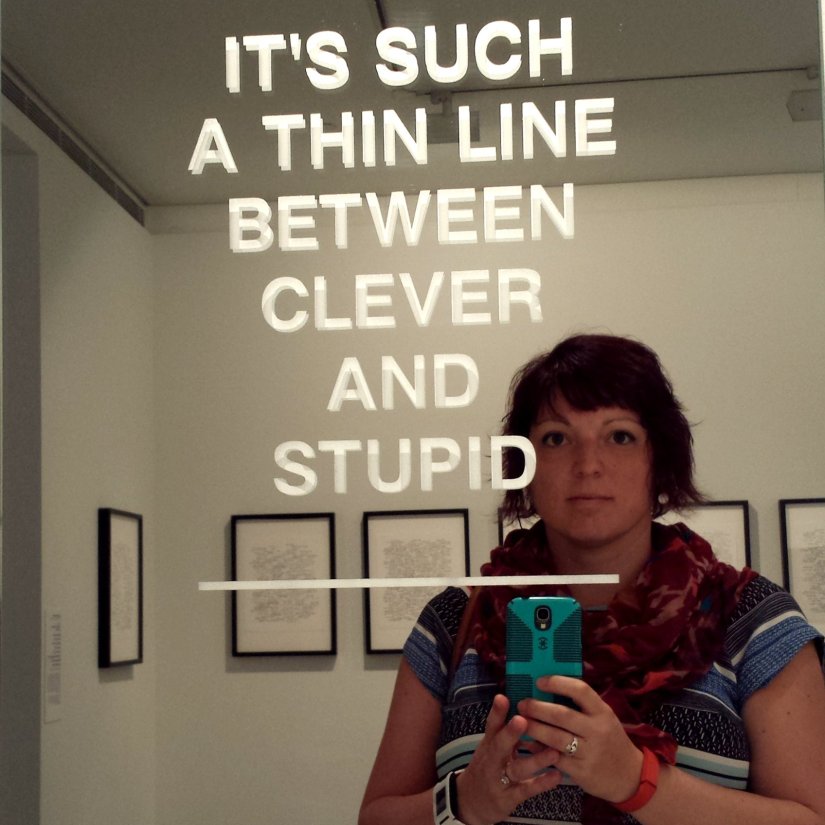
19500948685_f2386f3e10_oLast year, the TED Radio Hour podcast featured TED speakers who dug into what it means to be digital and connected in its two-part episode, Screen Time, Part I and Part 2The segments dive into how the digital version of ourselves are impacting who we are. There is one quote, in particular, that resonated with me from Jon Ronson’s segment in Part 2:

“The way we are defined on social media, on the Internet, and on Google has become more important than who we actually are as people.”

Ronson’s TED talk presents ideas he writes about in his book So You’ve Been Publically Shamed. His segment “How can our real lives be ruined by our digital ones?” discusses how the online self is impacting our offline self. With the recent US election, there are no shortages of examples of tasteless social media shares and volatile toned posts displayed online. The election is not the cause of this behavior; however, these type of actions and interactions within the higher ed community online are disheartening. If you are presenting your actual self online (and not an anonymous profile/account) the expression “in real life” or “IRL” no longer applies. What we do inside the screen does impact our life beyond the screen. What happens digitally and on the Internet IS IN REAL LIFE (exit distance worker soapbox rant for now).

As Inger puts it very well, there are some “academic assholes in the circles of niceness.” If you are on the social web and in higher ed, there is no doubt that you have witnessed more cruelty than kindness from your colleagues and far less empathy or compassion from your fellow practitioners in online communities.  For many of us who live our working life online, I think “our second selves” are impacting who we are.

Maybe it is also time for some reflection and perhaps a candid discussion about our digital self and our online communities. Thanks to two online communities — #SAchat and #AcAdv — we’re going to get real and talk these issues in higher ed in these upcoming Twitter Chats:

#SAchat TOPIC:

Personal and Professional Identity on Social Media & Online
sachat_logo

Thursday, December 1, 2016 for the DAYTIME #SAchat from 12-1 pm CDT; Follow @The_SA_Blog on Twitter

Let’s discuss what it means to “grow up” professionally online and offline in higher education. What motivates you to interact, engage, and share? What social networks and hashtags do you connect with for your work in student affairs and higher ed? Has being online impacted what you do professionally or personally? Share with us about your own digital identity development, specifically how it influences who you are and your work on campus. 

  • MOD for the DAYTIME #SAchat (12/1/6); TOPIC: Personal and Professional Identity on #SocialMedia & Online [Chat Transcript ARCHIVE]

#AcAdv Chat TOPIC:

Learning Online With And From A Community of Peers
acadv_chat

Tuesday, December 6, 2016 for the #AcAdv Chat from 12-1 pm CDT; Follow @AcAdvChat on Twitter

Let’s have a conversation about how online networks and digital spaces support your professional and personal well-being. Where do you learn online? What communities contribute to your work and success in #higher ed? Tell us how these networked communities offer resources, share ideas, and offer care for you, your professional role, and your personal growth.

If you work in higher education and care about these issues, please join in on one or both discussions on Thursday (12/1) and next Tuesday (12/6). We look forward to hearing what you have to say on the topics…Twitter Chat soon!

Do you have questions about this or our research team, please feel free to contact us or suggest a way you would like to collaborate!
Conference, edusocmedia, Higher Education, Reflections, StudentAffairs

Have You Thought About Your Digital Self Lately?

While working on today’s workshop for the National Conference on Student Leadership (NCSL), I was listening to the recent Higher Ed Live broadcast with Ed & Josie talking “Engaging the Digital Generation” (an NDSS book they edited, and I contributed to — I promise to follow up on a blog post on this topic later). I was not surprised, but often wondered why student affairs (SA) and higher ed folks often go directly to technology:

//platform.twitter.com/widgets.js

Why do practitioners in higher education, student affairs, and students services always go to the “tool” question first? Why do we want to know what’s “hot” with the digital, social technologies? Is it easier to think about a specific app, device, or platform? Why don’t we ask about the challenges or issues the technology is solving?  A wise supervisor once told me: Study problems, not things. The “thing” I’m thinking about are technology tools and platforms.

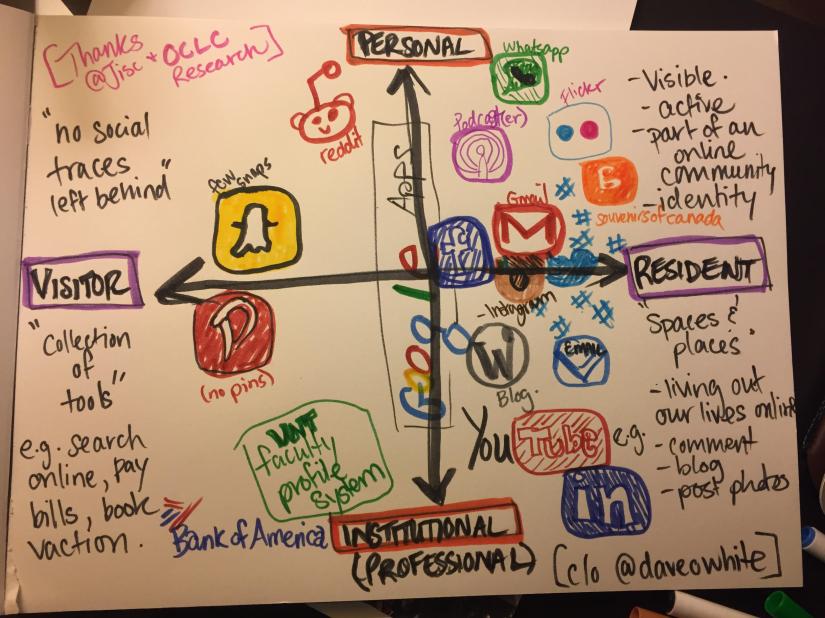
I am more interested how our campus stakeholders engage and interact with social and digital tools. What is their motivation and how are these online networks being utilized? Perhaps we should challenge professionals in higher education to start thinking about their own presence. I think it’s a good idea to reflect on our own contributions and social traces we are leaving in digital spaces and places [Hence why Paul & I are are studying just that: https://networkedcommunityofpractice.wordpress.com/] .  I really like the Visitors & Residents Continuum (White & Le Cornu, 2011) concept, which is also shared by Dave White (and colleagues from OCLC & Jisc) via a few resources and videos. Visitors tend to leave no social traces in the digital world. If you are Resident you are visible, active, and leave a part of you online in many spaces and places. If you have not heard of this concept, here’s a quick overview of the mapping process for visitor and resident in a personal and institutional (professional) context:

I think more thought and reflection into HOW and WHY we use these online networks and digital apps are needed. Here’s a start of my own visualization of my visitor and resident spaces & places — more will be added this afternoon during my NCSL Professional Workshop:

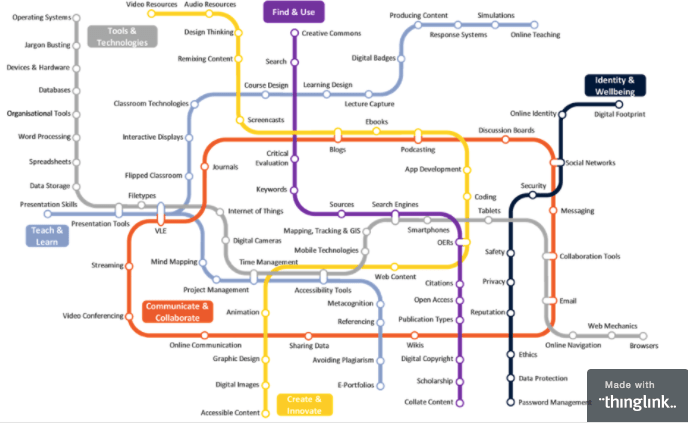
v_r_map_pasquiniHave you mapped your own V-R continuum lately? It’s an interesting process to think about and visualize. If so — please share and/or blog about it! To further this idea, what are the digital skills we need to hone within higher education? Here are a few suggestions organized on a metro map around digital skills:

digitalskillsframework

//www.thinglink.com/card/707638257155833857

This digital skills framework map was a solid start, but it definitely needs to be added to – what are your thoughts on this topic? How are you engaging and interacting with these spaces and places? What do we need to learn and bring to campus when it comes to digital understandings of self? How are you thinking about your resident vs. visitor self online? Show and share!

Reference:

White, D. S., & Le Cornu, A. (2011). Visitors and Residents: A new typology for online engagement. First Monday, 16(9).

#OLCInnovate, Learning Technologies, Reflections

The #OLCinnovateSDS: Our Re-Cap of the Plan, Design, & Pitch at OLC Innovate 2016

The inaugural OLC Innovate (#OLCInnovate) conference brought over a thousand educators, EdTech-innovators, and learning designers to New Orleans. This year was the inaugural Solution Design Summit (SDS) in which diverse teams of institutional stakeholders, campus partners, and EdTech innovators came together to solve learning challenges. Nine teams were selected to participate in the summit and pitch their learning solutions.

About the Solution Design Summit

Following OLC Emerging Technologies conference (2015) ideas from the “Teacher Tank,” we wanted to know, “How can we use the pitch format to design a solutions-based space for teams to work on solving a learning problem?” What resulted was the 2016 Solution Design Summit.

The SDS call for team proposals required participants to submit a learning challenge and a proposed solution to be worked on by an interdisciplinary team. The nine selected SDS teams then produced a 2-minute video trailer to describe their project. You can watch the 2016 SDS Video Trailers on YouTube or review the full SDS program here: http://bit.ly/olcinnovatesds16

Design Thinking Is A Process

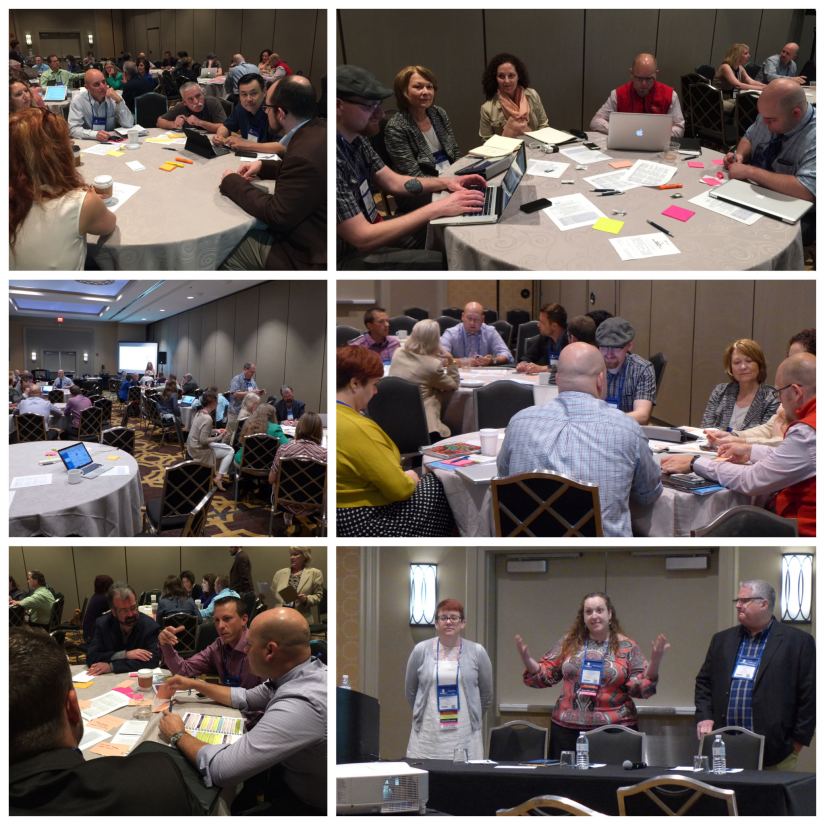
During the Summit, a 3-hour pre-conference working session, the teams identified critical success factors for their learning solutions, gathered feedback from external stakeholders, and used design thinking to refine their “pitch” presentations. During the #OLCInnovate conference, teams delivered their 10-minute pitches in one of three concurrent sessions. The SDS pitches were evaluated by a panel of invited judges and audience participants.

OLCinnovateSDS_2016_Montage

The SDS challenges

The Solution Design Summit asked teams to work on increasing learner success in one of the following four areas: personal and adaptive learning; professional learning and development; the impact of open learning; or choose your own learning challenge.

Listed below are the nine SDS teams. Click on any of the titles to find out about each SDS team’s challenge and solution:

And the Winners are…

The 2016 SOLUTION DESIGN SUMMIT WINNING TEAM is . . .

OLCSDSWinner

Image mashup c/o Tony Dalton from the SDS Muhlenberg College Team

Creating Pathways to Digital Peer Leadership in the Liberal Arts

Team members:  

  • Lora Taub-Pervizpour, Associate Dean for Digital Learning, Professor of Media & Communication at Muhlenberg College
  • Kathy Harring, Dean of Institutional Assessment & Academic Planning, Professor of Psychology at Muhlenberg College
  • Sean Miller, Manager of Media Services at Muhlenberg College
  • Thomas Sciarrino, Manager of Instructional Technology and Digital Learning at Muhlenberg College
  • Anthony Dalton, Digital Cultures Media Technician, Digital Media Design Lab Instructor at Muhlenberg College

Summary: Like many liberal arts institutions, Muhlenberg College is exploring the role of the digital in our mission, goals, and practices.  We believe that digital spaces, pedagogical practices, and tools can amplify our liberal arts mission and values, and support deep relationships between teaching and learning, appreciation for diverse ways of knowing, and an education that prepares students for citizenship and lifelong learning. At the heart of our student-centered environment is a nationally recognized peer-mentor model.  Our goal is to create an innovative peer education model that empowers students to develop the relationships, skills, and competencies the need to excel as leaders in digital learning contexts.

Kudos to the COMMUNITY CHOICE award for….

If You Build It, Will They Come?

Team members:  

  • Tracy Stuntz, Instructional designer, lead LMS trainer at California State University, Fresno
  • Jean-Marie Venturini, Instructional designer, lead LMS trainer at Otis School of Art and Design
  • Rex Bartholomew, New Model Development Administrator at Toyota

Summary: The challenge we’re facing is faculty/client attendance at non-mandatory (but needed) training events is low. The focus is on reasons for faculty/client lack of attendance, and how to reach and motivate participants.

Thank You To All Who Played In the Solution Design Sandbox!

A big thank you to the invited stakeholders, judges, audience members, and the SDS planning team who supported this program. Kudos to ALL the SDS teams for your amazing pitch presentations! By asking teams to work on a solution before meeting together and then creating iterations of their work, we know that this type of conference project proposal was not simple. We hope each team received valuable input, feedback, and considerations to bring to their institutions and companies. This was the first year of the Solution Design Summit, and we hope to see a similar track at OLC Innovate 2017 and anywhere educators, designers, and ed tech innovators gather at a conference.

Thanks and much love from the #OLCInnovateSDS: 2016 SDS Planning Team,

#3Wedu, OLC, Podcast, Reflections

#3Wedu Podcast #4: Women Who Innovate in Higher Ed [#OLCInnovate Recap of Session]

Last week, I was fortunate to meet up with a number of friends and colleagues at OLC Innovate (#OLCInnovate if you’ve been learning from the backchannel) in New Orleans. There’s a great deal I have to reflect upon about my conference experience; however that will be saved for later. What I do hope to share a bit about is the Conversations that Work session on Women Who Innovate in Higher Education: Challenges & Strategies. During this session, we hosted a few small-group discussions prompted by questions we shared: http://bit.ly/olcinnovate3Wedu16

//platform.twitter.com/widgets.js

For those of you who joined the 45-minute conversation, THANK YOU. By starting and continuing the conversations, I think we have already left this gathering  with more solutions than challenges for women in higher education.  These round-table conversations were great! I was fortunate to facilitate one of the 6 tables/circles who shared insights and experiences of women in higher ed. I appreciate the openness and thoughtfulness shared by the participants — specifically with regards to sharing challenges and suggestions to move more ladies forward at our institutions and within the field.  To be fully engaged in the conversation, I jotted down some notes pen-to-paper style. Here are a few highlights I can translate from my scribble, which might be interesting to dig into tomorrow (4/27) or in future #3Wedu podcasts: 

  • Education qualifications & Work Experiences: Do women require a Ph.D. vs. men who only have a masters degree? Or do women believe they have to “do more” to prove ourselves? This might include additional work experience(s), degrees, skills, etc.
  • Image of Women Leaders: The concept of “friendly” or a certain image is required by female leaders — this includes image, dress, language, and management style. Or do women take on “masculine characteristics” to lead and move up the career ladder – is this required? Expected?
  • Role on a Team: As a team member are their certain expectations of self and others? Are more women motivated and/or empowered by male vs. female supervisors? What aspect does culture at an institution play on this team environment?
  • Mentoring: Do we have enough time or make enough time to mentor other women in the field? It is important that we see strong female leaders, and also their vulnerabilities (i.e. the holistic view of the leader)
  • Work-Life Balance: Is this part of the institutional/organizational culture? How can this change? Organizational decision-making is relevant to improving and supporting a healthy balance of work in various roles and positions held by women.
  • Geography & Transitions for Career Advancement: Are women less portable to move or relocate? Do we have to move (geographically or to another institution) to move up in higher education? Is this a choice vs. a sacrifice? Are positions more flexible for men vs. women, in terms of promotion or advancement? Discussions on this topic included making geographic or career transitions based on life milestones, children, career development, negotiation with a partner for career planning, etc.
  • Solutions to Challenges — How can we improve women’s status in higher education?: Continue these conversations, continue to build our network of peers, consider restriction for communication (email, text, etc.) to encourage a work-life balance, consider looking at formal or informal policies that create barriers for women, think about opportunities to empower female colleagues on campus, movement needs to be asserted not just from female leaders, create “safe” spaces for women to speak up or out about challenges, and review how your institution embraces diversity within the organization or the division/unit/department considers the role of women.

Here is the challenge we left session participants with:

What can you do when you return back home to your institution after the conference? What is one thing you will work on to support and/or empower women within your campus community?

Above is the recording from this past Wednesday, April 27th @ 3 pm PST // 5 pm CDT // 6pm EST as we recap our experiences from #OLCInnovate. Here is the Google+ ON AIR Event Page where you can tune in LIVE or post comments, our Google Doc for show notes http://bit.ly/3Wedu4 and YOUR #OLCInnovate reflections (please add), and, of course, the podcast hashtag: #3Wedu for those who tweet along the backchannel. Here are the #3Wedu Twitter discussions from curated from #OLCInnovate in NOLA & our 4th podcast.

If you are interested in staying connected to be up-to-date on the monthly WomenWhoWine.edu (#3Wedu) podcast and other events — just  let us know!  Please complete the following #3Wedu Podcast Community Google Form

ACPA, ACPAdigital, Professional Development, Reflections

Introducing the 2016 @ACPA Powered By PechaKucha Night at #ACPA16

With the 2016 ACPA Convention just around the corner, I am so excited about the upcoming events and happenings in Montreal. As a member of the #ACPA16 Technology Programming Team (Shout out to our awesome chair Brian and fantastic planning posse: Erica, Jason, Kristen, Amanda, and Idriss), we have been busy organizing a number of program events like the Genius Labs, High Tech Room, and the “PK Talks.” I am really looking forward to the stellar ACPA Powered By PechaKucha night happening on Tuesday, March 8, 2016 from 7-10 pm in Palais des Congrès de Montréal, 517 C & D and on the backchannel with our event hashtag: #ACPA16PK.

acpa16_PK_welcome Join ACPA’s innovation movement and attend ACPA Powered by PechaKucha during the convention! PechaKucha is a simple, but innovative and challenging presentation format where presenters show 20 images, each for 20 seconds that cover a wide range of topics, ideas, perspectives and thoughts. Our goal is to create an exciting and uplifting atmosphere that is full of good thought and new ideas that will help advance the field of higher education. The event will include comfortable seating, coffeehouse lighting, a cash bar, and phenomenal presentations. A number of outstanding presenters who have had an impact on the association and higher education have been selected for this inspiring event will be welcomed by the co-hosts, Idriss Njike and moi! Here is the schedule line-up and a little bit “about the  PechaKucha talk” for this year’s event ACPA Powered by PechaKucha™ event:

UPDATE 3/9/16 – All the TWEETS shared on the #ACPA16PK Hashtag

UPDATE 3/25/16 – Videos from the #ACPA16PK are embedded below… enjoy!

PechaKuka Speakers

ACPA Powered by PechaKucha™ Talks

Paul Brown

Your Professional Network is Powered by Bacon

Many people have said that student affairs is a small profession. In this PechaKucha, the concept of “six degrees of separation” will be explored as it relates to professionals’ historical lineage and connection back to some of the founding members of the field.

Jacqueline Mac

“Where Are You From?”: A Complicated Question

Through exploring the concept of “home” and where “home” is for a group of displaced people for generations, this PechaKucha will attempt to answer the question, “where are you from?” This talk highlights storytelling as a tool for liberation, where voice and perspective is at the center.

Michael Goodman

Honoring Parentless Students

The landscape of families is changing, and “Mom’s Weekend,” “Dad’s Day,” and, “The Office of Parent Programs,” are no longer relevant to all students. Let this PechaKucha serve as a charge to you and your campus, with hope that we’ll adjust our practice to truly support all students.

Sarah Molitoris

Making the Impossible Possible: Lessons from Cirque du Soleil

Explore lessons from the whimsical world of Cirque du Soleil as they connect to student affairs work. Applying creativity to our work allows us to seek new ways to connect, create innovative environments and inspire ourselves, and those around us, to reach for the possibilities.

Hamza Khan

The Stress Paradox

Student affairs professionals are working longer and harder than ever before, and are at the risk of burning out (if we haven’t already burned out). It’s time to re-think stress, develop resilience, and make the transition from overachiever to high performer.

David Ip Yam

Supporting Francophone Students beyond the Classroom

The government of Ontario has made significant investments to increase access to French-language postsecondary programs. Learn about the imperatives and challenges of supporting Franco-Ontarian student life and success in minority settings.

Stacey Pearson-Wharton

Failing to Succeed: A Guide for Falling and Getting Back Up

Everyone has slipped fell down, failed, made a mistake..this is your chance to get back up again and thrive!

Kristen Perry

The Little Red Bird

Sexual assault is a scary and uncomfortable subject. This talk will walk you down a path of recovery, highlighting how a little red bird made a difference. This talk will give a voice to the stories that need to be told, and focus on the importance of empowering and supporting survivors.

PECHAKUCHA INTERMISSION BREAK

Bailey Parnell

“Dark Side of Social Media”: Social Media’s Impact on Mental Health

Yes it can be fun, but what else is happening out in the world of social media? How is it affecting our mental health and the mental health of our students? “The Dark Side of Social Media” will examine the current social media landscape, highlight the undesired effects it has on us every day and provide next steps for how to improve this situation.

Josué “JQ” Quiñones

Touch For Success

The sense of touch is a simple, yet powerful form of communication that can transform campus cultures and lead to more success.

Josie Ahlquist

What the Class of 2020 Doesn’t Know about Social Media

There is a difference between use of social media and leadership on social media, both for the incoming class of 2020 and student affairs professionals.

Tricia Seifert

Success isn’t Linear: It’s Geometric

Popular media cheats students out of the richness of college in its obsessive focus on defining success as a degree that leads to a high-paying career. “Success isn’t Linear, It’s Geometric” will introduce a success in all of its wonderful complexity.

Brittany Williams

Moving Beyond Identity Development: Why #DigitalActivismMatters

Digital activism empowers students and practitioners alike to address issues of social injustice and create multi-media platforms to acknowledge and celebrate their individual, cultural, and political identities. Session attendees will gain contextual understanding of the historical and social environments that inform digital activism, and its implications for campus and popular culture.


Keith Edwards

“Putting My Man Face On”

How do college men understand what it means to be a man? How do they construct their gender identity and manage their gender performance? What consequences does the performance have for others and themselves? What can we learn from their voices?

Stephanie Muehlethaler

Home and Abroad: Global Citizenship Identity Development Through Service Learning

Global Citizen. The term is everywhere in higher education. What does it even mean? Can any student develop and identify as a global citizen? This talk will explore one researcher’s questions around what constitutes a global citizen and whether or not all students have access to this identity.

Craig Bidiman

Revolution on Canvas: Art Therapy, Mental Health & the Job Search

This talk focuses on the often unspoken mental health aspects of the initial post-grad job searching in higher education. I will bring in my experiences with depression and anxiety and how I used art to not only cope with those issues, but also create a powerful networking tool!