Digital Literacy, Needs Assessment, Networked Practice, privacy, Reflections, technology

My Digital Audit: Where Do I Want to Be Online?

Do you know how much we weave social media platforms and online technology companies into our daily lives? Would it be possible to not live with Google, Facebook, Apple or other technology companies? It’s been something I have been thinking about for a while (like others), and often how much do we test these questions in the wild. If you have not seen the technology blocking experiment conducted by @Gizmodo‘s reporter, Kasmir Hill, you should. Kahsmir tries to take on and live without the technology giants, Amazon, Facebook (which includes owned companies, Whatsapp & Instagram), Google, Microsoft, and Apple. Impressive, right? But is it impossible? Even if you don’t plan to say, “Ciao!,” to these platforms this “Goodbye Big Five” investigation and hands-on reporting will inform you about how much we let these companies invade (most) of our lives, take our money, use our data, and capture our attention.

It is far too easy to sign up or sign on to websites, apps, and platforms with a simple click. No need to read those terms of service agreements. Nah! Also, all you need is my email, mobile phone number or one of those big tech accounts to sign up (e.g. Facebook, Google or Twitter), than why not join? Apps and social media platforms want to make our online user experiences fluid and seamless — which also allows the same platforms and apps to track your digital movement and access your personal data through your connected accounts.

Image c/o Vitor Sá: https://www.flickr.com/photos/virgu/12496426/

For the past 6 years, I have been doing an alright job of tracking of my digital life and auditing where/how I am online. I use a simple spreadsheet to itemize the account name, log in, information, connected accounts, purpose, and more for this digital audit. If interested, here’s a blank spreadsheet you can copy/download to use as you review your apps and online accounts yourself:

Digital/Web Audit TEMPLATE

That being said, it has been a while since I have given it a proper review to include where my personal data lies and maybe the social media apps, online accounts, and forgotten sign-ins that I have not really examined as closely. It is no longer easy to use JustDelete.me and a delete button to remove your data from online accounts. Our existence online is more complex and often woven into one another between the platforms we use and the shifts in these mediums. Maybe I have grown up a bit, but so have these digital platforms, and I’m not so sure they have matured into the tech adults I would like them to be. Here are a few platforms concerns with and why I’m considering closing a few of my own social media spaces, just to name a few:

Beyond policies, practices, and costs, I was trying to determine where I want to “live” online and what it means now that some of these platforms have merged or have experienced new management change. Back in January, I facilitated a workshop about managing your digital identity and being a professional online in higher education. Some of the big questions I challenge participants to reflect about as they consider their online self and where they want to be include:

  1. Why do I want to share my knowledge and expertise? What interests me about “being” online and maybe even connected to my peers?
  2. Where do you want to be online? How do I want others to find and connect with me?
  3. What digital/social platforms would be best for how and what I want to share? Where will I find my professional networks online?

I shared how my own digital presence or “being” online has evolved. Although I used to be in a log of social and digital spaces, that is not the case anymore. A number of platforms have been deactivated (RIP Google Reader & Delicious). While others might have been just a platform to test out or try on. That being said, if something does not resonates with me or find a purpose in my digital life, than I’m okay to say goodbye. So, if any digital space or online place does not “bring you joy” (hat tip to the digital #MarieKondo practice), maybe it’s time to bid farewell. Here is the main focus of my personal digital and data audit:

Where do I want to be online?

Some of my digital self review has been going on for a while, but this year is the year to finish and probably shut down a few social media platforms and online accounts for good. Permanently. It’s time to simplify my streams and declutter my social (media) life. I have started the process and initiated the review of the audit spreadsheet to determine what accounts are active and to itemize what is happening online. Here are a few things I did to start this digital and data audit of me:

  1. Unsubscribe: I used Unroll.me to start the initial clean up and unsubscribe of email lists, advertising, listservs, and duplicate groups/listservs from all my email accounts (personally/professionally).
  2. Revoke/Remove Connections: By logging into your social media platforms, online apps, and digital accounts, you might see you have granted 3rd party access to other applications/users/accounts — remove said things.
  3. Identify the Accounts Where Your Personal Information Lies: Using the various emails, I used Deseat.me to get a list of my accounts and apps that I have signed up for to identify and delete the ones I am not using OR to add these to my digital/web audit spreadsheet to track. This method offers a GDPR message template (thanks, EU GDPR!) to send a template email to the platform administrator to remove yourself from online and social media accounts. This might (and does) require follow up messaging, emails, and sometimes confirmation contracts to remove your information and personal data from certain accounts. It might take some time to get responses and confirmations for deleting yourself from various platforms, communities, or online programs (I know. I am in week 4 of this process.)
  4. Download Your Personal Data: For the accounts and platforms you are thinking about deleting, consider downloading your account data. This might be an archive of activity, posts, etc (e.g. Facebook). Or it could be a files, images, and other items within each account (e.g. Flickr). Part of this download may require you to determine storage elsewhere, such as, in another cloud-based service OR external hard drive (or both). Figure out the how much of data and your use of it, to determine your next steps.
  5. Delete Yourself: Depending on your goals, you may just want to wipe your accounts online to remove all that is there. There are a few guides to get yourself off the grid to get you started. Deseat.me will remove your data and delete some of your accounts, but you will need to visit each account/platform you have to manually complete the deletion process. Check out these suggestions for finding/deleting accounts from the Internet, a list of “how to” delete yourself from social media platforms, and suggestions for deleting (or locking down) your Facebook and Instagram accounts.
The above is just a start — but I thought I’d share what I’ve been working on, ironically, offline and online to audit my digital and data self. Let me know if you have suggestions, resources, or ideas for this review process. I would love to hear how your own audit, review, and reflections are going if you are pondering the same thing.
Reflections

2019 Intentions: The Finish Line

With a new year (and new semester), comes a time for planning and organizing what lies ahead. The new start to a year offers us space to reflect and take stock. Whether you decided to take a networked sabbatical or are in a digital detox right now, I know that being away from a screen the last few weeks has given me time and space to think about 2019. Now, I didn’t completely unplug over the holidays (podcasts & connecting to family/friends, duh!), but I did make sure to live in the analog by writing in a journal, reading real books, sketching ideas, and living the beach life.  It was nice to break from all things connected, as it gave me space to have a think about what’s on the horizon.

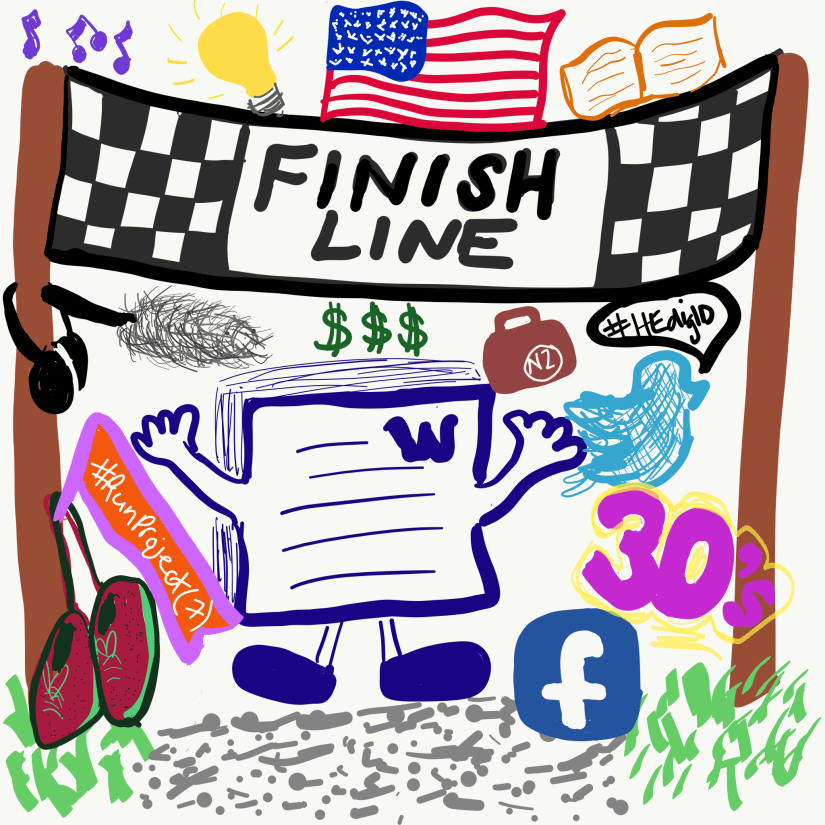
Typically the new year encourages many think about t how we want to use our time (or even take more of our time back) and improve ourselves in 2019 (here’s a list of 50 things to be your best you, if you’re still thinking about it). For me, I am saying goodby to new years resolutions and my #OneWord statements, and hello to goals and intentions! For 2019, I’m in training (metaphorically & literally) to see a few projects cross a finish line. I’m treating this year like I do for the races I run. There’s a finish line (a.k.a. completion) and I’m putting a concentrated effort to seeing my life projects, work initiatives, and personal goals reach the end before 2019 times out.

These are ALL THE THINGS I want to FINISH. This includes projects and initiatives I want to accomplish, wrap-up, remove, test out, delegate, abandon, perform, and sunset. In my professional life, I have new things I want to create, to do this I will need to finish current course re-design contracts, multiple research projects, team grants, and collaborative creative works. In my personal life, I am looking forward to racing in the #RunProject series, saying goodbye to my 30’s, learning new songs to sing/play on ukulele/guitar, personal digital audits & data deletions, writing/editing fictional stories, learning from the masters, planning travel adventures, #adulting stuff (wills, investments, and business opportunities… oh my!), and, oh yeah, Uncle Sam says I’m eligible to apply for citizenship – so there’s that.

So, as you can tell I have just a few things I want to see cross that finish line this year. To accomplish this I’ll continue with my the semester, monthly, and weekly planning in my #GetToWork book AND with daily tasks via Todoist. But this definitely calls for a long-term strategy that maps out how I’ll reach these goals. Good thing I am not alone with my big, audacious goal setting in 2019. In listening to a recent episode Quarterly Strategic Planning (from The Radial Self-Trust podcast channel hosted by Katie Linder), reading about other ideas on quarterly plans, and having a think about what I need to get done, I decided to make the time to organize what needs to get done in chunks (my version of quarterly personal planning) this year. By breaking up these projects, I can prioritize work and the time/attention it needs for completion.

Here is how I started with to map out my “project training plan” to reach the 2019 finish line goals & intentions:

  1. Create a vision or master plan: write down everything that has been pending, needs to be finished, and left incomplete.
  2. Outline domains or themes for your visionary ideas: categorize your intentions into buckets to group your project planning and figure out how you will start to craft your goals and prioritize this work.
  3. Identify goals (you know the SMART ones): outline actions and items that identify a project, initiative, or item is consider to be complete/finished.
  4. Select ways to track and measure your progress:  create systems to account for progress on these goals; this can be done daily, weekly, monthly, and quarterly time periods
  5. Design systems and strategies for success: identify time in your calendar where you’ll most likely work on a particular task, dedicate space(s) for focus/creativity, find accountability where/when needed, and add incentives/rewards built into this structure for each goal accomplished.

A few of my 2019 goals/intentions have specific timelines and some of these are already set in motion — especially the ones that require accountability from others and set deadlines. Now I’ll just need to add to my “Finish Line” Spotify playlists (e.g. Brain Food, The Social Network, and Alternative 90s) to enhance productivity. I welcome recommendations for more music. Always.

Reflections

My State of Create 2018

It’s the end of the year as we know it … and I feel fine.

Well, I feel pretty good, or I do now that I’ve spent some time wrapping up projects and a few tasks this last week. I have been thinking back to the goals, projects, and initiatives I’ve been working on personally and professionally in 2018. Last week, the #HEdigID chat offered a space for reflection and review of 2018 goals and things we still might need to work on in 2019.  Taking time to pause and take stock is important. I like to do this at the end of each academic semester (e.g. student grades/data, course evaluations, and my own feedback forms for learning), and also to figure out what has been my priority over the course of the year as well.

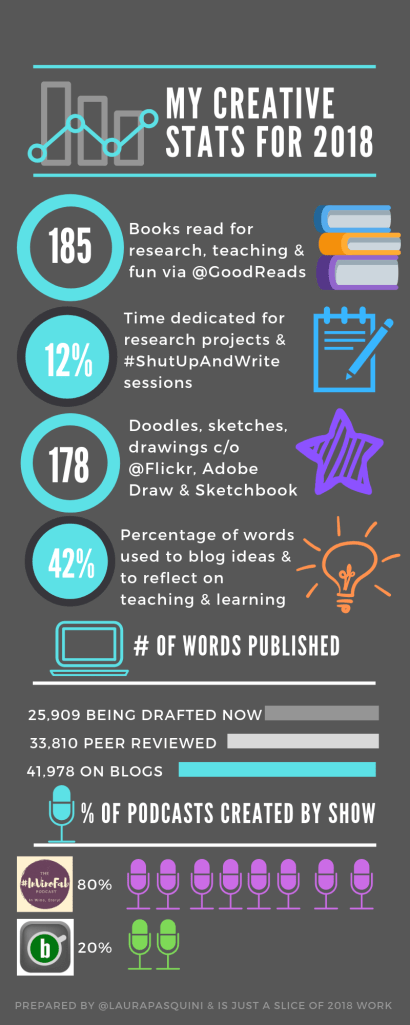
For 2018, I thought it would be fun to compile some of my statistics of things I have been making, producing, and creating — that may or may not “count” for what I’ve accomplished. I know that some websites and platforms offer insights into the number of posts, comments on blogs, image likes, and more – but I wanted to figure out what I have been working on in a variety of communities, digital spaces, and efforts across a variety of spaces and places (both online and offline). It can’t be all photo collages of inspiration, selfies, and achievements — per my #bestnine2018 of Instagram. There are so many other things that go beyond the typical data metric of a social media “like” or favorite, so I thought it was time I collected and reviewed this information as well. Here’s a slice of what I’ve been making and creating this year in this infographic:

I think some of the doodles, edits, revisions, and reads don’t always get noted in a typical performance review — but it helps to give me some perspective as to where I have been spending my time outside of my role, research projects, and design work to understand what has been my focus and priority this year for creativity. It was interesting to see what has been my focus and it gives me an idea of what I can look back at if I decide to reflect again on these items in 2019. How has 2018 been creative for you? What sort of maker stats would you collect to share your innovations, ideas, and initiatives that are more creative? Let me know!

#HEdigID, Reflections

#HEdigID Chat No. 11: 2018 – A Year In Review & Reflection

The end of the year (and semester for higher ed professionals) is nigh. This time of year can often bring closure, wrap-up of projects, and a time for reflection on what has happened in the last 12 months. There are no shortage of “best of” lists that circulate online to share media, music, and more. I can’t believe 2018 is over — time flies when you’re in the work grind. Over the next week or two, I am going to take pause to think about what has happened, what I’ve accomplished, and where life might take me next before I start 2019. It’s easy to just let the end of year pass by and even to hibernate until 2019, but I think it’s time to take stock of connections, contributions, creations, and more.

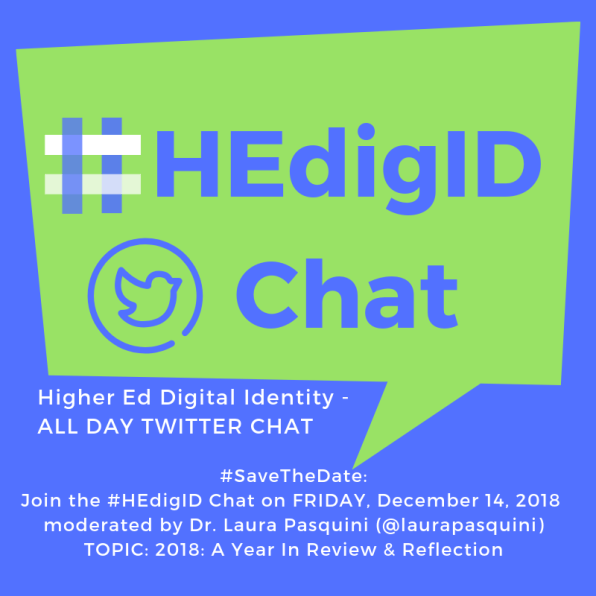
To kick things off, I’m going to moderate the LAST monthly Higher Ed Digital Identity (#HEdigID) chat  in 2018 with a similar theme. How did this past year go for you? What happened? Or, maybe even, where did the year go? Let’s review and reflect together! Prompted by my doodles I reflect with and my monthly #GetToWorkBook goal progress notes, I thought I’d see who might be interested in a collective conversation about their own year-in-review collectively.

Let’s talk it out and share how the goals from our professional and/or digital lives, specifically:

  • The 2018 Wins: Share your accomplishments, accolades, highlights, awards, and points of professional pride. #HumbleBrags
  • What’s In-Progress: Goals, projects, designs, and developments you are still working on now (or over the winter break). #GitRDun
  • The Let It Go! List: Goals, projects, tasks, & maybe even digital activities or workflows you plan to leave behind with 2018.
  • The 2019 “TO DO” List: What are you looking forward to in 2019? Are you planning to start a new projects Collaborate/Conspire with a colleague? Revitalize an old goal? Learn something new? Take on a new challenge? What’s on the horizon for your work and digital self in the new year?
  • #TreatYoSelf: How will you take a break, find self-care, and reward yourself for the efforts from 2018?

To get things started, I opened up a Twitter poll for #HEdigID Question 1 the other day. The voting for this poll is still open — if you’d like to cast your vote. Let me know how you are feeling about 2018. Where’s your head at? What’s your initial thoughts about how the past year has personally, professionally, and/or digitally for you?

https://platform.twitter.com/widgets.js

To prepare for this conversation around open ed practices, here is a bit more information to review before the upcoming #HEdigID Chat:

#HEdigID Chat TOPIC: 2018: A Year in Review & Reflection

This SLOW chat can be found on Twitter AND in an open Google doc. You can tweet your response to questions with the hashtag #HEdigID. OR even ask a few of your own to share how you’re starting to think about 2018 in review. Join us for this DAY-LONG reflection and sharing on FRIDAY, December 14th (in all global time zones).  Also, you can respond, ask questions, and add resources to this OPEN Google doc for the chat RIGHT NOW: http://bit.ly/hedigid11

Here are a few QUESTIONS to get you thinking about your own year in review for this #HEdigID ALL-DAY discussion:

  1. In thinking about your “2018: Year in Review,” how are you currently feeling? Just taking a pulse here for Friday’s (Dec. 14) #HEdigID chat: VOTE on Twitter https://twitter.com/laurapasquini/status/1072938007332818944
  2. List Your 2018 Wins: What are a few of your highlights from this past year? Boast to share your accomplishments, memories, new connections, or collaborative projects you were involved with in 2018.
  3. Still In Progress (Or Time To Let Go): What goals or projects might have sat “on the back burner” in your professional life that you did not get to in 2018? Also, what goals/projects are still “in development” or stalled that perhaps it’s time to let them go?
  4. Made You Think: What is one (1) game changer (e.g. unexpected event, information, or experience) that has shifted your priorities for how you think about your digital, professional self in #highered for 2019? This might be a change in habit, move on/off a platform, or way you share online.
  5. Taking Pause: How will you unwind, unplug or digitally detox to take a break during the holiday season and/or #highered winter break? Share how you will reset & regroup for self-care or to #TreatYoSelf
  6. The 2019 “To Do” List: What are you looking forward to in 2019? Are you planning to start a new projects Collaborate/Conspire with a colleague? Revitalize an old goal? Learn something new? Take on a new challenge? What’s on the horizon for your work and digital self in the new year?

Join the discussion and share your year in review & reflections:

  • Answering the questions by tweeting your response with the hashtag: #HEdigID

  • Responding anonymously or with your own name in IN this OPEN Google Doc: http://bit.ly/hedigid11

  • Use any of these questions to draft your own personal reflection and response (e.g. blog post, video, audio, drawing or offline discussion)

#HEdigID, Higher Education, highered, Learning Community, Networked Community, networkedscholar, PLN, Reflections

#HEdigID Chat No. 3: Privacy and Personal Data in Networked Spaces

If you are online and networked, your data and personal information is out there and it does not necessarily belong to you anymore. A number of us have signed up for a service, an application, or even a network under the assumption that it is “free.” What harm is there in answering a few personal questions to join an app, network, or online service?  Who would really be interested in my personal information I used when I completed that form or online agreement on that website? With a number of higher education colleagues living and working in networked spaces, we need to talk about how we have all (myself included) given away LOADS OF DATA to support our networked practices.

An introduction to the world of data online: Take a listen to Mozilla’s IRL (Online Life is Real Life) Podcast Episode 1: All Your Data Are Belong To Us.

“While you may think it’s no big deal to give away your personal data in exchange for free online services, how can you know that what you get for what you give is a fair trade?”

~Veronica Belmont, IRL Podcast: irlpodcast.org

Many of us have exchanged personal information for a “free” service, tool, technology platform, app, or network. This is common practice and almost a necessity to collaborate and communicate with others. How else can we stay in touch, share information, and participate in our personal and professional networks? Until the last few years, we have not thought much about the platforms or digital rights we have given away within these networked and digital spaces. We have witnessed a number of data breaches on popular platforms (e.g. LinkedIn and Dropbox) and we are currently gaining more insights into how scaled social networks, like Facebook, share our data with 3rd party providers (like Cambridge Analytica) and makes money off our individual profile contributions and participation in this platform.

I have been thinking about how we guide and support postsecondary stakeholders on social media and in digital networks for quite some time [see: socialmediaguidance.wordpress.com].  As social media permeates our personal and professional lives, a growing number of higher ed colleagues (like me) have been questioning the “privacy” (a.k.a. data) policies that exist on networked platforms, like Facebook, Twitter, LinkedIn, etc. [e.g. listen to @BreakDrink podcast episode, no. 10].

I am not sure the answer is to delete or leave a networked space. As our personal information and data is already out there, and a number of us are reliant on some of these tools to do our work and lead our lives. I don’t think these networked platforms are broken, disrupted, or that we need to even save social media. I just think we need to have a frank and open conversation about the things higher ed (as a whole) have been ignoring about these network spaces and platforms. Social media is no longer viewed as a trends or a passing fad. In the past, social and digital networks, were viewed as being on the periphery of the college/university experience. As these platforms have scaled and been embraced in our society, we are witnessing real impacts and implications within our campus communities.

It’s about time we have some REAL talk about individual privacy and personal data on social networks and digital platforms used by and among higher ed professionals. This month’s Higher Ed Digital Identity Chat on Friday, April 13th will be discussing the following TOPIC: “Privacy and Personal Data in Networked Spaces.”

Here are few QUESTIONS that will roll out on Twitter and are posted in the open Google doc for the #HEdigID Friday (April 13th) ALL-DAY digital conversation. In previous #HEdigID conversations we have talked about the affordances and challenges, but we have not touched upon our own personal data and privacy after we agree to an app or platforms terms of service. We need to discuss ways to support staff, faculty, and students using social media in higher ed, specifically in asking:

  1. As a networked higher education professional, what issues, topics, and questions SHOULD we be talking about with regards to our own privacy and personal data?
  2. What are your ultimate “Terms of Service” for sharing your personal data, updating your information, and putting yourself on digital/networked platforms? Share your philosophy or approach. [What are the things you are willing to give up when you sign up, log in, or share in networked spaces?]
  3. How does your higher ed institution or professional organizations educate and/or train yourself and colleagues about personal data and privacy online? Please share.
  4. How does your college/university guide or support community standards (e.g. policy, protocols, etc.) related to individual privacy or personal data in networked & digital spaces?
  5. For those who want to learn more about personal data, privacy, & security in #highered, what RESOURCES do you suggest? Please list & share (e.g. articles, websites, books, training, etc.).

What questions, issues, or challenges should we be discussing with our peers in networked spaces? How are we thinking about data and the use of data with our learners online? Are there ways to support engaged networked learning without compromising privacy or our personal data?  Feel free to answer any of the questions above as these are shared today (my Thursday, April 12th afternoon) until the afternoon of April 13, 2018 (in my timezone, Central Standard Time). This SLOW style Twitter chat is designed to allow more higher ed colleagues and friends to join in the conversation to account for different geographic regions, multiple time zones, busy schedules, and more

Join us on Friday, April 13, 2018 to discuss these questions and more! You can participate by:

  • Tweeting a response using this hashtag on Twitter: #HEdigID

  • Draft a longer response in the open OPEN Google Doc: http://bit.ly/hedigid3

  • Take any (or all) of these questions to create your OWN response in any media or format, you want: journal, blog post, video/audio reflection, drawing, or offline discussion. 🙂

I am open to YOUR suggestions. What QUESTIONS or ISSUES should we consider for this chat? Please share in the Google doc above or comments below. I’m looking forward to the conversation and contribution in Twitter and in the Google doc.