BreakDrink, CTCX

The @BreakDrink Campus Tech Connection #CTCX No. 70: Ginkgotree

There are a number of conversations about challenges, changes and disruptions to higher education. Recently, Ginkgotree, the “Tumbler for textbooks,” got me thinking more about my curriculum content and sharing for my courses.
Teaching with a course pack just got a whole lot simpler with the new Ginkgotree app. http://www.ginkgotree.com/
Ginkgotree launched last week to allow instructors the ability to customize and develop their learning material using a wide variety of multimedia and curriculum content. On Monday’s (10/8/12) BreakDrink Campus Tech Connection (#CTCX) show, we were able to get a LIVE show and tell to preview the new instructional resource from Scott Hasbrouck (@scotthasbrouck), Ginkgotree CEO & “Everything Hacker.”
Here are a few of the interesting features that might appeal to educators in higher education (and possibly K-12 as well):
1. Teaching from your own curriculum – instructors have the ability and control of designing their own course curriculum that meets the needs of their learning objectives and materials. Through an easy licensing service provided by Ginkgotree, instructors have the ability to use content from all over the web including journal articles, YouTube videos, images, and other content on the web. One this course pack is developed, instructors have the ability to share a private link to students to start the learning.
2. Do you have an aged textbook to add?  Ginkgotree allows you to utilize some of your favorite text material, even the ones that have been highlighted, annotated and difficult to retrieve in the past by using high quality scanners to digitize your print text and share legally with learners.
3. Give your students the best opportunities to learn – Remember when you wondered if your students even bought or even opened the textbook for your course? SOON instructors will be able to track learner progress and engagement through course pack analytics. Ginkgotree also has the ability to offer public and private notes, ask questions, and tag your content with keywords to make it easier for both the instructor and student to navigate.
4. Reduce the cost for your learners – Students pay a flat rate of $10/month for unlimited courses, plus any applicable copyright fees (usually 15 cents per page) for their books. Rather than spending $250 per textbook, average costs of textbooks range from $45-55. For instructors it is “Free. Always. Forever.”
I think Ginkgotree has an interesting model and can definitely contribute to the evolution of higher education and learning as we know it. Perhaps it is time to consider how we compile and share learning content with our students. Go on. Sign up. Play around with it yourself. Let me know what you think.
LPQ

CFP: The @LPQuarterly Volume 1, Issue 4 EXTENDED: DUE November 5, 2012

The Learning and Performance Quarterly (LPQ) is an online, open access peer-review journal designed to make research available to the public and to support a greater exchange of global knowledge. We have recently been invited to publish in the EBSCO research database, and our publication is growing both in author contributions and readership. Articles in support of innovative learning and performance across disciplines from developing and proven scholars are welcome for the last call for 2012 – here is the more information about the call for manuscripts.

CALL FOR SUBMISSIONS:
Learning and Performance Quarterly, Volume 1, Issue 4

The Learning and Performance Quarterly (LPQ) is currently accepting submissions for the second issue. Deadline for submissions is Friday, October 26 at 5 pm CDT. DEADLINE EXTENDED to Monday, November 5, 2012 at 11:59 CDT. Submission of manuscripts can be made online through the LP Quarterly website. For detailed submission guidelines and instructions on how to make a submission please visit Author Guidelines.


TYPES OF MANUSCRIPTS ACCEPTED
Research Articles :
Papers that are concerned with the various approaches to learning and performance impact. These papers should discuss the literature related to the approach employed and include a measure of the learning and performance impact of the approach employed.

Case Studies:
Case studies that highlight a particular learning, training, performance or instructional setting in which learning and performance resources were used to address a particular challenge. They present a discussion of the challenge from current literature, what was done to solve or explore it, and the results of the project. They often offer suggestions for others interested in addressing similar challenges.

Concept/Theory Papers:
Papers that present new concepts or contribute to existing theory for learning and performance. This should offer a discussion of the literature related to the concept/theory along with a discussion of the major issues for future research needed to validate the concept/theory.

Book Reviews:
Book reviews of publications 2011 or later will be accepted to highlight a issues and resources relevant for learning and performance and offer a suggested solution or direction. The position is supported with both a logical argument and a review of the pertinent literature. Preference will be given in the review process to book review essays that comment on two or more related books.  Book review essays should not exceed 3,800 words and should include city, state, publisher, and year of the book’s publication.  An abstract of 150 words or less and keywords are required for book review essays.  Reviews of single books should not exceed 1,900 words.  At the beginning of the text please include title, author, publisher, city, date, and page numbers of the book(s) under review.

CALL FOR LEARNING AND PERFORMANCE QUARTERLY REVIEWERS
Interested in reviewing articles for the LPQ Journal? The LPQ journal is looking for reviewers to conduct peer reviews and evaluations of submissions.
Please identify your reviewing interests, substantive areas of expertise, and preferred research methods when completing the LPQ journal registration online.

We look forward to receiving your submissions. Please pass this post onto other colleagues and researchers who might be interested in publishing, reviewing or editing for the Learning and Performance Quarterly journal.

Thank you,

Laura Pasquini & Dr. Jeff Allen, Founding Editors
Learning and Performance Quarterly
Like us on Facebook
Follow us on Twitter @LPQuarterly
Email: LPquarterly@gmail.com

Book Review

#BookReview – Brain Gain: Technology and the Quest for Digital Wisdom

A late add to my #summerreading list was Marc Prensky’s Brain Gain: Technology and the Quest for Digital Wisdom. With the start of the semester underway, I finally found some time to review this book. 

Added to my #summerreading list...

The premise of Prensky’s new book looks at how technology is changing and enhancing our minds with digital wisdom:

“Human culture and context is exponentially change for almost everyone. To adapt to and thrive in that context, we all need to extend our abilities. Today’s technology is making this happen, and it is extending and ‘liberating’ our minds in many helpful and valuable ways. Our technology will continue to make us freer and better — but only if we develop and use it wisely” (Prensky, 2012, p. 2).

Prensky shares how technology will “change our minds” to learn new things and produce new thoughts. With our gadgets and technological capabilities, we are able to extend our minds, heighten our cognitive surplus, increase our thinking powers and improve our thought process and concentration. As Albert Einstein stated “a new type of thinking is essential if mankind [and womankind] is to survive and move to higher levels” (Prensky, 2012, p. 35). It might be time to outsource some of our brains limitations, including memory, storage, accuracy, complexity and prediction, to a technological source. Prensky believes that by using technology we have an advantage to be “better thinkers who make wiser decisions and choices” (2012, p. 52). Much of our decision-making can come from the symbiosis of the mind and technology.

Although technology is often viewed in a negative light, this book identifies ways we enhance our “digital wisdom” via technology. Prensky defines wisdom as “the ability to find practical, creative, contextually appropriate and emotionally satisfying solutions to complicated human problems” (2012, p. 45). In contemplating the arguments against this idea of being wise with technology, the author introduces several fallacies, including:

  1. “Human” as Being Special and Always Better
  2. “Genuine”
  3. Longer Always Being Better
  4. Privacy Always Being Better
  5. Depth and Always Being Better
  6. Slower Being Better
  7. “One Thing at a Time” Being Better
  8. “Brain Science” Providing All , or Even Enough, Answers
  9. Relying on “Tried and True” Solutions in New Contexts
  10. “Reflection” Being Slow
  11. “Expertise” Meaning “Knowledge and Analysis of Data” and of Expertise Coming Only from Professionals
  12. Short Attention Spans
  13. “Limited Capacity” and the Need for In-Person/Online Trade-offs
  14. The “Cultural Now”
  15. “Wisdom” as Coming Only from Humans

Throughout this book (especially in Chapter Three) there are a number of examples of digital wisdom to demonstrate how the mind and technology function well with one another. Also scattered throughout the text, there are a number of references to other great technology-focused reads – many I have on my “to read” list or just added. Here are a couple of suggestions you might like shared by Prensky:

The book continues to share examples of digital cleverness and digital stupidity, with suggestions and examples on how we all can be smarter with our technology software, hardware and digital presence. Prensky continues to share how to cultivate digital wisdom in our personal life, at work and finally in education:

“Cultivating digital wisdom means being intellectually curious and active, continually expanding one’s online universe rather than sticking with the same things, and continually bringing more of the new world into our lives” (2012, p. 182).

Although Prensky touches on his former definition of “digital natives,” he digresses to move towards the need for educators to get comfortable with developing wisdom in classrooms with technology. The skills identified with digital wisdom and technology include collaboration, teamwork, decision-making, taking risks, making ethical and moral decisions, employing scientific deduction, thinking laterally and strategically, problem solving, and dealing with foreign environments and cultures (Prensky, 2012). The final chapters discuss the real dangers, things to be wary of, acknowledging problems to fix them, and evolution of the human as being impact by technology and singularity.

Overall, I think much of this book summarizes the impact of technology and our brain power with gadget and tech consumption. Prensky presents a decent summary and tries to synthesize how our thinking, actions and learning have changed – by curating and compiling examples and theories in a digestible way for the reader. Although the concepts are not novel, I think a number of readers will appreciate the concepts put forth around digital wisdom and technology.

Reference:

Prensky, M. (2012). Brain gain: Technology and the quest for digital wisdom. New York, NY: Palgrave Macmillan.

**Full disclosure: This book was sent to me by the Palgrave Macmillian publishing group to review on my blog. Thank you for the read. **

#phdchat, ATPI, Learning Technologies, LPQ, Reflections

LT Forum Interview – About My PhD Experience So Far…

The LT Forum is a place for students, staff and faculty in the Department of Learning Technologies at the University of North Texas to share news, announcements and updates. Here is an interview I did for them over the summer, that I forgot to cross-post here. Thanks to for inviting me to share my thoughts Jenny Wakefield.

« on: June 02, 2012, 01:24:32 PM »

We have many talented doctoral students in The Department of Learning Technologies. Our hope is to be able to interview and showcase these PhD learners here in the LT Forum as each reaches milestones through-out their journey towards their graduation. Reading about other students’ successes may boost that extra energy needed for others to push themselves forward and learning about challenges may help guide others. We also want to spotlight our students so that new learners come join our team and travel with us in the Learning Technologies – a great place to be! [Jenny Wakefield.]Our third interview is with Laura Pasquini, Doctoral Student in the APTI program:

Laura Pasquini – PhD Learner in ATPI

JW: Tell me a little bit about what made you decide to enroll in the ATPI program and pursue a PhD/EdD. (When did you enroll? How long have you been working towards your exam and course completion?)

LP: In looking for a graduate program that suited my scholar-practitioner interests in higher education, I thought that the Department of Learning Technologies at UNT was best suited for my talents and interests. After completing a course in Fall 2009. I decided to join the ATPI program in Spring 2010, as I liked the interdisciplinary approach and learning model that was built into the curriculum. As an ATPI doctoral student approaching completion, I appreciate the ability to study in the field of applied technology, human resource management, organizational change/theory, and educational research while connecting with faculty and leaders in the field. The end of 2012 marks the end of my course work and movement into being a PhD candidate. I am fortunate to be one of the first ATPI doctoral students to complete the NEW ATPI portfolio (instead of the comprehensive exam) by November, and after my last ATTD class with Dr. Nimon this Fall I will be ready to propose my doctoral dissertation and move on to being a doctoral candidate. The tentative plan is to be complete the ATPI doctoral program and graduate around May 2014.

JW: Who is your major professor?

LP: Dr. Jeff Allen is my major professor. It has been great collaborating and learning from one another. I appreciate the ability to work with and contribute to research, publications, and opportunities in the LT department. He has been a great faculty advisor who knows how to challenge and support my professional/academic needs.

JW: What has been the most challenging parts of your studies so far?

LP: Balance. I am a student, staff, and instructor at the University of North Texas. My role as an Academic Counselor/Instructor with the Office for Exploring Majors, Undergraduate Studies supports undecided students with their major/career choices and academic journey; whereas I am often found on campus, late in class, or researching/writing for another project. Besides working on courses, I have found great values in collaborating with other authors on publications, connecting in the field with other educators, and meeting corporate leaders. Besides working on courses, I have been busy with contributing to professional associations and journals with research, publications, and presentations. This year I have taken on the role as the editor for the Learning and Performance Quarterly (LPQ) which is a student-led, blind peer-review open-access online journal. We just published our first issue on May 22, 2012 and I’m looking forward to working with our reviewers and editors on the second issue over the summer.

JW: Tell us a little bit about your journey so far. What are challenges you’ve had to overcome? Have you had any pleasant surprises, aha-moments you’d like to share?

LP: I am originally from Toronto/Niagara Falls, Canada, so it took me a little while to adjust to the climate and the ways of Texas. I have been fortunate to meet some hospitable friends and colleagues who have helped my transition to the Lone Star state. So far I have really enjoyed my PhD journey. I have appreciated the projects, classes, discussions, and, most importantly, the connections with peers from UNT and in the learning technology field. I think that learning is an ongoing process, and developing as a researcher and academic is a continual experience. I have learned to celebrate the accomplishments and milestones along the way, and to be open to any feedback and new ideas I am exposed to along the way.

JW: What presentations have you attended/presented at? Tell us a little bit about one of them. Anything in particular that comes to mind? Advice for others?

LP: I have been fortunate to present research, papers, and theoretical sessions at a variety of professional associations and conferences over the last few years. Some have been collaborative and others have been a great learning experience where I have engaged with participants in meaningful discussions about shared research experiences.

LP: Over the last year I have been fortunate to be asked to share ideas and thoughts around connected learning and social practices for professionals as an invited speaker a few conferences/meetings. Last fall I was invited to talk to the University of Hawaii System Advising group at their annual workshop in Honolulu, HI about “Why Advising Networks Matter” and how holistic, community models of connected advising practices best support our learners. I just returned from Helena, MT where I was invited to be the opening keynote speaker for the Mountain MoodleMoot. During this talk I shared strategies for developing learning curriculum and ideas to support social learning with Digital Pedagogy to Engage. Both talks offered me opportunities to share my research ideas and practical experiences with social, connected learning; but more importantly it allowed me to connect with colleagues to discuss how these ideas can be applied to provide solutions for issues in education.

JW: What publications and/or creative works have you published?

LP: In collaborating with a few authors from our campus and other locations in the US, I have experience publishing book chapters, monograph chapters, and conference proceedings around topics in technology for advising, collaborative learning, and innovative practices for performance and learning. I am currently working on a few manuscripts for peer-reviewed journals. If you want to see my publications, I have current publications shared on my Mendeley account. Besides formal publications, I am often reflecting and sharing thoughts about my research on my blog or podcasting with the BreakDrink.com Student Affairs and Higher Education community on the Campus Technology Connection podcast.

JW: Have you decided on your dissertation topic and if so what was it? If so, what made you decide on this topic?

LP: I am currently culling through my literature review and narrowing my dissertation topic – which should be finalized over the break in coursework this summer. My current research thread and interests are in the areas of collaborative learning environments and personal learning networks, specifically how these networks and environments impact learning, training, and development in organizations. What interested me in these topics was personal experience connecting and learning in both formal and informal learning networks – specifically with peer-to-peer learning and mentoring in professional organizations. I hope to share some insights and values to how alternative forms of learning, training, and mentoring can impact professional development and career growth.

JW: Have you been studying full-time or also been working? How do you feel about combining PhD studies and working full-time (if you did)? What are things to potentially keep in mind?

LP: As I shared above, I have been working full-time as well as working on my doctoral studies, research, and publications. I will say that it is quite busy and challenging; however with some effective time management and organization it is not impossible to accomplish your academic goals. I am grateful to have supportive peers, colleagues, faculty, and family who continue to motivate and push me along my PhD journey. Although it is not impossible, I will say that it takes a great amount of energy, effort, and time to commit to doctoral research and academic professional development.

JW: Any recommendations you would like to share with the rest of us on the journey towards a PhD/Ed.D? 

LP: Stay the course. It seems like a long journey to the end of the PhD/Ed.D, but I think that there are some valuable experiences and rewards along the way. Embrace the challenges and opportunities that you have as a doctoral student beyond the course/program requirements. You can help shape your degree and academic experience, so be sure to make the most of it by getting involved, getting connected, and embrace new learning experiences that you stumble upon along the way.

JW: Anything else you would like to add?

LP: Thanks for asking me to share my thoughts about the Learning Technologies department and ATPI doctoral program. For those of you who want to follow along my PhD journey, I can often be found tweeting or reflecting on my blog. Get connected and share your experiences with me: http://about.me/laurapasquini
Book Review, Higher Education, K-12, Open Education, PLN

10 Principles for the Future of Learning

While working on some late night treadmill mileage, I decided to catch up on documents and books I have been collecting on my Kindle. Last week I read The Future of Learning Institutions in a Digital Age, which was a precursor to The Future of Thinking: Learning Institutions in a Digital Age book published by the John D. and Catherine T. MacArthur Foundation. Although this material is a bit dated, I think that some of the pedagogy still applies for educational development.

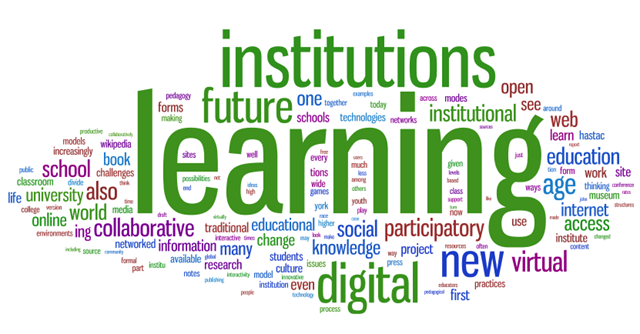
Image c/o Martin Hawksey (and his musings on this text as well). 

In the first collaborative project, the authors share ten principles to support the future of learning. Davidson and Goldberg (2009) presented these pillars of institutional pedagogy to help institutions rethink learning and meet the challenges that lie ahead for both K-12 and higher education:

  1. Self-Learning – discovering and exploring online possibilities
  2. Horizontal Structures – how learning institutions enable learning; from learning that to learning how; from content to process
  3. From Presumed Authority to Collective Credibility – shifting issues of authority to issues of credibility; understand how to make wise choices
  4. A De-Centered Pedagogy – adopt a more inductive, collective learning that takes advantage of our era and digital resources
  5. Networked Learning – socially networked collaborative learning stressing cooperation, interactivity, mutuality and social engagement
  6. Open Source Education – seeks to share openly and freely in the creation of culture and learning; provides a more collective model of interchange
  7. Learning as Connectivity and Interactivity – digital connection and interaction to produce sustainable, scaffolding ensembles
  8. Lifelong Learning – there is no finality to learning; learning is part of society and culture
  9. Learning Institutions as Mobilizing Networks – networks enable flexibility, interactivity, and outcome; new institutional organizations reliability and innovation
  10. Flexible Scalability and Simulation – new technologies allow for collaboration beyond distance or scale for productive interactions that warrant educational merit

Reference: Davidson, C.N. & Goldberg, D.T. (2009). The future of learning institutions in a digital age. Cambridge, MA: The MIT Press.