MOOC, Web Design

#EDUSprint 3 – Creating the IT Architecture for the Connected Age

Here’s the recap for the last EDUCAUSE webinar of the EDU Sprint series: #EDUSprint 3 – Creating the IT Architecture for the Connected Age. Today’s session talked about the role of IT on campus, technology planning, and the infrastructure of IT services for digital learning.

#EDUsprint 3 - Is IT Creating a New, Connected Age?

The session discussed the processes, management strategies, and governance structures from the following higher education leaders on the panel:

  • Tracy Futhey, Vice President, Information Technology and Chief Information Officer, Duke University
  • Tracy Schroeder, Vice President, Information Services and Technology, Boston University
  • Ethan Benatan, Vice President, Chief Information Officer, and Chief Strategy Officer, Marylhurst University

Many spoke about how their IT unit is thinking deeper about services to connect to learning and the needs on their campus in a holistic manner. Tracy Futhey shared her ideas around IT services, and how we not only need to consider location within the organization, but more about the delivery and methods for our IT units.

IT Services

Although there was talk about campus-wide strategy, I rarely heard much about bringing others around the table for this discussion. Much of higher education still operates in silos, so the full potential of connectedness and planning technology in learning cannot just occur in an IT unit, academic department or business solutions. I think that more administrative leaders need to bring faculty, staff, graduate students, undergraduate students, IT developers, and external shareholders together for these strategy meetings. in higher education. As our campus environments change, so does the IT needs and services to support learning and engagement.

I did appreciate when Tracy Schoeder shared about the Digital Learning Initiative and Technology Planning at Boston University. Although emerging technological trends evolve, I think that planning and assessment need to be part of the regular planning cycle.

Strategic IT Planning - The BU Example #edusprint I also appreciated that BU puts a focus on the human aspect of their planning, and not just the IT solution. Organizational structures should be assessed and reviewed for the IT architecture, to meet the needs and understand the institutional goals for learning.

Human Architecture for Digital Learning @ BU

Finally Ethan Benatan, started with a few predictions on how IT will change, be challenged, and move in the future – which is always a difficult task. I did appreciate that he shared a design process… and that it was just that – A PROCESS. There will not be a single solution to each campus environment, and it takes some agility and insight to move your higher education institution in the right IT direction and continue to assess your needs.

Here are some new links & reads from the session in no particular order:

Did you miss the last of the 3-day #EDUsprint? No worries. Here are a few resources for you:

You’re very welcome. Happy learning!
MOOC

#EDUsprint 2 – How Technology Can Change Pedagogy

The EDUCAUSE EDU Sprints continues, so why not share what I gleaned from today’s session. With a lot of information being shared, it actually feels like more of a marathon, so here’s the breakdown from the #EDUsprint 2:  How Technology Can Change Pedagogy webinar.

How Tech Can Change Pedagogy

The session was lead by the following panelists who shared their thoughts about gong “Beyond MOOCs”:

  • Hank Lucas, Professor of Information Systems, University of Maryland College Park
  • W. Eric L. Grimson, Chancellor, MIT
  • Susan Grajek, Vice President, Data, Research, and Analytics, EDUCAUSE

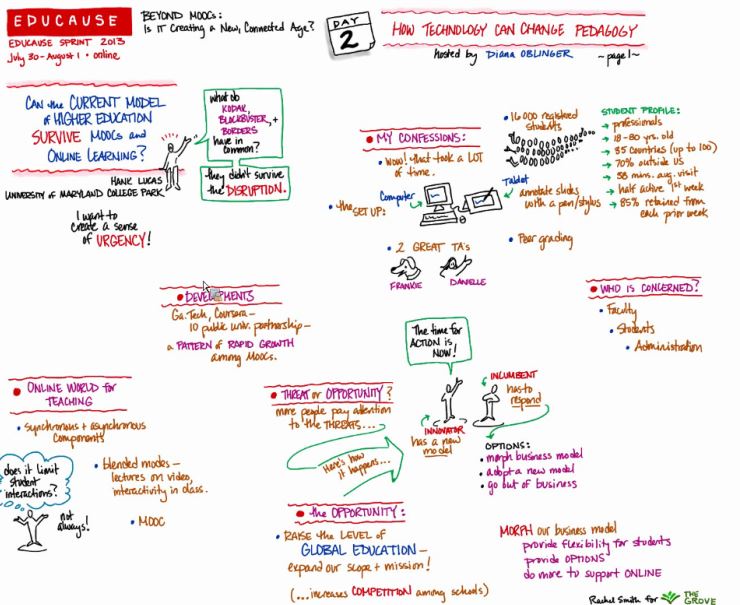
Hank Lucas sees great challenges and opportunities with blended learning, online learning, and MOOCs; however he wants to charge institutions with more than the technological trends. Due to these emerging technologies and social platforms, there are many different ways to connect with our students; however we have to be purposeful and think critically about our instructional design.  

The Survivor Model via Hank Lucas

Lucas shares his concept of ‘The Survivor Model’ (screen shot of slide), that outlines how disruptive technologies will impact higher education and learning. [Side note: You will find “disrupt” on the #sxswEDU 2013 bingo card I made back in March.} The language always seems so doom and gloom, especially when asked what the “threat” for learning technology is on our campus i.e. students, adminstration or faculty. Roll the cliche…

Lucas thinks more institutions need to question where they stand with online learning, blended learning, and MOOCs, as “The schools that compete vigorously with faculty who figure out how to add value to their courses will survive and flourish.” And I would agree with one of the final points he shared:

Eric Grimson gave his 2 cents of higher education and learning technology change, which included ideas around learning techniques, active engagement, suggestions for assessment, and a “new” accronym to add to our campus alphabet soup: SPOC (small private online course)

The second segment seemed to dive into ideas and themes being played out in our schema of learning in higher education. Grimson shared ideas and suggestions to help support online learning, which included:

A number of articles were shared in the streams, so here are a selection reads from today’s webinar:

More resources for online learning, instructional design, flipping, MOOC-ing, and then some:

Unfortunately I had to dip out of this session early and I will have to catch the rest of the webinar via the recording – but here are some interesting takeaways I found on the #EDUSprint Twitter backchannel that should be noted:

MOOC, Professional Development, SocioTech

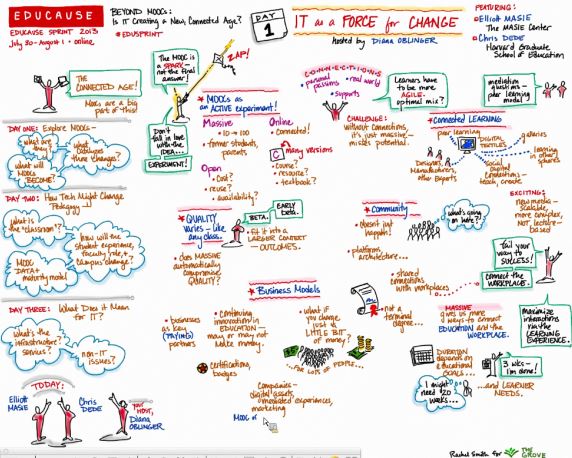
#EDUSprint 1: Beyond MOOCs – IT as a Force of Change

I joined today’s @EDUCAUSE 1st #EDUSprint webinar, IT as a Force of Change, discussed connected learning, technological impacts, educational models, and, of course, MOOCs. For those of us who educate, design, and research these items, not much of today’s session was new; however the speakers highlighted some interesting points and conversations around “where we are and where we need to go with higher education learning?” Today’s session was focused on framing large-scale, online learning programs – which is why MOOCs came to the forefront of the questions and discussion with the featured panel: Elliot Masie (The MASIE Center) and Chris Dede and Timothy Wirth (Learning Technologies, Harvard University). #EDUSprint 1 - Beyond MOOCs

MOOCs were called many things and labels were shared about the role of MOOCs in higher education. Here are a few words/phrases to describe MOOCs: unbundle, four letter word, innovation, change, disruption of education, learning model, same-old pedagogy, digital engagement, connected learning, revenue-maker, the future, and even an EXPERIMENT. If this is true…

In thinking about pedagogy and instructional design, I really hope we are considering the impact to our learners and subject material. Too often we go to the “shiny and new” hype for learning trends, rather than using learning outcomes to align curriculum content and assessments. Sometimes, I think our administration and educational leaders seem to miss the point…

Here are a few resources shared during the session that might be useful for those of you wanting to bone up on large-scale online learning with MOOCs:

Beyond the talk and questions about MOOCs, I thought the central thread for connected learning and meaning-making in education was strong. The fundamental question that needs to be ASKED and ANSWERED by more of our institutions was posed by Elliot.  was posed by Elliot is critical for our institutions to ASK and answer:

“How can we build a connected campus?

More information and a recording of the 1st #EDUsprint session can be found HERE, and, of course, there are a few Twitter notes from other #EDUsprint -ers for you to take a gander at… and perhaps I’ll see you in the #EDUsprint streams tomorrow…

EdTech, Professional Development

Career Forum Roundtables – The #EdTechCareer Line Up for #et4online

EdTech1sm

The Emerging Technologies for Online Learning (#et4online) Conference in Las Vegas NV is just around the corner (April 9-11, 2013). As mentioned in a previous post, I will be helping to support a new initiative at the conference – the Career Forum Roundtables.

We are very excited to offer the career roundtables as an opportunity for graduate students, junior scholars, and other interested #et4online participants who would like to chat about Ed Tech career planning and development. If you are interested, please feel free to join us for any of the scheduled sessions, and take advantage of meeting the career roundtable facilitators who have offered to share their  career insights and experiences. 

CAREER FORUM ROUNDTABLES (#EdTechCareers)

Please join us in the Westwood Boardroom for three Career Forum Roundtable sessions:
EdTech Career Tracks
Tuesday, April 9 – 2:30pm-3:20pm
There are a number of career directions and opportunities to apply for with your graduate degree. Join this roundtable to ask career questions and gain advice on which path is right for you:
·     Higher Education Faculty/Instructor – teaching vs. research institutions
·     Industry Research & Development
·     Consulting/Other
Facilitators: Whitney Kilgore from Academic Partnerships & Dr. Kevin Grazino from Nevada State College
Career Skills
Wednesday, April 10 – 10:10am-11:00am
In developing career skills for the educational technology field, it is critical to get involved and connected to both professional affiliations and peers. Come learn about how to build your CV and also showcase your experiences, as we talk about:
·     Professional Networking
·     Getting Involved in Professional Organizations
·     Scholarship Development – teaching, publishing, service
·     Interview Advice
Facilitators:Dr. George Veletsianos from the University of Texas & Dr. Rachel Salas-Didier from Nevada State College & Dr. Tanya Joosten from the University of Wisconsin Milwaukee
Career Applications
Thursday, April 11 – 10:10am-11:00am
Applying to your first faculty position? Looking for industry positions? Perhaps you should consider how you present yourself via your job application. Join us as we talk about things to consider when developing your career materials, including:
·     CV & Resume Writing
·     ePortfolio Development
·     References
Facilitators: Dr. Amy Collier from Stanford University & Laura Pasquini from the University of North Texas
 
See you at #et4online!
LPQ

Published: Learning and Performance Quarterly 1 (4)

The Learning and Performance Quarterly (LPQ) Volume 1, Issue 4 is hot off the press!

Editorial Abstract: The Learning Spectrum 

Learning is critical for curriculum design, training development, and educational objectives. Both pedagogy and design inform learning practices for suggested practices and models. In the fourth and final issue for the Learning and Performance Quarterly (LPQ) volume one houses a combination of manuscripts to span the learning spectrum.

LPQ Cover PhotoINVITED ARTICLE

What is Action Learning? Components, Types, Process, Issues, and Research Agendas ~ Yonjoo Cho  
CASE STUDY
Students perceptions of collaborative learning in intermedia and performance arts ~ Kate Sicchio, Grant Bridges  
CONCEPT/THEORY PAPER
Web-based Learning Management System Considerations for Higher Education ~ Chih-Hung Chung, Laura A. Pasquini, Chang E. Koh  
BOOK REVIEW
Book Review: Cases on Formal and Informal E-Learning Environments: Opportunities and Practices ~ Lindsay J. Ritenbaugh, Justin C. Shukas  

Call for Submissions

The Learning and Performance Quarterly (ISSN 2166-3564) is a peer-reviewed, open access journal from the Center for Knowledge Solutions at the University of North Texas. The journal takes a broad look at current developments and research that involves innovative learning, training, human resource development, and performance management across academic and professional disciplines.

We are seeking manuscript submissions for the following categories:

  • Research Articles – Qualitative/Quantitative
  • Concept/Theory Papers
  • Case Studies
  • Book or Media Reviews
  • Invited Articles


2013 call for submissions deadlines*:

LPQ 2(1): March 11, 2013 at 11:59 pm CDT

LPQ 2(2): May 20, 2013 at 11:59 pm CDT

LPQ 2(3): August, 2013 at 11:59 pm CDT

LPQ 2(4): October 21, 2013 at 11:59 pm CDT

*Submit your manuscripts ONLINE. Submission to publication turnaround time is 6-8 weeks. For detailed submission guidelines and instructions on how to make a submission please visit Author Guidelines. 
Thanks for reading,


Laura A. Pasquini & Dr. Jeff Allen, Founding Editors
Learning and Performance Quarterly
Like us on Facebook
Follow us on Twitter @LPQuarterly
Email: LPquarterly@gmail.com