EdTech, Professional Development, Social Media

My #edu13 Sampling Tour at @EDUCAUSE

With limited time in my October schedule, I was only able to drop into the 2013 EDUCAUSE annual conference (#edu13) in Anaheim, CA for a couple of days. It’s unfortunate that I was not able to stay longer; however I’ll share my sample of the #edu13 higher education and technology conference. {This is what happens when you are traveling to conferences, writing a dissertation proposal, advising for Spring 2014 registration, teaching a class & training for a marathon all in the same month. Lessons learned for next year.}

I was fortunate to be able to attend #edu13 since Tanya Joosten (@tjoosten) asked me to co-facilitate a virtual workshop on Social Media for Teaching and Learning. Much of this session shared ideas from Tanya’s book, our research article, and our practical application for utilizing social media for learning/teaching. During the session we modeled our teaching/learning expectations by encouraging participants to interact & dialogue with us on Twitter. Our emphasis was not on the tool, but more on the social learning and interactions you can have to augment educational experiences:

Let's get social #edusocmedia ....its not the tech #edu13Here is our digital handout from the workshop: http://bit.ly/edusocmedia13

Before I had to leave EDUCAUSE on Wednesday, I attended the #edu13 Prepare for Lift-Off: Becoming a Successful IT Pilot Site Panel and took a few digital notes: http://bit.ly/pilotpanel
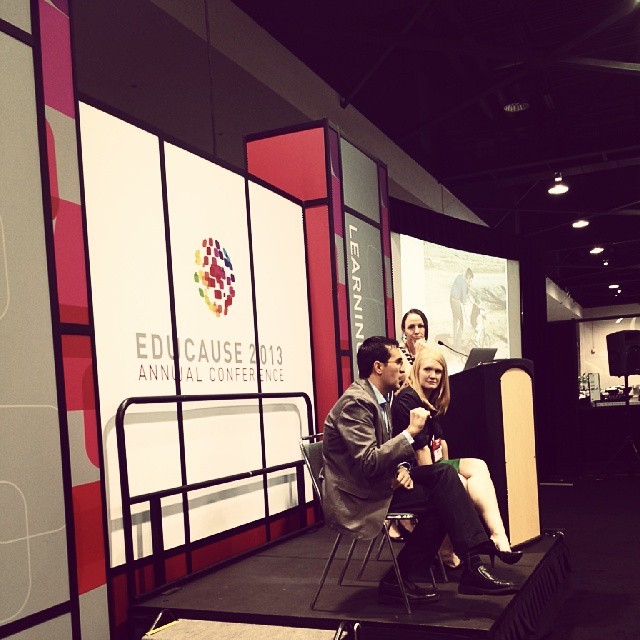
How can the solution improve student learning? Ask @tjoosten @amcollier & @Veletsianos #edu13

During this session, Tanya Joosten (@tjoosten), Amy Collier (@amcollier), and George Veletsianos (@veletsianos) discussed the TOP 10 questions every institution should ask before piloting a technology solution for learning at their campus:

  1. Why should this solution be introduced to the campus?
  2. How can the solution improve student learning?
  3. Does your institution have readiness or capacity to pilot a new solution?
  4. Who is the audience and are the stakeholders?
  5. What is the pedagogical model that will lead to the greatest?
  6. How will a vendor be selected for the new technology?
  7. How would faculty be selected to participate?
  8. How do you evaluate the impact of the solution on the identified outcomes?
  9. How do you diffuse the innovation on campus and beyond?
  10. What are your questions?

Since I missed out on the live happenings, I made sure to follow the #edu13 backchannel and my tweeps while traveling home. If you don’t have much time or interest in text mining all the many tweets, The Chronicle curated few conversations on Twitter and EdTech Magazine compiled a list of people to follow at EDUCAUSE 2013.

Good morning #edu13

AcAdv, nacada, NACADA Tech

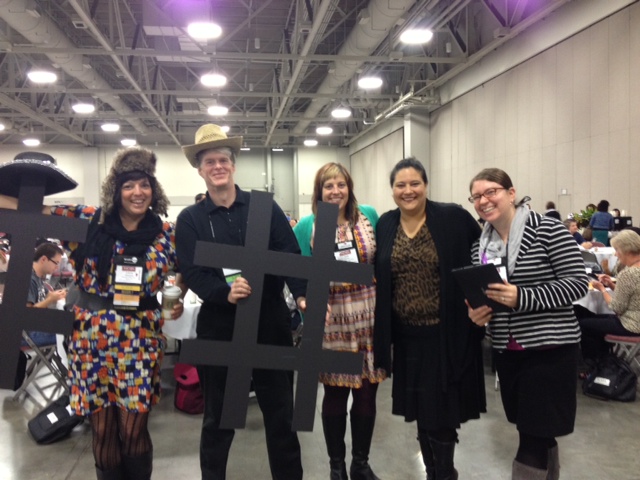
#AdvTech at #nacada13…More Than Just a Hashtag!

AdvTech Puts A Hashtag on It


Well, I’ve had some travel & packed appointment days, so here’s my delayed RECAP post from the 2013 Annual NACADA Conference (#nacada13) in Salt Lake City, UT. I proudly passed the NACADA Technology in Advising Commission (#AdvTech) chair torch to Julie Larsen (@julieclarsen); however I thought I would highlight some of the great things from our commission, steering committee, and general happenings at the #nacada13 conference:

So I just want to say…

Screen Shot 2013-10-07 at 12.08.33 AM

Are you interested in getting involved with the #advtech commission? The #AdvTech NACADA Technology in Advising Commission Sign-up for 2013-2014 is still open http://bit.ly/advtech13.  Please complete this form to let us know HOW you want to be involved this year. Talk to our #advtech steering committee leaders if you have questions, ideas, or suggestions for our commission!

Learning Technologies, Professional Development, Reflections

What Was In The Mix for #Blend13

Last week seems so far away, but not forgotten. Much of my time and social streams had a great mix of conversation in and around around #blend13 – The Sloan C Blended Learning Conference & Workshop. Thanks to the fabulous #blend Conference Chair, Tanya Joosten (@tjoosten), I was fortunate to be invited to present a workshop (or two) and get acquainted with the fine city of Milwaukee over the Summerfest weekend. #MKEwhawhat. Here’s my blogged mix tape of highlights and happenings from #blend13.mixtape

Not only did I fall in love with the city life in MKE, but I was alsoable to attend the 10th annual conference on the topic of blended learning to gain some insight to the history and impact as to where we are going in the field. As educational demands and challenges increase, there has been a great shift to personalized, digital pedagogy. Blended learning has helped to reshape roles for both the instructor and learner to create opportunities for deeper learning and sharing.

Untitled

During my workshop, I asked participants to share what blended learning meant in ONE WORD. A challenging task, as this learning pedagogy and model means so much to so many people. Here are the responses from my session. I learned how blended learning appears to have a number of similarities and differences depending on the academic institution, and the type of characteristics most suited for instructors and our students in blended learning environments.
Untitled#Blend13 connected me to a number of educators,  in both K-12 and higher education, who were using blending learning for curriculum engagement. Blended Learning has encouraged more collaboration and connection to open, shared learning resources. A number of faculty and instructors are finding value in enhancing their subject matter, and the student data on learning acquisition is proving its value. A number of instructors are finding opportunities to mentor and learn in their own personal learning networks, which are strengthening the profession and allowing for growth in education.

#BlendedLearning Word Cloud

Beyond interpreting the blended learning, seeing other models, and discussing effective practices for blending – a larger conversation and discussion thread that was prevalent was around MOOCs. Although I feel as this “hot topic” is appearing in most educational conferences, it was interesting to understand how MOOCs impact blended learning environments, and if they are distinguished from the blend pedagogy.

During the Using MOOCs for Blended Learning panel (#BLmooc), the discussion evolved around the impact (or lack there of) massively open online courses (MOOCs) have within higher education. The debate focused on how campuses should consider wider, strategic solutions for blended learning and the challenges/opportunities MOOCs provide for the learning process, students, open content, and various learning methods.

IMG_20130708_140836-MOTION

Thanks for sharing your thoughts on #BlendedLearning  and #MOOCs  at #Blend13  Karen, Shari, Amy & Tanya. 

There was talk about openness, content, delivery, and more. What struck me was the continued debate or talk about dualism between closed and open methods for delivery and content, which I think was shared in Andy’s tweet/blog post:

The last session I attended was the Unconference Session Around Researching MOOCs with George @Veletsianoshttp://tinyurl.com/moocresearch

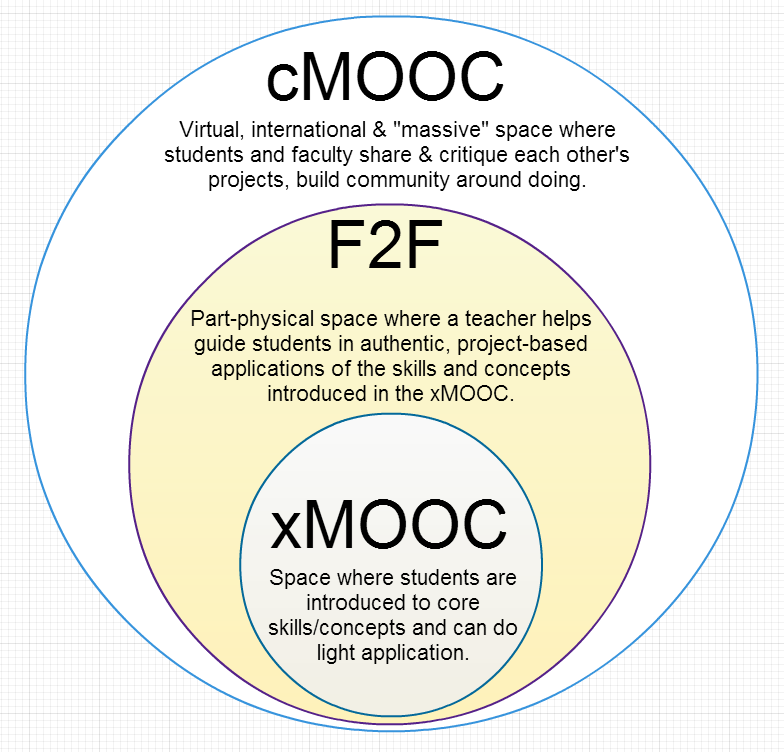
There is a number of interesting research questions, methods and more included in the Google Doc — and if you want to connect with any researcher, their contact information is also included. One article I found interesting from Mike Caufield (@holden ) was the x-MOOC  vs. c-MOOC debate shared via his Educause article. I wonder how many institutions consider the space or place their move to MOOC is going, and what sort of learning framework (if any) they place these models.

xmooc is a chewy center

Image c/o @holden in this article 


Last, but certainly not least, I was grateful for connecting with my #PLN of amazing colleagues that I am able to share with on a daily basis on different social media spaces. Who would have thought that this was my first time meeting Dr. Alec Couros (@courosa) in person — it feels like we go back for ages.  With a jam-packed, engaging keynote – I am glad that Alec and others took “notes” on Twitter. We also learned that when you let two Canadians loose in Milwaukee, there is bound to be some havoc. Highlights of our fun with the #blend13 crew (in no particular order) results in collaborative marketing campaigns for MKE, free-style karaoke, BACON love, killer dance moves, great conversations, photo-bombing, and general good times.

Untitled

Name the trouble makers who photo-bombed my #selfie.

Until we meet again #blend13 friends… keep it smooth.

AcAdv, nacada, NACADA Tech, Social Media

The Global #AdvTech Discussion at #nacadaINTL … And Then Some #acadv

At the beginning of June, I was fortunate to participate in the first International NACADA Conference in the Netherlands. The conversations (#nacadaINTL – archived tweets!) and sharing of ideas on how to advise and support students is universal. A number of countries and institutions were represented, and surprising enough, many of us face similar institutional challenges for effective student development.

I was happy to return to Maastricht, where I studied as a student, to present social media research, moderate a technology in advising panel, and facilitate a workshop on communication strategies for advising students.

Q: What do @ 4 am when you cant sleep? A: Go on a Maastricht walkabout to see what you remember from grad school circa 2004.

I shared recent collaborative research on guiding social media from @tjoosten & @lindseyharness, and how our institutions rarely think about learning when it comes to policy. It was good to discuss challenges and ideas on how other campuses manage social media practices, and my faculty advisor will be happy to learn that I gave me some direction for my dissertation work. 🙂

Poster Session: Guiding #socialmedia at Our Institutions on by @tjoosten @lindseyharness & moi at #nacadaINTL #acadv #highered

In thinking about actual engagement, I discussed communication plans and ideas for reaching and teaching our students. I do not think that social media is the only solution; however this workshop discussed comprehensive communication planning.

Much of what we fail to do is think holistically about this at our institutions, and I am certain that advising units can lead the way and be a strong example on campus.

This workshop discussed ideas, examples, and practical strategies – here is the digital handout and the presentation:

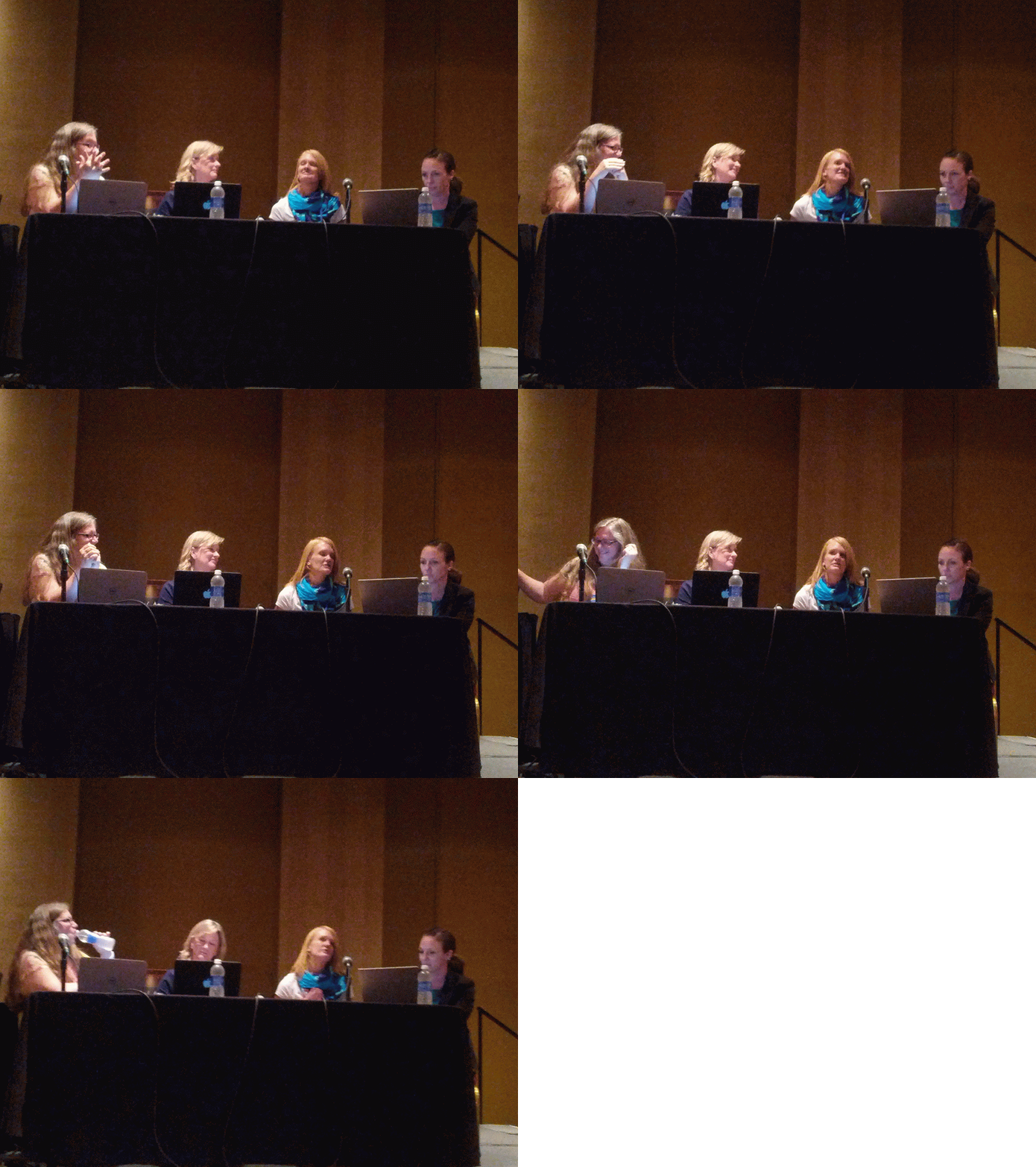
Finally, I would like to thank the #AdvTech Panel (left to right), Richard Sober (from Teesside University,UK), Joel Shelton (from Zayed University, UAE), Nicolai Manie (University of Maastricht,  NL), Catherine Mann (University of Melbourne-AUS), George Steele (The Ohio University, USA), and Jennifer Joslin (University of Oregon, USA) for joining in the vast conversation about technology in advising. Interested in meeting the the panel? There’s an open, Google doc for that HERE.

Untitled

Although the assigned panel topic was technology in learning, much of the discussion dealt with managing institutional objectives, supporting learning outcomes, considering effective communication strategies, and workflow solutions to make advising practices shared and developmental. The first question posed to the group  was to set the tone and give the participants an understanding of how varied and fluid “technology” is for our advising experiences.

Question:

Answers:

Immersive, necessary, potentially useful, collaborative, student-centered, electric, difficult, powerful, accessibility & connected. {What is YOUR word?}

Much of the panel discussion and general conversations at the conference around technology really involved our shared experiences for our student needs. It was not really the WHAT or HOW, but rather the reasons WHY technology is utilized at each of our institutions.

Different practices and trends for technology in advising have emerged; however an agreement on costs, advising models, student demand, and resource issues were common topics. More advising units around the globe seem to be moving towards holistic needs that require system-wide, institutional technologies to track student success, encourage mobile learning, and identify administrative solutions to make advising workflow easier. Are all institutions doing this? No. Not many at all.

I look forward to continued discussions beyond #nacadaINTL as we dig into what lies ahead for advising and technology on a global scale, specifically:

  • How can we best determine technology needs and use for advising practice?
  • What technology in advising resources will be used or should be used if they were available?
  • How is your institution attempting to respond to these questions and challenges in higher education?

Let’s keep the conversation going #advtech …

PhD, Reflections

#sxswEDU: Thoughts, Reflections & Then Some…

Time sure flies when you’re conferencing, volunteering and travelling… so my thoughts on South By South West Edu (#sxswEDU), are delayed by exactly 2 weeks. My bad.

Due to my love of Austin and enjoyment of SXSW, I thought SXSW Edu would be a great conference to engage with other educators and expand professionally. There were a number of things I liked – such as being on public transit, new perspectives on learning, and connecting with tweeps (Shout out to: @tjoosten, @gsiemens, @veletsianos@audreywatters & more #iamEDU friends!). I also appreciated the lively banter our Social Media in Higher Ed (#smHE) panel had on the topic, and the great follow up conversations with other instructors, practitioners, and researchers. 

Essentially, I got what I wanted out of the #sxswEDu conference – connect, social, interact and learn. I sort of expected something else from this conference, specifically with regards to the education (K-12 and Higher Ed) involvement. I was a bit disappointed to see that the Panel Picker selected more sessions with industry, rather than any educators. It was odd. I was not alone in noticing the tensions were felt between the industry and educationWhy were the instructors, teachers, principals, faculty, higher education professionals, and educational administrators not sitting in these #sxswEDU seats?

Let's get ready to MOOC-off! Where art thou @gsiemens?

Although the education presence was not the “sage on the stage” approach, I am glad I was present to listen to what industry and technology leaders think the “future of learning” will be. I know that many of these sessions were challenged and talked about outside the formal #sxswEDU program, and I was curious as to how other educators interpreted the conference message(s). 

One thing that was very noticeable = the repetitive rhetoric being shared from room to room. To mix it up I, jokingly, initiated the  #SXSWedu Terms to Know, Use, Love & Hate Google doc to note the key words, terms or phrases I heard at the conference. Some might say I was being jaded (*cough* Siemens *cough*), but really I was just having fun with the common language of the conference. After curating this list, I decided to create a game (…which had multiple players, I might add): 

#sxswEDU BINGO Card #3

Note: Another suggestion was to draft a blog post with the complete list of terms. I decided to respectfully decline said challenge; however I will stay alert to the language and context of these words. It’s not a bad idea to keep your ears open and listen every once in a while… Thanks for reminding me of that #sxswEDU.