Learning Community, Professional Development, UGST1000

Help My #ugstSTORY Class Tell Their Story

It seems that all is quiet on the TechKNOW Tools blog front… Sorry about that.

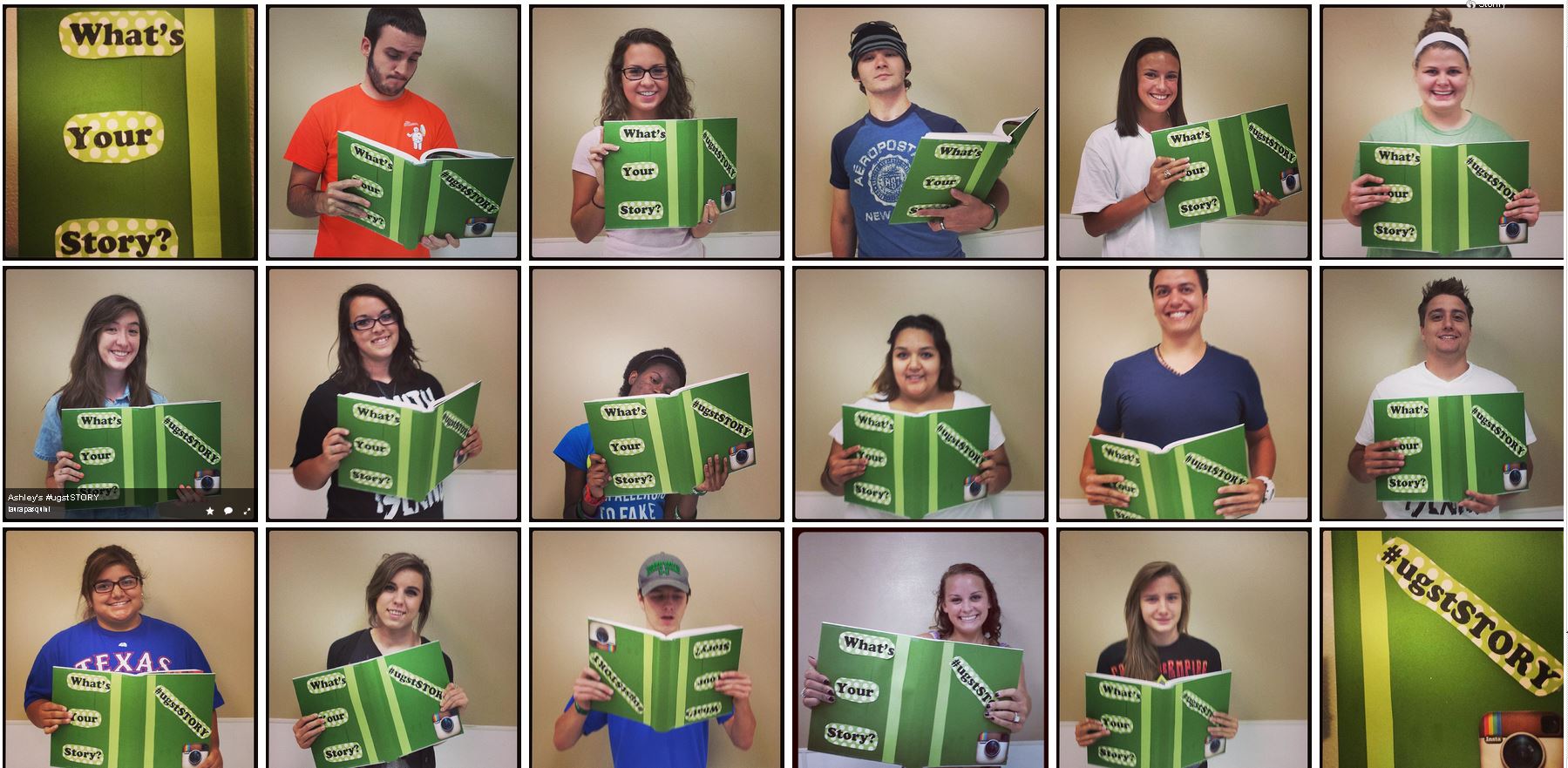
The start of the academic semester came fast and furious, and I have been busy engaging with and learning about my students’ stories for my #ugstSTORY class this Fall 2013 semester. This is my UGST 1000 – First Year seminar class where my students explore their major/career options, get support with transition to college, and learn more about themselves.  Feel free to follow along with our “story” this Fall if you would like:

ugstSTORY Pic

With this seminar class, a great portion of the focus is on self discovery and exploration for personal, academic, and career options. Like many students who are “undecided” or exploring their options, many of my #ugstSTORY students have more than one interest and want to make sure they are going down the right path for them. In learning about many of their talents and skills, I can see why it might be a challenge to just focus on one major. They are a creative and involved class who what to include what they VALUE in their future world of work and life.

What My #ugstSTORY Class Values
During the Fall 2013 semester, my #ugstSTORY students will leave a digital footprint, and will be encouraged to explore their personal and professional options. In their research to make an informed decision, a number of my students will reach out to professionals and industry leaders in the world of work to answer: “What do I want to do with my life?” and “How did you get to where you are?” I am not sure these BIG QUESTIONS will and/or can be answered in just one semester; however I think a few of the assignments and projects will hopefully get them started.

The first assignment, the Road Trip Nation (RTN) Project, is designed to help my students explore personal, academic, and career paths. More importantly, it allows them to understand that many directions will lead you towards your goals and dreams. Their recent blog posts identified what how to find their “Red Rubber Ball,” that is, where do they get their inspiration, passion, interests, values, and likes. Specifically, I asked what potential careers, professions or industries would they like to learn more about.  Here’s a short list from their in-depth blog posts this week:

Interview: Potential Careers & Industry

Interests & Passions

Journalism; Sports Journalism; Broadcaster Friends; Family; Hockey; Sports
Artist; Engineer; Philanthropist; Advertising; Therapist Stability; Helping Others
Journalism; Pre-Law; Psychologist Community Involvement; Travel; Family
Clinical Psych; Greenpeace Environment Activism; Animals; photography; food; language
High School Librarian Reading; books; writing
Engineering; Tourism; Economics Travel; Stability; Accomplishing goals
No Clue Relationships; Smile; Creativity; Individuality
Writer; Journalism Music; Belonging; Writing;
National Geographic; Journalism Travel; Photography;
Broadcaster/Journalism Sports Talking; Sports; Opinions to voice
Photojournalist; Forensics; Library Science Cartoons; Anime; Photography; Music
Psychology; Fashion Merchandising; Law People; Cultures; Travel;
Sales Engineering Music; Activism; Star Wars
Sports Analyst; Broadcaster/Journalist NFL Analyst; sports industry
Neurology; Psychology; Editor/Publishing Anime; Neuroscience; travel; career student; small business

The reason I am sharing more about my class with you is to get them connected beyond our class and the UNT campus. Since I have some phenomenal friends, family, and colleagues in my own learning and professional network, I thought a few of YOU might be able to provide some of your own experience and wisdom for their exploration, specifically by:

  1. SHARING A Resource: We tweet with the #ugstSTORY hashtag, so if you see a link, article, website or anything related to major and career exploration – cc: @ugstSTORY or just put the #ugstSTORY hashtag on it!
  2. READING Their Blog Posts: If you have time to read, comment & post on their WordPress blogs, that would be super rad. Although many are just blogging for the first time, a number of my #ugstSTORY students have very thoughtful and creative perspectives about life in college so far. It would be great if they got a response or two outside our #ugstSTORY class – drop them a comment or like. 🙂
  3. MENTOR Virtually: For the RTN Project a number of the #ugstSTORY learners will be seeking informational interviews with companies, professionals, and different organizations (listed above or might not be listed as they don’t know your about your occupation yet); if you OR someone you know is available and interested in sharing with my students what they do for a living and why they love it – LET ME KNOW!  Yes! I want to MENTOR a #ugstSTORY Student p.s. Pass this link onto a friend you might know as well. Thanks!

Reflections

Lucky 13: Top Blog Post Views for Summer 2013

13-ball

Since major news outlets, TV series, and  government officials seem to be on hiatus in August, I decided to take a break from blogging as well.  In looking back at what’s been trending on TechKNOW Tools,  here are the lucky 13 most viewed blog posts since  May.

LUCKY 13:  TOP BLOG POST VIEWS THIS SUMMER View
Social Media Strategies in Student Affairs
More stats
850
What’s Your Research Methods Worldview? More stats 353
#AcWriMo & Accountability to Write More stats 219
#EDUSprint 1: Beyond MOOCs – IT as a Force of Change More stats 116
Facebook for Learning Communities: Groups vs. Pages More stats 115
Passing the Torch: Leadership Transition in Our Professional Organizations More stats 115
Using Verbs for Specific Learning Outcomes More stats 114
Organizational Learning Constructs More stats 103
Backwards Design with TED-Ed More stats 84
I Tumblr For You… To Reflect. More stats 74
Going Mobile for Academic Advising: Tablets, iPads & Protocols on Campus More stats 72
Building Communities of Practice in Higher Ed More stats 65
My Prolegomenon to Technology
More stats
61

My pause from blogging will resume after I wrap up a few things before the Fall academic term starts: publications, projects, and proposals. #GradStudentProblems

MOOC, Web Design

#EDUSprint 3 – Creating the IT Architecture for the Connected Age

Here’s the recap for the last EDUCAUSE webinar of the EDU Sprint series: #EDUSprint 3 – Creating the IT Architecture for the Connected Age. Today’s session talked about the role of IT on campus, technology planning, and the infrastructure of IT services for digital learning.

#EDUsprint 3 - Is IT Creating a New, Connected Age?

The session discussed the processes, management strategies, and governance structures from the following higher education leaders on the panel:

  • Tracy Futhey, Vice President, Information Technology and Chief Information Officer, Duke University
  • Tracy Schroeder, Vice President, Information Services and Technology, Boston University
  • Ethan Benatan, Vice President, Chief Information Officer, and Chief Strategy Officer, Marylhurst University

Many spoke about how their IT unit is thinking deeper about services to connect to learning and the needs on their campus in a holistic manner. Tracy Futhey shared her ideas around IT services, and how we not only need to consider location within the organization, but more about the delivery and methods for our IT units.

IT Services

Although there was talk about campus-wide strategy, I rarely heard much about bringing others around the table for this discussion. Much of higher education still operates in silos, so the full potential of connectedness and planning technology in learning cannot just occur in an IT unit, academic department or business solutions. I think that more administrative leaders need to bring faculty, staff, graduate students, undergraduate students, IT developers, and external shareholders together for these strategy meetings. in higher education. As our campus environments change, so does the IT needs and services to support learning and engagement.

I did appreciate when Tracy Schoeder shared about the Digital Learning Initiative and Technology Planning at Boston University. Although emerging technological trends evolve, I think that planning and assessment need to be part of the regular planning cycle.

Strategic IT Planning - The BU Example #edusprint I also appreciated that BU puts a focus on the human aspect of their planning, and not just the IT solution. Organizational structures should be assessed and reviewed for the IT architecture, to meet the needs and understand the institutional goals for learning.

Human Architecture for Digital Learning @ BU

Finally Ethan Benatan, started with a few predictions on how IT will change, be challenged, and move in the future – which is always a difficult task. I did appreciate that he shared a design process… and that it was just that – A PROCESS. There will not be a single solution to each campus environment, and it takes some agility and insight to move your higher education institution in the right IT direction and continue to assess your needs.

Here are some new links & reads from the session in no particular order:

Did you miss the last of the 3-day #EDUsprint? No worries. Here are a few resources for you:

You’re very welcome. Happy learning!

MOOC

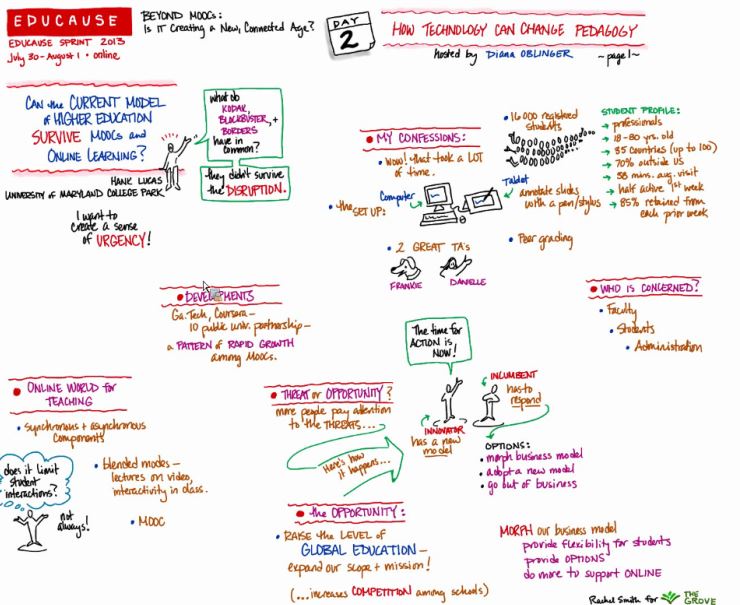
#EDUsprint 2 – How Technology Can Change Pedagogy

The EDUCAUSE EDU Sprints continues, so why not share what I gleaned from today’s session. With a lot of information being shared, it actually feels like more of a marathon, so here’s the breakdown from the #EDUsprint 2:  How Technology Can Change Pedagogy webinar.

How Tech Can Change Pedagogy

The session was lead by the following panelists who shared their thoughts about gong “Beyond MOOCs”:

  • Hank Lucas, Professor of Information Systems, University of Maryland College Park
  • W. Eric L. Grimson, Chancellor, MIT
  • Susan Grajek, Vice President, Data, Research, and Analytics, EDUCAUSE

Hank Lucas sees great challenges and opportunities with blended learning, online learning, and MOOCs; however he wants to charge institutions with more than the technological trends. Due to these emerging technologies and social platforms, there are many different ways to connect with our students; however we have to be purposeful and think critically about our instructional design.  

The Survivor Model via Hank Lucas

Lucas shares his concept of ‘The Survivor Model’ (screen shot of slide), that outlines how disruptive technologies will impact higher education and learning. [Side note: You will find “disrupt” on the #sxswEDU 2013 bingo card I made back in March.} The language always seems so doom and gloom, especially when asked what the “threat” for learning technology is on our campus i.e. students, adminstration or faculty. Roll the cliche…

Lucas thinks more institutions need to question where they stand with online learning, blended learning, and MOOCs, as “The schools that compete vigorously with faculty who figure out how to add value to their courses will survive and flourish.” And I would agree with one of the final points he shared:

Eric Grimson gave his 2 cents of higher education and learning technology change, which included ideas around learning techniques, active engagement, suggestions for assessment, and a “new” accronym to add to our campus alphabet soup: SPOC (small private online course)

The second segment seemed to dive into ideas and themes being played out in our schema of learning in higher education. Grimson shared ideas and suggestions to help support online learning, which included:

A number of articles were shared in the streams, so here are a selection reads from today’s webinar:

More resources for online learning, instructional design, flipping, MOOC-ing, and then some:

Unfortunately I had to dip out of this session early and I will have to catch the rest of the webinar via the recording – but here are some interesting takeaways I found on the #EDUSprint Twitter backchannel that should be noted:

MOOC, Professional Development, SocioTech

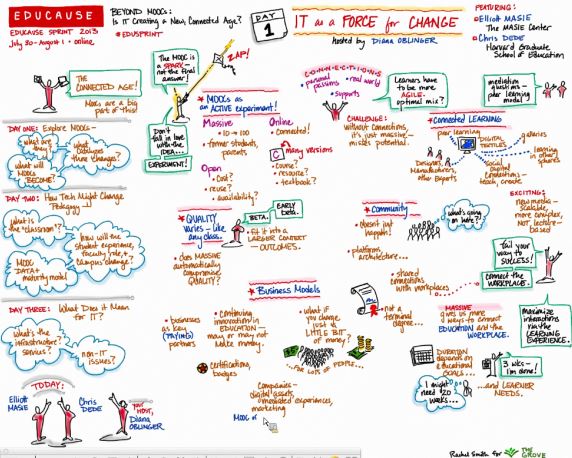
#EDUSprint 1: Beyond MOOCs – IT as a Force of Change

I joined today’s @EDUCAUSE 1st #EDUSprint webinar, IT as a Force of Change, discussed connected learning, technological impacts, educational models, and, of course, MOOCs. For those of us who educate, design, and research these items, not much of today’s session was new; however the speakers highlighted some interesting points and conversations around “where we are and where we need to go with higher education learning?” Today’s session was focused on framing large-scale, online learning programs – which is why MOOCs came to the forefront of the questions and discussion with the featured panel: Elliot Masie (The MASIE Center) and Chris Dede and Timothy Wirth (Learning Technologies, Harvard University). #EDUSprint 1 - Beyond MOOCs

MOOCs were called many things and labels were shared about the role of MOOCs in higher education. Here are a few words/phrases to describe MOOCs: unbundle, four letter word, innovation, change, disruption of education, learning model, same-old pedagogy, digital engagement, connected learning, revenue-maker, the future, and even an EXPERIMENT. If this is true…

In thinking about pedagogy and instructional design, I really hope we are considering the impact to our learners and subject material. Too often we go to the “shiny and new” hype for learning trends, rather than using learning outcomes to align curriculum content and assessments. Sometimes, I think our administration and educational leaders seem to miss the point…

Here are a few resources shared during the session that might be useful for those of you wanting to bone up on large-scale online learning with MOOCs:

Beyond the talk and questions about MOOCs, I thought the central thread for connected learning and meaning-making in education was strong. The fundamental question that needs to be ASKED and ANSWERED by more of our institutions was posed by Elliot.  was posed by Elliot is critical for our institutions to ASK and answer:

“How can we build a connected campus?

More information and a recording of the 1st #EDUsprint session can be found HERE, and, of course, there are a few Twitter notes from other #EDUsprint -ers for you to take a gander at… and perhaps I’ll see you in the #EDUsprint streams tomorrow…