Learning Technologies, Professional Development, Reflections

What Was In The Mix for #Blend13

Last week seems so far away, but not forgotten. Much of my time and social streams had a great mix of conversation in and around around #blend13 – The Sloan C Blended Learning Conference & Workshop. Thanks to the fabulous #blend Conference Chair, Tanya Joosten (@tjoosten), I was fortunate to be invited to present a workshop (or two) and get acquainted with the fine city of Milwaukee over the Summerfest weekend. #MKEwhawhat. Here’s my blogged mix tape of highlights and happenings from #blend13.mixtape

Not only did I fall in love with the city life in MKE, but I was alsoable to attend the 10th annual conference on the topic of blended learning to gain some insight to the history and impact as to where we are going in the field. As educational demands and challenges increase, there has been a great shift to personalized, digital pedagogy. Blended learning has helped to reshape roles for both the instructor and learner to create opportunities for deeper learning and sharing.

Untitled

During my workshop, I asked participants to share what blended learning meant in ONE WORD. A challenging task, as this learning pedagogy and model means so much to so many people. Here are the responses from my session. I learned how blended learning appears to have a number of similarities and differences depending on the academic institution, and the type of characteristics most suited for instructors and our students in blended learning environments.
Untitled#Blend13 connected me to a number of educators,  in both K-12 and higher education, who were using blending learning for curriculum engagement. Blended Learning has encouraged more collaboration and connection to open, shared learning resources. A number of faculty and instructors are finding value in enhancing their subject matter, and the student data on learning acquisition is proving its value. A number of instructors are finding opportunities to mentor and learn in their own personal learning networks, which are strengthening the profession and allowing for growth in education.

#BlendedLearning Word Cloud

Beyond interpreting the blended learning, seeing other models, and discussing effective practices for blending – a larger conversation and discussion thread that was prevalent was around MOOCs. Although I feel as this “hot topic” is appearing in most educational conferences, it was interesting to understand how MOOCs impact blended learning environments, and if they are distinguished from the blend pedagogy.

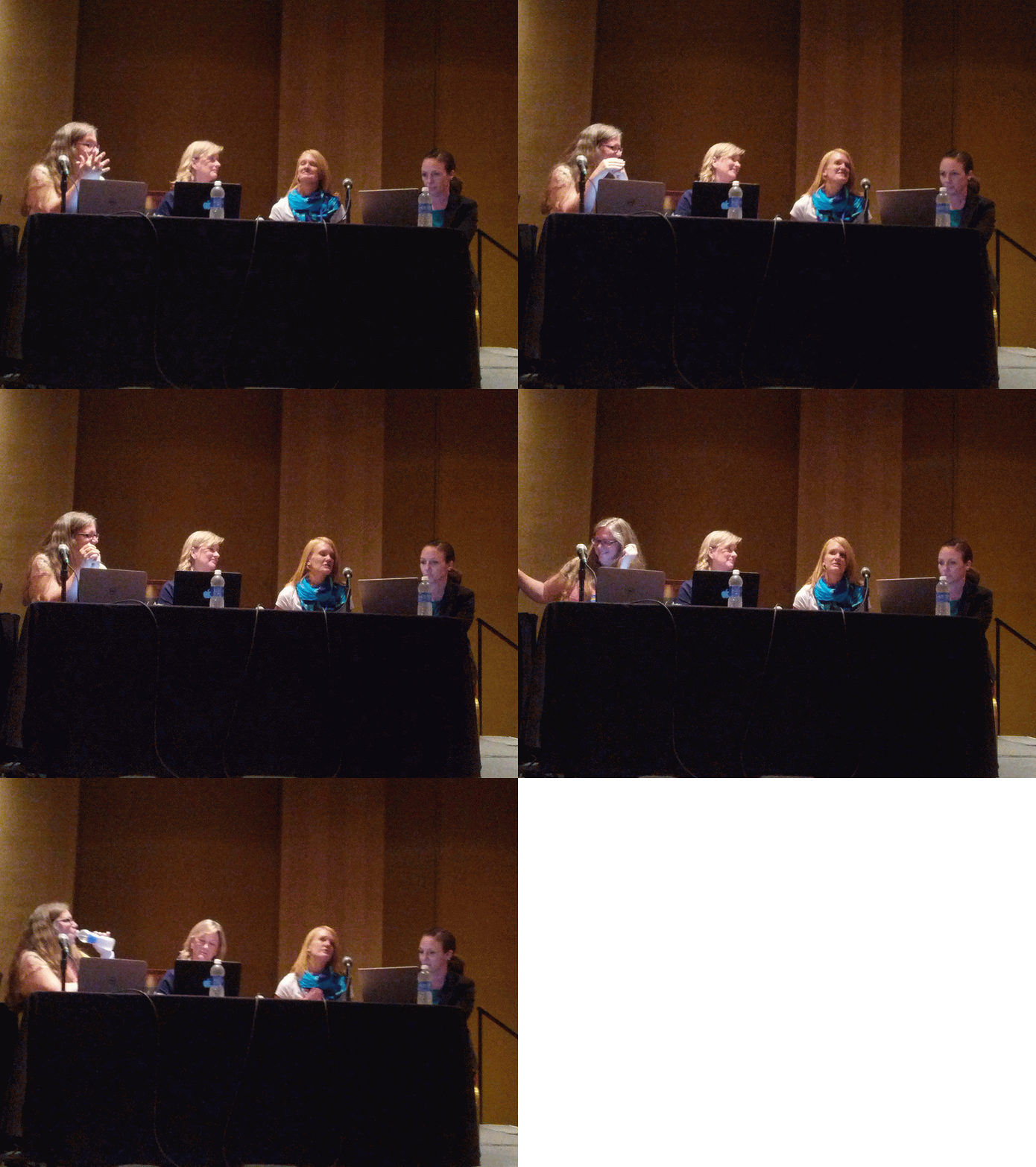
During the Using MOOCs for Blended Learning panel (#BLmooc), the discussion evolved around the impact (or lack there of) massively open online courses (MOOCs) have within higher education. The debate focused on how campuses should consider wider, strategic solutions for blended learning and the challenges/opportunities MOOCs provide for the learning process, students, open content, and various learning methods.
IMG_20130708_140836-MOTION

Thanks for sharing your thoughts on #BlendedLearning  and #MOOCs  at #Blend13  Karen, Shari, Amy & Tanya. 

There was talk about openness, content, delivery, and more. What struck me was the continued debate or talk about dualism between closed and open methods for delivery and content, which I think was shared in Andy’s tweet/blog post:

The last session I attended was the Unconference Session Around Researching MOOCs with George @Veletsianoshttp://tinyurl.com/moocresearch

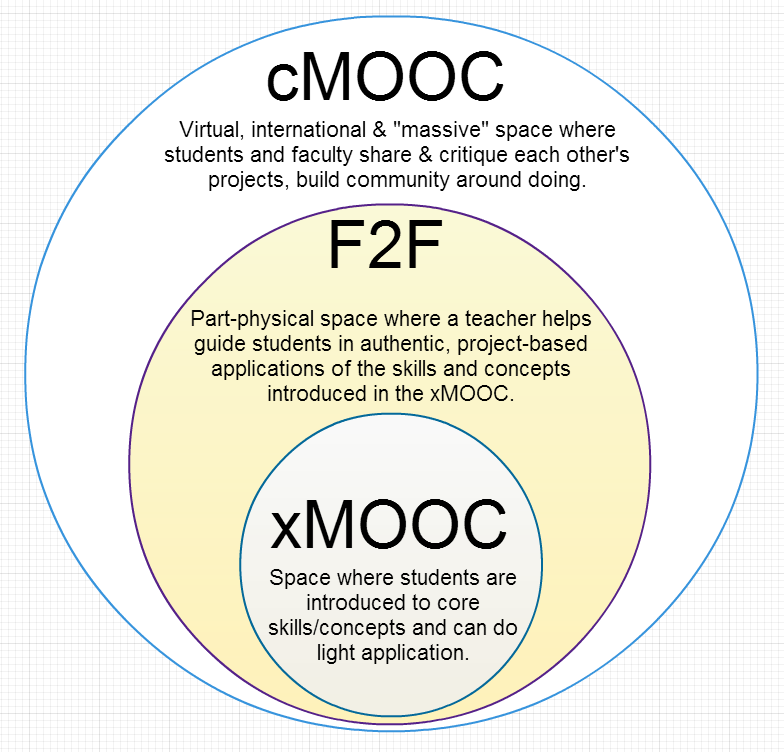
There is a number of interesting research questions, methods and more included in the Google Doc — and if you want to connect with any researcher, their contact information is also included. One article I found interesting from Mike Caufield (@holden ) was the x-MOOC  vs. c-MOOC debate shared via his Educause article. I wonder how many institutions consider the space or place their move to MOOC is going, and what sort of learning framework (if any) they place these models.
xmooc is a chewy center

Image c/o @holden in this article 


Last, but certainly not least, I was grateful for connecting with my #PLN of amazing colleagues that I am able to share with on a daily basis on different social media spaces. Who would have thought that this was my first time meeting Dr. Alec Couros (@courosa) in person — it feels like we go back for ages.  With a jam-packed, engaging keynote – I am glad that Alec and others took “notes” on Twitter. We also learned that when you let two Canadians loose in Milwaukee, there is bound to be some havoc. Highlights of our fun with the #blend13 crew (in no particular order) results in collaborative marketing campaigns for MKE, free-style karaoke, BACON love, killer dance moves, great conversations, photo-bombing, and general good times.

Untitled

Name the trouble makers who photo-bombed my #selfie.

Until we meet again #blend13 friends… keep it smooth.

AcAdv, nacada, NACADA Tech, Social Media

The Global #AdvTech Discussion at #nacadaINTL … And Then Some #acadv

At the beginning of June, I was fortunate to participate in the first International NACADA Conference in the Netherlands. The conversations (#nacadaINTL – archived tweets!) and sharing of ideas on how to advise and support students is universal. A number of countries and institutions were represented, and surprising enough, many of us face similar institutional challenges for effective student development.

I was happy to return to Maastricht, where I studied as a student, to present social media research, moderate a technology in advising panel, and facilitate a workshop on communication strategies for advising students.

Q: What do @ 4 am when you cant sleep? A: Go on a Maastricht walkabout to see what you remember from grad school circa 2004.

I shared recent collaborative research on guiding social media from @tjoosten & @lindseyharness, and how our institutions rarely think about learning when it comes to policy. It was good to discuss challenges and ideas on how other campuses manage social media practices, and my faculty advisor will be happy to learn that I gave me some direction for my dissertation work. 🙂

Poster Session: Guiding #socialmedia at Our Institutions on by @tjoosten @lindseyharness & moi at #nacadaINTL #acadv #highered

In thinking about actual engagement, I discussed communication plans and ideas for reaching and teaching our students. I do not think that social media is the only solution; however this workshop discussed comprehensive communication planning.

Much of what we fail to do is think holistically about this at our institutions, and I am certain that advising units can lead the way and be a strong example on campus.

This workshop discussed ideas, examples, and practical strategies – here is the digital handout and the presentation:

Finally, I would like to thank the #AdvTech Panel (left to right), Richard Sober (from Teesside University,UK), Joel Shelton (from Zayed University, UAE), Nicolai Manie (University of Maastricht,  NL), Catherine Mann (University of Melbourne-AUS), George Steele (The Ohio University, USA), and Jennifer Joslin (University of Oregon, USA) for joining in the vast conversation about technology in advising. Interested in meeting the the panel? There’s an open, Google doc for that HERE.

Untitled

Although the assigned panel topic was technology in learning, much of the discussion dealt with managing institutional objectives, supporting learning outcomes, considering effective communication strategies, and workflow solutions to make advising practices shared and developmental. The first question posed to the group  was to set the tone and give the participants an understanding of how varied and fluid “technology” is for our advising experiences.

Question:

Answers:

Immersive, necessary, potentially useful, collaborative, student-centered, electric, difficult, powerful, accessibility & connected. {What is YOUR word?}

Much of the panel discussion and general conversations at the conference around technology really involved our shared experiences for our student needs. It was not really the WHAT or HOW, but rather the reasons WHY technology is utilized at each of our institutions.

Different practices and trends for technology in advising have emerged; however an agreement on costs, advising models, student demand, and resource issues were common topics. More advising units around the globe seem to be moving towards holistic needs that require system-wide, institutional technologies to track student success, encourage mobile learning, and identify administrative solutions to make advising workflow easier. Are all institutions doing this? No. Not many at all.

I look forward to continued discussions beyond #nacadaINTL as we dig into what lies ahead for advising and technology on a global scale, specifically:

  • How can we best determine technology needs and use for advising practice?
  • What technology in advising resources will be used or should be used if they were available?
  • How is your institution attempting to respond to these questions and challenges in higher education?

Let’s keep the conversation going #advtech …

Higher Education, nacada, Professional Development, Training

Passing the Torch: Leadership Transition in Our Professional Organizations

In many professional organizations and associations (both formal and informal), leadership positions are fluid and change frequently. Whether it is an elected position, scheduled appointment, or a professional move, it is important to consider how your organization manages leadership succession and transition to sustain the association.

Passing the Torch

In thinking about transitioning out of my current role with NACADA, I was asked to share my experiences and resources* for incoming leaders for in the association. I figured I might as well share a few of these ideas with others who might be transitioning or transferring of roles in their professional organizations as well:

I. Build Your Professional Posse – No leader can do it alone, nor should they. Surround yourself with some great people who share similar interests and passions in your professional area. You know who they are – you have met them at a conference, attended one of their presentations, connected with them online, or heard about the great work they are doing – so reach out and get these members involved.

  • Recruit members at annual conferences/meetings in-person and online. We used a shared Google Form to invite others, e.g. the  #AdvTech Technology in Advising Commission Sign-up for 2012-13

  • Pass on and share the names, contact information (email, phone numbers, Twitter handles, etc)

  • Find out HOW members want to be involved with your group. Be open to suggestions and areas of interest that you have not thought about.


II. Take Note — Document, Organize & Archive – Be sure to keep notes, capture screenshots, record meetings, and file take notes, take screenshots, record online, and file information in an organized way throughout your elected/appointed term.

  • Save and file emails into folders from the professional association, members, and more – you never know when you will need to refer back to them

  • Organize information by projects, deadlines, and responsibilities

  • Store and save your files in an accessible space for your group to review

  • My “go to” spaces of organization for NACADA included:


III. Mentor While You Lead – Succession planning does not have to start at the beginning or end of your elected/appointed term. Consider involving members in your professional organization early and often.

  • Encourage point people for sub-groups, committees, or projects

  • Recommend collaboration within and outside your specific group

  • Involve participants in activities, presentations, research and development with your interest/commission area (psst you should not do it alone).


IV. Meet with Your Members – You will want to organize a regular meeting schedule with your committee, group or advisory board. Inquire about these at the start of each academic semester or quarter, and try to keep them on a regular schedule. Save the date(s) in advance.

  • Determine when you can meet. Try using a Doodle to sort out your meeting schedule.

  • Find the best space to “meet” for your group as they may not be anywhere near one another geographically:

    • Conference Call? There are a few free ones like http://www.freeconferencecall.com/ out there

    • Professional Association or institutional online web conferencing available? NACADA uses the Adobe Connect platform

    • I also am a fan of Google Plus Hangouts – free group video chat for 10 people and the ability to have IM chat and shared documents from Google Drive and/or screen sharing capability

  • Put out your agenda a week in advance to remind others of meeting, where/how you are meeting, and to give time to prepare/read over meeting information

    • I use Google Docs for shared agendas to encourage members to add discussion topics, questions, or updates


V. Create a Communication Plan – Consider making a communication plan for your professional group. This will help you understand the how, where, when and why for communication. This will also help you to disseminate information, seek out information, ask questions, and engage the members of your professional group.

  • Survey your group to find out WHERE they want to stay connected and informed. This can be at an annual conference/meeting or online. {We asked at the annual meeting, and on the digital sign-up sheet.}

  • Create welcome messages for email, Facebook or other networks to tailor and respond to interested members ASAP, for e.g.

Hello ________________,

Great to hear that you are interested in getting involved in the NACADA Technology in Advising Commission (#AdvTech)! Our #AdvTech Commission would love to have you join in the fun. To help identify your interests for involvement in the commission, please complete the NACADA Technology in Advising Commission Sign-up for 2012-13 {insert URL}

Also, be sure to connect to our commission  Facebook Group: {insert URL} There are a number of great conversations, questions and opportunities to share resources in this space. Finally, we do have an option to sign up to the commission listserv and information on the NACADA Technology in Advising Commission web page

Looking forward to getting you connected and involved soon!

Best,

Laura Pasquini

NACADA Technology in Advising Commission Chair 2011-2013

  • Get SOCIAL (media) – find an online, connected space that works for your group. Our group was interested in a moderated/closed Facebook Group; however I have seen Google Plus Communities, organizational listservs, Facebook Pages, LinkedIn groups (e.g. Advising Veterans), or hashtags on Twitter (e.g. #firstgen) to bring professional groups together. Just be sure to keep up with the conversation in whatever space you choose to use.

  • Be open for members to reach out to you for questions, ideas, suggestions, and getting involved. I often connected with members via email, Skype, on the phone, Google Plus, or another social network. Keep the conversation going, and consider hosting “office hours” or regular ways to connect with you.
  • Think outside the communication box. Consider offering different means for sharing member information and updates. We tried out the NACADA Tech Talks of 2012, and after the NACADA 2010 conference members of our group initiated the the #AcAdv Chat weekly Twitter conversations.


*There are a number of different tools and online resources to help with professional organization workflow. I am just sharing the specific ones I used with my NACADA Technology in Advising Commission the past couple of years. Figure out your purpose, then find the appropriate tool that will work for you.

Open Education, OpenAccess

Open Education: Why #OER Needs to Be Our Business and Policy

A couple weeks ago, I attended the WCET hosted webinar on our campus – Open Education: The Business & Policy Case for #OER presented by the Director of global learning at Creative Commons,  Cable Green (@cgreen).

Wait – what the heck is OER?

I did take a few notes (a.k.a. Tweets) and thought I would share my thoughts from the session – and general thoughts for OER materials.

avatar
{Irony: Not all of the OER Commons is CC licensed}

The real issue is about sharing and making a case for open policy on campus that fits a “business model” in higher education. This webinar addressed concerns and practices to implement open access policy that is good for business. Currently, many educational institutions do not value  or support “open” as an option. I am fortunate to work at a university that supports the open access movement and encourages sharing of scholarly research and publications. I have been thinking about my role as an open educator for a while, and what it means for my research, publications, editing, teaching, and learner engagement.

In reviewing the UNT institutional OER involvement, I know there is some progress for resources, but like many campuses, we have a way to go. It would be great to see more departments, faculty, and units participate in sharing resources and joining the #OER movement.  By swapping educational resources and encouraging remixing of ideas, we might be able to create more opportunities for collaboration  to enhance our learner experiences, including:

  • faculty mentoring
  • new ways instructional design development
  • program evaluation
  • cross-training of staff and faculty
  • student innovation/involvement
  • affordable learning materials e.g. http://opencourselibrary.org/
  • interdisciplinary learning commons
  • building capacity within your institution

If you’re at a publicly funded institution, your educational resources should be openly licensed – this just makes sense. Does your institution encourage and promote Open Access? Do you share Open Educational Resources at your school? Please share how you are #OER.

Collaboration, Reflections, Social Media

Why Understanding Differences and Coming Together Matter

To say that this past week has been eventful, would be putting it mildly. If you were under a rock or disconnected from any media, then let me do a brief re-cap of a few events that occurred:

During the week’s happenings, many were tuned into the news and social media streams. An even larger percentage of people expressed their thoughts, feelings, and concerns in various social media outlets. As events unfolded in different geographic locations, it was amazing to see people come together to show support for one another. The power of the community and lending a hand has been seen widely in these shared spaces. For example, the #RunForBoston initiative and the Americans for Mariage Equality equal signs could not be missed. Social media affords individuals to get involved, speak up, and share their thoughts.  Both our mobile and connected technologies have the power to make our world smaller and unite a community.

Unfortunately, there is a double-edged sword for this social sharing. With the increase in open, public dialogue comes harsh comments and demonstrations of disrespect. I learned that few often considered other perspectives as social/media streams shared a number of incorrect and inappropriate assumptions, outbursts, accusations, and opinions. It saddened me a bit, and I often stepped away from the screen.

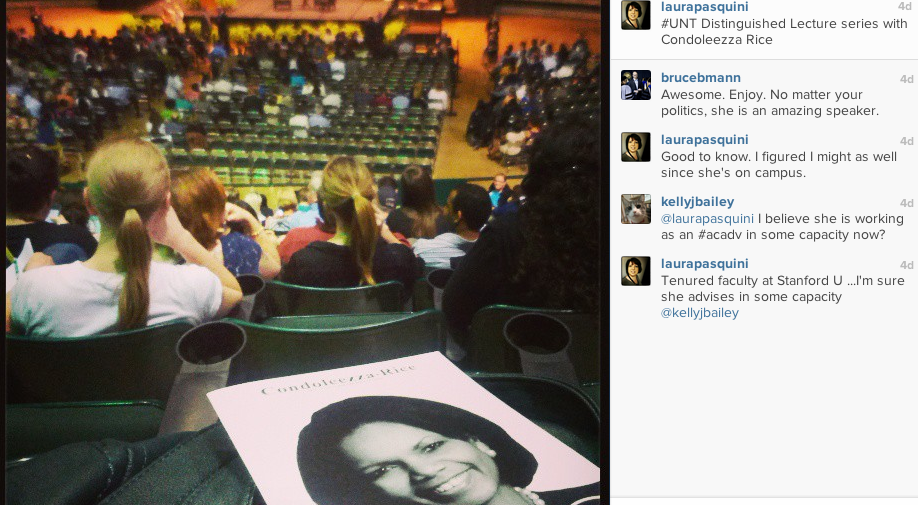
On Tuesday (4/16), I attended the Condoleezza Rice Distinguished Lecture hosted at UNT. My friend @brucebmann said it best when responding to this photo “No matter your politics, she is an amazing speaker.”

Screen Shot 2013-04-20 at 2.46.31 PMThis comment, and listening to the talk, made me think about my own perspectives and bias. How often do we challenge ourselves to think in a new way? How can listening to another perspective better inform our decisions? How is it possible to bring groups in conflict together?  I think it is possible, and I know that I am not alone.

Although “victory” has been seen this week, I don’t think that these events are really over. I challenge more of you to think about your influence and impact in social [media or not] spaces. What you say, tweet, blog, post, etc. influence the dialogue and community. It is easy to get [digital] high fives from friends and followers; however have you considered extending your reach to those you might not agree with? When is the last time you chatted with someone about the issues from this week who thinks differently than you do? Step away from the screen, and get to it.