Collaboration, Conference, Learning, Professional Development, Reflections, Research

Innovation for Learning: Submit Your Ideas for the #OLCInnovate Solution Design Summit

I have been thinking about innovation for a while. What does innovation mean to you? How does “innovation” play into your world of work and learning? The word INNOVATE feels very much like a buzzword when it comes to learning. It may even be as a prime contender found on one of my #edtech bingo cards used for education meetings and conferences. Now the word, innovate, has been placed as a conference title and I agreed to support the planning for this event => Online Learning Consortium (OLC) Innovate. These facts only means I have been reading and reflecting even more about innovation and what this term means. Here are my current ponderings and ideas.
pondering_innovation

Flickr photo c/o Missy Scmidt

A number of organizations are increasingly being influenced or impacted the eagerness to “solve” problems with technology. Last year, George Steele suggested the book, The Innovators, in a conversation about the culture of change in higher education (a HUGE topic I will save for another blog post). This was a well-timed referral and read for me. Isaacson (2014) describes how groups of individuals ingeniously cooperated to innovate in the real world. Say what? Tell me more!

Thinking, designing, and employing innovation for learning is complicated. The story of the collective successes (and failures) of many innovators need to be shared, and continually drafted as there are “far fewer tales of collaborative creativity, which is actually more important in understanding…how today’s technology revolution was fashioned. It can also be more interesting” (Isaacson, 2014, p. 1)

Although The Innovators shares the history of computing, technology, and the Internet, and it really spoke to my inner collaborator and WHY I dabble in the applied inquiry to understand more about online/blended learning technologies and workplace L & D. The collaboration emphasis resonated throughout this text, and I do believe that “no one individual…has truly achieved anything alone.” I concur.

By definition, we always appear to be “innovating” in learning, right? With formal education institutions (K-12 and higher education), professional associations, and learning organizations there seems to be a tension of how to balance innovative ideas or approaches due to structural, pedagogical, and workforce challenges in the real world. We want to be innovative, but sometimes our organizations or “the system” rarely allows this process to unfold with constrictions of our job portfolios/functions, institutional divides, or designated project timelines. As Martin Weller put aptly put it: “the rhetoric for the need for innovation is rarely backed up by practice that will encourage it.” Let’s change that narrative. Why don’t we try to play with a few innovative ideas and concepts together?

For OLC Innovate, there are a few new (I won’t say innovative, just yet) program features that are atypical of a traditional conference format. One of the goals the #OLCInnovate steering committee set out: Let’s have less “talking head” presentations (education sessions, lectures or plenary talks), and more conversations, fun social happenings, places to share, and opportunities to solve REAL problems for online/blended/F2F learning. <<Segue>> THAT being said, here’s a new feature of the #OLCInnovate program I hope you will consider:

The OLC Solution Design Summit (SDS)


Video trailer production credit to Kyle Johnson

The general call for program proposals is now closed (with the peer reviews completed, expect to see the full program online next week); however the call for TEAM Proposals is OPEN for the OLC SDS until February 10, 2016 [Deadline Updated to extend the call for proposals on 1/26/16]. Thanks to the 2015 #et4online unconference banter, the OLC SDS Team (Mike Goudzwaard, Patrice Torcivia, Kyle Johnson, Adam Croom, & Michael Atkisson) decided it was about time to offer a program feature that was less about product and more about process. Together we carved out space in the #OLCInnovate schedule to offer a space for design thinkers, tinkers, and leaders to assemble in order to propose and solve challenges we encounter in learning (in K-12, higher education, and industry-L & D), such as:

As we know innovation takes time and it is a team process. For this CFP we have a broader timeline for this program and we and different expectations for this call for submissions. We are not looking for an end solution. Our team is more interested in WHO is at your interdisciplinary team table and the potential problems you want to work on together. Solutions might appear, but regardless this will be shared opening before, during, and after the #OLCInnovate 2016 conference ends:

Before the Conference

  1. Prospective SDS participants submit a challenge proposal by February 10, 2016: Abstract about the problem, team, and potential solution.
  2. Acceptance notifications will be sent out to teams by February 16th. [Confirm acceptance of your team by 1/22]
  3. Those SDS teams with accepted challenges will submit a solution pitch video for public review on the OLC Innovate 2016 website, by March 11, 2016 (due March 4th).
  4. Experts and OLC Innovate attendees will be invited to view and comment online to provide feedback on the video pitches March 21 – April 1.
  5. SDS teams will meet via an online web conference for 30 minutes to debrief and plan before the with the SDS facilitators in early April, before the #OLCInnovate Conference.

During the Conference

  1. SDS teams participate in a two-part pre-conference workshop session the morning of April 20, 2016. This will involve sharing the challenge and potential solution.
  2. Building on the feedback from the pitch reviews before, the design-thinking workshop on day 1, and comments from the workshop (via educators, edtech experts, researchers, exhibitors, and other SDS teams), you will further develop your challenge statement and solution design “pitch” to present during a concurrent session.
  3. SDS teams will present their solution in a 15-minute (10-minute presentation & 5 minute Q & A) time slot during an OLC Innovate session for all conference attendees.

Post-Conference Winning Team Benefits

  1. The winning SDS team members will each receive a one-year OLC Professional Membership (limited to a maximum of 5 team members). Current OLC members would receive a 1-year extension to their existing OLC Professional Membership.
  2. The winning SDS team members will receive complimentary future OLC 2016 or 2017 conference registration (limited to a maximum of 5 team members, not applicable to OLC Innovate 2016).
  3. The OLC Team will engage the winning team in a conversation of how best to showcase their solution through OLC.  Examples may include a webinar, membership dashboard interaction, OLC social media promotion, etc.

Now that you know the details, I encourage and instigate ALL of you to REVIEW the Solution Design Summit CFP and SUBMIT your team application NOW! Please feel free to share with your colleagues, and instigate innovation among your peers as well. Do you have questions about the OLC SDS? Email our team: sds@onlinelearning-c.org or follow up with either Mike or me. Thanks!

References

Isaacson, W. (2014). The innovators: How a group of hackers, geniuses, and geeks created the digital revolution. New York, NY: Simon & Schuster.
Book Review, edusocmedia, Learning and Performance, Professional Development, Training & Development

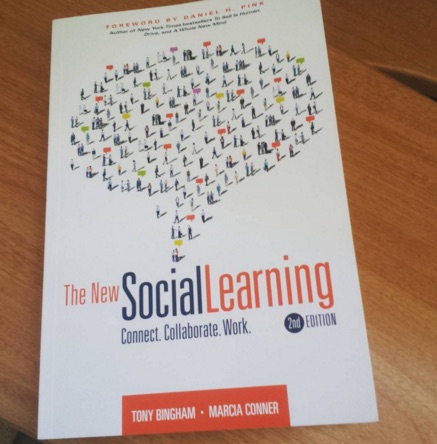
#BookReview: The New Social Learning, 2nd Edition #NewSocialLearning

The first edition of this book, The New Social Learning, was published 5 years ago. I read and have a copy of it on my bookshelf; however, we know that emerging and connected technologies have continued to flourish and influence our organizations. The social technology landscape has changed since 2010. There are a number of new platforms, additional functionalities and communication channels, an increase of utilization and adoption by our organizations, and a much greater acceptance of social media being applied for learning and development. Marcia Conner and Tony Bingham have recently published an updated version of this book with The New Social Learning: Connect. Collaborate. Work, 2nd Ed.* The latest edition provides a number of excellent case studies for how social media is being implemented in workplace learning, development, and performance.

SocialLearningBingham and Conner (2015, p. 8) define social learning as the “joining with others to make sense of and create new ideas…[it] is augmented with social media tools that bridge distance and time, enabling people to easily interact across workplace, passion, curiosity, skill or need. It benefits from a diversity in types of intelligence and in the experiences of those learning.” What is really “new” about this type of social learning with emerging technologies is the impact these platforms and tools have to the experience. “Social tools leave a digital audit trail, documenting our journey – often an unfolding story – and provide a path for others to learn from” (Bingham & Conner, 2015, p. 9). Social media facilitates the empowerment of learning among your networked peers beyond the limitations of geography or time.  I appreciate how the authors identify what is NOT the new social learning (e.g. informal, e-learning, MOOCs, just for knowledge workers, in contrast to formal learning/education), and how this type of learning is meant to augment, not replace, training, knowledge management, and communication practices in our organizations. As technology has accelerated change in the workplace, Bingham and Conner (2015, p. 18-19) see the opportunity to implement a new social learning strategy based on these changes in work:

  • The accelerated pace of change requires agility. Consider agile values for the workplace.
  • Our technologies go where we go without any boundaries. Not all can be controlled, contained, or developed from within an organization.
  • Our shifting workplace demographics change expectations, with regards to generations, gender, culture.
  • People desire personal connection to communicate, collaborate, and share.

Although the authors share a number of success stories about individuals and organizations who are engaged in social media to enhance learning, they do offer potential critiques and considerations for governance of social tools. By including applied examples and practice to social learning theory, this book identifies suggested approaches and considerations for implementation of a new social learning program as outlined by its table of contents (TOC):

  1. Reach Out and Connect – Introduction to the book topic and focus (download the TOC and part of Chapter 1 here: http://www.thenewsociallearning.com/)
  2. Embark on the Journey – Setting goals and planning for the “new social learning”
  3. Transition and Engage – Strategic steps for implementation of social media for learning
  4. Never Give Up – Reminders, challenges, suggestions, and issues to consider
  5. Analyze Insights and Returns – Suggested methods and areas to evaluate and measure
  6. In-Person Learning Reimagined – Opportunity to engage in F2F social learning from the springboard of social tools
  7. Appendix: Social Media Governance – Examples of a few corporate policies and guidelines to consider for your organization

Chapter 5 provided excellent considerations on how to analyze and understand stakeholders when considering a social (media) learning approach. This section outlines this lightweight analysis to help quantify social and digital tool adoption. As I tend to work with non-profits, K-12, higher education, and professional/trade associations, I modified the descriptions and questions from this section of Bingham and Conner’s (2015, pp. 206-252) book to focus the analysis for learning and development organizations:

  • Analysis 1 – Perspective: Do you have a sense of how people in your organization feel about the company/institution, each other, their clients, etc.? What if you could better map the perspective of your stakeholders? What is your priority with a new social learning approach? It will be critical to analyze patterns of attitudes, feelings, conversation tone, and individual voices in your organization by reviewing the unstructured data created by social and digital platforms.
  • Analysis 2 – Engagement: How important is it to have a large majority of your organization fully engaged in their work and/or learning? Are your stakeholders aware of the organization’s vision, mission, and purpose? What does it mean to have engaged educators and/or learners in your organization, with regards to online participation, generative production, and choices for collaboration?
  • Analysis 3 – Connectedness:  How do you want individuals in your organization to know each other or, at least, have a method by which they can get to know what skills and knowledge everyone brings to the table? Have you conducted an organizational network analysis yet? Do you have a method for sharing information, managing knowledge, and directing your organizational stakeholders to resources and/or other people?
  • Analysis 4 – Fiscal Fitness: Are you concerned that social (media) will be of little value to your organization? Are you afraid there is no way to measure the value many assure you is there with social media for learning? What is the ROI for social learning? Sometimes there might not be direct counts; however bench-marking our own performance indicators will help with identifying new opportunities to balance the reward-risk ratio. Outcomes of social learning might be noticed in the side effects, i.e., increased employee morale, a decline in sick days, or a growth in collaborative team projects.
  • Analysis 5 – Impact: How do you know what you are doing is actually making an impact to your organization? How have social (media) tools improved or supported your own learning and development? Is there a change in behavior, opinions, attitudes, and experiences of your stakeholders? Do you notice an increase in productivity or improved learning outcomes?
  • Analysis 6 – Influence: Do you know how collaboration and communication change measures of authority and the effect it has on who is “seen” to provide real value? Influence can come from a position of authority; however, it might also is socially and informally created with our digital, network tools. Involving all stakeholders to participate and identifying impactful messaging from leadership will be critical for open communication. You might not realize how pluralistic ignorance can impede social change in your organization.
  • Analysis 7 – Attention: Do you know how your own stakeholders can dramatically multiply the value of their own and their colleagues’ knowledge? Are your stakeholders paying attention to key messages and less attention to distracting noise? What are the key trends and movements in your organization on these social channels? Do you have a pulse of the conversation and needs on these platforms? Believe it or not, there is life without email.
  • Analysis 8 – Capacity: How do you want to expand the social learning methods and platforms you use to understand and maintain the critical skills needed for your organization? How can you analyze and foster leadership, interests, knowledge, content, or geographic distribution, for your social learning approach?
  • Analysis 9 – Change: How can you best understand your organization’s culture and the impact social approaches will have on transforming learning and development? How will you conduct a learning culture audit that includes the assessment of social media platforms for learning? How will you communication the transformation of your learning approach to the organization?
  • Analysis 10 – Fill the Holes:  How can you help others in your organization imagine a future and stimulate exploration of topics and ideas that might not fit into an existing structure? Can you conduct a personal network assessment to identify who in your organization might help to “fill in the missing holes” for your social learning approach? How might you analyze and review the real-time experience on your social media platforms?

Reference:

Bingham, T., & Conner, M. (2015). The new social learning: Connect. Collaborate. Work., 2nd Edition. Alexandria, VA: ATD Press.

*Full disclosure: The @NewSocialLearn book was sent to me by @ATD Press to read and post a review on my blog. Thank you for the read – it was enjoyed. 

#AcWriMo, Higher Education, K-12, Learning, Learning and Performance, Learning Technologies, Online Learning, Professional Development, Research, Training & Development

What *IS* Innovation? Tell us. The CFP for OLC Innovate 2016 (#OLCinnovate) is OPEN!

What *IS* innovation?

This is the FIRST question the Online Learning Consortium (OLC) co-chairs, Karen VignarePaige McDonald and I, asked each other as we started to organize the *NEW* OLC Innovate Conference (#OLCinnovate). Innovation is a BIG word. It means so many different things, to so many different people. Before putting out the call and promoting the #OLCInnovate conference (happening April 20-22, 2016 in  New Orleans, LA), we thought carefully about who we wanted to join the planning team and how to design a conference experience to live up to the “hype” of the word INNOVATE. This conference was formed to merge the best ideas of blended learning (from #blend15) and emerging technologies for online learning (from #et4online); however we expect this meeting in NOLA — OLC Innovate 2016 — to be SO MUCH MORE! Thanks to our AMAZING #OLCInnovate Steering Committee (Tw-shout outs HERE and HERE) we support to hash out what innovation means for the program tracks, developed thoughtful session types for program delivery/format, and, we hope, this conference will model the learning design we all strive for at our institutions and organizations.

logo_516x227

So WHY should you attend #OLCinnovate 2016? [What’s in it for me? you ask.]

  • Advancing learning requires continuous visionary leadership from all disciplines
  • Connecting with multiple stakeholders (i.e. learners, educators, administrators, trainers, researchers, administrators, faculty, policy-makers, designers, and industry leaders) to strategize about the evolving needs at our institutions and organizations
  • Sharing learning and development ideas for all levels – K-12, higher education, & industry
  • Implementing solution-based approaches to learning design, support, and structure
  • Researching and developing evidence-based practices for learning is now more critical than ever.

Our #OLCinnovate planning team thinks this conference is a great opportunity to bring ideas, perspectives, research, and practices to the table to truly support innovation in education. The program tracks are structured around areas we all face with learning and development in K-12, higher education, and industry:

  • Workforce Innovation – connections from K-12 to higher ed to the workforce, curriculum to meet industry needs, partnerships for learning & work
  • Structural Innovation – systemic challenges, organization of education, learning spaces, partnerships between educators & technology solutions
  • Pedagogical Innovation – course & program approaches, methods, design, assessment models, etc.
  • Challenging Barriers to Innovation – digital divide, OER, Open Access, sharing evidence, ethical research collaborations, opportunities and areas for learning growth
  • Propose Your Own Topic – Tell us what YOU think innovation IS or what is missing!

Extend_OLCinnovate_Dec2

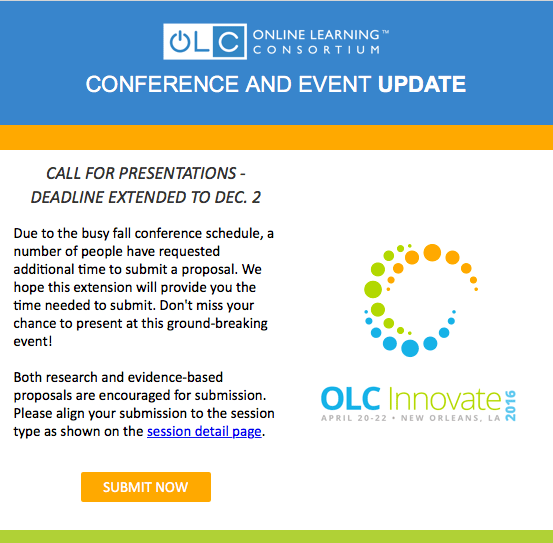
The call for proposals (CFP) is OPEN until November 9 December 2, 2015 

Program Format (Session Types) include:

  1. Conversations That Work – why have a panel, when you can facilitate a discussion on the topic with others in the room? Think of questions, discussion prompts, and ideas you want to chat about for this 45-minute session.
  2. Emerging Ideas – Forget the “traditional poster session” we want you to share your practice, research, and work-in-progress ideas in 10-15 minutes to get ideas, feedback, and suggestions during this networking event with both on-site & virtual attendees.
  3. Innovation Labs – 5-minute chat about the concept/idea; 20-minute demonstration; 20-minute applied skills for learning, technology, research, design, or other.
  4. Research Highlights & Trends – 15-minute presentation on your original research; abstract due in November; final, full paper due January 31, 2016 with the potential to be invited to a special issue of the Online Learning journal.
  5. Workshops – these are interactive 90-minute sessions with valuable take-away learning outcomes for participants (free to all conference participants).
  6. Education Sessions – a 45-minute lecture about an idea/concept with 5-10 minutes for Q & A at the end.

There are a number of helpful tips provided on the CFP page; however if you have questions or needs, I would be happy to support you with your proposal development/submission. It is getting the right PEOPLE and VOICES to the table that adds value to any learning and development experience. Please help us invite of institutional stakeholders from education (K-12 and higher ed), and industry (technology, design, L & D, and corporate training) to #OLCinnovate. Share this blog post with your peers, and tell me who the #OLCinnovate planning team should reach out to or invite. Thanks!

SUBMIT A PROPOSAL FOR OLC INNOVATE 2016!

Upcoming announcements of other #OLCinnovate program features, speakers, highlights, and are coming soon… stay tuned for more updates!

Higher Education, Professional Development, Reflections

Digesting #dLRN15: Making Sense of Higher Ed

In the midst of the death of higher ed headlines,the  disruption of HE,  and all the higher ed is broken rhetoric tossed out, a few of us took a pause last week to discuss how to deal with the issues and challenges facing the post-secondary education sector at #dLRN15. I felt fortunate to be able to connect with a number of colleagues to talk behind the buzzwords, and dig into a the real issues challenges our colleges and universities face. It’s time and there is a need to take time for making change in higher education (thanks for the prompt post, @KateMfD). I am not sure that “change” was made, but I am proud to be part of the discussion and momentum that will move some of it forward.

pre-con QaMany thanks to the conference organizers for bringing a few smart kids around the table to discuss the following issues:

  • Ethics of collaboration
  • Individualized learning
  • Systemic impacts
  • Innovation and work
  • Sociocultural implications

The panels, sessions, and keynotes left me with more questions than answers – and that is a good thing. Beyond the formal program, the sidebar chats over coffee/snacks/pints were not to be dismissed As Mike Caufield said, I will need to process discussions had at #dLRN15 for weeks. There were some deep discussions into complex issues that could not be dealt with in just two days.

In our pre-conference meeting, each group picked a question/issue based on the themes the conference was focused on (see above). One the groups developed a question that resonated with me the most:

keyquestionWe always want to push forward with big change and innovative ideas in higher ed, but really do we sometimes forget to recognize the incremental changes occurring within our institutions? How do we acknowledge the slow movements and progress we make in HE or that it is an on-going process of change? There are many micro-movements occurring within our learning spaces to help us evolve. I know there are a number of amazing things happening within our colleges and universities — sometimes it’s these slow contributions that make the difference and we often fail to recognize this gradual progress. Slow and steady does win the race.

FinalPanel

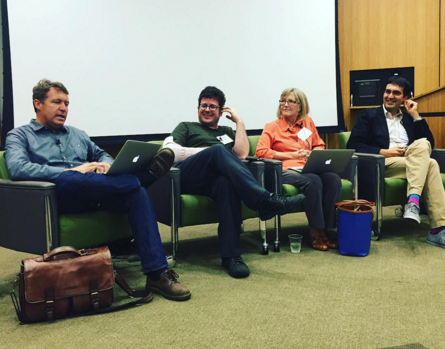
Ethics of Collaboration & Closing Remarks: Random Dude, Mike, Barbara & George

Fast-forward to the end of the conference, after a number of thoughtful conversations, this final panel reminded all of us of the call to action => to provide evidence for higher ed to shift. George Siemens asked us to utilize research to fuel the fight around the issues raised. Beyond collaboration, what are we really going to do with what we’ve talked about now? It’s great to hear that we are not alone in our discussions however we need empirical evidence to support the change ahead in higher education. I appreciated how this panel spoke about getting beyond the dichotomies and encouraged us to think about research in collaboration with our students and work. We really need to listen to our students and amplify their story/voice in the research we do. It’s easier to move and change when there is already momentum for systemic change, and perhaps #dLRN15 titled the scale for a few. There are a number of challenges and questions from #dLRN15 to consider with our research in higher education, including:

  • What were the foundational assumptions and purpose we thought about at the #dlrn15 ?
  • How do the threads of the conference fit together in a framework to support advancing higher ed? 
  • What does it mean to have a US-centrist focus in higher education? How does it impact HE on a global scale? Does it?
  • Was there enough systems-level research or research on systems change at #dLRN15?
  • Is there a need for systematic-change at all levels to advert change in higher ed?
  • How can higher ed research impact practitioner-based work?
  • Is research is the lever for change for us? And does empirical evidence have the potential to change the higher ed system?
  • How can we create a true design jam process — where research is reviewed and reflected?
  • Why should we trust the researchers?
  • We are able to get learners to the institution, but just not to get them through
  • economics of higher education — and the future of higher ed
  • Do we have enough divergent thoughts or ideas shared? Is this an echo chamber or do we need to invite others into the room/discussion for HE? 

This conversation (thankfully) is not over. Here’s a snapshot of my #dLRN15 Reading List with reflections and then some. Let’s keep this conversation and momentum going.

AcAdv, Higher Education, Learning, Professional Development, Social Media

Bringing Our Personality and Self(ie) to the Online

You can’t help but bring yourself to anything you are passionate about. I truly believe this.

Self-Love

This past week has brought conversation and debate prompted from a single blog post about The role of personality in education. Thank you, Martin. This post shared thoughts on how individual courses emerged with a “cult of personality” to drive it towards success, collaboration, interaction and then some. For these type of MOOCs, the learning design was intentionally focussed on the characters (Yes. Dave and Jim are characters… who I adore) to encourage participation and community in the vast Interwebs:

To be successful they often require someone with a well established online network to gather enough momentum, and because creating successful cMOOCs is hard work, that person usually needs to really be central in driving the course forward. And when this works well, it really does create a very engaging learning community.” ~ @mweller

I really think the “chalk and talk” can and should be changed for effective teaching and learning. This will take time, and much more than a popular face and/or a shiny technological platform to alter the culture of teaching and learning in higher education (online, blended OR F2F).:

…an understanding that public service is only a part of identity, and thus the educators who are engaging emergent technologies in the name of pedagogy and content need to be able and willing to build connections and relationships between the formal requirements of the educational system with the personal transformation of each individual.” ~ @RMoeJo

Of course, these ideas about personality and lead personalities are not always representative of the spectrum of learning we see leading these initiatives in higher ed. Social media has created opportunities for unique and powerful collaborations; however they have limited a voice from other populations. There are a number of flaws in elevating pedestals in online learning. Thanks for the reminder Kate, I appreciate her post to consider how we  reward and recognize privilege in our domain:

And on campus, we struggle with personality across student surveys and intellectual property policies: we haggle over the idea of the individual as creator of educational content whose expertise is the guarantee of student experience, while setting up procedures to assure the depersonalisation of content production so that students are protected from the vagaries of charm. Personality: can’t live with it, can’t live without it.” ~ @KateMfD

I am not naive in thinking a number of these social mediums and emerging technologies often influence the network, create affinity groups, and allow lead personalities to dominate. However; I am reminded these same social networks permit educators to customize student experiences, collaborate with researchers, and  build meaningful relationships to scaffold learning and inquiry.

A couple of weeks ago, I shared with student development and academic advising faculty/staff the only way I know how to best engage in what I do. To be myself, specifically, how to model your persona in the online to support student success and professional development on campus. In the #AdvSelfie session, we discussed how it is important, more than ever, to be present and engaged in the digital. More than ever we need to ask questions, be involved, and participate in the backchannel conversations happening at and around out institutions.

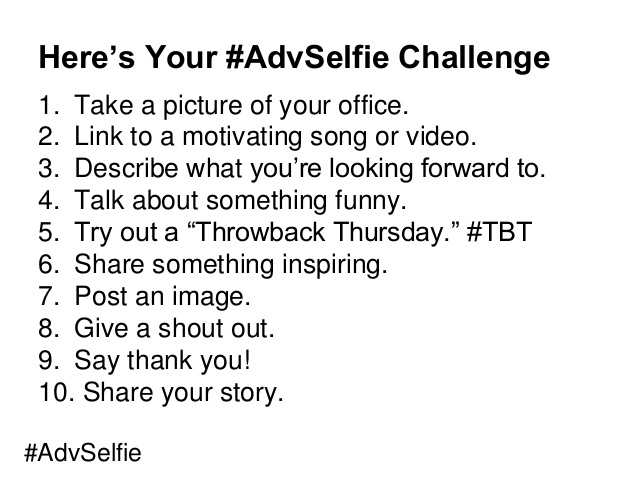
Mentoring and modelling online is the key to success for all in higher education — this includes our academic staff/faculty, administrators, staff, educators, and students of all educational levels. In an effort to engage in this dialogue, I challenged participants at the #NACADAmelb and other professional/faculty in higher ed online to BE PRESENT. This challenge stemmed from a 30-day challenge for those who are active online (or should be). To be the example for others on campus, I encouraged the advising group (hey – we all advise one way or another) to be the example with The #AdvSelfie Challenge – so you should probably participate as well:

the-advselfie-66-638_CHALLENGE

The #AdvSelfie Challenge: Post your best selfie showing how you mentor and model your online persona for your #highered campus (students, staff & faculty) with the hashtag #AdvSelfie before July 31, 2015 at 11:59 pm CDT. Prizes WILL be awarded … so get creative!

the-advselfie-7-638


UPDATE 08-14-15: And the winners of the #AdvSelfie Challenge Are….

Thanks to all of you who participated in The #AdvSelfie Challenge! It’s been great to see how you share some of yourself to colleagues, students, faculty and friends on campus. Kudos for being the digital mentors and models we need in higher ed!

Congratulations to the following “winners” of The #AdvSelfie Challenge:

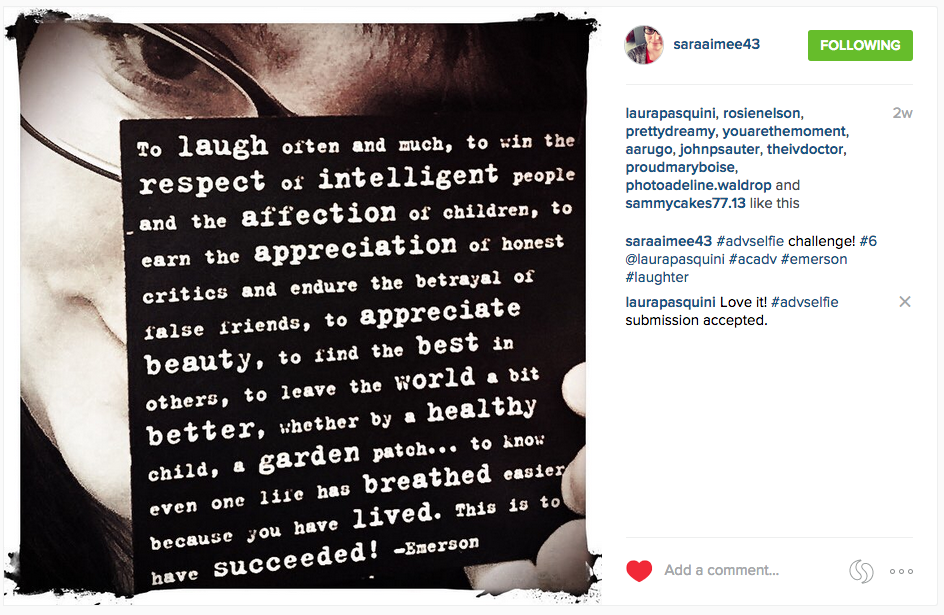
Sara Ackerson, Washington State University Vancouver, WA: For reminding her colleagues and students to laugh and find the best things in others for success.

SaraA

Amanda Mather, Texas A & M University at Qatar: For sharing who inspires and mentors her own advising career in high education.

AmandaM

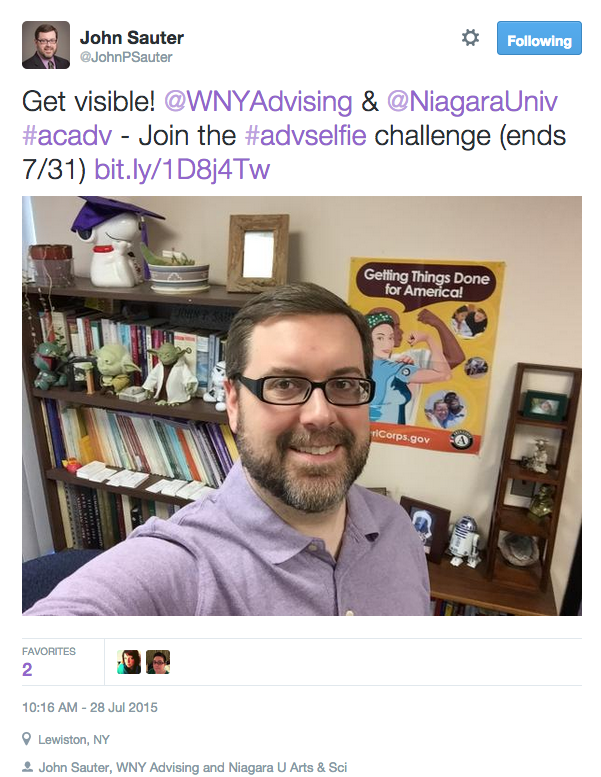
John Sauter, Niagara University, NY: For connecting his university and professional advising community in WNY to be active participants and engage online.

JohnS

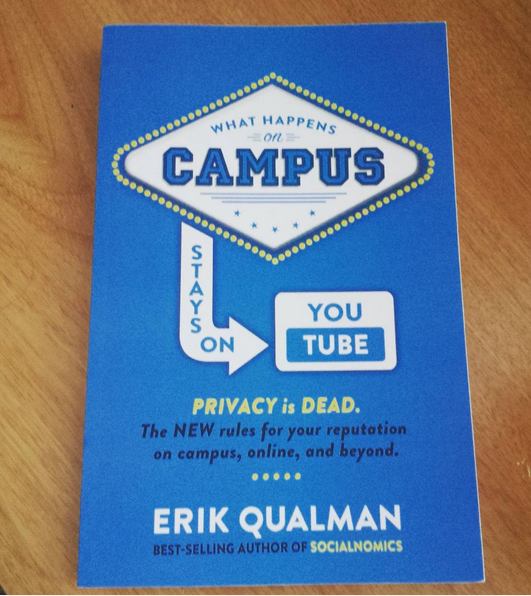
All winners will receive in the mail their own copy of the What Happens on Campus Goes on YouTube book shortly.

WHOCSY_book

Thanks for showing your #advselfie! Keep on supporting & being present online for your campus communities. Happy reading, y’all.