#phdchat, Academia, Higher Education, OLC

#AcDigID Workshop: Developing Your Social & Digital Self

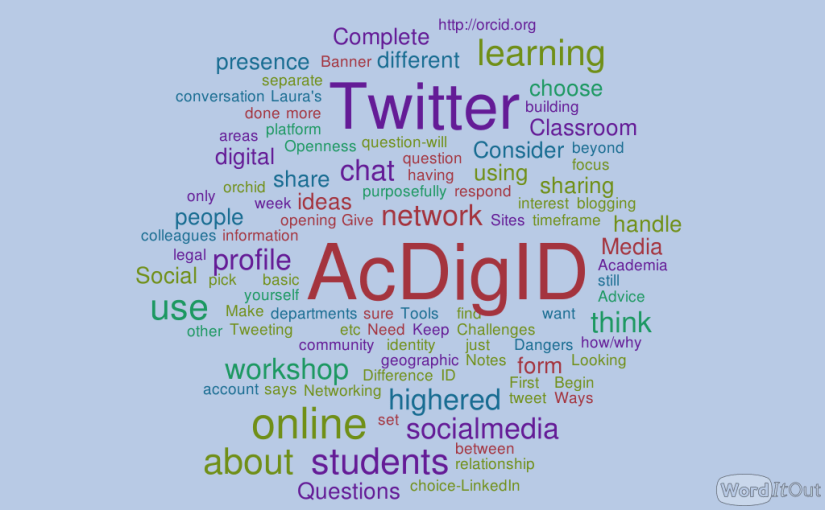
Next week I will be facilitating another edition of the @OLCToday workshop on “Developing Your Social Media and Digital Presenceor the #AcDigID workshop (for hashtag & nickname). This 7-day, asynchronous, online workshop is designed to support digital identity development for faculty and staff in higher education.worditout-word-cloud-1870260
Developing Your Social Media and Digital Presence

Workshop Description: What does your online identity look like today? Have you Googled yourself lately? In academia, it is becoming increasingly vital to publish and share your teaching, service, and research knowledge. Besides developing an online presence and utilizing social media for professional development, faculty and staff are actively utilizing open and digital channels to support, learn, and contribute a thriving network of connected scholars. In this workshop, you will explore meaningful ways to craft an active, online persona, learn about strategies to effectively include social media and digital resources for your professional development, and understand how an online community of practice can enhance the work you do.

Learning Objectives:

  • Evaluate social media and digital platforms for faculty professional development, connected learning, and research impact.
  • Establish effective strategies for developing an online digital identity for open, networked scholarship.
  • Outline the benefits & challenges of open and digital scholarship while using social

Dates Offered: September 26-October 2, 2016; Registration Page (to sign up)


Here’s the outline for the #AcDigID workshop this coming week:

  • Why Does Social & Digital Identity Matter in Academia?
    • Getting started, digital identity development, and state of scholars online
  • The Tools of the Digital Academic Trade: Social Media
    • Twitter, hashtags, blogging, podcasting, LinkedIn, and more!
  • Being a Connected and Digital Scholar
    • Digital research impact and influence, ORCID iD, academic social networks designed for scholars, and measuring impact.
  • Openness in Academia: Benefits & Challenges
    • Being open in higher education, the tension between challenges and affordances of online, and experiences from networked scholars.
  • Building Your Social and Digital Presence Online
    • Creating your own space and place for scholarship (at least 3 platforms)
  • Developing Your Digital Academic Identity
    • Bonus: ways to aggregate and showcase your digital/social profiles

In the  #AcDigID workshop, we will share ideas for online identity development, discuss open and shared practices on social media, and dig into the challenges and affordance of  networked participatory scholarship (Veletsianos & Kimmons, 2012).  I learned a great deal in the last workshop held in May, and I continue to learn what it means to “be online” in higher ed. I alway welcome any and all suggestions, experiences, and stories you have for academic digital identity development. If you are or have been a higher education faculty OR staff member who is/was on social media, academic networking sites, or just online – please consider giving some advice to my #AcDigID workshop participants — here’s how YOU can contribute your #AcDigID ADVICE and KNOWLEGE for this learning experience:

  • ADD TO THE LIST: to my “Academics Who Tweet” Twitter list? I would like to get a variety of scholars from all disciplines and areas in higher education. Let me know if YOU or someone else should be added.
  • TELL YOUR #AcDigID STORY: Interested in coming to talk about your #AcDigID development? How did you become a networked scholar? Why do you participate in networked, online communities higher ed? Let me know – happy to have you join during our #AcDigID Online, Synchronous Meeting on Wednesday, September 28, 201fromrm 12-1 pm EST.
  • JOIN THE #AcDigID TWITTER CHAT: Join us for the LIVE Twitter chat on Friday, September 30 from 1-2 pm EST – We will, of course, use the #AcDigID to ask questions and discuss the issues, challenges, and affordances of being a networked scholar or higher ed professional online.
  • USE the #AcDigID HASHTAG this week to introduce yourself, say hello, share resources, or offer advice.

Reference:

Veletsianos, G. & Kimmons, R. (2012). Networked Participatory Scholarship: Emergent Techno-Cultural Pressures Toward Open and Digital Scholarship in Online Networks. Computers & Education, 58(2), 766-774.

AcAdv, ACPA, ACPAdigital, Blended Learning, Higher Education, Learning, Learning Technologies, Online Learning, Professional Development

Academic Support In A Digital Age

Although you might not advise or support students in an online degree program, there are increasing efforts for teaching and learning technology. Learning delivery and design does impact how we support our students, and we mediate much of our work in higher education using digital tools and platforms. That being said, any adoption of technology should be led with informed decisions on modifying pedagogical methods (Bates, 2015), which is directly related to our advising models and programs we offer in the post-secondary.

Our students want the same flexibility, access, and online support they often receive from instruction and other services they use. When learning with technology, our students are accustomed to having access to student support or other features alongside their online/blended coursework; however, the digital student success side is frequently an afterthought for these technology determinations. We need to have more student success and academic advising programs consider the best technology to provide advising content and service delivery (Steele, 2015) for a more learner-centered approach.

digital DNA

Digital DNA by Adriana Varella and Nilton Malz 

Whether you are leveraging technology to optimize your student support services or your campus is transitioning to either a blended or online learning model, there is both a need and desire to improve technology for academic advisors and student support practices in higher education (Pasquini & Steele, 2015). During your planning, it will be critical for your institution to ask the following questions before selecting technology-mediated environments for advising and learner support: 

  • What technologies is your institution currently utilizing for academic advising or student support?
  • How does your division or unit on campus decide on the most appropriate mode of technology delivery? [Will this be a campus-wide decision?]
  • What factors should be determined when designing technology in advising program and/or student support functional area?
  • What other strategies and structural support might benefit your campus in preparing  staff as they support learners digitally?  (e.g. training, skill development, etc.)

Join me as I discuss this further next Wednesday, September 14th from 12-1 pm EDT for the ACPA Commission for Academic Support in Higher Education (CASHE) Presents Webinar: “Selecting Technology for Advising and Supporting Your Students.” During this online event, I will be sharing a few evidence-based ideas and practical resources to help your advising team address these questions. This webinar will introduce your campus planning group to a few strategies and structures as they select technology for advising and student support. Sign up for this FREE webinar sponsored by ACPA CASHE here: http://goo.gl/tR8THa 

References

Bates, A. W., (2015). Chapter 9: Modes of delivery. In Guidelines for designing teaching and learning for a digital age. Open Text BC.

Pasquini, L. A., & Steele, G. (2016). Technology in academic advising: Perceptions and practices in higher education. figshare. Retrieved from https://dx.doi.org/10.6084/m9.figshare.3053569.v7

Steele, G. (2015). Using Technology for Intentional Student Evaluation and Program AssessmentNACADA Clearinghouse of Academic Advising Resources. 

#AcDigID, #AcWri, #phdchat, Academia, Higher Education, networkedscholar

#AcDigID: Academic Digital Identity Matters

Over the last few weeks, you might have noticed the #AcDigID hanging off a few of my social posts. In between #OLCInnovate conference wrap-up work and the end-of-semester fun, I was designing a new workshop I’ll be facilitating via the Online Learning Consortium. This 7-day, asynchronous, online workshop is designed to support digital identity development for faculty and staff in higher education.

#AcDigID_hashtag

Developing Your Social Media and Digital Presence

Workshop Description: What does your online identity look like today? Have you Googled yourself lately? In academia, it is becoming increasingly vital to publish and share your teaching, service, and research knowledge. Besides developing an online presence and utilizing social media for professional development, faculty and staff are actively utilizing open and digital channels to support, learn, and contribute a thriving network of connected scholars. In this workshop, you will explore meaningful ways to craft an active, online persona, learn about strategies to effectively include social media and digital resources for your professional development, and understand how an online community of practice can enhance the work you do.

Learning Objectives:

  • Evaluate social media and digital platforms for faculty professional development, connected learning, and research impact.
  • Establish effective strategies for developing an online digital identity for open, networked scholarship.
  • Outline the benefits and challenges of open and digital scholarship while using social

Dates Offered: May 16-22, 2016 and September 26-October 2, 2016; Registration Page (if interested in signing up)

Initially, I was asked to create a workshop around social media; however I thought this could be more. There’s actually a lot more than just social media needed when becoming a networked scholar and in crafting your digital persona. Academic social networks are on the rise and there are a number of reasons why scholars use social media and digital resources (Van Noorden, 2014). This is an important topic we to talk about with our peers in higher ed, as we are all public intellectuals now – at least in some shape or form.

If you have ever attended a webinar and/or concurrent session with me on the topic, there’s way too much to share in just 45-60 minutes – so I was thrilled to think about these issues in an extended format and to figure out how to best support academics interested in building their digital presence. It’s been fun planning this workshop, as it has made me return back to my blog archive, review the articles I have curated, visit texts I’ve read, and also pick up a couple of new ones to learn more (future blog posts to review these books soon!).

Here’s the outline for the #AcDigID workshop this coming week:

  • Why Does Social & Digital Identity Matter in Academia?
    • Getting started, digital identity development, and state of scholars online
  • The Tools of the Digital Academic Trade: Social Media
    • Twitter, hashtags, blogging, podcasting, LinkedIn, and more!
  • Being a Connected and Digital Scholar
    • Digital research impact and influence, ORCID iD, academic social networks designed for scholars, and measuring impact.
  • Openness in Academia: Benefits & Challenges
    • Being open in higher education, the tension between challenges and affordances of online, and experiences from networked scholars.
  • Building Your Social and Digital Presence Online
    • Creating your own space and place for scholarship (at least 3 platforms)
  • Developing Your Digital Academic Identity
    • Bonus: ways to aggregate and showcase your digital/social profiles

I am looking forward to sharing ideas and strategies for digital scholarship and identity online this week in the #AcDigID workshop. I don’t claim to know all, and I continue to learn – however I will say I am grateful for those networked scholars who have supported my digital developing along the way. That being said, I know some of you might have suggestions, experiences, stories, and more when it comes to academic digital identity development. I welcome this. If you are or have been a higher education faculty/staff who is/was on social media, academic networking sites, or just online – please consider giving some advice to my #AcDigID workshop participants.

#AcDigID ADVICE and RESOURCES WANTED for how you share your teaching, service, and research scholarship online:

  • ADD TO THE LIST: to my “Academics Who Tweet” Twitter list? I would like to get a variety of scholars from all disciplines and areas in higher education. Let me know if YOU or someone else should be added.
  • SUGGEST A HASHTAG: Do you follow a particular academic hashtag that my #AcDigID community should know about?

//platform.twitter.com/widgets.js

  • TELL YOUR #AcDigID STORY: Interested in coming to talk about your #AcDigID development? How did you become a networked scholar? Want to share your issues, challenges or affordances for your academic online self? Let me know – happy to have you during a synchronous, online meeting.
  • JOIN THE #AcDigID TWITTER CHAT: Join us for the live Twitter chat this coming Friday, May 20 from 1-2 pm EST – We will, of course, use the #AcDigID to ask questions and discuss the issues, challenges, and affordances of being a scholar online.

//platform.twitter.com/widgets.js

  • USE the #AcDigID HASHTAG this week to introduce yourself, say hello, share resources, or offer advice.

Reference:

Van Noorden, R. (2014). Online collaboration: Scientists and the social network. Nature, 512(7513), 126-129.

#OLCInnovate, Conference, Higher Education, K-12, Learning, Learning Technologies, OLC, Online Learning

Feedback Wanted: #OLCInnovate Solution Design Summit Video Trailers

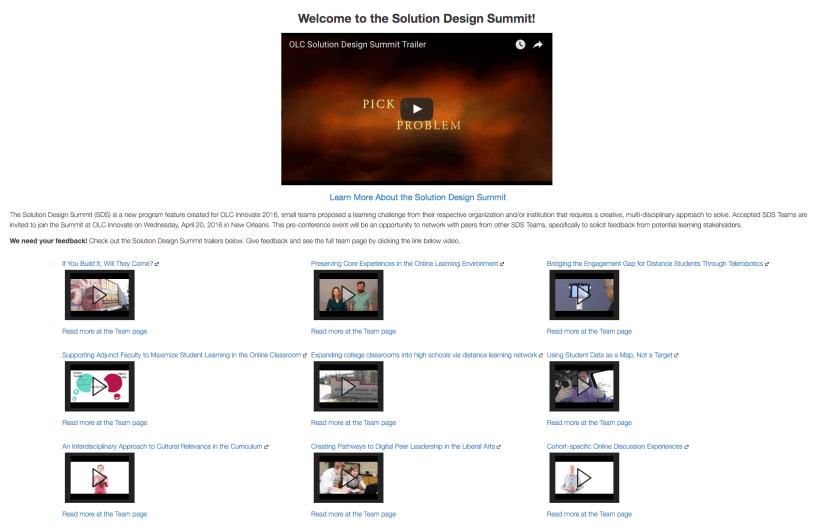
You may have read my previous CFP post looking for learning challenges & solutions – that was for the NEW program feature of #OLCInnovate, The Solution Design Summit (SDS). Nine SDS teams, who proposed a learning issue with a potential solution, have been selected by a blind, peer-review panel to be our finalists who will participate in our 1st Summit  at the 2016 OLC Innovate conference in NOLA. This pre-conference event will be an opportunity to network with peers from other SDS Teams, specifically to solicit feedback from potential learning stakeholders.

SDS_Teams_2016

VIEW THE SDS TEAM VIDEO TRAILERS

 Learn More About the Solution Design Summit

Now the SDS Teams need YOUR feedback!

Please WATCH the Solution Design Summit trailers on the #OLCInnovate Sandbox (a Canvas LMS site) for the conference. To join this Canvas site, click the “Enroll” button at the top of the page or enroll HERE https://canvas.instructure.com/enroll/MGEHMW  

To effectively COMMENT and provide FEEDBACK, our SDS Planning Team has developed  Guidelines for Solution Design Summit: Giving Feedback to Teams Please find all 9 videos and SDS Team pages HERE to do such things. You can READ the full proposal and learn more about these learning solutions by clicking on the “Read more at the Team page” links below.

If You Build It, Will They Come?

Read more at the Team page

Preserving Core Experiences in the Online Learning Environment

Read more at the Team page

Bridging the Engagement Gap for Distance Students Through Telerobotics

Read more at the Team page

Supporting Adjunct Faculty to Maximize Student Learning in the Online Classroom

Read more at the Team page

Expanding college classrooms into high schools via distance learning network

Read more at the Team page

Using Student Data as a Map, Not a Target

Read more at the Team page

An Interdisciplinary Approach to Cultural Relevance in the Curriculum

Read more at the Team page

Creating Pathways to Digital Peer Leadership in the Liberal Arts

Read more at the Team page

Cohort-specific Online Discussion Experiences

Read more at the Team page

Are you coming to #OLCInnovate? You should also plan to come to SDS Pitch Sessions during the Conference all hosted in Rhythms II Room of the New Orleans Sheraton Hotel. Three SDS Teams will pitch their learning challenge and solution during ONE (1) concurrent session in just 10-minutes. Audience members will be given 5 minutes for Q & A and then encouraged to cast their vote for the best solution design.

Thursday,

April 21, 2016

11:15 am-12:00 pm 1. Cohort-specific Online Discussion Experiences

2. Expanding College Classrooms into High Schools via Distance Learning Networks

3. Bridging the Engagement Gap for Distance Students Through Telerobotics

Friday,

April 22, 2016

9:45 am -10:30 am 1. If You Build It, Will They Come?

2. Supporting Adjunct Faculty to Maximize Student Learning in the Online Classroom

3. An Interdisciplinary Approach to Cultural Relevance in the Curriculum

Friday,

April 22, 2016

11:15 am -12:00 pm 1. Preserving Core Experiences in the Online Learning Environment

2. Using Student Data as a Map, Not a Target

3. Creating Pathways to Digital Peer Leadership in the Liberal Arts

Thanks for your support! Much love from the #OLCInnovate 2016 SDS Planning Team:

  • Mike Goudzwaard, Dartmouth College, @mgoudz (Co-Chair)
  • Laura Pasquini, University of North Texas, @laurapassquini (Co-Chair)
  • Patrice Torcivia, Cornell University, @profpatrice
  • Kyle Johnson, Chaminade University, @kyleejohnson
  • Michael Atkisson, Brigham Young University, @mikeatkisson
  • Adam Croom, University of Oklahoma @acroom
  • Allison Dulin Salisbury – EdSurge @amdulin  (Reviewer)
  • Sean Michael Morris – Hybrid Pedagogy, @slamteacher (Advisor)
#3Wedu, Higher Education, Podcast, wine, women, WomenWhoWine.edu

#3Wedu Podcast #3: [Great] Expectations of Women in Higher Ed

If you have not had a chance to tune into our The Women Who Wine in Edu (#3Wedu) podcast for episodes #1 or #2 — then you’re in luck. I hear third time for LIVE #3Wedu podcast viewing is a charm. 🙂

4921824311_8985dac1a4_o

What’s the #3Wedu Podcast all about ? Well, the #3Wedu hosts with the most [Nori (@nononi28), Jess (@jlknott), Patrice (@Profpatrice), Tanya (@tjoosten), & moi (@laurapasquini)] talk about issues, ideas, challenges, and more for women in higher education. Here’s why we started the #3Wedu podcast this year:

  • to understand the value of women leading innovation in learning
  • to overcome gender barriers women may experience in higher ed
  • to support women doing amazing things from the field
  • to provide better recognition and platform for said things
  • to highlight women in leadership roles through mentoring and coaching
  • to empower women junior and senior in education
  • do all of the above while enjoying a fine glass of wine with a few delightful ladies

Join us for #3Wedu podcast #3 on Wednesday, March 30, 2016 at 5 pm CST as we talk about [Great] Expectations of Women in Higher Ed.  

What expectations do you have of yourself or women in higher ed? This coming week’s wine edition of #3Wedu we shall dive into the expectations, judgements, image concerns, impressions, and then some for women in higher ed. Do you have something to say about how women in higher education dress, are concerned about the comments on faculty evaluations, or seem to be put through “America’s Got Talent-like” judgement during a campus interview? Well uncork that wine bottle, grab your goblet, and join the gab!

Send a Google+ Event Reminder to your Calendar, and be sure to follow the #3Wedu backchannel on Twitter. Cheers!