BreakDrink, Podcast

Podcasting, You’ve Changed… @BreakDrink Meanderings from Episode No. 1

Once upon a time, there was the original BreakDrink podcast. You might know them from the collaborative efforts of this podcast network from 2010 to 2013. Well… we’re back. Sort of. It’s not a comeback or the same @BreakDrink you know (and love?). This BreakDrink podcast will share the real conversation Jeff and I typically have … and perhaps a perspective from any guest who might be willing to join us for a bit of a chat. I have no doubt we will have random conversations. It could touch upon higher ed issues and possibly a bit of technology — but really, this podcast will dig into other relevant topics like tacos, coffee, travel, parenting, the NBA, rescue dogs, and more.  Why are we podcasting again? Apparently, we need a podcast to talk and record this banter on a regular basis — and, if you subscribe, then you can reap the benefits of these meanderings in our chats. 
breakdrink_logo_color_stackedrss

In our first episode of BreakDrink in January, Jeff and I reflected on how much podcasting has changed (or not changed) with the infusion of quality content productions and shared what’s in the podcasting realm we listen to these days. We both appreciate the storytelling meets investigation journalism, and love the audio format. For others on the podcasting bandwagon, I blame/thank Serial for the resurgence of this medium. 🙂  Since we’ve been out of the podcasting game, there are a few others podcasters who have emerged and this episode is a deep dive into just a few that sit on our podcast playlist that we enjoy. 

Here are a few recommended podcasts that Jeff & I have listened to … as of late:

    • Reply All hosted by PJ Vogt and Alex Goldman (from TDLR)
    • Crimetown
    • Homecoming starring Catherine Keener, Oscar Isaac, and David Schwimmer.
    • Wiretap (archived) by Jonathan Goldstein
    • Heavyweight with Jonathan Goldstein
    • We thank Serial for bringing back podcast love.
    • Startup chronicles the Gimlet Media podcast network startup (season 1)

And a  few, of MANY, higher ed podcasts to add to your listening cue:

You can listen directly below, or check out the notes from BreakDrink, Episode No. 1:

To share this podcast with friends, families, or foes, feel free to do so with the following links:

If you have comments, questions, or feedback about this podcast episode OR want to share your own input/resources, please feel free to post a comment below, or follow us on the following “BreakDrink” podcast channels:

BreakDrink, CTCX

Delicious Until the Last Sip… Goodbye @BreakDrink!

It’s been a while coming, but a couple of days ago Papa BreakDrink, Jeff Jackson, pulled the plug on BreakDrink.com. I am sad to see it go, but I am happy for what it was. This side project brought together a collaborative spirit of sharing and discussion around topics in Student Affairs and Higher Education, specifically “dedicated to providing alternative forms of professional development.” For the experiences, interactions, and laughs – I am fortunate to have had the pleasure. Thanks BreakDrink Family & Campus Tech Connection (#CTCX) listeners/friends.  [p.s. There are a number of our shows sitting in the archives should you want to take a listening walk down memory lane or check it out for the first time.]

Screen Shot 2013-11-20 at 11.56.53 PM

 Over the last few years a number of new (social media) spaces and places have appeared for Student and Academic Affairs professionals to flock to for trends, issues, news, learning, and connection. It might be my lack of interest in competing in the higher ed market place to be “the next big thing” online, or just a shift in personal and/or academic priorities – but it is time to say farewell to BreakDrink.com.
breakdrink_icon I would like to sincerely thank Jeff Jackson for instigating @BreakDrink, and inviting me via a Twitter DM to join the fun with Jeff Lail & then Bruce Mann. From thoughtful discussions, interesting debates, lively podcast interviews, snarky comments, new online training initiatives, mentoring relationships, and growing friendships – I say a fond goodbye to the BreakDrink family and friends. This community of practice has been a solid part of my informal/alternative professional development plan. From this beginning, I have continued to research and work in this area of higher education, and I am grateful to those who lit this spark.
I owe a great deal to many who are accomplices to the BreakDrink experience,  (see Jeff’s Pull the Plug Post) by contributing as podcasters, bloggers, creatives, brainstormers, and then some – I’m looking at you Julie Larsen. As we close this chapter of our lives, I am proud to say that I am leaving BreakDrink with some new tech skills, a broader understanding about things in the Student Affairs and Ed Tech realm, a new support professional network, and a few amazing people in my life. Here’s to our continued friendship, learning and sharing, BreakDrink Family! Until the next podcast or blog post… Laura Pasquini, for @BreakDrink #CTCX is signing off from BreakDrink.com! {Cue the closing music.}
BreakDrink, CTCX, Social Media, StudentAffairs

#CTCX No. 71: Tech News, Reddit & Updates

On Monday (10/22/12), the @BreakDrink Campus Tech Connection (#CTCX) discussed the latest technology gadget announcements, privacy on the Interwebz and challenges with Reddit, and diving into social media guidance in an upcoming assessment. Here is the video podcast:

And here are the show notes via Storify for your reading and linkage pleasure.

For those of you interested in giving your #SocialMedia Guidance in Education — please take some time to provide myself and Dr. Tanya Joosten (a.k.a. @tjoosten) feedback and information about “Guiding social media at YOUR institution” in a current survey: https://milwaukee.qualtrics.com/SE/?SID=SV_9HmS8C37kqKWyOh This SURVEY will take about 30 minutes to complete, and will close by Sunday, October 28, 2012 at midnight PST. Thanks!

This blog post is cross-posted at BreakDrink.com

BreakDrink, CTCX

The @BreakDrink Campus Tech Connection #CTCX No. 70: Ginkgotree

There are a number of conversations about challenges, changes and disruptions to higher education. Recently, Ginkgotree, the “Tumbler for textbooks,” got me thinking more about my curriculum content and sharing for my courses.
Teaching with a course pack just got a whole lot simpler with the new Ginkgotree app. http://www.ginkgotree.com/
Ginkgotree launched last week to allow instructors the ability to customize and develop their learning material using a wide variety of multimedia and curriculum content. On Monday’s (10/8/12) BreakDrink Campus Tech Connection (#CTCX) show, we were able to get a LIVE show and tell to preview the new instructional resource from Scott Hasbrouck (@scotthasbrouck), Ginkgotree CEO & “Everything Hacker.”
Here are a few of the interesting features that might appeal to educators in higher education (and possibly K-12 as well):
1. Teaching from your own curriculum – instructors have the ability and control of designing their own course curriculum that meets the needs of their learning objectives and materials. Through an easy licensing service provided by Ginkgotree, instructors have the ability to use content from all over the web including journal articles, YouTube videos, images, and other content on the web. One this course pack is developed, instructors have the ability to share a private link to students to start the learning.
2. Do you have an aged textbook to add?  Ginkgotree allows you to utilize some of your favorite text material, even the ones that have been highlighted, annotated and difficult to retrieve in the past by using high quality scanners to digitize your print text and share legally with learners.
3. Give your students the best opportunities to learn – Remember when you wondered if your students even bought or even opened the textbook for your course? SOON instructors will be able to track learner progress and engagement through course pack analytics. Ginkgotree also has the ability to offer public and private notes, ask questions, and tag your content with keywords to make it easier for both the instructor and student to navigate.
4. Reduce the cost for your learners – Students pay a flat rate of $10/month for unlimited courses, plus any applicable copyright fees (usually 15 cents per page) for their books. Rather than spending $250 per textbook, average costs of textbooks range from $45-55. For instructors it is “Free. Always. Forever.”
I think Ginkgotree has an interesting model and can definitely contribute to the evolution of higher education and learning as we know it. Perhaps it is time to consider how we compile and share learning content with our students. Go on. Sign up. Play around with it yourself. Let me know what you think.
BreakDrink, CTCX, Higher Education, K-12, Learning Technologies, Social Media

#SocialMedia & #HigherEd – Policy vs. Guidance

Last week, I attended the free @EDUCAUSE #EDUlive Developing Social Media Guidance in higher education with respect to #Privacy and #Security concerns. The presenters, from the University of Pennsylvania, shared ideas for how to promote safe usage of social media and detailed how to  draft guidance for addressing issues in teaching, research, administrative, and other functions.

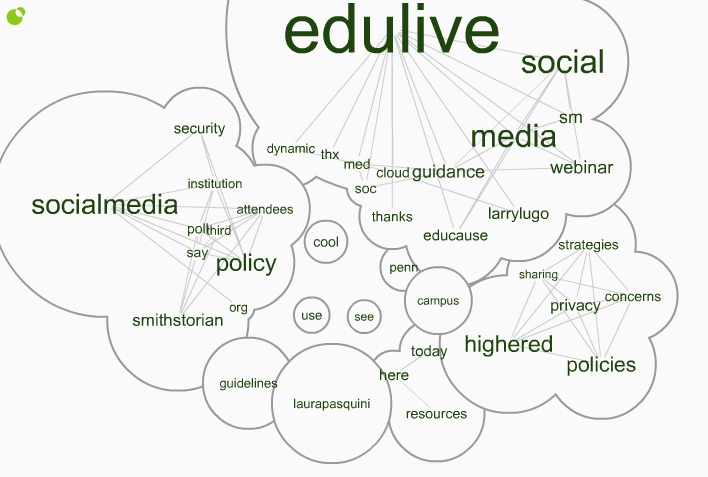
Click here for the Twitter Cloud interactive image =>  http://www.infomous.com/node/15059

If you missed the #EDUlive event, you can check out the webinar recording and archives posted on the EDUCAUSE website, Developing Social Media Guidanceand you can also read through the Storify of #EDUlive tweets I collected.

During the webinar, I shared the Social Media: Sharing Strategies, Policies &  Privacy Concerns in Higher Education open & shared Google Doc that was 1st created for a @BreakDrink Campus Tech Connection (CTCX) Show in September 2010. This document has been circulated around and curated for a while by myself and high ed professionals and faculty. Since there were a number of social media guidelines/policy examples shared during the webcast, I added  them to this doc. For others interested in developing guidelines, I think there are a few solid examples I like in here, and I know that @EricStoller shared some of his favourite #SM guidelines from the list on InsideHigherEd recently as well.

Before diving into creating rules, guidelines or policies for social media, it is important to consider how this emerging technology is being used on your campus. In Chapter 6 of Social Media for Educators, Tanya Joosten (2012) shares her thoughts around institutional considerations for social media policy and practice [which we chatted with Tanya about on #CTCX Episode No. 61 as well]. There are often concerns about the use of social media at educational institutions, since these social and  connected resources impact student behavior, online interactions, privacy concerns, and communication practices. When developing a social media policy, Joosten (2012) offers a few helpful suggestions for educators:

  • review current technology use at your institution
  • do not link policies to specific tools
  • revise current student conduct and institutional policies
  • use policy to address behaviors and activities, rather than focus on the technology
  • learn about FERPA (or FIPPA in Canada) issues and privacy of student information at your campus
  • develop best practices on campus for use by students, faculty, and support units

When thinking about the language of policy vs. guidelines, I am partial to establishing guidelines. There are probably already policies that address the actions and outcomes of student, staff, and/or faculty behavior on your campus. I think that it is important to review your home institutional policies and/or guidelines to best understand what is already being “regulated” on campus. It is also helpful to chat with your institutional office who deals with policy development, legal concerns, and/or questions you might have around privacy legislation.

Have you searched the terms “social media+policy” or “social media+guidelines” on your institutional website? Go on. See what shows up. If you find something, then start connecting and collaborating with that unit. If there is nothing to be found, then gather your peers and start the conversation.

References:
Joosten, T. (2012). Social media for educators. San Francisco, CA: Wiley/Jossey-Bass.