#AcWri, #AcWriMo

Accountability for Writing with #AcWriMo

Academic Writing Month (#AcWriMo) is a month-long academic write-a-thon that happens every November. Are you in it, to win it? I am!
acwrimo-unsw

Thanks to @CharlotteFrost for setting up the 1st #AcWriMo in 2011 (she’s also the founder and director of @PhD2Published) to coordinate a collaborative peer effort around accountability for academic writing.  After the first #AcWriMo ended, many embraced the #AcWri hashtag to continue a the discussion & discourse around academic writing (Follow: @AcWri). The PhD2Published blog shares ideas and inspiration for #AcWriMo – to follow these tips via the blog, follow the Twitter account, or “like” the Facebook page.

I’ve done #acwrimo in the past during my dissertating phase, so I know it works. This is a great peer community to help keep writing in check and supports my #acwri progress. This year I’ve set my #AcWriMo goals for November to wrap up a few writing and research projects. My priority is the green list, as these are active manuscripts in progress and need to be submitted before the month’s end. Then I’ll move right to publications in development, and future research ideas to tease out. Ask me how it goes this month – PLEASE!
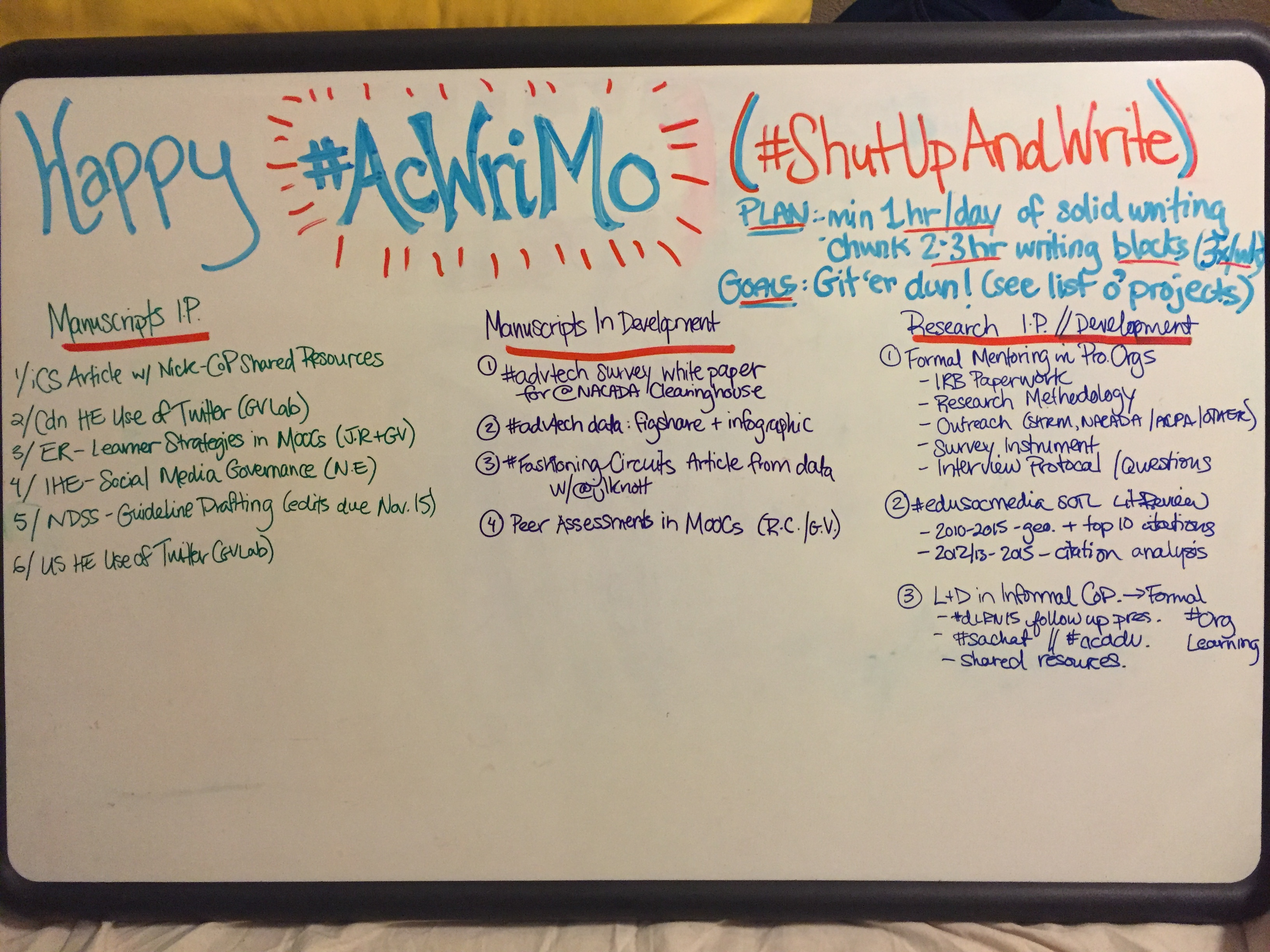
22742710956_3dd118705a_oGood news. As of day 3, I am already finished with green list #1 – first draft of this manuscript is being edited and sent to the editors before the week is done. I have also made some progress on the Research I.P. for the IRB application and Research design on mentoring thanks to a meeting with collaborators this evening.

It might be day 3, but it’s NOT TOO LATE TO JOIN IN the #AcWriMo 2015 challenge => here are the 6 basic rules from the @PhD2Published blog:

  1. Set your writing goal(s) & plan. This can be in words, hours, or end products. You decide. (Check out the PhDometer app or 750 Words site to help you measure!)
  2. Make it public. Make it known. SIGN UP and let your goals & plan be known on the AcWriMo 2015 Sign-Up Form and then return to edit daily your progress. Peer pressure can do wonders! Check out WHO is participating from around the world on the #AcWriMo Map.
  3. Draft a writing strategy. Plan how to accomplish your goals. Organize your schedule for your uninterrupted #ShutUpAndWrite time. PLAN TO WRITE IN ADVANCE!
  4. Share your writing progress. Post it publicly. Twiter, blog, Facebook, Instagram — share with the hashtag #AcWriMo how things are going AND track your daily progress on the community #AcWriMo PUBLIC Accountability spreadsheet.
  5. Keep the #AcWriMo -tivation going. Don’t slack off. Write like it matters. Push yourself to reach your goals — chunk out projects, writing sections, and manuscripts to GIT ‘R DUN!  December will be here sooner than you think…
  6. Declare your results. Update the spreadsheet or whatever space you are keeping track of your writing progress — then let the #AcWriMo community know about your writing results at the end of the month. It helps to share and be accountable in the open — it is also a chance to get support, cheers, and feedback along the way.

So what are you waiting for? It’s time to get your academic writing ON! See you out there, #AcWriMo!
#AcWriMo, Higher Education, K-12, Learning, Learning and Performance, Learning Technologies, Online Learning, Professional Development, Research, Training & Development

What *IS* Innovation? Tell us. The CFP for OLC Innovate 2016 (#OLCinnovate) is OPEN!

What *IS* innovation?

This is the FIRST question the Online Learning Consortium (OLC) co-chairs, Karen VignarePaige McDonald and I, asked each other as we started to organize the *NEW* OLC Innovate Conference (#OLCinnovate). Innovation is a BIG word. It means so many different things, to so many different people. Before putting out the call and promoting the #OLCInnovate conference (happening April 20-22, 2016 in  New Orleans, LA), we thought carefully about who we wanted to join the planning team and how to design a conference experience to live up to the “hype” of the word INNOVATE. This conference was formed to merge the best ideas of blended learning (from #blend15) and emerging technologies for online learning (from #et4online); however we expect this meeting in NOLA — OLC Innovate 2016 — to be SO MUCH MORE! Thanks to our AMAZING #OLCInnovate Steering Committee (Tw-shout outs HERE and HERE) we support to hash out what innovation means for the program tracks, developed thoughtful session types for program delivery/format, and, we hope, this conference will model the learning design we all strive for at our institutions and organizations.

logo_516x227

So WHY should you attend #OLCinnovate 2016? [What’s in it for me? you ask.]

  • Advancing learning requires continuous visionary leadership from all disciplines
  • Connecting with multiple stakeholders (i.e. learners, educators, administrators, trainers, researchers, administrators, faculty, policy-makers, designers, and industry leaders) to strategize about the evolving needs at our institutions and organizations
  • Sharing learning and development ideas for all levels – K-12, higher education, & industry
  • Implementing solution-based approaches to learning design, support, and structure
  • Researching and developing evidence-based practices for learning is now more critical than ever.

Our #OLCinnovate planning team thinks this conference is a great opportunity to bring ideas, perspectives, research, and practices to the table to truly support innovation in education. The program tracks are structured around areas we all face with learning and development in K-12, higher education, and industry:

  • Workforce Innovation – connections from K-12 to higher ed to the workforce, curriculum to meet industry needs, partnerships for learning & work
  • Structural Innovation – systemic challenges, organization of education, learning spaces, partnerships between educators & technology solutions
  • Pedagogical Innovation – course & program approaches, methods, design, assessment models, etc.
  • Challenging Barriers to Innovation – digital divide, OER, Open Access, sharing evidence, ethical research collaborations, opportunities and areas for learning growth
  • Propose Your Own Topic – Tell us what YOU think innovation IS or what is missing!

Extend_OLCinnovate_Dec2

The call for proposals (CFP) is OPEN until November 9 December 2, 2015 

Program Format (Session Types) include:

  1. Conversations That Work – why have a panel, when you can facilitate a discussion on the topic with others in the room? Think of questions, discussion prompts, and ideas you want to chat about for this 45-minute session.
  2. Emerging Ideas – Forget the “traditional poster session” we want you to share your practice, research, and work-in-progress ideas in 10-15 minutes to get ideas, feedback, and suggestions during this networking event with both on-site & virtual attendees.
  3. Innovation Labs – 5-minute chat about the concept/idea; 20-minute demonstration; 20-minute applied skills for learning, technology, research, design, or other.
  4. Research Highlights & Trends – 15-minute presentation on your original research; abstract due in November; final, full paper due January 31, 2016 with the potential to be invited to a special issue of the Online Learning journal.
  5. Workshops – these are interactive 90-minute sessions with valuable take-away learning outcomes for participants (free to all conference participants).
  6. Education Sessions – a 45-minute lecture about an idea/concept with 5-10 minutes for Q & A at the end.

There are a number of helpful tips provided on the CFP page; however if you have questions or needs, I would be happy to support you with your proposal development/submission. It is getting the right PEOPLE and VOICES to the table that adds value to any learning and development experience. Please help us invite of institutional stakeholders from education (K-12 and higher ed), and industry (technology, design, L & D, and corporate training) to #OLCinnovate. Share this blog post with your peers, and tell me who the #OLCinnovate planning team should reach out to or invite. Thanks!

SUBMIT A PROPOSAL FOR OLC INNOVATE 2016!

Upcoming announcements of other #OLCinnovate program features, speakers, highlights, and are coming soon… stay tuned for more updates!

#AcWri, #AcWriMo, Dissertation

#AcWriMo In Review: My Output

Many things come to an end as the month of November closes. See you later Thanksgiving, Fall 2013 semester, #Movember, and Academic Writing Month (#AcWriMo). (Actually – it’s more of a see you soon, really.) Officially, the month of November is dedicated to #AcWriMo; however a number of graduate students (including yours truly) used this past month to complete a good chunk of their dissertation to loose this moniker:

Why my weekends are filled with literature reviews, data collection & #acwri sessions... #acwrimo

Review of My November #AcWriMo Goals… and my Lessons Learned:

  1. Complete my doctoral dissertation proposal so that it is ready to DEFEND to my committee.  Almost there. I did get a good chunk of writing accomplished at the UNT Dissertation Boot Camp – so this helped #acwrimo my progress. Although drafted, my dissertation proposal is not ready to defend yet. In working on a new application for methodology for social science, I want to meet with a couple faculty members on campus to hash out specifics and needs for Chapter 3 (Methodology) and test some of this during the month of December. It looks like a January 2014 date is more realistic for my dissertation proposal defense. I’m okay with this – because once this proposal is approved then Chapters 1, 2, and 3 for my dissertation are DONE!

Lesson Learned: Dedicate the time for the dissertation. As a doctoral candidate you need to be selfish with your writing time. Since this is large project, you need to chunk out your research and writing time that is supported by realistic short- and long-term goals.

  1. Finish “Technology in Advising for Higher Education” manuscript to submit to the NACADA Journal. Since I started #AcWriMo a day later, I used December 1st to work on the #AdvTech research findings and drafting of this manuscript. I am not sure why this project was put on a back burner, but I definitely need to move forward and submit this in December 2013 for Spring 2014 publication eligibility. This goal is not complete, but I will plan on sharing it with my co-authors before the week is out so we can submit to the journal editors for review.

Lesson Learned: Finish your #acwri projects before taking others on. Sure the promise of more research and writing might be enticing, but how productive will you be on your own or with a collaborative writing team if you are not finishing your manuscripts and publishing them? Always be submitting.

  1. #iConf14 Social Media Expo – paper & video for conference. After a lunch brainstorm session with Andrew Miller (@findandrew) and @FiachraM last week, I found the momentum to draft the abstract for the #iConf14 proposal.  Although not submitted (just yet), the abstract is being wrapped up and edited this evening. The final video will be compiled tomorrow evening; however our team Dropbox is filled with photos and images, with Andrew to capture video tomorrow.

Lesson Learned: Innovative ideas come from interdisciplinary thinking and problem solving. Research that is participatory and collaborative drives my writing and efforts. Also, when you experience #acwri well with other scholars, be sure to include these researchers as conspirators for your common research interests and projects.

  1. Complete a minimum of 2 blog posts per week – on writing progress and projects. Done. Whether I was reading, researching, or writing – I was able to share what I was working on with my blog readers, and provide on-going updates about my #acwrimo progress.

Lesson Learned: Stating goals out loud and adding social pressure is great, but reflection and sharing always helps me to process ideas more. Although my “official” month of #acwrimo accountability is over, I am fortunate to have my blog to share and write about my research progress, dissertation progress, teaching methods, and more.

Overall…

This month of academic writing has been very productive for me. In looking at my contribution to the #AcWriMo Accountability in the Spreadsheet o’ Fun you can see I logged at least 35, 097 words, and have been dedicated to the daily habit of writing. It is not so much the word count, but really the completed projects, which are finished and not taking up real estate in my research/writing space. I am taking the #acwrimo lessons learned with me by continuing this #acwrimo habit in December by setting specific project goals, carving out dedicated writing time, and reflecting my progress via my blog.

How did #AcWriMo in November go for you? What have you learned from this academic writing month? Post a comment to share, or respond to this #AcWriMo Questionnaire (not mine).

#AcWri, #AcWriMo, #phdchat, PhD

#AcWriMo Peer Pressure: Time, Challenge/Support & Cheerleaders

As many of you know, I signed up and successfully completed my first UNT Eagle Dissertation/Thesis Boot Camp over that past few days. What did I accomplish? (you might ask). Here is my summary, in a tweet:

The boot camp structure helped me find time, space (physically & mentally), and support to dedicate 3 FULL DAYS of just writing and research for my dissertation. Dr. Oppong and the Toulouse Graduate School provided the group of doctoral students with advice on the PhD process, motivation, meals, and, of course, COFFEE! Boot camp let me be selfish with my time and required me to just SHUT UP AND WRITE my dissertation.

Shut Up & Write #AcWriMo Start of Dissertation Boot Camp

During the camp, I purposefully unplugged from all social streams, e-mail, phone, etc. Unless you were my faculty advisor,  my friend Paeng from our COI research lab, or my partner-in-crime – you probably did not hear from me much.

Similar to #AcWriMo November 2013, this boot camp included goal setting and accountability with our writing progress. Here’s my self-evaluation from camp:
Boot camp sel-evaluation. #acwrimo #phdchat #latergram

My main purpose for this boot camp was to finish my dissertation proposal for my committee to review. Essentially the dissertation proposal consists of Chapter 1 (Summary), 2 (Literature Review) & 3 (Methodology) for my final dissertation. Want to learn more about this writing process? Check out SAGE’s new resource: Do You Understand What is Required in a Doctoral Dissertation or Thesis? [PDF]

I managed to get most of these beginning chapters drafted, and have them loosely reviewed by my faculty advisor. I also put my writing drafts into the official UNT Dissertation format, and identified areas I need to edit and add to. I plan on using December to meet with a few faculty members to review my research methodology (the recipe for research), and then I will work with my faculty advisor to set up a time for my dissertation committee gather for review in early 2014.

Overall, this boot camp was a great experience, and I am quite pleased with my progress. I think that agraphia groups and writing support programs are invaluable for doctoral students. Events like this offer peer pressure, social support, and, most importantly, TIME for writing. I would like to attend the next UNT boot camp in February to write up Chapter 4 (Data Collection, Analysis, & Findings) and Chapter 5 (Conclusions) in the Spring.

Thanks for the challenge & support from the following tweeps: #AcWriMo writersinstigator of research ideas, and especially those of you who cheered me on. Always be writing…

#AcWri, #AcWriMo, Dissertation

#AcWriMo Discipline: Dissertation Boot Camp Here I Come!

In honour of my #AcWriMo November Goal #1, I decided to apply to the UNT Eagle Dissertation Boot Camp that is happening this week (November 21-23). To date, my word count for the month is 19, 344; however I need to dedicate more of these words to my dissertation drafting.

BootCampGraphic

Image from UDaily post from University of Delaware.

After approval from my faculty advisor and support from my supervisor, I applied to this 3-day boot camp to SHUT UP AND WRITE.  I just received my official acceptance to the program from Dr. Joseph Oppong, the Associate Dean for Research and Professional Development in the Toulouse Graduate School:

 Dear Student,

Congratulations, you have been accepted to attend the Eagle Dissertation Boot Camp! It will be held in the Willis Library Forum (first floor area). The boot camp is designed to provide you 3 days of interruption-free, stress-free, no-excuses-just-do-it writing time for your dissertation. To help you prepare so that you optimize your output here are some packing tips.

Be sure to clear your calendar for the whole of the boot camp. You need to commit to attend the entire workshop. You will not be excused to teach or attend class. Arrange transportation and childcare so that you are free to attend each day.

This is your notice that you are enrolled in Boot Camp. If you cannot attend this session let me know immediately. If you cancel within 3 days of the event you will be considered a “no show” unless you situation truly is serious. If you “no show” you will not be allowed to participate in the next session and your advisor will be notified. We have limited funds, space, and resources and you must commit to coming or give your seat to someone else.

Please bring a laptop, a mug (coffee/tea available) and/or water bottle. If you don’t have a laptop, you can check one out from the Library, but, bring a flash drive to save your work. MP3 players and headphones are recommended if they help you concentrate, or if you find nearby conversations distracting. Work tables, lunch, and snacks are provided.

No lateness, please. It’s distracting for the other campers…

Here is the line up this week’s dissertation boot camp – so don’t expect a whole lot of tweets, email responses, social network posts,  or interaction from me as my Interwebs use will be limited from Thursday (11/21) morning onward:

Boot Camp Schedule

Day 1 Day 2 Day 3
8:00-9:30 a.m. Formatting Workshop
9:30-10:00 a.m. Roll Call, Welcome, Introductions, Breakfast
10:00-11:30 a.m. Writing
11:30-12:00 p.m. Wellness Activity
12:00-1:30 p.m. Writing
1:30-2:00 p.m. Lunch
2:00-3:30 p.m. Writing
3:30-6:00 p.m. Optional Writing Time or Optional Individual Consulting
9:00-10:30 a.m. Writing
10:30-11:00 p.m. Wellness Activity
11:00-12:30 p.m. Writing
12:30-1:00 p.m. Lunch with Advisors
1:00-2:30 p.m. Writing
2:30-3:00 p.m. Self-Assessment and Discussion
3:00-6:00 p.m. Optional Writing Time or Optional Individual Consulting
9:00-10:30 a.m. Writing
10:30-11:00 a.m. Wellness Activity
11:00-12:30 p.m. Writing
12:30-1:30 p.m. Lunch
1:30-3:00 p.m. Writing
3:00-6:00 p.m. Optional Writing Time or Optional Individual Consulting

Each day includes:

  • several blocks of writing time
  • scheduled, limited time for web-browsing
  • tip sheets
  • wellness breaks
  • a lunch conversation with fellow campers (box lunches provided)
  • space to continue writing in the afternoon (if interested)

The reason I applied, is to have specific time carved out and a dedicated space to move forward on my #AcWriMo goal #1. A number of things get in the way of my dissertation writing, including other writing projects, presentations, work items, and life. Also, as a student who wears “many hats” on campus and outside my job, I can sometimes find it challenging to pick up where I have left off, and my motivation to just write is fragmented with other responsibilities. I think this dedicated writing schedule will push me further along with my dissertation goals.

I will report back in after “camp” is over. Write on, my friends. Write on.