AcAdv

#AdvTech Commission Events & Happenings at #nacada13

Hello #acadv & #nacada13 friends! The 2013 Annual NACADA Conference has kicked off, and is in full swing here in Salt Lake City, UT. This might be my last week serving as the NACADA Technology in Advising Commission (#AdvTech) chair; however I have no doubt that our group will continue great things with the incoming elected chair, Julie Larsen (@julieclarsen).  Here is a little bit about our NACADA Commission, and how you can get involved with us whether you are in SLC or at home.

What is the #AdvTech Commission?

The purpose of NACADA’s Technology in Advising Commission is to help academic advisors, faculty advisors, and advising administrators understand the impact of using technologies in advising, including:

  • Online communication & virtual advising
  • Degree audits & web registration
  • Student information systems & electronic advising notes
  • Social and connected spaces for innovative staff/faculty resources
  • Understand the ideas and trends of how technology is being utilized in higher education

How to get active with our commission?  Find out from our very own #advtech steering committee member and NACADA Commission & Interest Group Division Service Award winner, Paul Cox (@peacox), on how to get ACTIVE with #advtech:

Do you want to get involved and ACTIVE with the #advtech commission? #AdvTech NACADA Technology in Advising Commission Sign-up for 2013-2014 http://bit.ly/advtech13.  This form is for ALL commission members both at the conference in SLC and at home. Please let us know HOW you want to be involved this year. Talk to our #advtech steering committee leaders or me if you have questions, ideas, or suggestions for our commission!

Here are a few dates, times and locations to for our #AdvTech Commission Happenings and Events at the 2013 NACADA Annual Conference:
Screen Shot 2013-10-07 at 12.08.33 AM
• CIG Fair & Continental Breakfast – Tuesday (10/8) from 7:15-8:30 am (Exhibit Hall A); drop by our booth & say hello!
• #AdvTech Commission Meeting – Tuesday (10/8) from 4:30-5:30 pm (251 EF); all are welcome – information, updates & fun. 
• #nacada13 & #AcAdv Chat Tweet Up – Tuesday (10/8) 7:30 pm (Location TBA) http://bit.ly/nacada13tweetup (Pass it on!)

Screen Shot 2013-10-07 at 12.37.47 AM
• #AdvTech HOT TOPIC – Wednesday (10/9) from 10:30-11:30 am (255 C); roundtable discussions to chat more about advising technology, specifically:

1. Mobile Learning in Academic Advising

2. Enterprise (CRM/LMS) Student Information Systems in Advising

3. Communication Modes & Mediums We Use with Our Students

4. Advising Technology Policies, Strategies, & Guidance in Our Institutions

Side note: Here are #nacada13 panels I am involved outside of the #advtech commission specific events:

  • Session 42: How To Hack Your PhD: Being a Doctoral Student & Academic Advisor @drmelissajl,  @polishpattycake@sarahhcraddock – Monday (10/7) 11:30 am-12:30 pm in Grand Ballroom A
  • Session 94: Social Media “Strategery” & Guidance for Advising with @matt_rupert – Follow #SMadv & http://bit.ly/smadv – Monday (10/7) 3:15-4:15 pm in 255 C

  • Session 165: #AltProDev Using Technology in Training: Informal Learning & Communities of Practice for Advising with @allenmtaylor, @peacox, @polishpattycake – Tuesday (10/8) 11:15 am-12:15 pm in 255 D

 

#AcWri, Learning Technologies, LPQuarterly, OpenAccess

The @LPQuarterly – Year Two, An Editor’s View, and Volume Two

It is my second year editing and working with the Learning and Performance (a.k.a. @LPQuarterly) here at the University of North Texas.

The Learning and Performance Quarterly (ISSN 2166-3564) is a peer-reviewed, open access journal from the Center for Knowledge Solutions at the University of North Texas. The journal takes a broad look at current developments and research that involves innovative learning, training, human resource development, and performance management across academic and professional disciplines.

Creating an open access, academic writing space from scratch is a bit like a “start up” – it takes a lot of time, investment, tears, creativity, stress, and collaboration (not in any particular order). In being an open educator and seeing academic channels open for scholarly publications, It was only fitting that our agraphia writing/research group from the Department of Learning Technologies consider developing an interdisciplinary, online space for scholars, practioners, and researchers to publish in our field. In coming from the University of Toronto, I knew that the Faculty of Information Quarterly (FIQ) was a student-led, peer review project — so I figured that our talented group could do the same thing.

lpq_logo_enhanced

After reading Karina Quinn’s (a.k.a. @riotk ) blog post, “How to start an Open Access journal,” I thought I could have helped to co-author that post. 🙂 I shared some similar stories and a deep respect for her experiences in open access publishing. So, with that, I thought I would share a few of my lessons learned (from Fall 2011) about the academic publishing process:

  • It takes time to build a journal. TIME!
  • You will have to always CHECK your journal email for communication updates from authors, reviewers, editors and then some. This SHOULD be separate from your personal and work e-mail to keep your life organized, and if your editorial board needs access to the journal email.
  • You can NEVER have enough quality peer reviewers on your roster. Search them out. Invite them. Mentor/support them. Grade and evaluate them with your editorial team.
  • Surround yourself with many talents on your editorial team – think of copyediting, layout, recruitment, and more!
  • Find great scholars and researchers to publish – help to build your street cred and raise the bar for your journal content.
  • Communicate & Market – share what you are doing with different professional associations, student groups, conferences, research listservs, social media outlets, and then some. I started bringing flyers and cards for the journal to places I would go to invite potential authors/researchers, copy editors and most of all peer reviewers.
  • Connect to your friendly neighborhood librarian for advice, indexing, database set up, and then some. They have some GREAT experiences & ideas.
  • Sharpen your editing TOOLS – read books, review websites, watch tutorials, learn about publishing guidelines, school yourself in APA 6th,  talk to other editors, peer review in for other academic journals, and more!
  • Offer developmental writing workshops and opportunities for graduate students and junior scholars, e.g. HOW TO: Effectively Review, Submit & Publish Your Academic Manuscript. . This is a great space for learning, and provides them with opportunities to inquire about academic writing. Also, find experienced scholars and faculty who can share their publication experiences – the good, the rejected, and then some!
  • You will learn new tech skills: read “how to” for the Open Journal System (OJS), linking to EBSCOhost databases, and meta data fun times!
  • Consider how your virtual team will function, meet, and connect on a regular basis to publish issues.
  • Identify a workflow and easy to use spaces for archiving meeting notes, recruitment/marketing material, and communication for your editorial team.
  • Understand your institutional policies for publishing if you are a university. Our university is Open Access, and I’m proud to say that our Provost just signed the latest SPARC agreement to for Fair Access to Science and Technology Research Act (FASTR) bill. What will it mean for an open access publication at YOUR campus?
  • Build in transition and mentoring into your role as an editor. Look for peer reviewers who might be great copy-editors, and consider your change in role as an editor.  I am currently working with our Assistant Editor, Tekeisha Zimmerman, this year who will take on the main editor role for 2014.
  • Never doubt the power of your network. Talk up what you’re doing in person at conferences, when you meet researchers, and get SOCIAL online. We share our call for papers and information about writing on Twitter (@LPQuarterly), our LPQ Facebook Page, and on LinkedIn Groups that are relevant to LPQ.

PUblishing

With the support of the LPQ editorial team, I have been able to work with a number of brilliant contributing authors, peer reviewers, and readers within the fields of education (K-12 and higher ed), learning technology, human resource development, human computer interaction, knowledge management, training and development assessment, and performance management systems. We are currently seeking manuscript submissions for the following categories:

  • Research Articles – Qualitative/Quantitative
  • Concept/Theory Papers
  • Case Studies
  • Book or Media Reviews
  • Invited Articles

If you are interested in submitting an article, the 2013 call for papers is OPEN. Please submit your manuscripts ONLINE today!

For more information or questions, please contact the Learning and Performance Quarterly Editors:
Laura A. Pasquini, Editor
Tekeisha Zimmerman, Assistant Editor
Dr. Jeff M. Allen, Managing Editor
~~~~~~~~~~~~~~~~~~~~~~~~~

On behalf of the editorial LP Quarterly team, we invite you to read the current issue, or visit the archives for your research and learning.

Here is the most recent issue,Learning and Performance Quarterly, Vol 2, No 1 (2013) that is…

HOT-OFF-THE-PRESSES

Table of Contents
http://www.sageperformance.com/ojs/index.php/LPQ/issue/view/7

Editorial
——–
Transforming Teaching, Knowledge Management & Performance Measurement
Systems
Laura A. Pasquini,      Tekeisha Zimmerman,     Jeff M. Allen

Invited Articles
——–
Traditional Teaching or Innovative Teaching via Technology?
Victor C.X. Wang,       Patricia Cranton

Concept/Theory Paper
——–
A Conceptual Model for Community of Practice and Its Implications for Human
Resource Development Practice
Hee Sung Lee,   Jeong Rok Oh

Performance Measurement Systems and Culture:  An Integrative Literature
Review
Shelby Danks

Book Review
——–
A Year Up: How a Pioneering Program Teaches Young Adults Real Skills for
Real Jobs with Real Success
Michael F. Koslosk

AcAdv, NACADA Tech, nacada10, Reflections

Academic Advisors + @AcAdvChat = #AcAdv Chat Network

For my colleagues in higher education, WHERE do you get new ideas, resources, and share information about academic advising?

  • Is it just down the hall from your office in the break room near the water-cooler or coffee pot?
  • Do you connect with others at a regional or national conference every year?
  • Or is there an opportunity to connect with other faculty and professional advisors at your campus for a training and development session?
  • Is it through a professional association listserv, e-mail list or discussion board?
  • On a Facebook page/group, LinkedIn Discussion, or another social media platform?

BUT wouldn’t it be great if you had a regular space and place to have these conversations, ask questions, share trends & issues, utilize a professional sounding board, and connect to  advising colleagues at other institutions about academic advising? {A small group of advisors asked in October 2010 at #nacada10}

sh

ENTER = @AcAdvChat & the #AcAdv Chat Hashtag

#AcAdv Chat

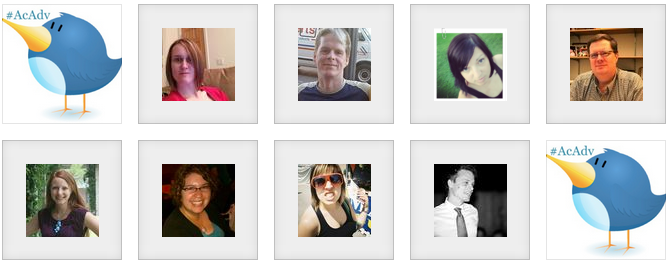
Since the start we have been fortunate to have a few great people collaborate to support the @AcAdvChat handle and chat each week. The #AcAdv Chat Team helps create weekly chat topic polls, brainstorm questions,  moderate the chat, and update our social media platforms, including those we said goodbye to (Delicious & Posterous), and those  social media sites we still use (Twtpoll, WordPress, Twitter, & Facebook Page) each and every week. THANKS FOR ALL THAT YOU DO! Go team! Here are the #AcAdv Chat-ers current & past from the top (L-R): @AcAdvChat, @sarahhcraddock, @peacox, @laurapasquini, @bilmorrill, @kellyjbailey, @howardsj, @julieclarsen, & @bradpopiolek!

Screen Shot 2013-09-14 at 12.48.02 PM

Can you believe that we are about to celebrate our 100th @AcAdvChat? It’s true! The #AcAdv tweeps have been busy discussing academic advising issues and happenings in higher education since Fall 2010! Time flies when you’re having fun with the fantastic members in the #AcAdv community.

Join us on Tuesday, September 17, 2013 from 12-1 pm CT for our 100th #AcAdv Chat.

100-fireworks

To honor this milestone with our #acadv chat friends, we thought it would be great to share WHY YOU PARTICIPATE in #AcAdv Chat. Let us know how we got to this 100th #AcAdv Chat.  Also, please be sure to  introduce your academic advising colleagues #AcAdv Chat (about) and encourage others to FOLLOW @AcAdvChat on Twitter. Thanks!   Now let us know…

“Why do you #AcAdv Chat?”


{This message is cross-posted at the AcAdvChat WordPress Blog}

Learning Community, Professional Development, UGST1000

Help My #ugstSTORY Class Tell Their Story

It seems that all is quiet on the TechKNOW Tools blog front… Sorry about that.

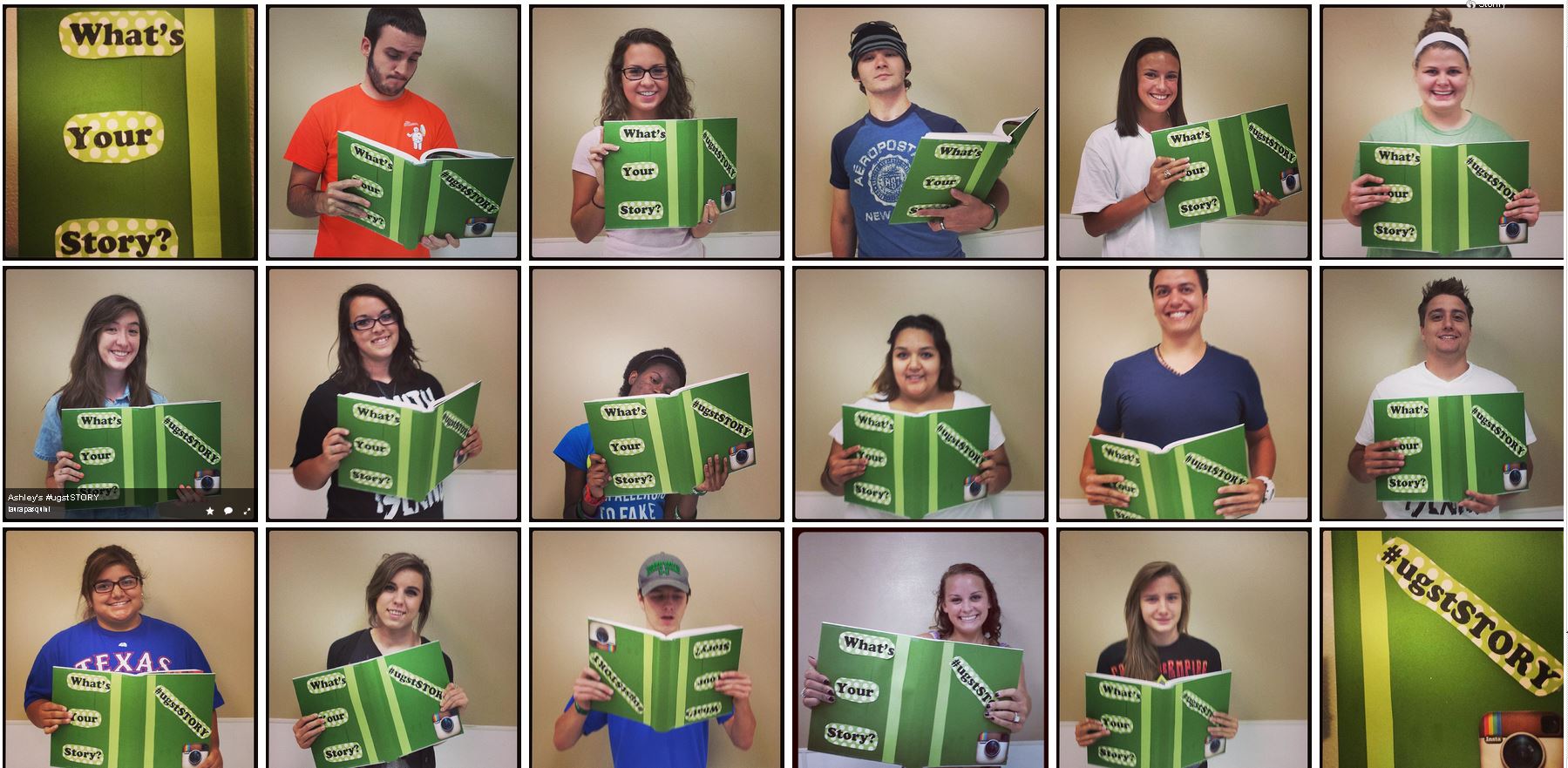
The start of the academic semester came fast and furious, and I have been busy engaging with and learning about my students’ stories for my #ugstSTORY class this Fall 2013 semester. This is my UGST 1000 – First Year seminar class where my students explore their major/career options, get support with transition to college, and learn more about themselves.  Feel free to follow along with our “story” this Fall if you would like:

ugstSTORY Pic

With this seminar class, a great portion of the focus is on self discovery and exploration for personal, academic, and career options. Like many students who are “undecided” or exploring their options, many of my #ugstSTORY students have more than one interest and want to make sure they are going down the right path for them. In learning about many of their talents and skills, I can see why it might be a challenge to just focus on one major. They are a creative and involved class who what to include what they VALUE in their future world of work and life.

What My #ugstSTORY Class Values
During the Fall 2013 semester, my #ugstSTORY students will leave a digital footprint, and will be encouraged to explore their personal and professional options. In their research to make an informed decision, a number of my students will reach out to professionals and industry leaders in the world of work to answer: “What do I want to do with my life?” and “How did you get to where you are?” I am not sure these BIG QUESTIONS will and/or can be answered in just one semester; however I think a few of the assignments and projects will hopefully get them started.

The first assignment, the Road Trip Nation (RTN) Project, is designed to help my students explore personal, academic, and career paths. More importantly, it allows them to understand that many directions will lead you towards your goals and dreams. Their recent blog posts identified what how to find their “Red Rubber Ball,” that is, where do they get their inspiration, passion, interests, values, and likes. Specifically, I asked what potential careers, professions or industries would they like to learn more about.  Here’s a short list from their in-depth blog posts this week:

Interview: Potential Careers & Industry

Interests & Passions

Journalism; Sports Journalism; Broadcaster Friends; Family; Hockey; Sports
Artist; Engineer; Philanthropist; Advertising; Therapist Stability; Helping Others
Journalism; Pre-Law; Psychologist Community Involvement; Travel; Family
Clinical Psych; Greenpeace Environment Activism; Animals; photography; food; language
High School Librarian Reading; books; writing
Engineering; Tourism; Economics Travel; Stability; Accomplishing goals
No Clue Relationships; Smile; Creativity; Individuality
Writer; Journalism Music; Belonging; Writing;
National Geographic; Journalism Travel; Photography;
Broadcaster/Journalism Sports Talking; Sports; Opinions to voice
Photojournalist; Forensics; Library Science Cartoons; Anime; Photography; Music
Psychology; Fashion Merchandising; Law People; Cultures; Travel;
Sales Engineering Music; Activism; Star Wars
Sports Analyst; Broadcaster/Journalist NFL Analyst; sports industry
Neurology; Psychology; Editor/Publishing Anime; Neuroscience; travel; career student; small business

The reason I am sharing more about my class with you is to get them connected beyond our class and the UNT campus. Since I have some phenomenal friends, family, and colleagues in my own learning and professional network, I thought a few of YOU might be able to provide some of your own experience and wisdom for their exploration, specifically by:

  1. SHARING A Resource: We tweet with the #ugstSTORY hashtag, so if you see a link, article, website or anything related to major and career exploration – cc: @ugstSTORY or just put the #ugstSTORY hashtag on it!
  2. READING Their Blog Posts: If you have time to read, comment & post on their WordPress blogs, that would be super rad. Although many are just blogging for the first time, a number of my #ugstSTORY students have very thoughtful and creative perspectives about life in college so far. It would be great if they got a response or two outside our #ugstSTORY class – drop them a comment or like. 🙂
  3. MENTOR Virtually: For the RTN Project a number of the #ugstSTORY learners will be seeking informational interviews with companies, professionals, and different organizations (listed above or might not be listed as they don’t know your about your occupation yet); if you OR someone you know is available and interested in sharing with my students what they do for a living and why they love it – LET ME KNOW!  Yes! I want to MENTOR a #ugstSTORY Student p.s. Pass this link onto a friend you might know as well. Thanks!
Reflections

Lucky 13: Top Blog Post Views for Summer 2013

13-ball

Since major news outlets, TV series, and  government officials seem to be on hiatus in August, I decided to take a break from blogging as well.  In looking back at what’s been trending on TechKNOW Tools,  here are the lucky 13 most viewed blog posts since  May.

LUCKY 13:  TOP BLOG POST VIEWS THIS SUMMER View
Social Media Strategies in Student Affairs
More stats
850
What’s Your Research Methods Worldview? More stats 353
#AcWriMo & Accountability to Write More stats 219
#EDUSprint 1: Beyond MOOCs – IT as a Force of Change More stats 116
Facebook for Learning Communities: Groups vs. Pages More stats 115
Passing the Torch: Leadership Transition in Our Professional Organizations More stats 115
Using Verbs for Specific Learning Outcomes More stats 114
Organizational Learning Constructs More stats 103
Backwards Design with TED-Ed More stats 84
I Tumblr For You… To Reflect. More stats 74
Going Mobile for Academic Advising: Tablets, iPads & Protocols on Campus More stats 72
Building Communities of Practice in Higher Ed More stats 65
My Prolegomenon to Technology
More stats
61

My pause from blogging will resume after I wrap up a few things before the Fall academic term starts: publications, projects, and proposals. #GradStudentProblems