MOOC, Web Design

#EDUSprint 3 – Creating the IT Architecture for the Connected Age

Here’s the recap for the last EDUCAUSE webinar of the EDU Sprint series: #EDUSprint 3 – Creating the IT Architecture for the Connected Age. Today’s session talked about the role of IT on campus, technology planning, and the infrastructure of IT services for digital learning.

#EDUsprint 3 - Is IT Creating a New, Connected Age?

The session discussed the processes, management strategies, and governance structures from the following higher education leaders on the panel:

  • Tracy Futhey, Vice President, Information Technology and Chief Information Officer, Duke University
  • Tracy Schroeder, Vice President, Information Services and Technology, Boston University
  • Ethan Benatan, Vice President, Chief Information Officer, and Chief Strategy Officer, Marylhurst University

Many spoke about how their IT unit is thinking deeper about services to connect to learning and the needs on their campus in a holistic manner. Tracy Futhey shared her ideas around IT services, and how we not only need to consider location within the organization, but more about the delivery and methods for our IT units.

IT Services

Although there was talk about campus-wide strategy, I rarely heard much about bringing others around the table for this discussion. Much of higher education still operates in silos, so the full potential of connectedness and planning technology in learning cannot just occur in an IT unit, academic department or business solutions. I think that more administrative leaders need to bring faculty, staff, graduate students, undergraduate students, IT developers, and external shareholders together for these strategy meetings. in higher education. As our campus environments change, so does the IT needs and services to support learning and engagement.

I did appreciate when Tracy Schoeder shared about the Digital Learning Initiative and Technology Planning at Boston University. Although emerging technological trends evolve, I think that planning and assessment need to be part of the regular planning cycle.

Strategic IT Planning - The BU Example #edusprint I also appreciated that BU puts a focus on the human aspect of their planning, and not just the IT solution. Organizational structures should be assessed and reviewed for the IT architecture, to meet the needs and understand the institutional goals for learning.

Human Architecture for Digital Learning @ BU

Finally Ethan Benatan, started with a few predictions on how IT will change, be challenged, and move in the future – which is always a difficult task. I did appreciate that he shared a design process… and that it was just that – A PROCESS. There will not be a single solution to each campus environment, and it takes some agility and insight to move your higher education institution in the right IT direction and continue to assess your needs.

Here are some new links & reads from the session in no particular order:

Did you miss the last of the 3-day #EDUsprint? No worries. Here are a few resources for you:

You’re very welcome. Happy learning!
MOOC

#EDUsprint 2 – How Technology Can Change Pedagogy

The EDUCAUSE EDU Sprints continues, so why not share what I gleaned from today’s session. With a lot of information being shared, it actually feels like more of a marathon, so here’s the breakdown from the #EDUsprint 2:  How Technology Can Change Pedagogy webinar.

How Tech Can Change Pedagogy

The session was lead by the following panelists who shared their thoughts about gong “Beyond MOOCs”:

  • Hank Lucas, Professor of Information Systems, University of Maryland College Park
  • W. Eric L. Grimson, Chancellor, MIT
  • Susan Grajek, Vice President, Data, Research, and Analytics, EDUCAUSE

Hank Lucas sees great challenges and opportunities with blended learning, online learning, and MOOCs; however he wants to charge institutions with more than the technological trends. Due to these emerging technologies and social platforms, there are many different ways to connect with our students; however we have to be purposeful and think critically about our instructional design.  

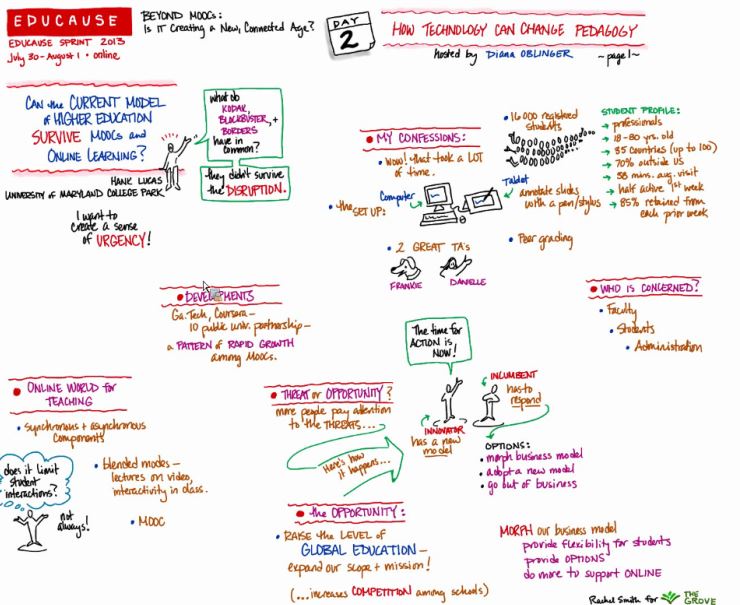
The Survivor Model via Hank Lucas

Lucas shares his concept of ‘The Survivor Model’ (screen shot of slide), that outlines how disruptive technologies will impact higher education and learning. [Side note: You will find “disrupt” on the #sxswEDU 2013 bingo card I made back in March.} The language always seems so doom and gloom, especially when asked what the “threat” for learning technology is on our campus i.e. students, adminstration or faculty. Roll the cliche…

Lucas thinks more institutions need to question where they stand with online learning, blended learning, and MOOCs, as “The schools that compete vigorously with faculty who figure out how to add value to their courses will survive and flourish.” And I would agree with one of the final points he shared:

Eric Grimson gave his 2 cents of higher education and learning technology change, which included ideas around learning techniques, active engagement, suggestions for assessment, and a “new” accronym to add to our campus alphabet soup: SPOC (small private online course)

The second segment seemed to dive into ideas and themes being played out in our schema of learning in higher education. Grimson shared ideas and suggestions to help support online learning, which included:

A number of articles were shared in the streams, so here are a selection reads from today’s webinar:

More resources for online learning, instructional design, flipping, MOOC-ing, and then some:

Unfortunately I had to dip out of this session early and I will have to catch the rest of the webinar via the recording – but here are some interesting takeaways I found on the #EDUSprint Twitter backchannel that should be noted:

AcAdv, nacada, NACADA Tech, Social Media

The Global #AdvTech Discussion at #nacadaINTL … And Then Some #acadv

At the beginning of June, I was fortunate to participate in the first International NACADA Conference in the Netherlands. The conversations (#nacadaINTL – archived tweets!) and sharing of ideas on how to advise and support students is universal. A number of countries and institutions were represented, and surprising enough, many of us face similar institutional challenges for effective student development.

I was happy to return to Maastricht, where I studied as a student, to present social media research, moderate a technology in advising panel, and facilitate a workshop on communication strategies for advising students.

Q: What do @ 4 am when you cant sleep? A: Go on a Maastricht walkabout to see what you remember from grad school circa 2004.

I shared recent collaborative research on guiding social media from @tjoosten & @lindseyharness, and how our institutions rarely think about learning when it comes to policy. It was good to discuss challenges and ideas on how other campuses manage social media practices, and my faculty advisor will be happy to learn that I gave me some direction for my dissertation work. 🙂

Poster Session: Guiding #socialmedia at Our Institutions on by @tjoosten @lindseyharness & moi at #nacadaINTL #acadv #highered

In thinking about actual engagement, I discussed communication plans and ideas for reaching and teaching our students. I do not think that social media is the only solution; however this workshop discussed comprehensive communication planning.

Much of what we fail to do is think holistically about this at our institutions, and I am certain that advising units can lead the way and be a strong example on campus.

This workshop discussed ideas, examples, and practical strategies – here is the digital handout and the presentation:

Finally, I would like to thank the #AdvTech Panel (left to right), Richard Sober (from Teesside University,UK), Joel Shelton (from Zayed University, UAE), Nicolai Manie (University of Maastricht,  NL), Catherine Mann (University of Melbourne-AUS), George Steele (The Ohio University, USA), and Jennifer Joslin (University of Oregon, USA) for joining in the vast conversation about technology in advising. Interested in meeting the the panel? There’s an open, Google doc for that HERE.

Untitled

Although the assigned panel topic was technology in learning, much of the discussion dealt with managing institutional objectives, supporting learning outcomes, considering effective communication strategies, and workflow solutions to make advising practices shared and developmental. The first question posed to the group  was to set the tone and give the participants an understanding of how varied and fluid “technology” is for our advising experiences.

Question:

Answers:

Immersive, necessary, potentially useful, collaborative, student-centered, electric, difficult, powerful, accessibility & connected. {What is YOUR word?}

Much of the panel discussion and general conversations at the conference around technology really involved our shared experiences for our student needs. It was not really the WHAT or HOW, but rather the reasons WHY technology is utilized at each of our institutions.

Different practices and trends for technology in advising have emerged; however an agreement on costs, advising models, student demand, and resource issues were common topics. More advising units around the globe seem to be moving towards holistic needs that require system-wide, institutional technologies to track student success, encourage mobile learning, and identify administrative solutions to make advising workflow easier. Are all institutions doing this? No. Not many at all.

I look forward to continued discussions beyond #nacadaINTL as we dig into what lies ahead for advising and technology on a global scale, specifically:

  • How can we best determine technology needs and use for advising practice?
  • What technology in advising resources will be used or should be used if they were available?
  • How is your institution attempting to respond to these questions and challenges in higher education?

Let’s keep the conversation going #advtech …

Collaboration, Reflections, Social Media

Why Understanding Differences and Coming Together Matter

To say that this past week has been eventful, would be putting it mildly. If you were under a rock or disconnected from any media, then let me do a brief re-cap of a few events that occurred:

During the week’s happenings, many were tuned into the news and social media streams. An even larger percentage of people expressed their thoughts, feelings, and concerns in various social media outlets. As events unfolded in different geographic locations, it was amazing to see people come together to show support for one another. The power of the community and lending a hand has been seen widely in these shared spaces. For example, the #RunForBoston initiative and the Americans for Mariage Equality equal signs could not be missed. Social media affords individuals to get involved, speak up, and share their thoughts.  Both our mobile and connected technologies have the power to make our world smaller and unite a community.

Unfortunately, there is a double-edged sword for this social sharing. With the increase in open, public dialogue comes harsh comments and demonstrations of disrespect. I learned that few often considered other perspectives as social/media streams shared a number of incorrect and inappropriate assumptions, outbursts, accusations, and opinions. It saddened me a bit, and I often stepped away from the screen.

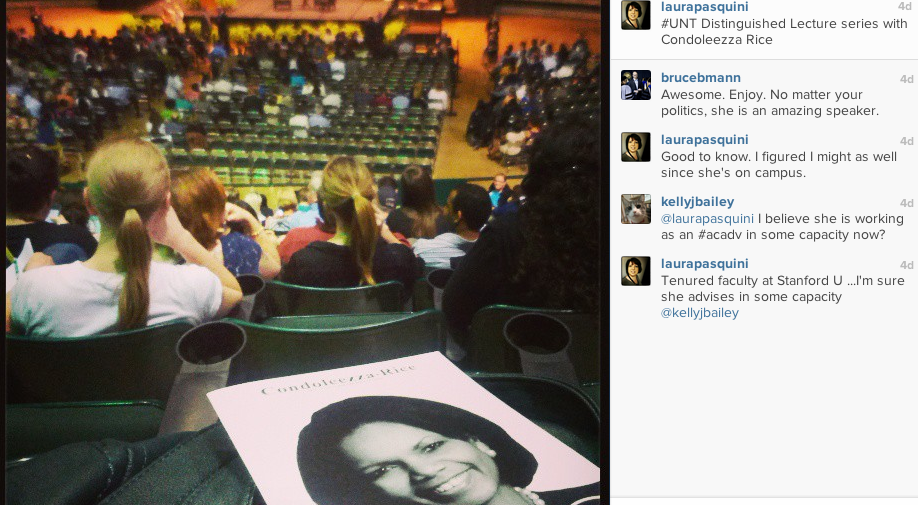
On Tuesday (4/16), I attended the Condoleezza Rice Distinguished Lecture hosted at UNT. My friend @brucebmann said it best when responding to this photo “No matter your politics, she is an amazing speaker.”

Screen Shot 2013-04-20 at 2.46.31 PMThis comment, and listening to the talk, made me think about my own perspectives and bias. How often do we challenge ourselves to think in a new way? How can listening to another perspective better inform our decisions? How is it possible to bring groups in conflict together?  I think it is possible, and I know that I am not alone.

Although “victory” has been seen this week, I don’t think that these events are really over. I challenge more of you to think about your influence and impact in social [media or not] spaces. What you say, tweet, blog, post, etc. influence the dialogue and community. It is easy to get [digital] high fives from friends and followers; however have you considered extending your reach to those you might not agree with? When is the last time you chatted with someone about the issues from this week who thinks differently than you do? Step away from the screen, and get to it.

Professional Development, Reflections, Training

Supporting Student Success at #UFTL13

UFTL13

I was able Last week UNT hosted the annual University Forum on Teaching & Learning:

UNT’s University Forum on Teaching & Learning (UFTL) is a one-day annual event that enables faculty, graduate teaching fellows, and staff involved in supporting teaching and learning to share ideas and practices that motivate learners, promote critical thinking skills, engage in real-world problems, and better prepare students for life and work in the 21st century.

This year’s #UFTL13 focus,  “Supporting Student Success,” helped initiate the conversation and help our campus understand how to support our students. It also shed some light on what success is and what it REALLY looks like for our learners.  In moving beyond the dirty R-word (retention),  it is critical to think how the meaning of the word success varies for our students. Our planning of “good” teaching and learning practices may need to extend beyond a course credit, a classroom setting, or a syllabus requirement for our students to be truly successful.

During the morning round table discussions, we chatted about reaching students beyond our state mandates or the general push to graduation, and thought more about how to connect with our learners to better understand their needs and purpose for being at the university. It was clear that success means many things to many different people. Our small group identified different things that signify success (in general) including promotion, failure, self-discovery, overcoming challenges, and such. The key issue we had in talking about “success” for learning is the divergent goals that formal education require specifically in terms of assessment, evaluation formats, and individual competency reviews.

Later in the morning Dr. Cassandre G. Alvarado, from UT Austin, asked “What is student success really?” in her keynote address. In Dr. Alvarado’s opening statements, she shared how higher education is broken with the “universal problem” being = too many students are not successful. [I will get into the “broken higher education” discussion in a future blog post- note this for now].

First we talked about the definition of success, brainstormed a few ideas, and chatted about how we might need to redefine success in our classroom and on our campus. Here is what success meant to our small group and from the speaker’s point of view:

  • effecting people in a positive way
  • being an inspiration
  • impacting others around you
  • having a goal, working hard & making sacrifices to work towards that goal
  • passion for what you are doing or how you are working with others

BIG IDEA: Success is more than content knowledge.

enjoy-your-success

 Key Goals for Success & to Be Successful shared by Dr. Alvarado in her keynote:

1. Perseverance  “Nearly every man who develops an idea works at it up to the point where it looks impossible, and then gets discouraged. That’s not the place to be discouraged.” ~ Thomas Edison

  • We need to share with our students our struggle so they can learn
  • Model for our students our own struggles
  • Reward effort as well as correctness, e.g. rewarding effort on homework and tests, using innovative assessment methods produced almost triple gains

2. Community –  “My model for business is the Beatles. Total is the sum of the parts… Great things in business are never done by one person. They’re done by a team of people.” ~ Steve Jobs, 2003

  • Community happens inside and outside of the classroom
  • Is about understanding our role
  • Is more than just friends, e.g. Creation of learning communities increase ention through Drop, Fail & Withdrawal rates stayed the same; cluster of courses

3. Imagination – “The value of an idea lies in the using of it.” Thomas Edison

  • Discovery is imagination
  • Ask students to solve problems that don’t yet exist not ones that have already been solved
  • “See yourself on the other side.” Dr. Marcy Haag’s mantra 4 breaking a board in a Taekwondo class and she shares this for learning/perseverance

Finally, I was asked to join a student, staff, and faculty panel (I fit a couple of these roles) to talk more about student success at UNT. Here are the questions posed to the #UFTL13 panel:

  • How do you define student success? Can you share an example of or tell a story about student success at UNT. (This could be a personal story, one of a colleague, classmate, friend, etc.)
  • From your perspective, what do students need to experience success at UNT?  Do you have any examples to share?
  • What types of partnerships make student success a reality at UNT?  Do you have any personal experience with partnerships?
  • From your perspective, what can staff/instructors/students do to enhance student success?

Of course, I took a few notes and tweeted during the panel, so here are a few themes that emerged from the our responses:

#UFTL13 Student Success Panel Responses

How do you define student success on your campus? What student success stories can you share? Think about it, and let me know.