
Micro-Blogs

HOW TO: Set Up a Twitter Account

  1. Go to http://twitter.com and find the sign up box, or go directly to https://twitter.com/signup.
  2. Create a Twitter account. If you are creating a Twitter account for a specific purpose or class requirement, you might want to read Disposable Twitter Accounts for Classroom Use by @ProfHacker – The Chronicle of Higher Education
  3. Enter your full name, email address, and a password.
  4. Click “Sign up for Twitter.”
  5. On the next page, you can select a username (usernames are unique identifiers on Twitter) — type your own or choose one Twitter suggests. Twitter will tell you if the username you want is available.
  6. Double-check your name, email address, password, and username.
  7. Click Create my account. You may be asked to complete a Captcha to let Twitter know that you are human and not a spam bot.
  8. Twitter will send a confirmation email to the address you entered on sign up, click the link in that email to confirm your email address and account.
  9. Add a photo (preferably a head shot) and write a short bio about you.

Resources:
Twitter in Plain English – YouTube http://bit.ly/ruNe4g
How to Sign Up for Twitter via the Twitter Help Center
A Beginner’s Guide to Twitter via ReadWriteWeb
Twitter Basics [VIDEO] http://www.jasonrhode.com/twitterbasics
45 Simple Twitter Tips Everyone Should Know About | Edudemic
7 Free Tools For Integrating Twitter With Your WordPress Blog
BreakDrink Twitter Guide http://breakdrink.com/twitter-guide/

Hashtags & Backchannels
Hashtag: A symbol used in Twitter messages, the # symbol, used to identify keywords or topics in a Tweet. The hashtag was an organic creation by Twitter users as a way to categorize Twitter messages and link keywords posted. Our class will use #ugstJOUR hashag on Twitter.

What Are Hashtags? via the Twitter Help Center
#Hashtag + Community = Learning? « TechKNOW Tools
How Hashtagging the Web Could Improve Our Collective Intelligence via Mashable
Backchannel in Education – Nine Uses
10 Ways Twitter Is Reinventing the College Lecture – Online Universities


#AcWri, LPQ

Learning and Performance Quarterly, 1(2) is Published

As the founding student editor for the Learning and Performance Quarterly, an open, online peer reviewed journal, I am excited to share with you the second issue. This publication has an eclectic mix of ideas and research for a wide array of academic disciplines in the learning, training, development and performance industries. As, indicated in my editorial, I think that there is great value to be shared outside of our professional silos.

I hope that you enjoy reading this issue as much as I did during the production phase. There are a number of concepts and resources shared within these articles for professionals in education, instruction, leadership planning, and training and development. Many thanks to the contributing authors, peer reviewers and section editors who made great efforts to produce this publication over the summer months. I appreciate the attention to details and edits during the summer months.

For those who want to contribute, review, or follow along — be sure to check out the LPQ Website, Follow @LPQuarterly on Twitter, or “Like” the LPQuarterly on Facebook. We are always interested in adding to our repertoire of peer reviewers and editors – please register for the LPQ journal and let us know how you would like to contribute to this open, scholarly publication.

Here is the Learning and Performance QuarterlyVol 1, No 2 (2012) — Table of Contents and Abstracts for the current journal contributions.

Editorial
Leadership, Training, Mentoring, and Instructional Design (1) [PDF]
Laura A. Pasquini

Abstract: The second issue of the Learning and Performance Quarterly (LPQ) is filled with submissions that span a wide scope of interests.

Case Studies
Developing a student leadership retreat using instructional design
techniques (2-29) [PDF]
Dr. Melissa L. Johnson

Abstract: The purpose of this paper is to describe how the Morrison, Ross, and Kemp (2007) instructional design model was used to design a student leadership retreat. An overview of instructional design and the Morrison, et al. model is provided. The application of the model to designing the retreat is then described in detail, including the learner and task analysis, development of instructional objectives, sequencing and materials, and formative evaluation. Finally, the implementation of the actual retreat, including summative evaluation procedures is provided.
Research Articles
Mentoring and Middle School Teachers: Using Subjective Affective Measures as
Performance Indicators (30-46) [PDF]
Dr. Ray K. Haynes

Abstract: This paper presents findings from a research study examining mentoring, organizational commitment, work alienation, and job satisfaction, among middle school teachers (n = 352) in large urban school district. Survey data obtained using a quantitative research design suggest that  formal and informal mentoring is occurring within middle schools and middle school teachers perceive both types of mentoring to be effective. Results of regression analyses suggest that ratings of formal mentoring effectiveness had stronger relationships to organizational commitment, work alienation, and job satisfaction than effectiveness ratings of informal mentoring.   Further analysis suggests that the predictor variable, as measured by ratings of mentoring (formal /informal) effectiveness, had statistically significant positive associations with the mediator and dependent variables. Implications are discussed along with suggestions for future research.

Concept/Theory Paper
Cross cultural training and success versus failure of expatriates (47-62) [PDF]
Ashwini Esther Joshua-Gojer
Abstract: The past few decades has seen an explosion in research on expatriates and cross-cultural training. There has been controversy and an unending debate on the goals, effectiveness, implementation and processes of CCT. There are very few reviews that have condensed literature detailing the best practices of CCT. This review also details the success and failure of expatriates. The antecedents or moderators that play a role in the evaluation of success and failure have been outlined in this literature review. It also brings to light certain solutions that will make CCT more effective and provides directions for future research.

Creative Leadership: Does It Clash Across Cultures? (63-82) [PDF]
Seogjoo Hwang
Abstract: As international competition, technology advancement, and the knowledge-based economy increases, creativity is becoming increasingly critical for the success of organizations all around the world. While leadership or support of individuals’ immediate leaders is one of the most potent factors impacting individual creativity, the majority of previous studies examining the relationship between leadership and creativity were conducted in Western contexts and only few studies investigated the cross-cultural aspects of leadership and creativity.

This study explores the connection between traditional creativity research and cross-cultural leadership research, building toward a conceptual framework proposed for further discussion and ultimately testing. Conceptual links between participative leader behaviors, individualism-collectivism, power distance, and creativity are examined. Implications for leadership development in order to enhance organizational creativity in an international HRD context bring this article to a close.

Book Review
Social Media for Educators (83-84) [PDF]
Laura A. Pasquini

Abstract: Social Media for Educators is an excellent book that interweaves theory, applications, and current pedagogical experiences for learning environments. For those in the learning and performance industry, this book provides insights and ideas to help guide social media use for both educators and learners. Joosten provides current examples, benefits, and considerations throughout each chapter. Whether educators are beginning to design their learning curriculum or learners are considering social media for organizational development, this book presents helpful insights and experiences that will potentially influence and shape effective engagement and learning with social media.

#phdchat, Learning Technologies, LPQ

Announcement: Learning and Performance Quarterly First Issue Published & Call For Submissions for Issue No. 2

THE LEARNING AND PERFORMANCE QUARTERLY (LPQ), 1(1) FIRST ISSUE IS NOW PUBLISHED!

Thank you to the number of authors, reviewers and editors who helped contribute to the first open, access online Learning and Performance Quarterly journal. Please read and share with colleagues and researchers who might be interested:

Learning and Performance Quarterly, 1(1)

CALL FOR PAPERS: LPQ, 1(2)

The Learning and Performance Quarterly (LPQ) is currently accepting submissions for the second issue. Deadline for submissions is Friday, June 15, 2012 at 11:59 pm CSTSubmission of manuscripts can be made online through the LP Quarterly website via the Open Journal System.

TYPES OF MANUSCRIPTS ACCEPTED

Research Papers :

Papers that are concerned with the various approaches to learning and performance impact. These papers should discuss the literature related to the approach employed and include a measure of the learning and performance impact of the approach employed.

Case Studies:

Case studies that highlight a particular learning, training, performance or instructional setting in which learning and performance resources were used to address a particular challenge. They present a discussion of the challenge from current literature, what was done to solve or explore it, and the results of the project. They often offer suggestions for others interested in addressing similar challenges.

Concept/Theory Papers:

Papers that present new concepts or contribute to existing theory for learning and performance. This should offer a discussion of the literature related to the concept/theory along with a discussion of the major issues for future research needed to validate the concept/theory.

Book Reviews:

Book reviews of publications 2011 or later will be accepted to highlight a issues and resources relevant for learning and performance and offer a suggested solution or direction. The position is supported with both a logical argument and a review of the pertinent literature. Preference will be given in the review process to book review essays that comment on two or more related books.  Book review essays should not exceed 3,800 words and should include city, state, publisher, and year of the book’s publication.  An abstract of 150 words or less and keywords are required for book review essays.  Reviews of single books should not exceed 1,900 words.  At the beginning of the text please include title, author, publisher, city, date, and page numbers of the book(s) under review.

The deadline for submissions is Friday, June 15, 2012 at 11:59 pm CST. For detailed submission guidelines and instructions on how to make a submission please visit Author Guidelines.

CALL FOR LPQ REVIEWERS

Interested in reviewing articles for the LPQ Journal? The LPQ journal is looking for reviewers to conduct peer reviews and evaluations of submissions.

Please identify your reviewing interests, substantive areas of expertise, and preferred research methods when completing the LPQ journal registration online.

We look forward to receiving your submissions. Please pass this post onto other colleagues and researchers who might be interested in publishing, reviewing or editing for the Learning and Performance Quarterly journal.

Thanks!

Laura Pasquini & Jeff Allen, Founding Editors

Learning and Performance Quarterly

Like us on Facebook

Follow us on Twitter @LPQuarterly

Email: LPquarterly@gmail.com

BreakDrink, Learning Technologies, Reflections

My Prolegomenon to Technology

A few weeks ago, @JenniferKeegin posted to the #SAWTT Blog with the prompt – What got me interested in Technology?

I think that my prolegomenon to technology was definitely the Commodore 64. I was introduced to this machine at a young age, thanks to my father.

For those who do not know, my father taught high school economics, business, and computers. Beyond having a great collection of books in his office, I was often drawn to his Commodore 64 and I am fortunate that I was able to dabble with device at home. The black screen and green text provided me with the backdrop to my first writing drafts, school projects, pong quests, and weather war game battles.

Around the time this prompt was posted, we sadly said our RIPs to Jack Tramiel, the father of the Commodore 64.  Although I have no personal connection to him, this made me sit back and reflect. I felt very fortunate to be introduced to Mr. Tramiel’s machine, and how lucky I was as a child to have the opportunity to tap these keys (along with a few typewriter keys) when technology might not have been as common at home. Of course, I owe a debt of gratitude to  my father for exposing my siblings and me to computers at a young age. He challenged us to be curious and explore with technology early on. Thanks the introduction and challenging us to think beyond the possible, Dad.

#phdchat, PhD, Virtual Communities

Organizational Learning Constructs

The nature of learning at the organizational level is a challenge to measure. Huber (1991) defines  organizational learning as the development of new knowledge or insights that have the potential to influence behavior.

There are a number of human resource development articles that reflect the individual learning experience and objectives. In considering the organizational learning process, I began to look at the organization level for learning in online communities of practice for an organizational science perspective.

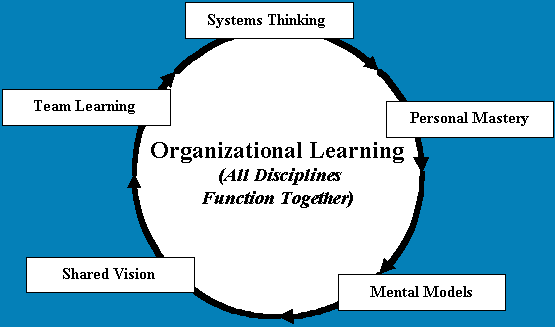
Image via Organizational Learning Software… <http://www.sqakki.com/LearningOrg/>

In researching and working on my final organizational theory paper, I began to assess how learning characteristics can be evaluated in online learning networks and communities of practice. There are a number of models and evaluation instruments to assess learning in organizations; however the constructs established by Yang, Watkins, and Marsick (2004) provide a solid framework for methodology and empirical assessment:

Systems Thinking – Senge (1990) identifies a learning organization as an organization that has the ability to creat alternative futures and possesses the following five disciplines: team learning, shared visions, mental models, personal mastery and system thinking. 

Learning Perspective – The learning organization is an “organization that facilitates the learning of all of its members and continuously transforms itself in order to meet its strategic goals” (Pedler, Burgoyne & Boydell, 1991). Eleven areas are identified through which this occurs: a learning approach to strategy, participative policymaking, informating, formative accounting and control,, internal exchange , reward flexibility, enabling structures, boundary workers as environmental scanners, inter-company learning, learning climate and self-development for all.

Strategic Perspective – a learning organization requires an understanding of the strategic internal drivers necessary for building learning capacity. Goh (1998) identifies five core strategics building blocks: clarity and support for mission and vision, shared leadership and involvement, a culture that encourages experimentation, the ability to transfer knowledge across organizational boundaries, and teamwork and cooperation.

Integrative Perspective – the concept of the learning organization is “on that learns continuously and transforms itself..Learning is continuous, strategically used process – integrated with and running parallel to work” (Watkins & Marsick, 1996).

These constructs will help define and lay the ground work to establishing a solid theoretical framework for assessment. I welcome any and other suggestions to reviewing online communities of practice with regards to organizational learning.

References

Huber, G.P. (1991). Organizational learning: The contributing processes and the literature. Organization Science, 2; 88-115.

Goh, S. C. (1998). Toward a learning organization: The strategic building blocks. S.A. M. Advanced Management Journal, 63(2); 15-20.

Peddler, M., Burgoyne, J., & Boydell, T. (1991). The learning company: A strategy for sustainable development. New York: McGraw-Hill.

Senge, P. M. (1990). The fifth discipline: The art and practice of the learning organization. New York: Random House

Watkins, K.E. & Marsick, V. J. (1996). In action: Creating the learning organization. Alexandria, VA: American Society for Training and Development.

Yang, B., Watkins, K. E., & Marsick, V.J.(2004). The construct of the learning organization: Dimensionsmeasurement, and validation. Human Resource Development Quarterly, 15(1); 31-55.