AcAdv, Career, UGST1000

Open Options: Choosing a Major With Road Trip Nation

With first year students, there are many new, exciting and scary things about starting college or university. Higher education offers a place to be intellectually challenged, develop socially, discover your interests, and engage with a variety of opportunities on campus and beyond. The road and journey are both wide open. The open road and the growing number of academic/career possibilities seems to be a bigger challenge to our student population. Besides the confusion of campus jargon and the navigation of a larger than high school institution, there seems to be more students and family members at orientation who are anxious about making the “right decisions now” for later. Many higher ed students have an idea or inkling of what they want to do, but most are not sure about their academic options, career path planning, and helpful resources to support their decision-making process.

For UNT students who enter into the undecided/undeclared program at UNT, the Office for Exploring Majors [where I work] utilizes the Roadtrip Nation (RTN) resources and has a  RTN project as part of the UGST 1000 – First Year Seminar class.

The Open Road for #UGST1000 Course Design The RTN project helps students explore their personal, academic, and career path. More importantly, it allows them to learn that there is more than one path to obtain their goals and dreams. In picking up  Roadtrip Nation: A Guide to Discovering Your Path in Life and Finding the Open Road: A Guide to Self-Construction Rather Than Mass Production – I was reminded about my own academic/career journey and questions I had in undergrad and after. There are a number of different professional journeys and narratives that provide readers a “path” of how to get to where you want to go.

Overall, I will be using Finding the Open Road stories and interviews (posted online) to help expose the pre-Journalism (News, Advertising, Strategic Communication & PR) and pre-Business (Entrepreneurship, Marketing, Management) students in UGST 1000 figure out how to navigate their own experience. I do like the strategies and ideas in the “Do It Yourself” section of the Roadtrip Nation book to help guide our students learning. The plan is to take the follow chapters and make them into easy-to-use guides for both the UGST 1000 instructors and students that follows the Roadtrip Nation Manifesto:

  1. First, Find Your Red Rubber Ball – What inspires you? What is your passion? Identifying interests, values, and likes.
  2. Whom Should You Meet? – tips on how to find people, being resourceful, using your personal network, how to reach out to new people
  3. Getting the Meeting – cold calls, the pitch, being persistent, communication strategies
  4. Preparing for the Interview – researching the person, their company, their work experience
  5. In the Meeting – what to talk about, suggested questions, informational interview samples, interview/meeting etiquette
  6. Closing – ending a meeting, sending thanks, developing a mentoring relationship

RTN asks....

References:

Marriner, M. & Gebhard, N. (2006). Roadtrip Nation: A guide to discovering your path in life. New York: Ballentine Books.

Marriner, M., McAllister, B. & Gebhard, N. (2005). Finding the open road: A guide to self-construction rather than mass production. Berkeley, CA: Ten Speed Press.

Collaboration, Professional Development

How Do You Cultivate Mentoring Opportunities?

During our session at the #UNTAdv12  Conference last week, our panel hosted a discussion on the topic of mentoring in higher education. We talked about what formal and informal mentoring looks like on our college and university campuses, specifically to support our faculty, develop our staff members and engage our students students. Here are the key words that were shared during the discussion:

It is important for campus communities to consider the potential of mentoring. There are a number of benefits to supporting mentoring at a college or university. Some might be interested in connecting our students to their learning environment, while other institutions might be interested in helping new faculty transition. A number of mentoring programs provide return on investment for employees, which includes increased retention, career development, and professional engagement. By developing a culture of mentoring, organizations have the ability to increase collaborative learning and support sustainable leadership.

What sort of mentoring is happening on your campus or within your organization? Please feel free to add your mentoring program or resources to the open google doc: http://bit.ly/MentoringMatters

BreakDrink, CTCX, Higher Education, K-12, Learning Technologies, Social Media

#SocialMedia & #HigherEd – Policy vs. Guidance

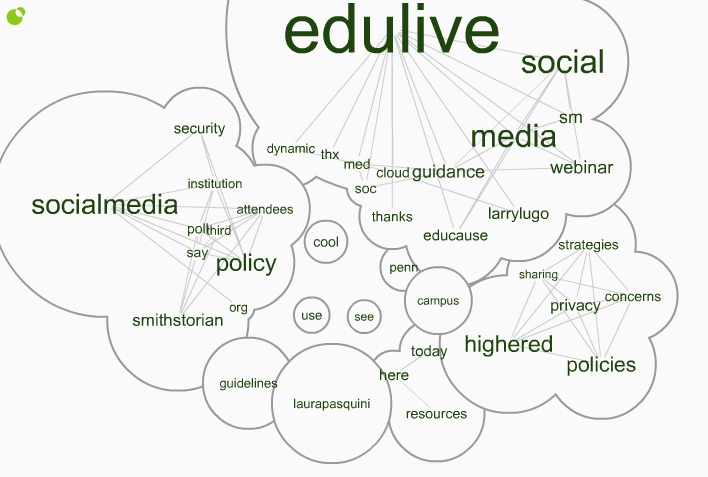
Last week, I attended the free @EDUCAUSE #EDUlive Developing Social Media Guidance in higher education with respect to #Privacy and #Security concerns. The presenters, from the University of Pennsylvania, shared ideas for how to promote safe usage of social media and detailed how to  draft guidance for addressing issues in teaching, research, administrative, and other functions.

Click here for the Twitter Cloud interactive image =>  http://www.infomous.com/node/15059

If you missed the #EDUlive event, you can check out the webinar recording and archives posted on the EDUCAUSE website, Developing Social Media Guidanceand you can also read through the Storify of #EDUlive tweets I collected.

During the webinar, I shared the Social Media: Sharing Strategies, Policies &  Privacy Concerns in Higher Education open & shared Google Doc that was 1st created for a @BreakDrink Campus Tech Connection (CTCX) Show in September 2010. This document has been circulated around and curated for a while by myself and high ed professionals and faculty. Since there were a number of social media guidelines/policy examples shared during the webcast, I added  them to this doc. For others interested in developing guidelines, I think there are a few solid examples I like in here, and I know that @EricStoller shared some of his favourite #SM guidelines from the list on InsideHigherEd recently as well.

Before diving into creating rules, guidelines or policies for social media, it is important to consider how this emerging technology is being used on your campus. In Chapter 6 of Social Media for Educators, Tanya Joosten (2012) shares her thoughts around institutional considerations for social media policy and practice [which we chatted with Tanya about on #CTCX Episode No. 61 as well]. There are often concerns about the use of social media at educational institutions, since these social and  connected resources impact student behavior, online interactions, privacy concerns, and communication practices. When developing a social media policy, Joosten (2012) offers a few helpful suggestions for educators:

  • review current technology use at your institution
  • do not link policies to specific tools
  • revise current student conduct and institutional policies
  • use policy to address behaviors and activities, rather than focus on the technology
  • learn about FERPA (or FIPPA in Canada) issues and privacy of student information at your campus
  • develop best practices on campus for use by students, faculty, and support units

When thinking about the language of policy vs. guidelines, I am partial to establishing guidelines. There are probably already policies that address the actions and outcomes of student, staff, and/or faculty behavior on your campus. I think that it is important to review your home institutional policies and/or guidelines to best understand what is already being “regulated” on campus. It is also helpful to chat with your institutional office who deals with policy development, legal concerns, and/or questions you might have around privacy legislation.

Have you searched the terms “social media+policy” or “social media+guidelines” on your institutional website? Go on. See what shows up. If you find something, then start connecting and collaborating with that unit. If there is nothing to be found, then gather your peers and start the conversation.

References:
Joosten, T. (2012). Social media for educators. San Francisco, CA: Wiley/Jossey-Bass.

Higher Education, Professional Development

The Productive & Disruptive Innovation of EDU

The Innovator’s DNA: Mastering the Five Skills of Disruptive Innovators, identifies key behaviors to find innovative solutions to impact organizations, products, and services. Christensen and Gregersen (2011) share five skills that leaders need to innovate their way out of problems and into opportunities:
  1. Question – ask challenging questions that take on common wisdom to create new directions
  2. Observe – watch the behavior of customers, suppliers and competitors the way an anthropologist would identify new ways of doing things
  3. Network – talk to people with different life experiences and perspectives to spark new ideas
  4. Experiment – construct interactive experiences and build prototypes to provide unorthodox responses and gain new insights
  5. Associate – draw unexpected connections between questions, problems or ideas from unrelated fields
In education, both K-12 and higher ed, we need to spend a more time mastering these disruptive skills and improving our productivity. By adding these tools, educators will be able to consider different possibilities to support our learners and find new solutions to educational issues. This new approach to education requires innovation, organizational collaboration, and teamwork on the fly. It’s great to see that there are innovative ideas brewing, such as #change11,  BigIdeas and #EmergentEDU.
How are YOU using these 5 disruptive skills for education?
BreakDrink, CTC, Higher Education, nacada10, SAchat, Social Media

Social Media Strategies in Student Affairs

Last night, the Break Drink Campus Tech podcasting crew decided to tackle the hot topic of Social Media Strategies in Student Affairs. During the Campus Tech #14 show, the three of us shared some thoughts and ideas that are currently being put into practice for many higher education institutions, and discussed how social media is impacting our university and college campuses.

Photo c/o http://www.policytool.net/

The hot topic included the following discussion points:

  • digital citizenship
  • education and awareness of Student Affair practitioners and students
  • the evolution of social media on campus
  • questions & concerns for best practices of social media in higher ed
  • examples of current social media policies & guidelines
  • resources for developing social media strategy for your campus

Image c/o The Advanced Human Technologies Group

Here are a few great resources to check out if you are designing your own social media strategy on campus:

In thinking about this grand topic, the Campus Tech posse realized that it was a daunting issue to tackle in a 60 minute podcast. The discussion about emerging technology and social media in higher education will not be over soon. To help continue the conversation and support best practices using social media, I initiated a digital archive of resources we hope other Student Affairs practitioners will contribute to:

Social Media Strategies in Student Affairs Google Doc

If your campus has a social media strategy or you have further resources for best practices, please share them in the above document. The Campus Tech show would love to know what you think about social media on campus, and we will be sure to talk about updates or comments we receive.

NEXT WEEK on the Campus Tech Podcast:  Speaking of Social Media in Higher Education….

Stay tuned for the show next Monday (8/4/10) at 7 pm CDT as we connect to the LIVE happenings of the 2010 NACADA Annual Conference for Academic Advising professionals. This year is the first year @NACADA has recruited a team to support social media and a backchannel for participants near & far.  Here’s the NACADA Social Media Guide & be sure to follow the hashtag #nacada10.