EdTech, Higher Education, Social Media, StudentAffairs

#SXSWedu Panel: Social Media in Higher Ed – Where Are We Going? #smHE

Are you attending the SXSW Edu (#SXSWedu) conference in Austin this week? Why not drop into our panel just after the opening of #SXSWedu? Join our session on Monday, March 4th from 1:30-2:30 pm in the Austin Convention Center Room #15. Here is the skinny on our panel:

Panel: Social Media in Higher Ed – Where Are We Going?

Social Media Propoganda

Image c/o Justonescarf

100% of Colleges and Universities are now adopting “social media” tools to engage students. While strategies and tactics vary per institution there has been little analysis into the effectiveness of these networks both from the student and institutional perspective. Social Media Managers have been hired, consultants have been giving “best practices” on how to use “free tools” but is all this network chasing really getting us anywhere? In this panel we’ll showcase examples of good and bad social media implementation, and use these as a framework to discuss what a meaningful social media strategy and guidance looks like.

Intended Audience: Higher Education; Student Affairs; Academic Affairs; Faculty; Ed Tech Start Ups

Join the dialogue with Tanya (@tjoosten), Brandon (@bcroke), Brad (@bradpopilolek), and myself (@laurapasquini) as we chat about these three central questions proposed by our panel:


1. What does a failed social media strategy look like?
How do we know social media failed OR was successful? Do we need social media strategy, guidance, or policy on our campus?

2. What does a successful social media strategy look like? What are three pillars every social media initiative should have? What works really well with using social media? What initiatives have you seen?

3. What role should institutions play in engaging students with social media? How should institutions engage  social media? Why should we use social media? How can the different players on campus (faculty, administrators, students, developers, industry, & start ups) work together and collaborate for purposeful social media use?

If you have a question and you want to chime in during the session (near or far), I’ll be tracking the conversation with the hashtag #smHE to collect your questions, thoughts, and contributions before and during our panel session. What questions do you have about social media in higher education? Let me know.

UPDATED: Slide Deck & #smHE Tweets Collected. Enjoy. 

#SXSWed Panel: Social Media in Higher Ed – Where Are We Going?#smHE (with images, tweets) · laurapasquini · Storify or http://bit.ly/Z422Pw

AcAdv

Implications for Use of Technology in Advising @NACADA 2011 National Survey

In Fall 2011, I was asked to review data collected from a national survey sponsored by The Global Community of Academic Advising (NACADA) and contribute to the chapter on advising technology. The survey posed a few questions about technology in advising, such as assessment of institutional advising types (e.g. online, on-campus, and blended), communication with advisees, and student information management practices. The entire 2011 NACADA National Survey results and chapters can be found in the NACADA Clearinghouse; and my chapter, “Implications for use of technology in advising 2011 National Survey” are available to read online.

One final sentiment I shared in the conclusion, was to push higher education administration to consider how they assess technology in advising as holistic process connected to other campus divisions:

“When assessing technology usage, postsecondary leadership must also consider future significant challenges such as economic pressures and new modes of scholarship (Johnson et al., 2012). Through researching these technological trends and challenges, conducting campus-wide assessments, and establishing strategic plans, advising stakeholders can effectively integrate technology in advising practices that support both advising units and institutional goals” (Pasquini, 2013).

I did include a few recommendations and guiding questions to consider when considering and  evaluating technology for advising:

“Many students bring expectations about using technology to campus, and therefore, many institutions participate in community advising approaches in which technological solutions provide seamless support and communication for academic planning and progression. When advising units address the use of technologies for both managing student information and communicating with students, they may impact student support and retention initiatives on campus. Higher education institutions, who deploy technologies for communication and information management, benefit from having both the data and ability to effectively connect to their student populations” (Pasquini, 2013).

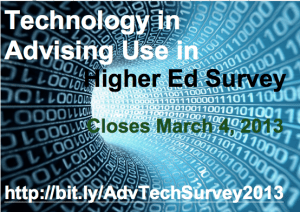
What was key from this data analysis, was that the advising and a number of student service providers lack specific information about the WHY, WHAT, and HOW technology is being used in the advising profession. With the 2011 NACADA survey and encouragement from the NACADA Executive Office, development of the 2013 Technology in Advising Use in Higher Education Survey (which is still OPEN FOR RESPONSES until March 4, 2013 at 11:55 pm CDT) was initiated. I hope that this instrument helps us critically evaluate HOW the field of advising IS using technology at colleges and universities around the globe.

#AdvTech Use in #HigherEd Survey… Launches on 02-18-2013

In developing this instrument, our working group discovered that, overall, any assessment of technology in advising was lacking. The last time information about advising and technology was collected was circa 2002, and a number of the instrument items are already obsolete (e.g. overhead projectors, Netscape web browser, and Palm Pilots). Needless to say, information about where the advising community and technology stood was missing, and the overarching idea about use, perceptions, and  the current state for technology in advising.

Here are the objectives for the 2013 Technology in Advising Use in Higher Education survey:

  1. Establish what the current use of technology in advising among the advising profession – student management, regular use, applications, software, etc.
  2. Understand how technology in advising is being used for communication purposes with students, professionals and faculty
  3. Identify the relevance of technology for advising on a global scale for the advising profession
  4. Understand the current perspectives and perceptions of how technology in advising is being utilized in the profession today

So far we have 523 responses to the survey. The data collected will help to better inform the advising profession beyond anecdotal assessment, and critically evaluate how technological solutions effectively support our advising practice.  Without any real assessment for technology use in advising, how can we determine what direction we should move forward? I hope that survey responses and data analysis can provide some of these answers. More to come…

Reference:

Pasquini, L. A. (2013). Implications for use of technology in advising 2011 National Survey. NACADA Clearinghouse. Retrieved from http://www.nacada.ksu.edu/Resources/Clearinghouse/View-Articles/Implications-for-use-of-technology-in-advising-2011-National-Survey.aspx

Higher Education, Social Media

Guiding Social Media at Our Institutions [ARTICLE]

Remember last fall when Tanya Joosten (@tjoosten), Lindsey Harness (@LindseyHarness) and I asked for your input on how your institution guides social media? No? Too long ago to remember? 🙂 Well regardless, we appreciated those who could respond as it helped us gather information on what we are (or are not) doing to direct social media use in higher education.

The results from the research are in, and published! Here is the recently published, peer-reviewed article for the Society for College and University Planning (SCUP).

Access the article in PDF form here.

This article expands on Chapter 6 from Social Media for Educators to understand how higher education is guiding social media use. Through our open-ended questions, we learned more about how institutions are supporting and guiding social media. Often we see social media used a broadcast medium and there has also been a shift to designate new roles or responsibilities to support its use on campus.

Thanks to the SCUP Change-Disruption Mojo for featuring some of the findings as this week’s topic, specifically to Alexandria Stankovich (@thinkstank) for sharing both sides of the issue:

  • Concerns: monitoring online behavior, identity thief, privacy, FERPA/FIPPA, maintaining university image, control, ownership, required trainings

  • Benefits: interaction and engagement beyond the formal learning environment

Want to learn more about the research and/or article findings?

Key takeaways:

  • Social media is often used as a “broadcast channel”
  • We should engage and develop a culture through the use of social media tools
  • Institutions need fluid access to information regardless of the technology
  • Simplicity principle to build capacity for the social web
  • We need to develop models of effective practice for LEARNING!
  • Trust the faculty you hire – they have some great ideas
  • Recognize that learners are MORE than sponges
  • Match technology with task & building digital literacy opportunities
  • Is social media in your strategic plan? Is social media or technologies part of your learning outcomes on campus? THIS is where your efforts need to be
  • Institutional encouragement is needed for collaboration ON YOUR CAMPUS to identify how to best guide social media models & effective practices
“The pedagogical benefit of social media use beyond its application as a motivational technique continues to be unaddressed by many universities.”

This study was just the tip of the iceberg. There is definitely more research on learning, social media use, and higher education to be done. Time to get at it! Back to the dissertation proposal grind…

Reference:

Joosten, T., Pasquini, L. A., & Harness, L. (2013). Guiding social media at our institutions. Society for College and University Planners – Integrated Planning for Higher Education, 41(2), 1-11.

AcAdv

2013 Technology in Advising (#AcAdv) Use in #HigherEd [SURVEY]

Dear Academic Advising Professionals, Faculty & Administrators in Higher Education,

The division of Undergraduate Studies at the University of North Texas (UNT) is hosting the 2013 Technology in Advising Use in Higher Education survey to assess how technology in academic advising is being utilized in colleges and universities around the globe. The NACADA Technology in Advising Commission sponsored study is designed to examine the current use and perception of technology in advising among academic advising professionals, faculty advisors, and advising administrators in higher education.

#AdvTech Use in #HigherEd Survey

If you agree to participate, you will be asked to respond to a 20-question survey, which will take approximately 15-20 minutes to complete.  The questions will ask for your opinion of technology in advising use at your college and/or university institution, and your own perception about how technology is supporting the field of academic advising as a whole. Your responses are completely confidential and no individual participant will ever be identified with his/her answers.

SURVEY: 2013 Technology in Advising Use in Higher Education or cut and paste the following URL link into a web browser: http://bit.ly/AdvTechSurvey2013

This survey will close on Monday, March 4th at 11:55 pm CST.

If you have any questions or comments, please free to contact me. On behalf of the Global Community for Academic Advising (NACADA) and the advising profession, I would like to thank you for your time and input. Please pass this survey along to other advising faculty, professionals, and administrators at your college and/or university.

Thank you,

Laura Pasquini (@laurapasquini)

NACADA Technology in Advising Commission Chair 2011-2013

Academic Counselor, Office for Exploring Majors – Undergraduate Studies, UNT

This blog post is cross-posted at The Official NACADA Blog.

G*STEP

Using Verbs for Specific Learning Outcomes

Verb Wheel

Student learning outcomes is a very common term in education. For many of my k-12 colleagues we have used this term from graduate course work, to teaching practicum, and for curriculum planning. The challenge in writing student learning outcomes happens when you have to find actionable items and SPECIFIC methods for learning assessment.

Last week I attended “Writing student learning outcomes and the GSTEP teaching template:  How they inform your teachingfor the G*STEP program presented by Shana Cole & Nancy Fire from CLEAR.

We talked about components of a teaching strategy, which included:

A. Context for your teaching strategy
B. Selecting learning challenges to address with your teaching strategy
C. Objectives for this experience
D. Foundational knowledge necessary for students to participate in teaching strategy
E. Step by step planning
F. Ground rules (if needed for you strategy)
G. Assessment: How do you plan to assess the effectiveness of your learning strategy?
H. Anticipated Challenges: Indicate how you plan to deal with any of these challenges that may apply. Describe.
I. Journal Reflection

The three level model for student learning outcome development, which included the following levels:

  1. Goal
  2. General Learning Outcomes (GLOs)
  3. Specific Learning Outcomes (SLOs)

The last step – Specific Learning Outcomes (SLOs) – is where we focused our attention. Specific learning outcomes are highly measurable and possess detailed requirements. As an instructional designer who is often involved in program evaluation or course design, I appreciated the cross-disciplinary conversations on how to meet various subject matter content issues with the needs of the learner. A helpful resource to keep us on the same page and to guide our SLOs discussion was the Bloom’s Taxonomy verb wheel. This was a practical tool that helped to focus our planning and here were some of the key points I gleaned from the overall workshop:

  • be clear, specific & measurable
  • identify what the students should be able to do as a result of a learning experience
  • display evidence that learning has occurred at a specified competency level
  • focus shifts from what “I will teach” to “what students will learn”
  • define content, expectations, assessments & creates constructive data i.e. data, percentage, and understanding of student learning

For student learning outcomes to work they have to connect to the learning. A great way to assess your expectations of your SLOs is to share these with other educators,  both inside and outside your discipline or subject matter expertise. Student learning outcomes need to be written at a general level to ensure clear communication, and limit subjective language. By using SLOs you are able to modify course objectives, assess curriculum design, and measure how your instruction impacts learners. By creating 3-7 overall goals in your course, you will want to consider at least 3-5 specific learning outcomes to measure each goal. These goals will help address your teaching strategy and how you assess your learner’s progress.

How do your specific learning outcomes (SLOs) fit into your entire course planning and content delivery?