Higher Education, MOOC, Open Education

New Social Learning … is It “New”?

Education rarely reinvents the wheel. This is not necessarily a bad thing. There are a number of great theorists, researchers, scholars, practitioners, and educators who have been utilizing connected and social learning ideas for decades.

In thinking about social learning for instructional design, I will turn to Bingham and Conner’s (2010) outline for how this is “new” in many of our organizations:

  • The new social learning is not just for knowledge workers – community-oriented.
  • Plays well with formal education to capture shared learning.
  • Compliments training and supplements development.
  • Similar but not the same as informal learning – more search and reading.
  • More than just online search and social networking.
  • Not like broadcasting information, more communal.
  • Allows for interaction and experiences to share ideas.

Image from Social Media Portal

Thomas and Brown (2011) inquire about the new culture of learning in their book, specifically asking: “What happens to learning when we move from stable infrastructure of the twentieth century to the fluid infrastructure of the twenty-first century, where technology is constantly creating and responding to change?”

I am thinking about this question a lot. A number of educators are looking for the “new” instead of asking questions and assessing the present practices. As a scholar-practitioner with perhaps faculty inklings, I have many concerns and questions for the future of our learning in higher education:

  1. Who (collaboratively) will best respond to the challenges and changes for our learning landscape on your campus?
  2. Why are educational changes and decisions being made? Is there assessment and evaluation? Data-driven decisions? Literature to support the change?
  3. What are we doing well & what can we improve upon in our face-to-face, online, and blended pedagogy in higher education?
  4. How are we thinking about connections, creativity, and social learning for our campus learning environments?
  5. When & how seek out the learner’s input for changes to our educational curriculum, campus programs, and student support services?

The idea of one idea, one thing, or one person to tackle the challenges/changes in higher education is ridiculous. If you think a “new” way to learn – perhaps a MOOC – will solve your university or college, then I am concerned about your strategic goals and learning outcomes. Take a gander at George Siemen’s recent #open13 talk [slides & video] to get a historical perspective on MOOCs (then and now), learning challenges, and other considerations for higher education pedagogy. [P.s. If you want to talk more MOOCs and research – y’all should come down to Texas for the 1st MOOC Research Conference in December]

One great take away from George’s talk (via a priest) about the upcoming shifts to higher education: “Don’t move away from things…because if you move away from things you don’t have a clue where you’re going to end up. Instead, move towards something.”

References

Bingham, T., & Conner, M. (2010). The new social learning: A guide to transforming organizations through social media. Berrett-Koehler Store.

Thomas, D., & Brown, J. S. (2011). A new culture of learning: Cultivating the imagination for a world of constant change (Vol. 219). Lexington, KY: CreateSpace.

Siemens, G. (2013, November 7). MOOCs: How did we get here? Elearnspace. Retrieved from http://www.elearnspace.org/blog/2013/11/07/moocs-how-did-we-get-here/

Higher Education, Social Media

Gathering #SocialMedia Guidelines from Higher Education #SoMe #edusomedia #highered

Grey of Social Media

When discussing social media guidance in higher education, there seems to be a lot of grey areas. Social media use is a relevant topic on many college and university campuses. Over the course of the next few months, my plan is to review social media guidelines to sort out the grey, and identify more black and white ideas about social media guidance.

To pursue my dissertation research, I am currently gathering ANY and ALL Social Media Guidelines from Higher Education Institutions from ANY and ALL COUNTRIES. If you currently attend, work, teach, or know of any a post-secondary institution that provides guidance for social media, then I need your help! Please search your institutional website for “social media” guidelines. Keep in mind, your higher education institutional “guidance” for social media may also be labeled as: guidelines, policy, tips, rules, beliefs, regulations, strategy, or take on another name. If you are aware of any websites, documents, or artifacts that guide social media in higher education, please COMPLETE THIS FORM.

 Please consider contributing to help advance social media guidance and use at our post-secondary education institutions: 

Submit a Social Media Guideline & Policy Document

The following website was created to gather and build a social media guideline database and share information about this research:

http://socialmediaguidance.wordpress.com/

If you have questions, concerns, or want to get more involved in this social media guideline project, please feel free to CONTACT ME. Thank you!

EdTech, Professional Development, Social Media

My #edu13 Sampling Tour at @EDUCAUSE

With limited time in my October schedule, I was only able to drop into the 2013 EDUCAUSE annual conference (#edu13) in Anaheim, CA for a couple of days. It’s unfortunate that I was not able to stay longer; however I’ll share my sample of the #edu13 higher education and technology conference. {This is what happens when you are traveling to conferences, writing a dissertation proposal, advising for Spring 2014 registration, teaching a class & training for a marathon all in the same month. Lessons learned for next year.}

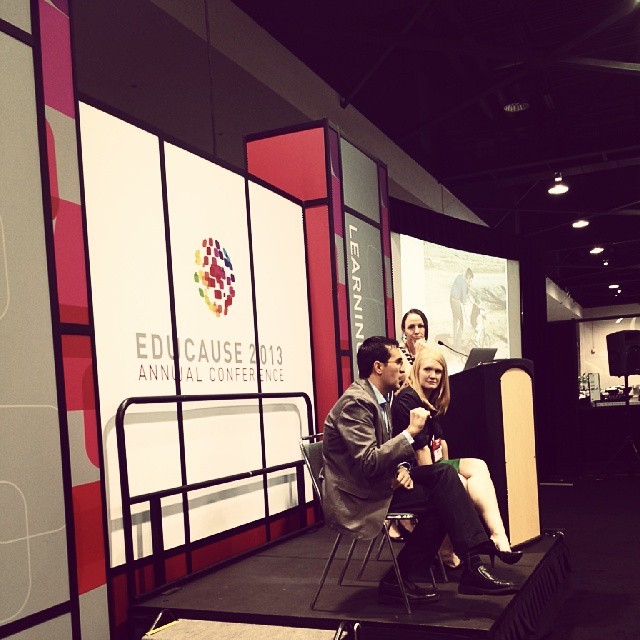
I was fortunate to be able to attend #edu13 since Tanya Joosten (@tjoosten) asked me to co-facilitate a virtual workshop on Social Media for Teaching and Learning. Much of this session shared ideas from Tanya’s book, our research article, and our practical application for utilizing social media for learning/teaching. During the session we modeled our teaching/learning expectations by encouraging participants to interact & dialogue with us on Twitter. Our emphasis was not on the tool, but more on the social learning and interactions you can have to augment educational experiences:

Let's get social #edusocmedia ....its not the tech #edu13Here is our digital handout from the workshop: http://bit.ly/edusocmedia13

Before I had to leave EDUCAUSE on Wednesday, I attended the #edu13 Prepare for Lift-Off: Becoming a Successful IT Pilot Site Panel and took a few digital notes: http://bit.ly/pilotpanel

How can the solution improve student learning? Ask @tjoosten @amcollier & @Veletsianos #edu13

During this session, Tanya Joosten (@tjoosten), Amy Collier (@amcollier), and George Veletsianos (@veletsianos) discussed the TOP 10 questions every institution should ask before piloting a technology solution for learning at their campus:

  1. Why should this solution be introduced to the campus?
  2. How can the solution improve student learning?
  3. Does your institution have readiness or capacity to pilot a new solution?
  4. Who is the audience and are the stakeholders?
  5. What is the pedagogical model that will lead to the greatest?
  6. How will a vendor be selected for the new technology?
  7. How would faculty be selected to participate?
  8. How do you evaluate the impact of the solution on the identified outcomes?
  9. How do you diffuse the innovation on campus and beyond?
  10. What are your questions?

Since I missed out on the live happenings, I made sure to follow the #edu13 backchannel and my tweeps while traveling home. If you don’t have much time or interest in text mining all the many tweets, The Chronicle curated few conversations on Twitter and EdTech Magazine compiled a list of people to follow at EDUCAUSE 2013.

Good morning #edu13

AcAdv, NACADA Tech, nacada10, Reflections

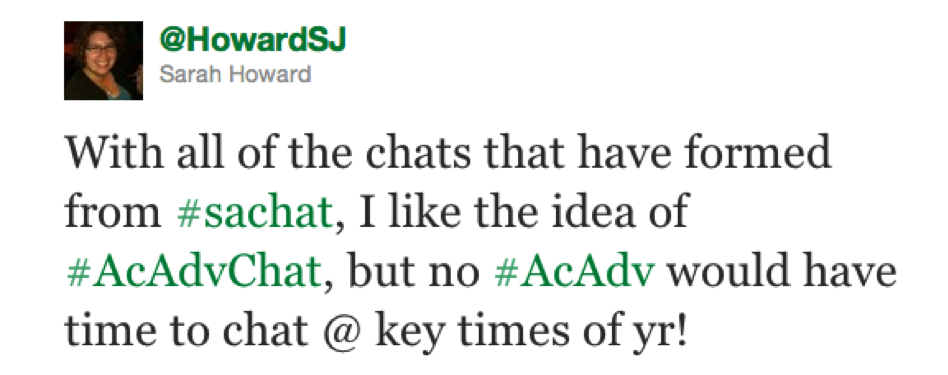
Academic Advisors + @AcAdvChat = #AcAdv Chat Network

For my colleagues in higher education, WHERE do you get new ideas, resources, and share information about academic advising?

  • Is it just down the hall from your office in the break room near the water-cooler or coffee pot?
  • Do you connect with others at a regional or national conference every year?
  • Or is there an opportunity to connect with other faculty and professional advisors at your campus for a training and development session?
  • Is it through a professional association listserv, e-mail list or discussion board?
  • On a Facebook page/group, LinkedIn Discussion, or another social media platform?

BUT wouldn’t it be great if you had a regular space and place to have these conversations, ask questions, share trends & issues, utilize a professional sounding board, and connect to  advising colleagues at other institutions about academic advising? {A small group of advisors asked in October 2010 at #nacada10}

sh

ENTER = @AcAdvChat & the #AcAdv Chat Hashtag

#AcAdv Chat

Since the start we have been fortunate to have a few great people collaborate to support the @AcAdvChat handle and chat each week. The #AcAdv Chat Team helps create weekly chat topic polls, brainstorm questions,  moderate the chat, and update our social media platforms, including those we said goodbye to (Delicious & Posterous), and those  social media sites we still use (Twtpoll, WordPress, Twitter, & Facebook Page) each and every week. THANKS FOR ALL THAT YOU DO! Go team! Here are the #AcAdv Chat-ers current & past from the top (L-R): @AcAdvChat, @sarahhcraddock, @peacox, @laurapasquini, @bilmorrill, @kellyjbailey, @howardsj, @julieclarsen, & @bradpopiolek!

Screen Shot 2013-09-14 at 12.48.02 PM

Can you believe that we are about to celebrate our 100th @AcAdvChat? It’s true! The #AcAdv tweeps have been busy discussing academic advising issues and happenings in higher education since Fall 2010! Time flies when you’re having fun with the fantastic members in the #AcAdv community.

Join us on Tuesday, September 17, 2013 from 12-1 pm CT for our 100th #AcAdv Chat.

100-fireworks

To honor this milestone with our #acadv chat friends, we thought it would be great to share WHY YOU PARTICIPATE in #AcAdv Chat. Let us know how we got to this 100th #AcAdv Chat.  Also, please be sure to  introduce your academic advising colleagues #AcAdv Chat (about) and encourage others to FOLLOW @AcAdvChat on Twitter. Thanks!   Now let us know…

“Why do you #AcAdv Chat?”


{This message is cross-posted at the AcAdvChat WordPress Blog}

Learning Community, Professional Development, UGST1000

Help My #ugstSTORY Class Tell Their Story

It seems that all is quiet on the TechKNOW Tools blog front… Sorry about that.

The start of the academic semester came fast and furious, and I have been busy engaging with and learning about my students’ stories for my #ugstSTORY class this Fall 2013 semester. This is my UGST 1000 – First Year seminar class where my students explore their major/career options, get support with transition to college, and learn more about themselves.  Feel free to follow along with our “story” this Fall if you would like:
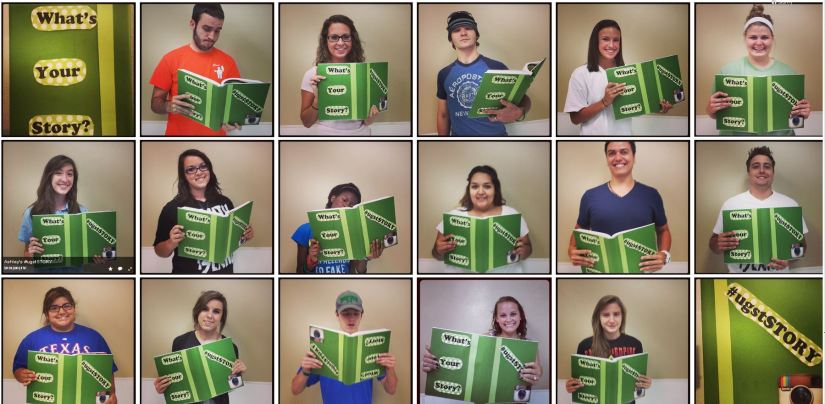
ugstSTORY Pic

With this seminar class, a great portion of the focus is on self discovery and exploration for personal, academic, and career options. Like many students who are “undecided” or exploring their options, many of my #ugstSTORY students have more than one interest and want to make sure they are going down the right path for them. In learning about many of their talents and skills, I can see why it might be a challenge to just focus on one major. They are a creative and involved class who what to include what they VALUE in their future world of work and life.

What My #ugstSTORY Class Values
During the Fall 2013 semester, my #ugstSTORY students will leave a digital footprint, and will be encouraged to explore their personal and professional options. In their research to make an informed decision, a number of my students will reach out to professionals and industry leaders in the world of work to answer: “What do I want to do with my life?” and “How did you get to where you are?” I am not sure these BIG QUESTIONS will and/or can be answered in just one semester; however I think a few of the assignments and projects will hopefully get them started.

The first assignment, the Road Trip Nation (RTN) Project, is designed to help my students explore personal, academic, and career paths. More importantly, it allows them to understand that many directions will lead you towards your goals and dreams. Their recent blog posts identified what how to find their “Red Rubber Ball,” that is, where do they get their inspiration, passion, interests, values, and likes. Specifically, I asked what potential careers, professions or industries would they like to learn more about.  Here’s a short list from their in-depth blog posts this week:

Interview: Potential Careers & Industry

Interests & Passions

Journalism; Sports Journalism; Broadcaster Friends; Family; Hockey; Sports
Artist; Engineer; Philanthropist; Advertising; Therapist Stability; Helping Others
Journalism; Pre-Law; Psychologist Community Involvement; Travel; Family
Clinical Psych; Greenpeace Environment Activism; Animals; photography; food; language
High School Librarian Reading; books; writing
Engineering; Tourism; Economics Travel; Stability; Accomplishing goals
No Clue Relationships; Smile; Creativity; Individuality
Writer; Journalism Music; Belonging; Writing;
National Geographic; Journalism Travel; Photography;
Broadcaster/Journalism Sports Talking; Sports; Opinions to voice
Photojournalist; Forensics; Library Science Cartoons; Anime; Photography; Music
Psychology; Fashion Merchandising; Law People; Cultures; Travel;
Sales Engineering Music; Activism; Star Wars
Sports Analyst; Broadcaster/Journalist NFL Analyst; sports industry
Neurology; Psychology; Editor/Publishing Anime; Neuroscience; travel; career student; small business

The reason I am sharing more about my class with you is to get them connected beyond our class and the UNT campus. Since I have some phenomenal friends, family, and colleagues in my own learning and professional network, I thought a few of YOU might be able to provide some of your own experience and wisdom for their exploration, specifically by:

  1. SHARING A Resource: We tweet with the #ugstSTORY hashtag, so if you see a link, article, website or anything related to major and career exploration – cc: @ugstSTORY or just put the #ugstSTORY hashtag on it!
  2. READING Their Blog Posts: If you have time to read, comment & post on their WordPress blogs, that would be super rad. Although many are just blogging for the first time, a number of my #ugstSTORY students have very thoughtful and creative perspectives about life in college so far. It would be great if they got a response or two outside our #ugstSTORY class – drop them a comment or like. 🙂
  3. MENTOR Virtually: For the RTN Project a number of the #ugstSTORY learners will be seeking informational interviews with companies, professionals, and different organizations (listed above or might not be listed as they don’t know your about your occupation yet); if you OR someone you know is available and interested in sharing with my students what they do for a living and why they love it – LET ME KNOW!  Yes! I want to MENTOR a #ugstSTORY Student p.s. Pass this link onto a friend you might know as well. Thanks!