Tag: edtech
Online Learning: More Than Just a MOOC
As a life-long learner, I have appreciated engaging and interacting with a wide variety of educators in a few Massively Open Online Courses (MOOCs). The concept of a MOOC is has been around for a while. In previous blog posts, I have shared the definition of a MOOC and my participation and experience. I have appreciated learning from the #eci831 and #CCK09 MOOC facilitators, such as Alec Couros, George Siemens & Stephen Downes. Even more, I appreciate the knowledge shared by invited speakers and the connected learning participants who I continue to engage and exchange with beyond the course structure. MOOCs are now on the tip of everyone’s tongue due to recent education technology start-ups who are now designing MOOC-like courses and creating partnerships with many accredited higher education institutions. What’s all the MOOC about if the concept of a MOOC is not a new innovation?
Image c/o Flickr user guilia.forsythe
In a recent CBC radio interview and blog post, George Siemens discusses more about the good and bad aspects of Massively Open Online Courses are for online learning. There are different sides of the camp on this topic. Some believe MOOCs will either kill or transform the academy as we know it. Here are some interesting points that were shared in the interview from George and callers to the show:
Current Learning & Development = #AltProDev
If there is an interesting alternative professional development (#AltProDev) opportunity available – I’m there! Part of the reason why I have connected to podcasting with BreakDrink.com or participation in Twitter Chats (#AcAdv Chat, #SAchat or #PhDchat) can be attributed to my early learning experiences with MOOCs. I enjoy engaging in PD to improve my skills and add to my knowledge repertoire. Across various personal and professional spheres, I have learned a great deal at formal conferences, workshops and education sessions; however, I am also proud to say I learn a great deal from my informal training and development environments that are primarily cultivated online. I think that MOOCs provide a set time period for professionals to learn about a specific topic and engage with others in a similar informal fashion. What is neat about this classroom is, that although the course might end, your network and learning artifacts continue to thrive outside the specific learning environment.
Teaching locally but accredit widely.
As a current student in higher education (I’m in process of working on my doctoral degree in learning technologies at UNT), I tend to research, read, archive, and share online to keep on top of the trends and happenings. I think my involvement in MOOCs have connected me to new concepts, research ideas, learning networks, and continue to support my formal education goals. My intention when signing up for this type of free, online learning was to support my own professional development and expose myself to new learning concepts. I reflected my MOOC experiences to my faculty advisor and he believed that participation in any one of these classes could be an added elective for my doctoral degree plan since this informal learning environment was contributing to my research design. How would this type of learning be looked like at your institution for degree requirements? Here is one suggestion for earning college credit from MOOCs if interested.
Sustainable model? Or Just Branding?
The MOOC talk seems to be all the rage as start-up companies, such as Coursera, edX, and Udacity, partner to “reshape online learning” with well-known higher education institutions. Will the massive hype of these MOOC types lead to effective use and sustainable funding models? Or is this just another method for marketing and propagation of the university brand? I do not know. I agree with George’s thoughts – we will see after the dust settles and the MOOC hype levels off in higher education.
Types of MOOCs
As the online learning trend grows there will be various types, targets and tiered offerings of MOOCs. Some of the MOOCs I have reviewed have included areas for digital competence, open education and technical resources. The content, subjects, platforms and learning environments will vary from MOOC to MOOC – and will most likely depend on the partnering institutions influence as well. Online learning will continue to be part of higher education curriculum at many institutions, but as George says “open and online courses is not going to be what cures the ails of online education.” I concur.
Incomplete = Failure?
Does a lack of commitment or completion mean that a MOOC failed? In looking at the retention and completion rates of MOOCs, the numbers vary from start to finish of a MOOC. Audrey Watters wrote a great about dropping out of MOOCs last week. She questioned if it was the content, instructor, platform or learner themselves. Good questions. If this was a multiple choice test, I might even select (E) Any of the above. Or perhaps our MOOC participants would commit more if they paid to learn – even $2 Would the freemium model commit participants more if there was a certification, badge, or accreditation for courses attached? Does extrinsic motivation trump the intrinsic goal for learning and self-fulfillment? I’m not sure.
Dynamics of MOOCs vs. Organic Classroom Experience
There are many pedagogical and theoretical underpinnings for MOOCs. If designed well, a number of online education opportunities allow for discussion, problem-solving, reflection, and unique dynamic interactions. A question from one of the callers to the CBC radio program asked (paraphrased) – can online education and MOOCs really replace the organic interactions in a face-to-face classroom environment? My initial response = it depends. I have always thought good teaching and solid learning outcomes is what drives the course. That being said it is important to note that technology is “not just a tool.” As a student, I have been in both fantastic and terrible courses both online and in class. Depending on the course purpose and objectives, instructors have the POTENTIAL to engage learners in a truly immersive and participative online learning environment. Technology is the instrument; the students are the musicians – it is up to the instructor to orchestrate and guide the collaborative instrumental play in online education.
What are your thoughts about MOOCs? Have you participated in a MOOC? Are you planning to participate in a MOOC in the near future? Please share.
Education Bloggers Research – My Blog Survey
After reading @mweller ‘s blog survey for Alice Bell’s research on education bloggers, I thought that I might as well contribute to the study since I sometimes write about education, learning, and the likes here on TechKNOW Tools. From the post from Alice, it looks as though she will collect responses via e-mail (edubloggingstudy@gmail.com) or via your own blog (so you can share responses with your readers) – and send her the link. If you’re an education blogger, perhaps you too should contribute to the research. All responses are due by by the 15th of June. This sounds interesting and useful – I look forward to hearing about the analysis, but for now here is my blog survey…
Blog URL: techknowtools.wordpress.com
What do you blog about? Learning networks & environments, academic advising, educational technology, higher education, doctoral stuff, research and writing, training and development, instructional pedagogy & design, social web & open access, podcasting, student affairs, and then some.
Are you paid to blog? No. Only in digital high fives and thanks.
What do you do professionally (other than blog)? Academic Counselor/Instructor & Doctoral Student
How long have you been blogging at this site? Since October 23, 2008 [say my WP Sitestats].
Do you write in other platforms? (e.g. in a print magazine?) I have published book chapters, academic papers, peer-reviewed journal publications, conference papers and proceedings, other blog contributions (like BreakDrink.com and personal blog), and online magazine contributions.
Can you remember why you started blogging? I started blogging personally in 2006 when I was working and travelling around to different countries (on another blogging website); and I started to blog here after reading a number of educational and learning blogs. This blog was created as a space to share ideas and resources for a NACADA Technology Seminar learning community back in February 2009 – my friend Eric Stoller suggested I try out WordPress since I was using Blogger for my personal blog. This blog soon evolved into a space where I curated content around what I was reading, writing, researching, or working on related to learning technologies and other issues related in education and training development.
What keeps you blogging? I enjoy it. My academic background in history and education might take some of the credit for blogging. I use my blog to reflect and think about things. It is also a great space to archive, document and curate what I am up to and what I am learning or reading about. Now blogging is just part of my regular routine. I like starting the conversation here, sharing it in my networks and then learning what others think.
Do you have any idea of the size or character if your audience? How? My Google Feedburner says I have 61 subscribers & Sitestats says I have 29 follows on WP with 115,072 views from 49 countries. I might consider using Google Analytics to track this better in the future, but at the end of the day I think I blog for me than my audience. My audience is composed of higher education professionals, faculty, teachers and instructors from fields in training and development, marketing, management, technology, and education.
What’s your attitude to/ relationship with people who comment on your blog? Typically I have seen more shares of my blog posts on Twitter and Facebook. I have a great network and community that often engage on there more than here. Although the traffic and views are outside WP, I do appreciate and I am delighted to receive a blog comments on here from time to time (Thanks!). I would say that I have better relationships and interactions with those who comment “off the blog.” Some of my blogging prompts shared dialogues on other networks or with other peers who share similar interests.
Do you feel as if you fit into any particular community, network or genre of blogging? (e.g. schools, science, education, museums, technology) Sort of? I think technology and learning – but I have been known to dive into training and development, organizational management, and higher education due to the nature of my academic program/professional interests.
If so, what does that community give you? I think this community is like the “Office Water Cooler” I have always wanted. It’s a great place to catch up, share interesting news, find out about new resources, swap great ideas, and stay in touch with my personal learning network.
What do you think are the advantages of blogging? What are its disadvantages/ limitations? I shared my thoughts in the “What Prompts You To Blog?” post last month => https://techknowtools.wordpress.com/2012/05/04/what-prompts-you-to-blog/
I think blogging has supported my digital scholarship as a transparent and open researcher and writer. There could be limitations to this, as I often share ideas and references before the referred journal article is published and there is that possibility that others could “borrow” it. The other challenge I can see is the need to publish or perish to make it through the academic ranks for jobs and tenure. Although my writing style is more informal and offers a variety of structure I do enjoy the practice of writing and processes what I am writing. Unfortunately blogging does not equate a journal article and I am aware of the need to contribute to traditional publications and peer-reviewed work to support my career path in academia.
Do you tell people you know offline that you’re a blogger? (e.g. your grandmother, your boss) I think most of my offline (i.e. not in social networks) family or friends know that I “do stuff with technology” and most have some idea of what a blog is. I share the odd blog post with a limited number folks who are not exposed to this blog regularly (like my boss & parents) if there is a topic something that might interest them. I use another blog and a Flickr account to share more of my “life happenings” so my friends and family are not bored with any of my geek/nerd ramblings on this blog.
Is there anything else you want to tell me about I haven’t asked? I think you have covered most. Good luck with your research! I look forward to hearing how it goes. 🙂
Announcement: Learning and Performance Quarterly First Issue Published & Call For Submissions for Issue No. 2
THE LEARNING AND PERFORMANCE QUARTERLY (LPQ), 1(1) FIRST ISSUE IS NOW PUBLISHED!
Thank you to the number of authors, reviewers and editors who helped contribute to the first open, access online Learning and Performance Quarterly journal. Please read and share with colleagues and researchers who might be interested:
Learning and Performance Quarterly, 1(1)
CALL FOR PAPERS: LPQ, 1(2)
The Learning and Performance Quarterly (LPQ) is currently accepting submissions for the second issue. Deadline for submissions is Friday, June 15, 2012 at 11:59 pm CST. Submission of manuscripts can be made online through the LP Quarterly website via the Open Journal System.
TYPES OF MANUSCRIPTS ACCEPTED
Research Papers :
Papers that are concerned with the various approaches to learning and performance impact. These papers should discuss the literature related to the approach employed and include a measure of the learning and performance impact of the approach employed.
Case Studies:
Case studies that highlight a particular learning, training, performance or instructional setting in which learning and performance resources were used to address a particular challenge. They present a discussion of the challenge from current literature, what was done to solve or explore it, and the results of the project. They often offer suggestions for others interested in addressing similar challenges.
Concept/Theory Papers:
Papers that present new concepts or contribute to existing theory for learning and performance. This should offer a discussion of the literature related to the concept/theory along with a discussion of the major issues for future research needed to validate the concept/theory.
Book Reviews:
Book reviews of publications 2011 or later will be accepted to highlight a issues and resources relevant for learning and performance and offer a suggested solution or direction. The position is supported with both a logical argument and a review of the pertinent literature. Preference will be given in the review process to book review essays that comment on two or more related books. Book review essays should not exceed 3,800 words and should include city, state, publisher, and year of the book’s publication. An abstract of 150 words or less and keywords are required for book review essays. Reviews of single books should not exceed 1,900 words. At the beginning of the text please include title, author, publisher, city, date, and page numbers of the book(s) under review.
The deadline for submissions is Friday, June 15, 2012 at 11:59 pm CST. For detailed submission guidelines and instructions on how to make a submission please visit Author Guidelines.
CALL FOR LPQ REVIEWERS
Interested in reviewing articles for the LPQ Journal? The LPQ journal is looking for reviewers to conduct peer reviews and evaluations of submissions.
Please identify your reviewing interests, substantive areas of expertise, and preferred research methods when completing the LPQ journal registration online.
We look forward to receiving your submissions. Please pass this post onto other colleagues and researchers who might be interested in publishing, reviewing or editing for the Learning and Performance Quarterly journal.
Thanks!
Laura Pasquini & Jeff Allen, Founding Editors
Learning and Performance Quarterly
Like us on Facebook
Follow us on Twitter @LPQuarterly
Email: LPquarterly@gmail.com
#SocialMedia & #HigherEd – Policy vs. Guidance
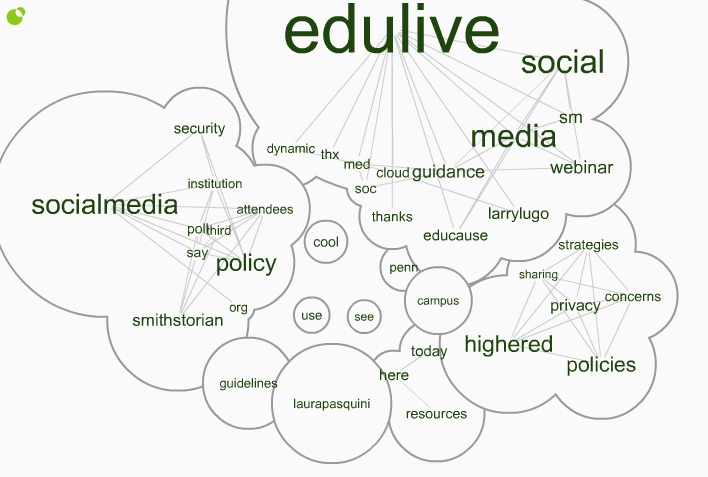
Last week, I attended the free @EDUCAUSE #EDUlive Developing Social Media Guidance in higher education with respect to #Privacy and #Security concerns. The presenters, from the University of Pennsylvania, shared ideas for how to promote safe usage of social media and detailed how to draft guidance for addressing issues in teaching, research, administrative, and other functions.
If you missed the #EDUlive event, you can check out the webinar recording and archives posted on the EDUCAUSE website, Developing Social Media Guidance, and you can also read through the Storify of #EDUlive tweets I collected.
During the webinar, I shared the Social Media: Sharing Strategies, Policies & Privacy Concerns in Higher Education open & shared Google Doc that was 1st created for a @BreakDrink Campus Tech Connection (CTCX) Show in September 2010. This document has been circulated around and curated for a while by myself and high ed professionals and faculty. Since there were a number of social media guidelines/policy examples shared during the webcast, I added them to this doc. For others interested in developing guidelines, I think there are a few solid examples I like in here, and I know that @EricStoller shared some of his favourite #SM guidelines from the list on InsideHigherEd recently as well.
Before diving into creating rules, guidelines or policies for social media, it is important to consider how this emerging technology is being used on your campus. In Chapter 6 of Social Media for Educators, Tanya Joosten (2012) shares her thoughts around institutional considerations for social media policy and practice [which we chatted with Tanya about on #CTCX Episode No. 61 as well]. There are often concerns about the use of social media at educational institutions, since these social and connected resources impact student behavior, online interactions, privacy concerns, and communication practices. When developing a social media policy, Joosten (2012) offers a few helpful suggestions for educators:
- review current technology use at your institution
- do not link policies to specific tools
- revise current student conduct and institutional policies
- use policy to address behaviors and activities, rather than focus on the technology
- learn about FERPA (or FIPPA in Canada) issues and privacy of student information at your campus
- develop best practices on campus for use by students, faculty, and support units
When thinking about the language of policy vs. guidelines, I am partial to establishing guidelines. There are probably already policies that address the actions and outcomes of student, staff, and/or faculty behavior on your campus. I think that it is important to review your home institutional policies and/or guidelines to best understand what is already being “regulated” on campus. It is also helpful to chat with your institutional office who deals with policy development, legal concerns, and/or questions you might have around privacy legislation.
Have you searched the terms “social media+policy” or “social media+guidelines” on your institutional website? Go on. See what shows up. If you find something, then start connecting and collaborating with that unit. If there is nothing to be found, then gather your peers and start the conversation.
References:
Joosten, T. (2012). Social media for educators. San Francisco, CA: Wiley/Jossey-Bass.


![#jiscwebinar What Is A MOOC? @dkernohan @mweller @jonathan_worth @loumcgill @daveowhite [visual Notes]](https://i0.wp.com/farm8.staticflickr.com/7131/7549370822_636e1260a2.jpg)

You must be logged in to post a comment.