EdTech, Learning Technologies, Professional Development

Are You Coming to #et4online in Dallas? You Should.

The Emerging Technologies for Online Learning Symposium (#et4online), hosted by the Sloan Consortium and MERLOT, is just around the corner. This 7th Annual #EdTech conference will be held in Dallas, TX from April 9-11, 2014, and based on the program you can expect a number of talented individuals to be in attendance. Registration is OPEN!

et4online

I know that the #et4online is giving you 7 Reasons Why You Should Join Us…
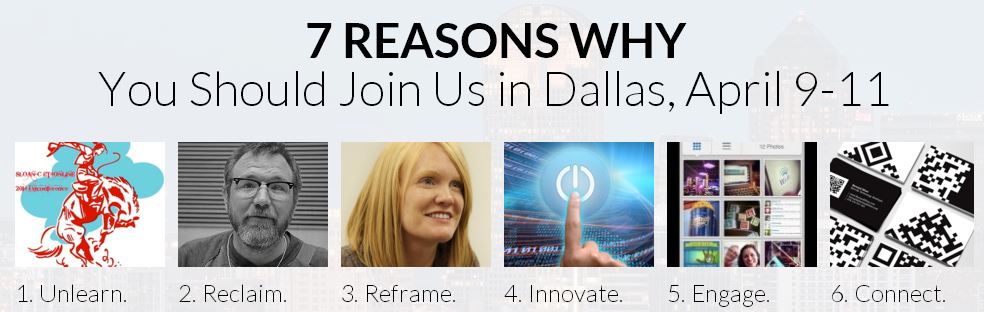
7 reasons

However I will give the reasons I am attending:

  • I get to talk about my #ugstSTORY class in terms of student development, learning design, social media applications, and my own lessons learned for instructional design.
  • Yours truly invited the Featured Sessions speakers to the conference, based on the amazing things they are working on in the field of Ed Tech and my own interest in meeting them. 🙂
  • I always learn something new from any of the interactive workshops and information sessions I have participated in.
  • You are able to order (almost) FREE MOO cards to help with your networking and such. This could also be handy as you attend the Career Forum (#edtechcareers) this year with some fantastic panelists c/o @RMoeJo
  • If you don’t know Jim Groom (@jimgroom) & his work on Reclaim Hosting – you should. He’s an #EdTech bad ass, and I look forward to his keynote.
  • The discussion, debate, & idea swapping in the Unconference is brilliant. All sessions are user-generated and led by those who attend these meetings. There is usually something for everyone, with regards to topics, and I usually leave with some interesting take-aways and things I want to work on as we wrap up the conference.
  • Last, but certainly not least… I attend #et4online because of THE PEOPLE. This conference is a fantastic meet up for a number of graduate students, early career  researchers, experienced scholars, instructors, entrepreneurs, faculty and more! From my previous #et4online experience, I have been fortunate to collaborate and connect with a number of folks beyond the conference to research, publish, and play. 

Can’t travel to the Big D? Learn more about our virtual attendee option.

Let me know if you’re heading to Dallas for the #et4online conference. If enough people are around, there could be rumours of me hosting a Texan BBQ at my homestead.  Until then, I look forward to following the banter about it on Twitter:

Hashtag: #et4online 
Handle @et4online

Higher Education, Social Media

Gathering #SocialMedia Guidelines from Higher Education #SoMe #edusomedia #highered

Grey of Social Media

When discussing social media guidance in higher education, there seems to be a lot of grey areas. Social media use is a relevant topic on many college and university campuses. Over the course of the next few months, my plan is to review social media guidelines to sort out the grey, and identify more black and white ideas about social media guidance.

To pursue my dissertation research, I am currently gathering ANY and ALL Social Media Guidelines from Higher Education Institutions from ANY and ALL COUNTRIES. If you currently attend, work, teach, or know of any a post-secondary institution that provides guidance for social media, then I need your help! Please search your institutional website for “social media” guidelines. Keep in mind, your higher education institutional “guidance” for social media may also be labeled as: guidelines, policy, tips, rules, beliefs, regulations, strategy, or take on another name. If you are aware of any websites, documents, or artifacts that guide social media in higher education, please COMPLETE THIS FORM.

 Please consider contributing to help advance social media guidance and use at our post-secondary education institutions: 

Submit a Social Media Guideline & Policy Document

The following website was created to gather and build a social media guideline database and share information about this research:

http://socialmediaguidance.wordpress.com/

If you have questions, concerns, or want to get more involved in this social media guideline project, please feel free to CONTACT ME. Thank you!

MOOC

#EDUsprint 2 – How Technology Can Change Pedagogy

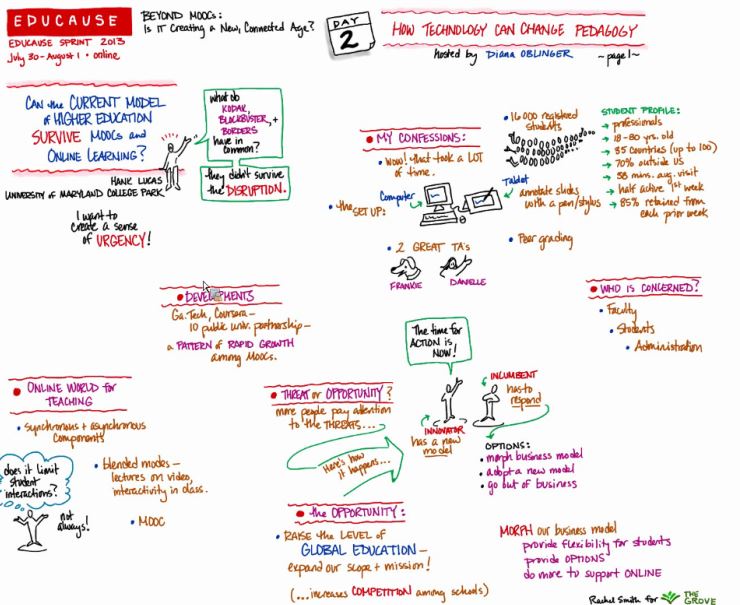
The EDUCAUSE EDU Sprints continues, so why not share what I gleaned from today’s session. With a lot of information being shared, it actually feels like more of a marathon, so here’s the breakdown from the #EDUsprint 2:  How Technology Can Change Pedagogy webinar.

How Tech Can Change Pedagogy

The session was lead by the following panelists who shared their thoughts about gong “Beyond MOOCs”:

  • Hank Lucas, Professor of Information Systems, University of Maryland College Park
  • W. Eric L. Grimson, Chancellor, MIT
  • Susan Grajek, Vice President, Data, Research, and Analytics, EDUCAUSE

Hank Lucas sees great challenges and opportunities with blended learning, online learning, and MOOCs; however he wants to charge institutions with more than the technological trends. Due to these emerging technologies and social platforms, there are many different ways to connect with our students; however we have to be purposeful and think critically about our instructional design.  

The Survivor Model via Hank Lucas

Lucas shares his concept of ‘The Survivor Model’ (screen shot of slide), that outlines how disruptive technologies will impact higher education and learning. [Side note: You will find “disrupt” on the #sxswEDU 2013 bingo card I made back in March.} The language always seems so doom and gloom, especially when asked what the “threat” for learning technology is on our campus i.e. students, adminstration or faculty. Roll the cliche…

Lucas thinks more institutions need to question where they stand with online learning, blended learning, and MOOCs, as “The schools that compete vigorously with faculty who figure out how to add value to their courses will survive and flourish.” And I would agree with one of the final points he shared:

Eric Grimson gave his 2 cents of higher education and learning technology change, which included ideas around learning techniques, active engagement, suggestions for assessment, and a “new” accronym to add to our campus alphabet soup: SPOC (small private online course)

The second segment seemed to dive into ideas and themes being played out in our schema of learning in higher education. Grimson shared ideas and suggestions to help support online learning, which included:

A number of articles were shared in the streams, so here are a selection reads from today’s webinar:

More resources for online learning, instructional design, flipping, MOOC-ing, and then some:

Unfortunately I had to dip out of this session early and I will have to catch the rest of the webinar via the recording – but here are some interesting takeaways I found on the #EDUSprint Twitter backchannel that should be noted:

MOOC, Professional Development, SocioTech

#EDUSprint 1: Beyond MOOCs – IT as a Force of Change

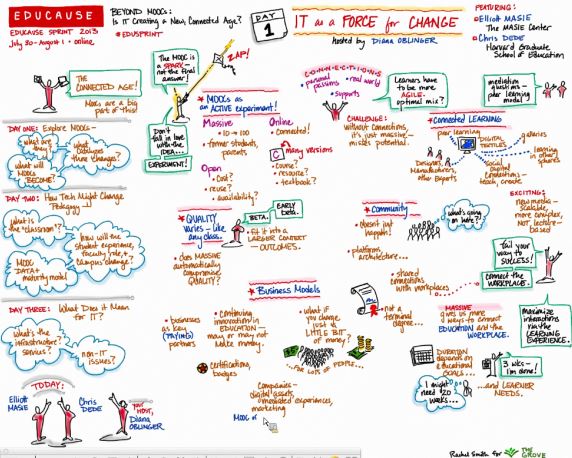
I joined today’s @EDUCAUSE 1st #EDUSprint webinar, IT as a Force of Change, discussed connected learning, technological impacts, educational models, and, of course, MOOCs. For those of us who educate, design, and research these items, not much of today’s session was new; however the speakers highlighted some interesting points and conversations around “where we are and where we need to go with higher education learning?” Today’s session was focused on framing large-scale, online learning programs – which is why MOOCs came to the forefront of the questions and discussion with the featured panel: Elliot Masie (The MASIE Center) and Chris Dede and Timothy Wirth (Learning Technologies, Harvard University). #EDUSprint 1 - Beyond MOOCs

MOOCs were called many things and labels were shared about the role of MOOCs in higher education. Here are a few words/phrases to describe MOOCs: unbundle, four letter word, innovation, change, disruption of education, learning model, same-old pedagogy, digital engagement, connected learning, revenue-maker, the future, and even an EXPERIMENT. If this is true…

In thinking about pedagogy and instructional design, I really hope we are considering the impact to our learners and subject material. Too often we go to the “shiny and new” hype for learning trends, rather than using learning outcomes to align curriculum content and assessments. Sometimes, I think our administration and educational leaders seem to miss the point…

Here are a few resources shared during the session that might be useful for those of you wanting to bone up on large-scale online learning with MOOCs:

Beyond the talk and questions about MOOCs, I thought the central thread for connected learning and meaning-making in education was strong. The fundamental question that needs to be ASKED and ANSWERED by more of our institutions was posed by Elliot.  was posed by Elliot is critical for our institutions to ASK and answer:

“How can we build a connected campus?

More information and a recording of the 1st #EDUsprint session can be found HERE, and, of course, there are a few Twitter notes from other #EDUsprint -ers for you to take a gander at… and perhaps I’ll see you in the #EDUsprint streams tomorrow…

EdTech, PhD, Professional Development, Reflections

#et4online What Happens In Vegas, Should be Blogged

Much to my surprise, my first visit to Sin City was less about the bright lights, gambling, or trouble I could cause…and more about innovative ideas and collective sharing for learning technologies. This is what happens when you attend the 6th Annual International Symposium on Emerging Technologies for Online Learning (#et4online).

Waiting for my flight to #et4online

In returning from the #et4online conference, I think that there are a number of great conversations, thoughts, and questions I am left with. So, fortunately for my readers, what happens at an #et4online conference in Las Vegas, will NOT stay in Vegas.

Here are a few #et4online conference highlights, notes & tweets (I am not alone – as I know @tjoosten does this as well):

  1. Location Location Location – Kudos for the Planet Hollywood site. Easy to get around, wifi access was great, it was the middle of the strip & close to some great restaurants, and, most importantly, Rex Manning from Empire Records looked over me while I sleep. What more could a gal want?
  2. #EdTechCareer Forum Round Tables – This was the 1st year to start this initiative; however we had a decent turn out and more importantly conversation with our facilitators @amcollier @veletsianos@tjoosten, @whitneykilgore, Kevin Grazino & Rachel Salas-Didier. Thank you to the emerging scholars and career-seekers who stopped by to talk about direction in the field, finding passion, planning for career applications, and more around the job search and career development we have in the #edtech field.
  3. Keynote: What’s That Coming Over the Hill? Digital Futures, Emerging Cultures, New Learning c/o @timbuckteeth This chat had a malay of ideas and experiences for connected learning and pedagogy. Unfortunately Steve had to return back to #PELC13 back in Plymouth, otherwise it would have been great to pick his brain about e-learning more.  Here are a few notes myself & others took via Twitter from his talk.
  4. Plenary: Seven Tales of Learning Online with Emerging Technologies with @veletsianos I like how George shared his learning experiences as a student, researcher, and instructor to help us look critically and realistically at how we are using emerging technologies in education. Here are a few collected tweets from the talk.
  5. The Launch Pad: What a great way to show case Ed Tech start ups, and provide an space in the conference to discuss how educators/developers can work together and collaborate to pilot these initiatives. It was great to connect with Lida & Scott from @Ginkgotree after our BreakDrink.com podcast last October to demo the product. Great to hang out & hopefully we’ll connect again in MI soon!
  6. Discussion & Dialogues of Education Is and Is Not – Specifically what is broken or needs to be fixed, and the reality of this statement. I appreciate how George Veletsianos engages in this more on his blog post, and chat with Amy Collier encouraged me more to think about the change, challenges, and issues being labeled in higher education and for online learning.
  7. #UNet4online: Open Space Technology – These sessions were threaded throughout the conference program and facilitated by Jennifer Ross (@jar) to encourage conversations and idea-swapping for online learning. I was able to attend one on April 10th and the final one on April 11th. I appreciated the  free space to challenge, ask questions, brainstorm, and share ideas/practices with peers. Shout out to the #unet4online tweeps: @amcollier ,@rasebastian, @veletsianos@KavuBob, @jleung81, @g4m, @johnrturnerhpt, @jar@hollyrae, @desertjul & @markjwlee who joined in on various unconference conversations. We were able to  talk about valuable ideas for learning including distributed flip educational models (not.a.MOOC),  higher education organizational design/culture, and ownership in education. Want to learn more? Check out the fantastic post on the (f)unconference from Amy Collier or my rough Google doc notes.
  8. Getting Social  – For me, this is why you attend a conference. I love connecting with others and learning how they are working with students, researching ideas, and just having some great banter. I am glad I got some quality time with @amcollier, catch up time with @tjoosten & @veletsianos, and hang time with new friends, such as @jar @dwicksspu & @kavubob. For those of you who were social [media] online – it was nice to connect via the #et4online hashtag. Let’s continue the conversation.

Screen Shot 2013-04-16 at 11.53.16 PM

Thanks to David Wicks (@dwicksspu) for inviting me to join the #et4online conference steering committee. I look forward to 2014 #et4online planning in Dallas, TX. Giddy up! For those of you who are going to Summerfest & #Blend13 – I will see you in July. 🙂