PhD, Professional Development, Reflections, SocioTech

Finding a Research “Home” with #SocioTech at #iConf13

As a College of Information student, the learning technology department compliments a number of research areas emphasized within our iSchool and at the 2013 iConference. Andrew Miller (@findandrew), Leila Mills, Mark Evans and I proudly represented UNT as one of the 12 finalists for the Social Media Expo hosted by FUSE Labs of Microsoft Research at the iConference this year. After conducting our ethnographic study on the Denton Local Food System (LFS), we submitted a research paper, video, poster, and created an online space for the LFS community to share information, house knowledge and connect to local happenings within the community at FeedDenton.org.
#iConf13 Social Media Expo Finalists
  Social Media Expo poster @ 2013 iConference (#iConf13) with @findandrew

What I enjoyed most about attending the conference was the refreshing opportunities to engage about research methodology and conceptual frameworks that apply to my scholarly interests. It felt like I was coming “home” when talking shop with various academics and graduate students during the conference. The best part might have been the pre-conference session:  Sociotechnical Systems Research workshop (#CNFWSP2). This is where I was able to connect to other #sociotech researchers, and learn more about areas of inquiry coming out of the iSchools and various disciplines.

The pre-conference was a full day of fun that housed various speakers, discussions, and sharing of directions in sociotechnical research, including

  • critical study and comparative study
  • considerations for multi-scale ethnographic research
  • artifacts that change communication in organizations
  • impacts of human and non-human delegation
  • shifts from visible to invisible networks (part of ANT)
  • organization as a constant communication
  • sustainable information practices
  • action-based research for informatics improvement
  • participation, community resilience, plurality, design

Later in the day, Steve Sawyer, conducted a master class to present various sociotechnical systems (STS) perspectives, which drew upon theories from Actor-Network to social construction. Everything is relational as new forms of social organization is occurring with new technical arrangements all around us. We talked about #sociotech in practice, specifically how to situate the phenomena (conceptual & empirical framing) and conceptualize sociotechnical systems (identify characteristics of the social, technical and interactions) by looking at this STS conceptual space mapping from Steve.

Untitled
This post is just the tip of the iceberg, as I have a number of notes, ideas, references, and research peers to turn to thanks to this workshop. I was not surprised to run into some of the #sociotech usual suspects in #iConf13 sessions such local communities, learning environments, or ethnographic studies of online communities. I appreciated the comments and dialogues brought to both the paper and notes sessions (I preferred the workshop space in the notes session better), and I am motivated to dig back into my own research and dissertation grind.

Want to read more about the 2013 iConference proceedings or connect to a few sociotechs? Here you go:


Reference:

Miller, A. J., Pasquini, L. A., Mills, L. A., & Evans, M. (2013). Towards a methodology of virtually augmenting a knowledge sharing community of practice: A case study of the local food system of Denton, Texas. iConference 2013 Proceedings (pp. 1095-1101). doi:10.9776/13527

Reflections, Social Media, StudentAffairs

#Dalton13 – Google + Interview & Keynote Teaser

Thanks so much to the Dalton Institute (@DaltonInsitute) coordinators, Jessica Dean (@j_deanSAys) & Emily Fox (@EmilyFox526), for hosting my Google + Interview on Tuesday (1/9). I appreciate the great questions from the both of them, and the #Dalton13 backchannel. Everyone really made me reflect and ponder my own technology and student development path – so thanks!


In watching the video recording (which I rarely do), it helped me think more about my talk and how to best shape the focus. Here’s a sneak peak at my #dalton13 keynote title and abstract, for those of you who will be attending the session on February 2nd:

Here is my 2013 Dalton Institute Character Clearinghouse Interview and a preview to my keynote next week:

Title: 

Student Development 2.0: Optimizing Social Media to Connect Your Campus

Abstract: Today’s college student operates in a world that is informal, networked, and filled with technology. Digital interactions are influencing both our students’ characters and values, with increasing access to information and continual contentedness  With the emergence of social web resources, student development professionals and faculty have the ability to engage in experiential and applied learning objectives for their campus environments. Social media creates a space where “everybody and anybody can share anything anywhere anytime” (Joosten, 2012, p.6). Educational paradigms are shifting to include new modes of online and collaborative learning and student-centered, active learning to challenge our students to connect curriculum with real life issues (Johnson, Adams & Cummins, 2012). As new generations of students create and share content on campus, college educators need to realize the potential social media has to construct a culture of participatory, open learning. Emerging technology platforms and devices are beginning to disrupt higher education as we know it. To co-evolve and positively impact our learners’ success, it is critical that we consider the influence and impact social media has on our student populations. This keynote plenary will share ideas and suggested practices to develop a richer learning experience to help students thrive in the changing digital frontier.

References

Johnson, L., Adams, S. & Cummins, M. (2012). The NMC Horizon Report: 2012 Higher Education Edition. Austin, TX: The New Media Consortium.

Joosten, T. (2012) Social media for educators. San Francisco: Jossey Bass.

Higher Education, Open Education

Open Access For All #oa12unt

Yesterday, I attended the 3rd Annual Open Access Symposium at UNT (#oa12unt). It was a full day of talking about open data, sharing research and collaborative efforts and examples in #highered. The open access process is not as simple as you think. It was interesting to hear from researchers, academics, librarians, industry partners, and data managers about what it means to be “open” and accessible for others. Here are a few open notes I took and a Storify I curated from the day.

I think the concluding remarks (and other notes) made by Brian Schottlaender (@ucsdBECS) helped to summarize the key points that were  both said and were not said during the day, including the following topics:

  • Data Preservation
  • Data Aggregation
  • Attribution
  • Citation
  • Publication
  • Data Ecology
  • Peer Review
  • Discovery & Delivery
  • Data Governance
  • Exhortations to Librarians

These final thoughts left me questioning about how higher education will engage in open access and consider what academic tenure/promotion will look like in the future. The open movement is present in my learning network, among the Social and Open Educators like @courosa and academic contributors who want to End Knowledge Cartels in publication such as @academicdave, There are many open and transparent academics/educators contributing to the open movement – but there needs to be more. And more importantly, academic institutions need to recognize and accept open scholarship.

I know the #oa12unt symposium lit the fire for me to finish the layout and publish the first issue of the Learning and Performance Quarterly. This student-lead, open access  journal is an open access publication that I am proud to edit and coordinate with a phenomenal group of reviewers and a great editorial team. The inaugural issue was JUST published online today, and is available for your reading and sharing pleasure HERE.

What have you done openly lately in #highered? Please share.

Collaboration, nacada, NACADA Tech, Professional Development, web 2.0

NACADA Region 8 Technology Seminar

Kudos to Eric Stoller for kicking of 2010 with NACADA Region 8 Technology Seminar in Seattle, WA. It’s been a while since the 1st #NACADAtech seminar, and it was good to be part of the technology in advising action.

Eric asked if I would like to contribute, and I gladly wanted to join in the fun. Last Sunday, I presented (virtually) a session for academic advisors interested in  collaborating with wikis. Skype’s screen sharing application made getting involved in this session cost-effective and simple. 🙂

There was a lot of information packed into this day & 1/2 seminar, but I could tell by the Twitter feed & comments in the session that many ideas were sparked & I could tell the wheels were spinning. It’s great to connect with other advisors to get some inspiration and share thoughts about best technological practices for the advising profession.

Conference, Professional Development

Tech Trends from Educause 09

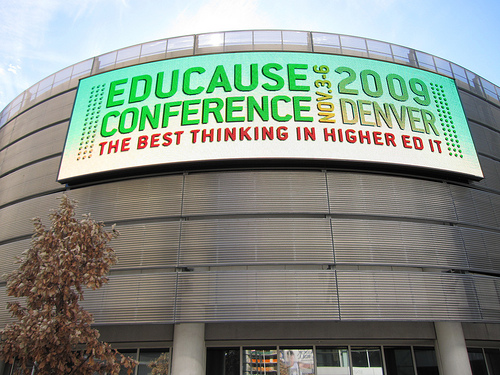
The Chronicle’s Wired Campus released a short video clip about the buzz from the  Educause Conference 09 in Denver, CO. A few attendees were asked about what they thought the top technological trends in higher education & also their concerns at the conference:

4072038913_5f54d15628

Picture c/o educausestaff on Flickr.

Trends:

  • Web 2.0
  • Virtualization
  • Cloud Computing
  • Social Networking
  • Mobile Learning
  • ePortfolios

Concerns:

  • Open Access
  • Transformational Course Management Systems
  • Security Concerns
  • Finances
  • Learners’ Needs
  • Keeping track of connections made at the conference

Whether you’re at the Educause 09 conference or following from afar, you can stay connected to the diolage on Twitter (hashtag #EDUCAUSE09), Flickr, & via the streaming of select conference content online.