#AcWri, OpenAccess

SPARC Addendum & Author Rights for Publishing #OpenAccess

As part of the international open access week last fall, I attended the #SPARC Addendums and Author Rights Workshop facilitated by Kris Helge from the UNT Libraries. As an author and editor for a journal, this session reminded me about the critical stakeholders and expectations for the scholarly publishing process and the need to consider my own author agreements before signing away my work. I am fortunate enough to work and study at an institution who supports Open Access,and #OpenAccess publications.

I am also excited that other academic journals (e.g. JALN) are joining the #OA movement; however there are a number of peer-reviewed, academic publications who hold traditional publisher agreements and copyright limitations close to their heart. If you are an academic, scholarly author, or early career researcher and you have NOT heard about SPARC … then this blog post is for you!

mainheader

After a brief review of copyrights and “traditional publishing agreements,” the workshop reminded me about of the importance of reading author agreements CAREFULLY and THOROUGHLY. A number of authors and early career researchers are just excited to get the chance to publish, that they rarely considering they are agreeing to transfer ALL OF THEIR COPYRIGHTS TO THE PUBLISHER. As researchers, we need to value our intellectual property and have a conversation with the publisher and inquire if any of the publishing agreement is negotiable.

Cue the SPARC Addendum

SPARC. or the Scholarly Publishing and Academic Resources Coalition, advocates for collaboration among authors, publishers, and libraries to correct imbalances found in the academic publishing system.

For a more balanced approach for author and publisher agreements you might want to consider the SPARC Addendum. This is a FREE, legal document that modifies the publisher’s agreement and allows authors to keep specific copyrights related to intellectual property (e.g. articles).  The author is able to retain their desired publishing rights with limited restrictions, and the publisher retains non-exclusive rights to publish and distribute your work. Overall, it allows authors to consider the access of their research, placement of writing into an electronic repository, and get the proper attribution when your work is utilized.

Want to know more about SPARC and #OpenAccess publishing resources? Check them out :


Reference:

Helge, K. (2012, October 24). SPARC Addendums and Author Rights Workshop. 2012 International Open Access Week @ UNT.

LPQ

Published: Learning and Performance Quarterly 1(3)

The third issue of the Learning and Performance Quarterly (LPQ) speaks to the area of facilitation, teams and mobile support systems. This issue discusses theoretical building blocks for researchers that have a renewed interest in teams and their support. The reemergence of this area of study is important as we move further into the age of social media, personal learning networks and global information exchange. Thank you to our authors, editors, and peer reviewers for their contributions to the Learning and Performance Quarterly, Volume 1, Issue 3.

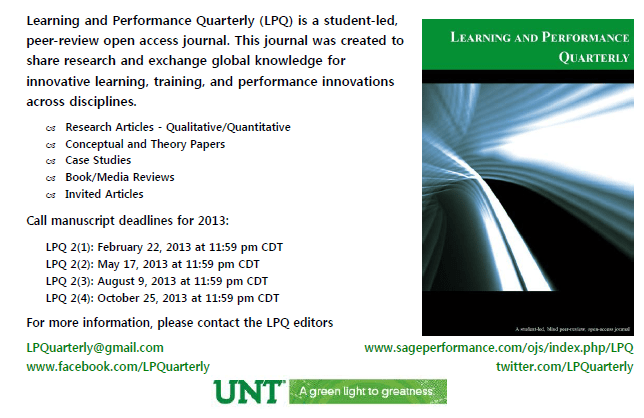
The Learning and Performance Quarterly (LPQ) is an online, open access peer-review journal designed to make research available to the public and to support a greater exchange of global knowledge. The call for submissions for 2013 is now open – here are the deadlines for manuscripts for Volume 2:

Submission can be made online through the LP Quarterly website. For detailed submission guidelines and instructions on how to make a submission please visit Author Guidelines.

Happy reading,

Laura A. Pasquini & Dr. Jeff Allen, Founding Editors
Learning and Performance Quarterly
Like us on Facebook
Follow us on Twitter @LPQuarterly
Email: LPquarterly@gmail.com

#AcWri, #phdchat

Reasons to #AcWri and Writing Considerations

For tonight’s class (yay for Fridays!) I will be sharing the basic concepts from Rocco and Hatcher’s (2011) publication – The Handbook of Scholarly Writing and Publication – as I outline chapter 1. This book was part of my #summerreading list. I picked it up to read advance for ATTD 6480: Research Methods class, and consider how to hone my own writing and publishing practice. Much of this book offers basic ideas and structure for suggested scholarly writing practices. Stay tuned, as I am sure that I will share a few other nuggets of #AcWri tips from time to
time.

Here are some basic writing tips from Chapter 1:

  • Make projects from opportunities
  • Meet deadlines – yours and others
  • Keep your commitments
  • Organize & prioritize your projects => To Do lists & Tracking of Your Work
  • Write down ideas – ALWAYS
  • Outline your writing projects in progress
  • Take notes when you read/research
  • Identify at least ONE journal to submit to
  • Review journal articles where you want to submit
  • Learn the style & preferred manuscript structure
  • Rejection = helpful review comments & suggestions

Reference:

Rocco, T.S. & Hatcher, T. (2011). The handbook of scholarly writing and publishing. San Francisco: Wiley/Jossey-Bass.

LPQ

CFP: The @LPQuarterly Volume 1, Issue 4 EXTENDED: DUE November 5, 2012

The Learning and Performance Quarterly (LPQ) is an online, open access peer-review journal designed to make research available to the public and to support a greater exchange of global knowledge. We have recently been invited to publish in the EBSCO research database, and our publication is growing both in author contributions and readership. Articles in support of innovative learning and performance across disciplines from developing and proven scholars are welcome for the last call for 2012 – here is the more information about the call for manuscripts.

CALL FOR SUBMISSIONS:
Learning and Performance Quarterly, Volume 1, Issue 4

The Learning and Performance Quarterly (LPQ) is currently accepting submissions for the second issue. Deadline for submissions is Friday, October 26 at 5 pm CDT. DEADLINE EXTENDED to Monday, November 5, 2012 at 11:59 CDT. Submission of manuscripts can be made online through the LP Quarterly website. For detailed submission guidelines and instructions on how to make a submission please visit Author Guidelines.


TYPES OF MANUSCRIPTS ACCEPTED
Research Articles :
Papers that are concerned with the various approaches to learning and performance impact. These papers should discuss the literature related to the approach employed and include a measure of the learning and performance impact of the approach employed.

Case Studies:
Case studies that highlight a particular learning, training, performance or instructional setting in which learning and performance resources were used to address a particular challenge. They present a discussion of the challenge from current literature, what was done to solve or explore it, and the results of the project. They often offer suggestions for others interested in addressing similar challenges.

Concept/Theory Papers:
Papers that present new concepts or contribute to existing theory for learning and performance. This should offer a discussion of the literature related to the concept/theory along with a discussion of the major issues for future research needed to validate the concept/theory.

Book Reviews:
Book reviews of publications 2011 or later will be accepted to highlight a issues and resources relevant for learning and performance and offer a suggested solution or direction. The position is supported with both a logical argument and a review of the pertinent literature. Preference will be given in the review process to book review essays that comment on two or more related books.  Book review essays should not exceed 3,800 words and should include city, state, publisher, and year of the book’s publication.  An abstract of 150 words or less and keywords are required for book review essays.  Reviews of single books should not exceed 1,900 words.  At the beginning of the text please include title, author, publisher, city, date, and page numbers of the book(s) under review.

CALL FOR LEARNING AND PERFORMANCE QUARTERLY REVIEWERS
Interested in reviewing articles for the LPQ Journal? The LPQ journal is looking for reviewers to conduct peer reviews and evaluations of submissions.
Please identify your reviewing interests, substantive areas of expertise, and preferred research methods when completing the LPQ journal registration online.

We look forward to receiving your submissions. Please pass this post onto other colleagues and researchers who might be interested in publishing, reviewing or editing for the Learning and Performance Quarterly journal.

Thank you,

Laura Pasquini & Dr. Jeff Allen, Founding Editors
Learning and Performance Quarterly
Like us on Facebook
Follow us on Twitter @LPQuarterly
Email: LPquarterly@gmail.com

#AcWri, LPQ

Learning and Performance Quarterly, 1(2) is Published

As the founding student editor for the Learning and Performance Quarterly, an open, online peer reviewed journal, I am excited to share with you the second issue. This publication has an eclectic mix of ideas and research for a wide array of academic disciplines in the learning, training, development and performance industries. As, indicated in my editorial, I think that there is great value to be shared outside of our professional silos.
I hope that you enjoy reading this issue as much as I did during the production phase. There are a number of concepts and resources shared within these articles for professionals in education, instruction, leadership planning, and training and development. Many thanks to the contributing authors, peer reviewers and section editors who made great efforts to produce this publication over the summer months. I appreciate the attention to details and edits during the summer months.

For those who want to contribute, review, or follow along — be sure to check out the LPQ Website, Follow @LPQuarterly on Twitter, or “Like” the LPQuarterly on Facebook. We are always interested in adding to our repertoire of peer reviewers and editors – please register for the LPQ journal and let us know how you would like to contribute to this open, scholarly publication.

Here is the Learning and Performance QuarterlyVol 1, No 2 (2012) — Table of Contents and Abstracts for the current journal contributions.

Editorial
Leadership, Training, Mentoring, and Instructional Design (1) [PDF]
Laura A. Pasquini

Abstract: The second issue of the Learning and Performance Quarterly (LPQ) is filled with submissions that span a wide scope of interests.

Case Studies
Developing a student leadership retreat using instructional design
techniques (2-29) [PDF]
Dr. Melissa L. Johnson

Abstract: The purpose of this paper is to describe how the Morrison, Ross, and Kemp (2007) instructional design model was used to design a student leadership retreat. An overview of instructional design and the Morrison, et al. model is provided. The application of the model to designing the retreat is then described in detail, including the learner and task analysis, development of instructional objectives, sequencing and materials, and formative evaluation. Finally, the implementation of the actual retreat, including summative evaluation procedures is provided.
Research Articles
Mentoring and Middle School Teachers: Using Subjective Affective Measures as
Performance Indicators (30-46) [PDF]
Dr. Ray K. Haynes

Abstract: This paper presents findings from a research study examining mentoring, organizational commitment, work alienation, and job satisfaction, among middle school teachers (n = 352) in large urban school district. Survey data obtained using a quantitative research design suggest that  formal and informal mentoring is occurring within middle schools and middle school teachers perceive both types of mentoring to be effective. Results of regression analyses suggest that ratings of formal mentoring effectiveness had stronger relationships to organizational commitment, work alienation, and job satisfaction than effectiveness ratings of informal mentoring.   Further analysis suggests that the predictor variable, as measured by ratings of mentoring (formal /informal) effectiveness, had statistically significant positive associations with the mediator and dependent variables. Implications are discussed along with suggestions for future research.

Concept/Theory Paper
Cross cultural training and success versus failure of expatriates (47-62) [PDF]
Ashwini Esther Joshua-Gojer
Abstract: The past few decades has seen an explosion in research on expatriates and cross-cultural training. There has been controversy and an unending debate on the goals, effectiveness, implementation and processes of CCT. There are very few reviews that have condensed literature detailing the best practices of CCT. This review also details the success and failure of expatriates. The antecedents or moderators that play a role in the evaluation of success and failure have been outlined in this literature review. It also brings to light certain solutions that will make CCT more effective and provides directions for future research.

Creative Leadership: Does It Clash Across Cultures? (63-82) [PDF]
Seogjoo Hwang
Abstract: As international competition, technology advancement, and the knowledge-based economy increases, creativity is becoming increasingly critical for the success of organizations all around the world. While leadership or support of individuals’ immediate leaders is one of the most potent factors impacting individual creativity, the majority of previous studies examining the relationship between leadership and creativity were conducted in Western contexts and only few studies investigated the cross-cultural aspects of leadership and creativity.

This study explores the connection between traditional creativity research and cross-cultural leadership research, building toward a conceptual framework proposed for further discussion and ultimately testing. Conceptual links between participative leader behaviors, individualism-collectivism, power distance, and creativity are examined. Implications for leadership development in order to enhance organizational creativity in an international HRD context bring this article to a close.

Book Review
Social Media for Educators (83-84) [PDF]
Laura A. Pasquini

Abstract: Social Media for Educators is an excellent book that interweaves theory, applications, and current pedagogical experiences for learning environments. For those in the learning and performance industry, this book provides insights and ideas to help guide social media use for both educators and learners. Joosten provides current examples, benefits, and considerations throughout each chapter. Whether educators are beginning to design their learning curriculum or learners are considering social media for organizational development, this book presents helpful insights and experiences that will potentially influence and shape effective engagement and learning with social media.