#3Wedu

The @3Wedu Podcast No. 5: Men Who Support Women in Higher Ed #3Wedu

26998029442_01d77790da_oAn article from the Harvard Business Review discussed how so many incompetent men become leaders and shared that:

female managers are more likely to elicit respect and pride from their followers, communicate their vision effectively, empower and mentor subordinates, and approach problem-solving in a more flexible and creative way (all characteristics of “transformational leadership”), as well as fairly reward direct reports.

Women’s path to leadership positions are paved with many barriers including a very thick glass ceiling. But what we have NOT discussed, on the #3Wedu podcast, is that there ARE a growing number of men in higher ed who ARE attempting to remove these career obstacles.

Today (5/18) on the @3Wedu Podcast we will chat about the Men Who Support Women in Higher Ed, specifically the male advocates, mentors, support, and more we have had in our careers.  Please join us here for the LIVE broadcast, hosted in Niagara Falls, Canada at 3 pm PST // 5 pm CDT // 6pm EST:

UPDATED: Here is the Google+ ON AIR Event Page where for the live event to post comments, our Google Doc for show notes http://bit.ly/3Wedu5 and share YOUR own experiences and thoughts about today’s topic.  Of course, the podcast hashtag: #3Wedu for those who tweet along the backchannel, and you can now follow the @3Wedu Twitter Account as well! Here are ALL THE TWEETS shared during the show tonight.

If you are interested in staying connected to be up-to-date on the monthly WomenWhoWine.edu (#3Wedu) podcast and other events — just  let us know!  Please complete the following #3Wedu Podcast Community Google Form

#AcDigID, #AcWri, #phdchat, Academia, Higher Education, networkedscholar

#AcDigID: Academic Digital Identity Matters

Over the last few weeks, you might have noticed the #AcDigID hanging off a few of my social posts. In between #OLCInnovate conference wrap-up work and the end-of-semester fun, I was designing a new workshop I’ll be facilitating via the Online Learning Consortium. This 7-day, asynchronous, online workshop is designed to support digital identity development for faculty and staff in higher education.

#AcDigID_hashtag

Developing Your Social Media and Digital Presence

Workshop Description: What does your online identity look like today? Have you Googled yourself lately? In academia, it is becoming increasingly vital to publish and share your teaching, service, and research knowledge. Besides developing an online presence and utilizing social media for professional development, faculty and staff are actively utilizing open and digital channels to support, learn, and contribute a thriving network of connected scholars. In this workshop, you will explore meaningful ways to craft an active, online persona, learn about strategies to effectively include social media and digital resources for your professional development, and understand how an online community of practice can enhance the work you do.

Learning Objectives:

  • Evaluate social media and digital platforms for faculty professional development, connected learning, and research impact.
  • Establish effective strategies for developing an online digital identity for open, networked scholarship.
  • Outline the benefits and challenges of open and digital scholarship while using social

Dates Offered: May 16-22, 2016 and September 26-October 2, 2016; Registration Page (if interested in signing up)

Initially, I was asked to create a workshop around social media; however I thought this could be more. There’s actually a lot more than just social media needed when becoming a networked scholar and in crafting your digital persona. Academic social networks are on the rise and there are a number of reasons why scholars use social media and digital resources (Van Noorden, 2014). This is an important topic we to talk about with our peers in higher ed, as we are all public intellectuals now – at least in some shape or form.

If you have ever attended a webinar and/or concurrent session with me on the topic, there’s way too much to share in just 45-60 minutes – so I was thrilled to think about these issues in an extended format and to figure out how to best support academics interested in building their digital presence. It’s been fun planning this workshop, as it has made me return back to my blog archive, review the articles I have curated, visit texts I’ve read, and also pick up a couple of new ones to learn more (future blog posts to review these books soon!).

Here’s the outline for the #AcDigID workshop this coming week:

  • Why Does Social & Digital Identity Matter in Academia?
    • Getting started, digital identity development, and state of scholars online
  • The Tools of the Digital Academic Trade: Social Media
    • Twitter, hashtags, blogging, podcasting, LinkedIn, and more!
  • Being a Connected and Digital Scholar
    • Digital research impact and influence, ORCID iD, academic social networks designed for scholars, and measuring impact.
  • Openness in Academia: Benefits & Challenges
    • Being open in higher education, the tension between challenges and affordances of online, and experiences from networked scholars.
  • Building Your Social and Digital Presence Online
    • Creating your own space and place for scholarship (at least 3 platforms)
  • Developing Your Digital Academic Identity
    • Bonus: ways to aggregate and showcase your digital/social profiles

I am looking forward to sharing ideas and strategies for digital scholarship and identity online this week in the #AcDigID workshop. I don’t claim to know all, and I continue to learn – however I will say I am grateful for those networked scholars who have supported my digital developing along the way. That being said, I know some of you might have suggestions, experiences, stories, and more when it comes to academic digital identity development. I welcome this. If you are or have been a higher education faculty/staff who is/was on social media, academic networking sites, or just online – please consider giving some advice to my #AcDigID workshop participants.

#AcDigID ADVICE and RESOURCES WANTED for how you share your teaching, service, and research scholarship online:

  • ADD TO THE LIST: to my “Academics Who Tweet” Twitter list? I would like to get a variety of scholars from all disciplines and areas in higher education. Let me know if YOU or someone else should be added.
  • SUGGEST A HASHTAG: Do you follow a particular academic hashtag that my #AcDigID community should know about?

//platform.twitter.com/widgets.js

  • TELL YOUR #AcDigID STORY: Interested in coming to talk about your #AcDigID development? How did you become a networked scholar? Want to share your issues, challenges or affordances for your academic online self? Let me know – happy to have you during a synchronous, online meeting.
  • JOIN THE #AcDigID TWITTER CHAT: Join us for the live Twitter chat this coming Friday, May 20 from 1-2 pm EST – We will, of course, use the #AcDigID to ask questions and discuss the issues, challenges, and affordances of being a scholar online.

//platform.twitter.com/widgets.js

  • USE the #AcDigID HASHTAG this week to introduce yourself, say hello, share resources, or offer advice.

Reference:

Van Noorden, R. (2014). Online collaboration: Scientists and the social network. Nature, 512(7513), 126-129.

#OLCInnovate, Learning Technologies, Reflections

The #OLCinnovateSDS: Our Re-Cap of the Plan, Design, & Pitch at OLC Innovate 2016

The inaugural OLC Innovate (#OLCInnovate) conference brought over a thousand educators, EdTech-innovators, and learning designers to New Orleans. This year was the inaugural Solution Design Summit (SDS) in which diverse teams of institutional stakeholders, campus partners, and EdTech innovators came together to solve learning challenges. Nine teams were selected to participate in the summit and pitch their learning solutions.

About the Solution Design Summit

Following OLC Emerging Technologies conference (2015) ideas from the “Teacher Tank,” we wanted to know, “How can we use the pitch format to design a solutions-based space for teams to work on solving a learning problem?” What resulted was the 2016 Solution Design Summit.

The SDS call for team proposals required participants to submit a learning challenge and a proposed solution to be worked on by an interdisciplinary team. The nine selected SDS teams then produced a 2-minute video trailer to describe their project. You can watch the 2016 SDS Video Trailers on YouTube or review the full SDS program here: http://bit.ly/olcinnovatesds16

Design Thinking Is A Process

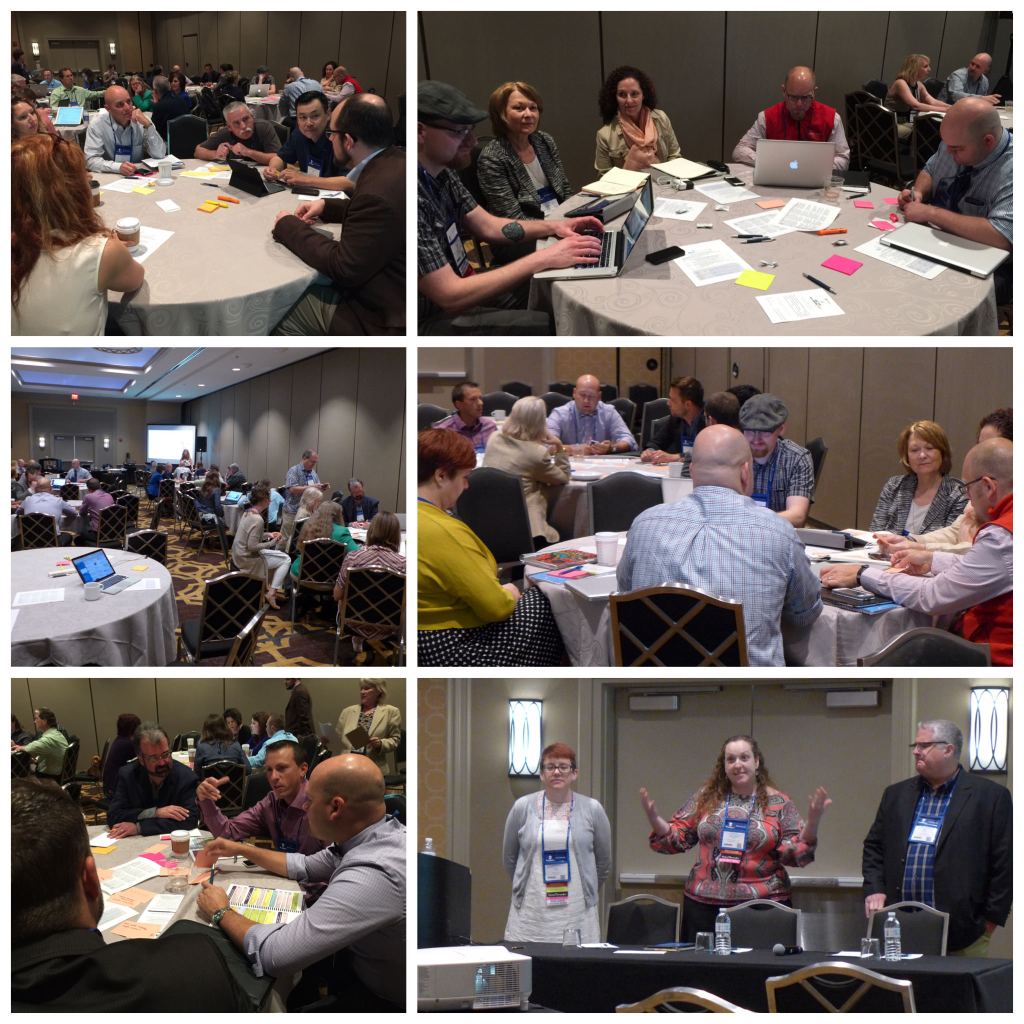
During the Summit, a 3-hour pre-conference working session, the teams identified critical success factors for their learning solutions, gathered feedback from external stakeholders, and used design thinking to refine their “pitch” presentations. During the #OLCInnovate conference, teams delivered their 10-minute pitches in one of three concurrent sessions. The SDS pitches were evaluated by a panel of invited judges and audience participants.
OLCinnovateSDS_2016_Montage

The SDS challenges

The Solution Design Summit asked teams to work on increasing learner success in one of the following four areas: personal and adaptive learning; professional learning and development; the impact of open learning; or choose your own learning challenge.

Listed below are the nine SDS teams. Click on any of the titles to find out about each SDS team’s challenge and solution:

And the Winners are…

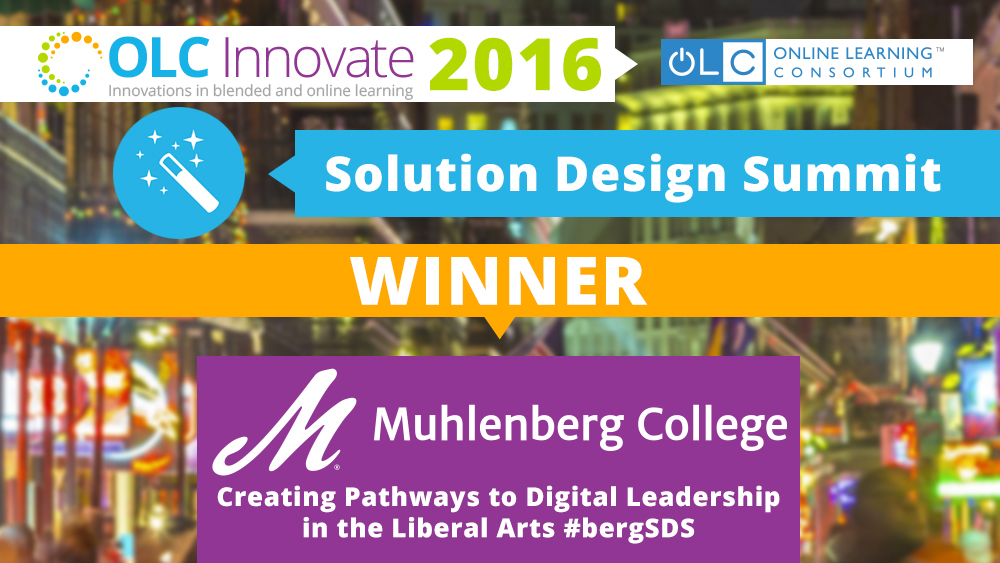
The 2016 SOLUTION DESIGN SUMMIT WINNING TEAM is . . .
OLCSDSWinner

Image mashup c/o Tony Dalton from the SDS Muhlenberg College Team

Creating Pathways to Digital Peer Leadership in the Liberal Arts

Team members:  

  • Lora Taub-Pervizpour, Associate Dean for Digital Learning, Professor of Media & Communication at Muhlenberg College
  • Kathy Harring, Dean of Institutional Assessment & Academic Planning, Professor of Psychology at Muhlenberg College
  • Sean Miller, Manager of Media Services at Muhlenberg College
  • Thomas Sciarrino, Manager of Instructional Technology and Digital Learning at Muhlenberg College
  • Anthony Dalton, Digital Cultures Media Technician, Digital Media Design Lab Instructor at Muhlenberg College

Summary: Like many liberal arts institutions, Muhlenberg College is exploring the role of the digital in our mission, goals, and practices.  We believe that digital spaces, pedagogical practices, and tools can amplify our liberal arts mission and values, and support deep relationships between teaching and learning, appreciation for diverse ways of knowing, and an education that prepares students for citizenship and lifelong learning. At the heart of our student-centered environment is a nationally recognized peer-mentor model.  Our goal is to create an innovative peer education model that empowers students to develop the relationships, skills, and competencies the need to excel as leaders in digital learning contexts.

Kudos to the COMMUNITY CHOICE award for….

If You Build It, Will They Come?

Team members:  

  • Tracy Stuntz, Instructional designer, lead LMS trainer at California State University, Fresno
  • Jean-Marie Venturini, Instructional designer, lead LMS trainer at Otis School of Art and Design
  • Rex Bartholomew, New Model Development Administrator at Toyota

Summary: The challenge we’re facing is faculty/client attendance at non-mandatory (but needed) training events is low. The focus is on reasons for faculty/client lack of attendance, and how to reach and motivate participants.

Thank You To All Who Played In the Solution Design Sandbox!

A big thank you to the invited stakeholders, judges, audience members, and the SDS planning team who supported this program. Kudos to ALL the SDS teams for your amazing pitch presentations! By asking teams to work on a solution before meeting together and then creating iterations of their work, we know that this type of conference project proposal was not simple. We hope each team received valuable input, feedback, and considerations to bring to their institutions and companies. This was the first year of the Solution Design Summit, and we hope to see a similar track at OLC Innovate 2017 and anywhere educators, designers, and ed tech innovators gather at a conference.

Thanks and much love from the #OLCInnovateSDS: 2016 SDS Planning Team,

#3Wedu, OLC, Podcast, Reflections

#3Wedu Podcast #4: Women Who Innovate in Higher Ed [#OLCInnovate Recap of Session]

Last week, I was fortunate to meet up with a number of friends and colleagues at OLC Innovate (#OLCInnovate if you’ve been learning from the backchannel) in New Orleans. There’s a great deal I have to reflect upon about my conference experience; however that will be saved for later. What I do hope to share a bit about is the Conversations that Work session on Women Who Innovate in Higher Education: Challenges & Strategies. During this session, we hosted a few small-group discussions prompted by questions we shared: http://bit.ly/olcinnovate3Wedu16

//platform.twitter.com/widgets.js

For those of you who joined the 45-minute conversation, THANK YOU. By starting and continuing the conversations, I think we have already left this gathering  with more solutions than challenges for women in higher education.  These round-table conversations were great! I was fortunate to facilitate one of the 6 tables/circles who shared insights and experiences of women in higher ed. I appreciate the openness and thoughtfulness shared by the participants — specifically with regards to sharing challenges and suggestions to move more ladies forward at our institutions and within the field.  To be fully engaged in the conversation, I jotted down some notes pen-to-paper style. Here are a few highlights I can translate from my scribble, which might be interesting to dig into tomorrow (4/27) or in future #3Wedu podcasts: 

  • Education qualifications & Work Experiences: Do women require a Ph.D. vs. men who only have a masters degree? Or do women believe they have to “do more” to prove ourselves? This might include additional work experience(s), degrees, skills, etc.
  • Image of Women Leaders: The concept of “friendly” or a certain image is required by female leaders — this includes image, dress, language, and management style. Or do women take on “masculine characteristics” to lead and move up the career ladder – is this required? Expected?
  • Role on a Team: As a team member are their certain expectations of self and others? Are more women motivated and/or empowered by male vs. female supervisors? What aspect does culture at an institution play on this team environment?
  • Mentoring: Do we have enough time or make enough time to mentor other women in the field? It is important that we see strong female leaders, and also their vulnerabilities (i.e. the holistic view of the leader)
  • Work-Life Balance: Is this part of the institutional/organizational culture? How can this change? Organizational decision-making is relevant to improving and supporting a healthy balance of work in various roles and positions held by women.
  • Geography & Transitions for Career Advancement: Are women less portable to move or relocate? Do we have to move (geographically or to another institution) to move up in higher education? Is this a choice vs. a sacrifice? Are positions more flexible for men vs. women, in terms of promotion or advancement? Discussions on this topic included making geographic or career transitions based on life milestones, children, career development, negotiation with a partner for career planning, etc.
  • Solutions to Challenges — How can we improve women’s status in higher education?: Continue these conversations, continue to build our network of peers, consider restriction for communication (email, text, etc.) to encourage a work-life balance, consider looking at formal or informal policies that create barriers for women, think about opportunities to empower female colleagues on campus, movement needs to be asserted not just from female leaders, create “safe” spaces for women to speak up or out about challenges, and review how your institution embraces diversity within the organization or the division/unit/department considers the role of women.

Here is the challenge we left session participants with:

What can you do when you return back home to your institution after the conference? What is one thing you will work on to support and/or empower women within your campus community?

Above is the recording from this past Wednesday, April 27th @ 3 pm PST // 5 pm CDT // 6pm EST as we recap our experiences from #OLCInnovate. Here is the Google+ ON AIR Event Page where you can tune in LIVE or post comments, our Google Doc for show notes http://bit.ly/3Wedu4 and YOUR #OLCInnovate reflections (please add), and, of course, the podcast hashtag: #3Wedu for those who tweet along the backchannel. Here are the #3Wedu Twitter discussions from curated from #OLCInnovate in NOLA & our 4th podcast.

If you are interested in staying connected to be up-to-date on the monthly WomenWhoWine.edu (#3Wedu) podcast and other events — just  let us know!  Please complete the following #3Wedu Podcast Community Google Form

#OLCInnovate, Conference, Higher Education, K-12, Learning, Learning Technologies, OLC, Online Learning

Feedback Wanted: #OLCInnovate Solution Design Summit Video Trailers

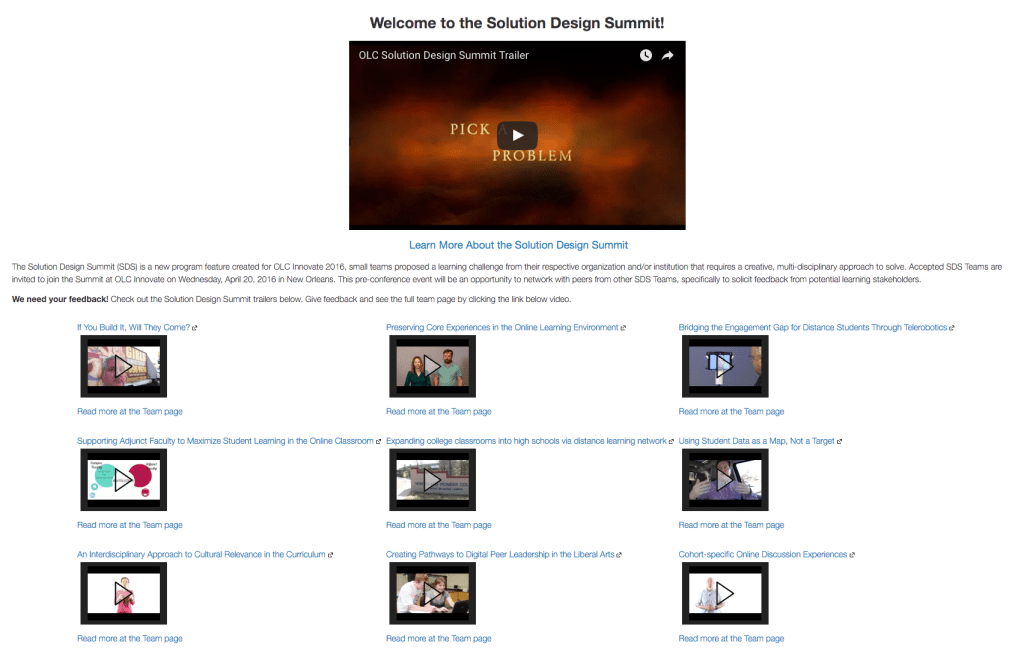
You may have read my previous CFP post looking for learning challenges & solutions – that was for the NEW program feature of #OLCInnovate, The Solution Design Summit (SDS). Nine SDS teams, who proposed a learning issue with a potential solution, have been selected by a blind, peer-review panel to be our finalists who will participate in our 1st Summit  at the 2016 OLC Innovate conference in NOLA. This pre-conference event will be an opportunity to network with peers from other SDS Teams, specifically to solicit feedback from potential learning stakeholders.

SDS_Teams_2016

VIEW THE SDS TEAM VIDEO TRAILERS

 Learn More About the Solution Design Summit

Now the SDS Teams need YOUR feedback!

Please WATCH the Solution Design Summit trailers on the #OLCInnovate Sandbox (a Canvas LMS site) for the conference. To join this Canvas site, click the “Enroll” button at the top of the page or enroll HERE https://canvas.instructure.com/enroll/MGEHMW  

To effectively COMMENT and provide FEEDBACK, our SDS Planning Team has developed  Guidelines for Solution Design Summit: Giving Feedback to Teams Please find all 9 videos and SDS Team pages HERE to do such things. You can READ the full proposal and learn more about these learning solutions by clicking on the “Read more at the Team page” links below.

If You Build It, Will They Come?

Read more at the Team page

Preserving Core Experiences in the Online Learning Environment

Read more at the Team page

Bridging the Engagement Gap for Distance Students Through Telerobotics

Read more at the Team page

Supporting Adjunct Faculty to Maximize Student Learning in the Online Classroom

Read more at the Team page

Expanding college classrooms into high schools via distance learning network

Read more at the Team page

Using Student Data as a Map, Not a Target

Read more at the Team page

An Interdisciplinary Approach to Cultural Relevance in the Curriculum

Read more at the Team page

Creating Pathways to Digital Peer Leadership in the Liberal Arts

Read more at the Team page

Cohort-specific Online Discussion Experiences

Read more at the Team page

Are you coming to #OLCInnovate? You should also plan to come to SDS Pitch Sessions during the Conference all hosted in Rhythms II Room of the New Orleans Sheraton Hotel. Three SDS Teams will pitch their learning challenge and solution during ONE (1) concurrent session in just 10-minutes. Audience members will be given 5 minutes for Q & A and then encouraged to cast their vote for the best solution design.

Thursday,

April 21, 2016

11:15 am-12:00 pm 1. Cohort-specific Online Discussion Experiences

2. Expanding College Classrooms into High Schools via Distance Learning Networks

3. Bridging the Engagement Gap for Distance Students Through Telerobotics

Friday,

April 22, 2016

9:45 am -10:30 am 1. If You Build It, Will They Come?

2. Supporting Adjunct Faculty to Maximize Student Learning in the Online Classroom

3. An Interdisciplinary Approach to Cultural Relevance in the Curriculum

Friday,

April 22, 2016

11:15 am -12:00 pm 1. Preserving Core Experiences in the Online Learning Environment

2. Using Student Data as a Map, Not a Target

3. Creating Pathways to Digital Peer Leadership in the Liberal Arts

Thanks for your support! Much love from the #OLCInnovate 2016 SDS Planning Team:

  • Mike Goudzwaard, Dartmouth College, @mgoudz (Co-Chair)
  • Laura Pasquini, University of North Texas, @laurapassquini (Co-Chair)
  • Patrice Torcivia, Cornell University, @profpatrice
  • Kyle Johnson, Chaminade University, @kyleejohnson
  • Michael Atkisson, Brigham Young University, @mikeatkisson
  • Adam Croom, University of Oklahoma @acroom
  • Allison Dulin Salisbury – EdSurge @amdulin  (Reviewer)
  • Sean Michael Morris – Hybrid Pedagogy, @slamteacher (Advisor)