Higher Education, Networked Community, Podcast, Professional Development, Research, StudentAffairs, Training & Development

Where’s Your Digital “Water Cooler” for Professional Development?

Social media has afforded a number of educators (both in higher ed and K-12) a space and place to share, learn, curate, and connect.  If you look online, you will find no shortage of educational hashtags, podcasts, blogs, Twitter chats, online groups, and more. These user-driven, digital communities are thriving as teachers, faculty, staff, and students seek out professional development virtually. It makes sense as social media PD is on-demand, socially integrated, accessible from a variety of devices, portable, and FREE!

Image c/o Killer Infographics (https://vimeo.com/89969554)
Image c/o Killer Infographics https://vimeo.com/89969554

Last week, I shared how our networked communities are a bit like a digital water cool for PD on Vicki Davis’ (@coolcatteacher) 10-Minute Teacher Podcast, episode no. 19: Social Media PD Best Practices #DLDay (or Listen on iTunes). Check out the wealth of resources from Vicki, that definitely spills past K-12 education sphere:

cropped-the-cool-cat-teacher-blog

In looking at these social media spaces, both for research and practice, I am grateful for the learning, support, and care I have received from my peers. I share about the #AcAdv Chat community on this podcast and how it has impacted my practices, with regards to how I support learners in academic advising and instruction. Not only has it been a form of PD, but I am thankful for the connections I have made on a personal level.  I have a number of #AcAdv colleagues have become close friends, and I value them well beyond being a Twitter follower or Facebook reaction in my feed.

These social technologies are connecting professional to help us in the workplace. They allow us to be more fluid to allow for us to search for ideas, share effective practices, offer just-in-time training, and broadcast our daily work experiences online.
to-be-in-a-profession-being-social-is-really-important-and-vital-for-our-practices-to-advance-and-you-dont-do-that-without-learning-from-one-another

These social media “water coolers” are having an impact on how we work in higher ed. It’s not the medium, per se, but we should examine how these platforms impact our social interactions and community development in the field. I believe social media affords us great opportunities for how we share information, curate knowledge, support professional learning, and apply ideas into our practice. That being said, there are challenges and issues we must also consider with regards to professional identity development, being in a networked space to learn, and how these mediums might influence our practice. As we talk with higher ed administrators and staff for our research study, we are beginning to chip away at the motivations for being part of a digital community, how practitioners value online spaces to support the work in higher ed, what does it mean to be a “public” professional online, and how personal/professional identity is complicated, evolving, and varies based on social media platform or how a community is support.  This research is SO fascinating…

We will share more about our findings soon. That being said, we are still collecting data AND interested in hearing about YOUR networked experience. Where is your digital water cooler on social media? Where do you go online to learn, share, and curate knowledge? How does being online and in these virtual spaces impact your professional (and personal) identity, growth, and career?

SURVEY: http://bit.ly/networkedcommunity

Here s a short, web-based survey that will take 15-20 minutes to complete. You will be asked questions about your online/digital communities of practice, and you will be given the option to share about your digital, online engagement.

INTERVIEW: http://bit.ly/networkedcommunityshare

We are interested in understanding more of your digital, networked self, which might include reviewing your digital presence on social media and other online platforms, and you may potentially be invited for one (1) interview lasting approximately 45-60 minutes in duration. During our interviews, we will ask participants to reflect on networked practices in online digital communities, inquire about your observations of these communities, ask about your interactions and contributions in the network, and discuss issues related to professional identity and professional influence in online spaces.
Networked Community, Professional Development, Research, video, Virtual Communities

What Communities and Hashtags Connect You On Twitter?

Twitter is commonly used for learning & development. We know that hashtags are great ways to link conversations, trends, news, and happenings on this social network. In real time, you can follow a story, participate in a conversation, and contribute to a community by including a hashtag in your tweet. A hashtag community might be formed by an instructor for a specific educational course or program. Or maybe there is a hashtag you are following for a professional learning event or for a specific conference backchannel (I’ve been known to inquire about these before). Hashtags have the power to share learning/knowledge from a conference for participants who are on-site or at a distance.

GotHashtagFor example, Kimmons and Veletsianos (2016) examined the tweets shared during the 2014 and 2015 American Educational Research Associations (AERA) annual conferences by reviewing the #aera14 and #aera15 hashtag. They found that backchannels are a venue for both scholarly and non-scholarly communications. It’s used for more than just promotion — the conference backchannel offers a way to share work, engage in scholarly conversations, and discussion current events or issues relevant to education.  Want to learn more? Watch the Research Shorts video below:


Conference participants gave a nod to other educational communities online, such as #edchat or #edreform, who regularly dialog, share, and interact with one another on Twitter using their group hashtag.

Like a number of educators, I have an affinity to a few Twitter communities online based on the hashtags they share and use. Some of these groups have regular  Twitter chats, and a number of Twitter communities offer support, advice, and guidance within a field or discipline. I’ll give a hat-tip to (one of many) a hashtag that supported my own work as a doctoral researcher active on Twitter => #PhDchat. This informal, online network has been known to support many graduate students work through dissertation/thesis development, swap research methods, and learn about effective academic writing practices (to name a few). emergent, online community is an informal network. Learn more about the #phdchat community from Ford,  Veletsianos, and Resta’s (2014) as they share their examination of this emerging, online network:

As some of you might know, I am working with some stellar researchers to learn more about how these online, informal Twitter communities/hashtags impact professional development.  We are currently gathering hashtags that you connect to for conversation and community on Twitter. If you participate in a regular/semi-regular Twitter chat with other educations — tell us about it! Or is there just a hashtag you follow and use frequently in your tweets? Let us know! Share your hashtags & Twitter chats you have in your discipline, field, or occupation by ADDING  to this OPEN Google doc — SHARE your Twitter Community and/or Hashtag here: http://bit.ly/hashtagcommunity Thank you!

References:

Ford, K., Veletsianos, G., & Resta, P. (2014). The structure and characteristics of #phdchat, an emergent online social network. Journal of Interactive Media in Education, 18(1).

Kimmons, R. & Veletsianos, G. (2016). Education Scholars’ Evolving Uses of Twitter as a Conference Backchannel and Social Commentary Platform. British Journal of Educational Technology, 47(3), 445—464.

Want to see more visual research? I suggest you go take a look at Research Shorts on YouTube => Subscribe & Watch NOW: http://bit.ly/researchshorts

Research

Visualizing Research and Work

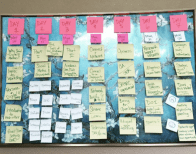
Do you ever doodle to figure out an idea? Do you sketch out a concept to make sense of it? Have you every created a Post-It Note wall montage on a wall to map out a project? Is there a whiteboard where you have a series of equations or problems you are working through? If so, then visualizing research and related works might be for you!

art

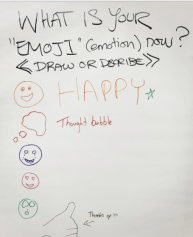
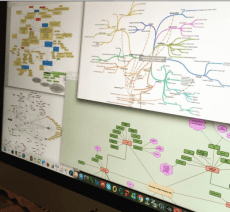
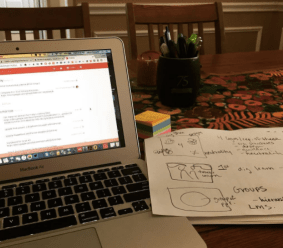
For the last workshop I facilitated, I opted to go low-tech to in order allow for reflection and discussion about our digital spaces and places. Sometimes analog processing with markers provides instigates creativity or creates an opportunity for deeper thinking. Drawing or concept mapping is a process I often use to plan programs/events, design websites, draft course curriculum, and more. I find these visualizations helpful for gathering thoughts, linking concepts ,and facilitating group/team processes.

emo_draw  course_design_posts  concept_maps_for_uunderstanding

Much to my surprise, my research role with The Digital Learning and Social Media Research Group has moved beyond your typical scholarly practice, such as literature review, data collection, data analysis, and academic writing, to include a visual design to share research. I thank/blame George for the opportunity to dig into valuable research to identify findings and implications by creating a short script and putting these audio narrations to animated format on the Research Shorts YouTube Channel [If you’re not subscribed, you should!].

storyboarding_research   research_shorts_video

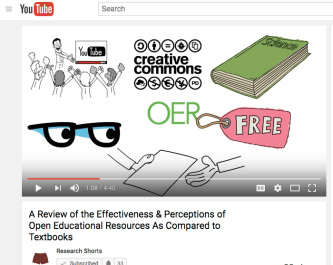
In a recent Research Shorts video, we scripted and produced Hilton’s (2016) recent article review of OER and college textbooks choices (highlighted in George’s post). Although this is an open access publication, we hope this video visualization extends beyond the typical scholarly audience and reaches other campus stakeholders in higher education who are thinking about these learning resources. You can view this video here:

For the Research Shorts video creation process, I have been scripting and storyboarding academic articles (of mine and others) to explain the implications and applications of these studies in a few short minutes. This work has made me think more about how I include visuals in my own scholarly practice, specifically to identify the “so what” or key points for my own initiatives. I typically map out works-in-progress, lesson plans, course designs, and meetings I will be facilitating or hosting by using a visual map or plan. From my experiences, visualizations for research and work projects have helped myself and my research collaborators:

  • Ideate and brainstorm for developments/project planning
  • Filter and itemize relevant results for literature reviews
  • Map out concept for a research plan and work initiatives
  • Connect the dots between theories and relevant published research
  • Organize a research pipeline and project workflows for effective project management
  • Provide “in plain English” about your research findings
  • Highlight key implications based on research results
  • Develop better images or visuals for conference presentations and/or posters
  • Showcase information through a new communication method or medium
  • Can lead to new insights for yourself and your audience/stakeholders — offer access to publications or complex work designs
  • Capture the “what’s the point” for organizational leaders for published reports
  • Pitch research implications/findings as an executive summary in meetings

Beyond creating a video to share visual research on YouTube, I am also considering what images or graphs I put into my own academic publications. Our written text can tell the story of our research; however, diagrams, images, or graphs can create meaning to our academic manuscripts, reports, and planning documents. What does the aesthetics of science look for you?  Have you put much thought into how you visualize traditional research publications, like conference proceedings or journal articles? What support your academic writing beyond the text? Do you give much consideration to these in your writing? If so, please share.

Reference:

Hilton, J. (2016). Open educational resources and college textbook choices: a review of research on efficacy and perceptions. Educational Technology Research and Development, 1-18.

MOOC, Online Learning, publication, Research

How Do Online Learners Overcome Challenges in MOOCs? [New Publication]

In analyzing recent MOOC research, a number of studies explore the vast amount of data collected by digital learning platforms to understand learning behaviors in these scaled classes. What we don’t know much about is:

  • How online learners resolve the problems
  • How students online persist in a course
  • The strategies MOOC students use to overcome challenges

In a new publication, The Life Between Big Data Log Events: Learners’ Strategies to Overcome Challenges in MOOCs, George Veletsianos, Justin Reich, and I share what we learned from talking to 92 MOOC students ages 21 to 81 enrolled in 4 different courses from North America, South America, Europe, Africa, Asia, and Australia. The whole paper is free and available for your reading pleasure at the new open access education journal, AERA Open, and check out the research findings presented in this short video summary created by moi:

During these interviews, we learned that there is so much more going on beyond the screen, tracking logs, and platform learning analytics. Learners shared how they engaging in the online course and activities in three domains:

  1. Describing their designated workstations and study methods for learning
  2. Utilizing online and outside resources beyond the learning platform
  3. Engaging with social networks both inside and outside the online course

Read more here:

Veletsianos, G., Reich, J., & Pasquini, L. A. (2016). The life between big data log events: Learners’ strategies to overcome challenges in MOOCs. AERA Open, 2(3); 1–10. doi: 10.1177/2332858416657002

mentor, mentoring, Research

Research Study: Exploring Mentoring Experiences

Mentoring is often a relationship between a less experienced individual, called a mentee or protégé, and a more experienced individual known as a mentor. Traditionally, mentoring is viewed as a face-to-face, long-term relationship and interactions between a supervisory adult and a novice student that fosters the mentee’s professional, academic, or personal development (Donaldson, Ensher, & Grant-Vallone, 2000). The typical examples of mentoring focus on a senior and junior configuration; however there are growing experiences and models that vary in mentoring experiences. Different structures of mentoring (e.g. formal, peer, group, network, and informal mentoring) support career goals, while other mentoring opportunities help contribute to a particular field or discipline.

mentoring

About the Research Study

A number of our professional organizations offer mentoring opportunities and structured mentoring programs as a form of learning and development. For this research study, our team would like to learn more about MENTORING EXPERIENCES; specifically, how these experiences impact the participants (i.e. mentors,protégé, and program coordinators) with regards to their personal and professional development. We are in the early days of learning the how mentoring has impacted individueals and what mentoring means for professionals.

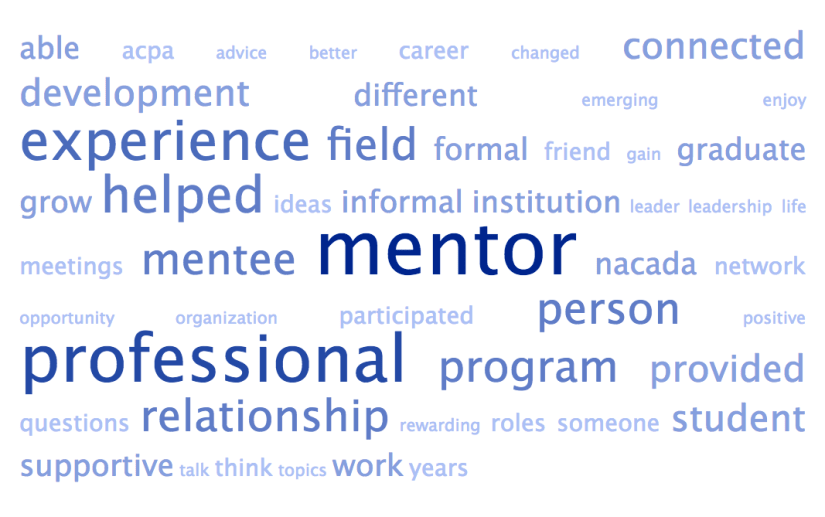
mentor_words

We seek to explore mentoring through the shared narrative of mentoring experiences to answer the following research questions:

  • What influence does mentoring have on personal, professional, academic, and career development?
  • How does mentoring impact contributions to a professional association and/or learning organizations?
  • How does mentoring contribute to a professional field or industry?

Support our Mentoring Research!

Phase 1: Survey http://bit.ly/ExploringMentoring

This survey asks both open- and close-ended questions, and it will take 15-20 minutes to complete. Respondents will be asked about personal perspectives on mentoring based on their own experiences and demographic information:

If you have had more than one formal mentoring role and/or formal mentoring experience – please feel free to submit another survey response. This survey will remain open for several weeks if you decide to complete this survey or if you wish to pass this along to other colleagues who can share their mentoring experience.

Phase 2: Research Interviews

 http://bit.ly/MentoringInterviews 

We want to learn more about mentoring programs and its impact on personal and professional development, to its influence on the field/discipline, and to understand how mentoring supports professional associations who create these programs.The interview is expected to take 45-60 minutes and no sensitive questions will be asked during it. Your participation in this study is completely voluntary and optional.If you are willing to talk with a researcher via phone or Skype about your experiences, please click on this link to complete the informed consent formhttp://bit.ly/MentoringInterviews

Thanks to the members of the Exploring Mentoring Research Team who are supporting to this study:

  • Mariya Gavrilova Aguilar, University of North Texas
  • Laura Lambeth, Oregon State University
  • Sara Ackerson, Washington State University Vancouver
  • Ed Cabellon, Bridgewater State University

With thanks for support and development also from:

  • Craig McGill, Florida International University
  • Erin Justyna, Texas Tech University
  • Brandan Lowden, Pikes Peak Community College

For further questions or inquiries about this study, please contact Dr. Laura Pasquini (Laura.Pasquini@unt.edu), as we would be more than happy to follow up with questions, additional support, recruitment, and/or collaboration.

Reference:

Donaldson, S. I., Ensher, E. A., & Grant-Vallone, E. J. (2000). Longitudinal examination of mentoring relationships on organizational commitment and citizenship behavior. Journal of Career Development, 26, 233-249.