Learning Technologies, Professional Development, Reflections

What Was In The Mix for #Blend13

Last week seems so far away, but not forgotten. Much of my time and social streams had a great mix of conversation in and around around #blend13 – The Sloan C Blended Learning Conference & Workshop. Thanks to the fabulous #blend Conference Chair, Tanya Joosten (@tjoosten), I was fortunate to be invited to present a workshop (or two) and get acquainted with the fine city of Milwaukee over the Summerfest weekend. #MKEwhawhat. Here’s my blogged mix tape of highlights and happenings from #blend13.mixtape

Not only did I fall in love with the city life in MKE, but I was alsoable to attend the 10th annual conference on the topic of blended learning to gain some insight to the history and impact as to where we are going in the field. As educational demands and challenges increase, there has been a great shift to personalized, digital pedagogy. Blended learning has helped to reshape roles for both the instructor and learner to create opportunities for deeper learning and sharing.

Untitled

During my workshop, I asked participants to share what blended learning meant in ONE WORD. A challenging task, as this learning pedagogy and model means so much to so many people. Here are the responses from my session. I learned how blended learning appears to have a number of similarities and differences depending on the academic institution, and the type of characteristics most suited for instructors and our students in blended learning environments.
Untitled#Blend13 connected me to a number of educators,  in both K-12 and higher education, who were using blending learning for curriculum engagement. Blended Learning has encouraged more collaboration and connection to open, shared learning resources. A number of faculty and instructors are finding value in enhancing their subject matter, and the student data on learning acquisition is proving its value. A number of instructors are finding opportunities to mentor and learn in their own personal learning networks, which are strengthening the profession and allowing for growth in education.

#BlendedLearning Word Cloud

Beyond interpreting the blended learning, seeing other models, and discussing effective practices for blending – a larger conversation and discussion thread that was prevalent was around MOOCs. Although I feel as this “hot topic” is appearing in most educational conferences, it was interesting to understand how MOOCs impact blended learning environments, and if they are distinguished from the blend pedagogy.

During the Using MOOCs for Blended Learning panel (#BLmooc), the discussion evolved around the impact (or lack there of) massively open online courses (MOOCs) have within higher education. The debate focused on how campuses should consider wider, strategic solutions for blended learning and the challenges/opportunities MOOCs provide for the learning process, students, open content, and various learning methods.
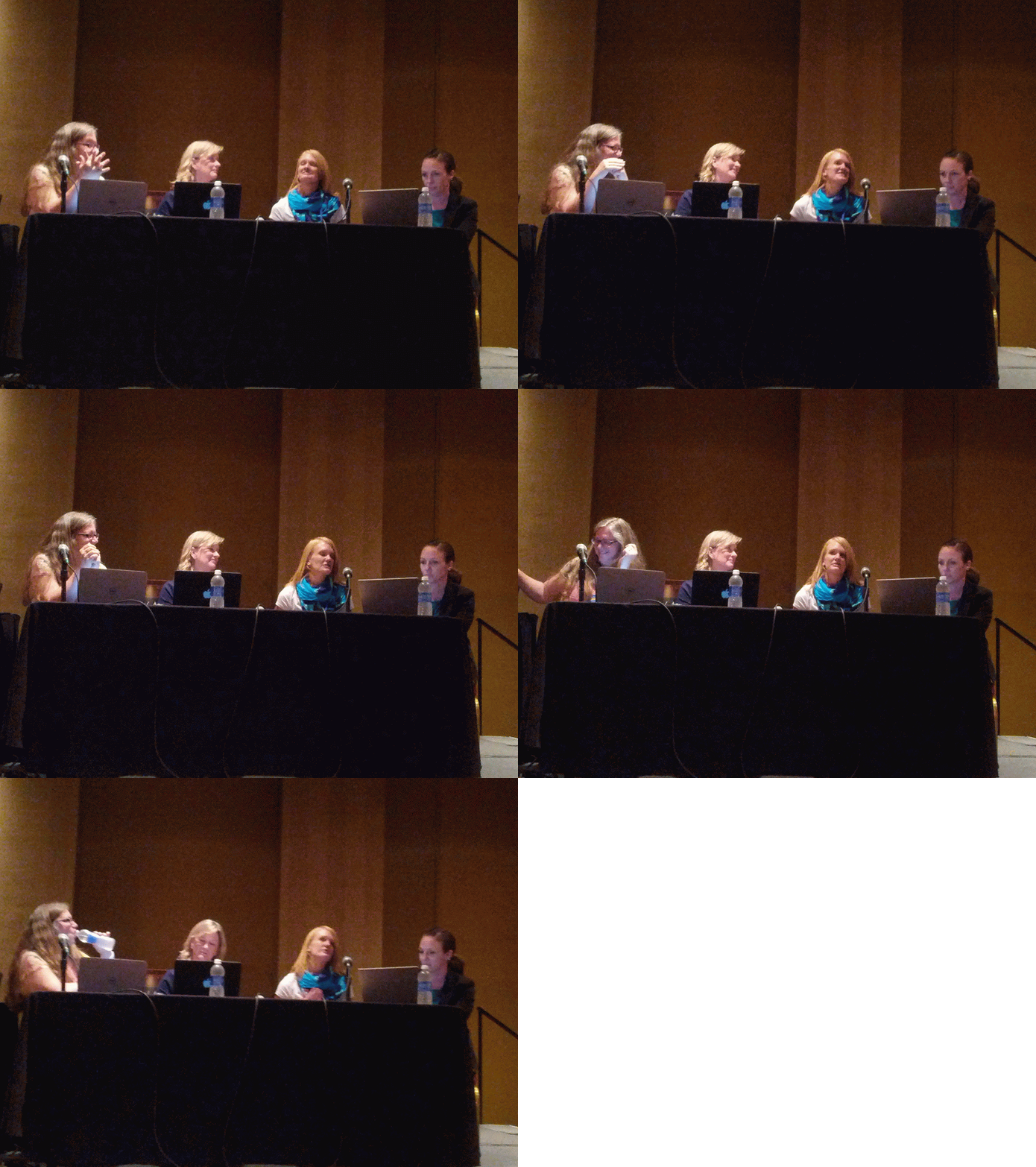
IMG_20130708_140836-MOTION

Thanks for sharing your thoughts on #BlendedLearning  and #MOOCs  at #Blend13  Karen, Shari, Amy & Tanya. 

There was talk about openness, content, delivery, and more. What struck me was the continued debate or talk about dualism between closed and open methods for delivery and content, which I think was shared in Andy’s tweet/blog post:

The last session I attended was the Unconference Session Around Researching MOOCs with George @Veletsianoshttp://tinyurl.com/moocresearch

There is a number of interesting research questions, methods and more included in the Google Doc — and if you want to connect with any researcher, their contact information is also included. One article I found interesting from Mike Caufield (@holden ) was the x-MOOC  vs. c-MOOC debate shared via his Educause article. I wonder how many institutions consider the space or place their move to MOOC is going, and what sort of learning framework (if any) they place these models.
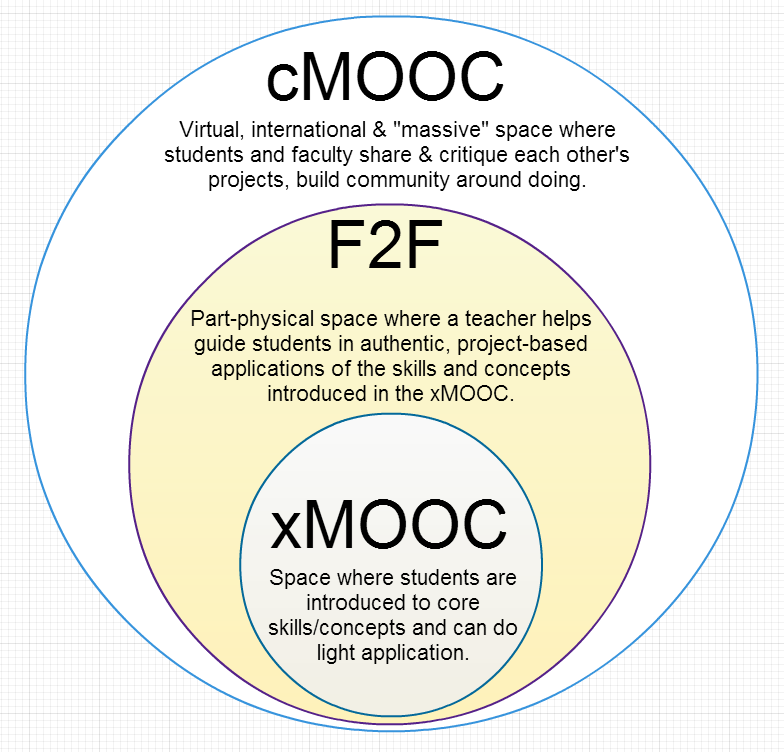
xmooc is a chewy center

Image c/o @holden in this article 


Last, but certainly not least, I was grateful for connecting with my #PLN of amazing colleagues that I am able to share with on a daily basis on different social media spaces. Who would have thought that this was my first time meeting Dr. Alec Couros (@courosa) in person — it feels like we go back for ages.  With a jam-packed, engaging keynote – I am glad that Alec and others took “notes” on Twitter. We also learned that when you let two Canadians loose in Milwaukee, there is bound to be some havoc. Highlights of our fun with the #blend13 crew (in no particular order) results in collaborative marketing campaigns for MKE, free-style karaoke, BACON love, killer dance moves, great conversations, photo-bombing, and general good times.

Untitled

Name the trouble makers who photo-bombed my #selfie.

Until we meet again #blend13 friends… keep it smooth.
Collaboration, Reflections, Social Media

Why Understanding Differences and Coming Together Matter

To say that this past week has been eventful, would be putting it mildly. If you were under a rock or disconnected from any media, then let me do a brief re-cap of a few events that occurred:

During the week’s happenings, many were tuned into the news and social media streams. An even larger percentage of people expressed their thoughts, feelings, and concerns in various social media outlets. As events unfolded in different geographic locations, it was amazing to see people come together to show support for one another. The power of the community and lending a hand has been seen widely in these shared spaces. For example, the #RunForBoston initiative and the Americans for Mariage Equality equal signs could not be missed. Social media affords individuals to get involved, speak up, and share their thoughts.  Both our mobile and connected technologies have the power to make our world smaller and unite a community.

Unfortunately, there is a double-edged sword for this social sharing. With the increase in open, public dialogue comes harsh comments and demonstrations of disrespect. I learned that few often considered other perspectives as social/media streams shared a number of incorrect and inappropriate assumptions, outbursts, accusations, and opinions. It saddened me a bit, and I often stepped away from the screen.

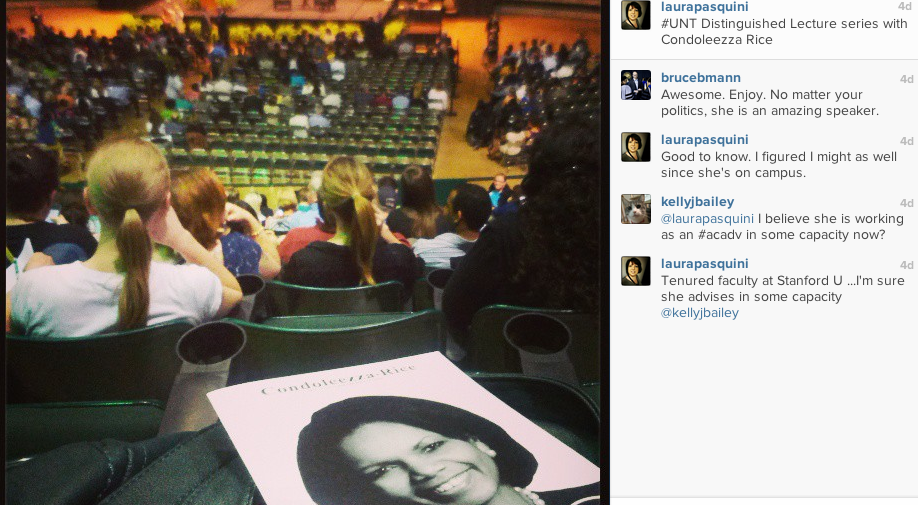
On Tuesday (4/16), I attended the Condoleezza Rice Distinguished Lecture hosted at UNT. My friend @brucebmann said it best when responding to this photo “No matter your politics, she is an amazing speaker.”

Screen Shot 2013-04-20 at 2.46.31 PMThis comment, and listening to the talk, made me think about my own perspectives and bias. How often do we challenge ourselves to think in a new way? How can listening to another perspective better inform our decisions? How is it possible to bring groups in conflict together?  I think it is possible, and I know that I am not alone.

Although “victory” has been seen this week, I don’t think that these events are really over. I challenge more of you to think about your influence and impact in social [media or not] spaces. What you say, tweet, blog, post, etc. influence the dialogue and community. It is easy to get [digital] high fives from friends and followers; however have you considered extending your reach to those you might not agree with? When is the last time you chatted with someone about the issues from this week who thinks differently than you do? Step away from the screen, and get to it.

Professional Development, Reflections, Training

Supporting Student Success at #UFTL13

UFTL13

I was able Last week UNT hosted the annual University Forum on Teaching & Learning:

UNT’s University Forum on Teaching & Learning (UFTL) is a one-day annual event that enables faculty, graduate teaching fellows, and staff involved in supporting teaching and learning to share ideas and practices that motivate learners, promote critical thinking skills, engage in real-world problems, and better prepare students for life and work in the 21st century.

This year’s #UFTL13 focus,  “Supporting Student Success,” helped initiate the conversation and help our campus understand how to support our students. It also shed some light on what success is and what it REALLY looks like for our learners.  In moving beyond the dirty R-word (retention),  it is critical to think how the meaning of the word success varies for our students. Our planning of “good” teaching and learning practices may need to extend beyond a course credit, a classroom setting, or a syllabus requirement for our students to be truly successful.

During the morning round table discussions, we chatted about reaching students beyond our state mandates or the general push to graduation, and thought more about how to connect with our learners to better understand their needs and purpose for being at the university. It was clear that success means many things to many different people. Our small group identified different things that signify success (in general) including promotion, failure, self-discovery, overcoming challenges, and such. The key issue we had in talking about “success” for learning is the divergent goals that formal education require specifically in terms of assessment, evaluation formats, and individual competency reviews.

Later in the morning Dr. Cassandre G. Alvarado, from UT Austin, asked “What is student success really?” in her keynote address. In Dr. Alvarado’s opening statements, she shared how higher education is broken with the “universal problem” being = too many students are not successful. [I will get into the “broken higher education” discussion in a future blog post- note this for now].

First we talked about the definition of success, brainstormed a few ideas, and chatted about how we might need to redefine success in our classroom and on our campus. Here is what success meant to our small group and from the speaker’s point of view:

  • effecting people in a positive way
  • being an inspiration
  • impacting others around you
  • having a goal, working hard & making sacrifices to work towards that goal
  • passion for what you are doing or how you are working with others

BIG IDEA: Success is more than content knowledge.

enjoy-your-success

 Key Goals for Success & to Be Successful shared by Dr. Alvarado in her keynote:

1. Perseverance  “Nearly every man who develops an idea works at it up to the point where it looks impossible, and then gets discouraged. That’s not the place to be discouraged.” ~ Thomas Edison

  • We need to share with our students our struggle so they can learn
  • Model for our students our own struggles
  • Reward effort as well as correctness, e.g. rewarding effort on homework and tests, using innovative assessment methods produced almost triple gains

2. Community –  “My model for business is the Beatles. Total is the sum of the parts… Great things in business are never done by one person. They’re done by a team of people.” ~ Steve Jobs, 2003

  • Community happens inside and outside of the classroom
  • Is about understanding our role
  • Is more than just friends, e.g. Creation of learning communities increase ention through Drop, Fail & Withdrawal rates stayed the same; cluster of courses

3. Imagination – “The value of an idea lies in the using of it.” Thomas Edison

  • Discovery is imagination
  • Ask students to solve problems that don’t yet exist not ones that have already been solved
  • “See yourself on the other side.” Dr. Marcy Haag’s mantra 4 breaking a board in a Taekwondo class and she shares this for learning/perseverance

Finally, I was asked to join a student, staff, and faculty panel (I fit a couple of these roles) to talk more about student success at UNT. Here are the questions posed to the #UFTL13 panel:

  • How do you define student success? Can you share an example of or tell a story about student success at UNT. (This could be a personal story, one of a colleague, classmate, friend, etc.)
  • From your perspective, what do students need to experience success at UNT?  Do you have any examples to share?
  • What types of partnerships make student success a reality at UNT?  Do you have any personal experience with partnerships?
  • From your perspective, what can staff/instructors/students do to enhance student success?

Of course, I took a few notes and tweeted during the panel, so here are a few themes that emerged from the our responses:

#UFTL13 Student Success Panel Responses

How do you define student success on your campus? What student success stories can you share? Think about it, and let me know.

EdTech, PhD, Professional Development, Reflections

#et4online What Happens In Vegas, Should be Blogged

Much to my surprise, my first visit to Sin City was less about the bright lights, gambling, or trouble I could cause…and more about innovative ideas and collective sharing for learning technologies. This is what happens when you attend the 6th Annual International Symposium on Emerging Technologies for Online Learning (#et4online).

Waiting for my flight to #et4online

In returning from the #et4online conference, I think that there are a number of great conversations, thoughts, and questions I am left with. So, fortunately for my readers, what happens at an #et4online conference in Las Vegas, will NOT stay in Vegas.

Here are a few #et4online conference highlights, notes & tweets (I am not alone – as I know @tjoosten does this as well):

  1. Location Location Location – Kudos for the Planet Hollywood site. Easy to get around, wifi access was great, it was the middle of the strip & close to some great restaurants, and, most importantly, Rex Manning from Empire Records looked over me while I sleep. What more could a gal want?
  2. #EdTechCareer Forum Round Tables – This was the 1st year to start this initiative; however we had a decent turn out and more importantly conversation with our facilitators @amcollier @veletsianos@tjoosten, @whitneykilgore, Kevin Grazino & Rachel Salas-Didier. Thank you to the emerging scholars and career-seekers who stopped by to talk about direction in the field, finding passion, planning for career applications, and more around the job search and career development we have in the #edtech field.
  3. Keynote: What’s That Coming Over the Hill? Digital Futures, Emerging Cultures, New Learning c/o @timbuckteeth This chat had a malay of ideas and experiences for connected learning and pedagogy. Unfortunately Steve had to return back to #PELC13 back in Plymouth, otherwise it would have been great to pick his brain about e-learning more.  Here are a few notes myself & others took via Twitter from his talk.
  4. Plenary: Seven Tales of Learning Online with Emerging Technologies with @veletsianos I like how George shared his learning experiences as a student, researcher, and instructor to help us look critically and realistically at how we are using emerging technologies in education. Here are a few collected tweets from the talk.
  5. The Launch Pad: What a great way to show case Ed Tech start ups, and provide an space in the conference to discuss how educators/developers can work together and collaborate to pilot these initiatives. It was great to connect with Lida & Scott from @Ginkgotree after our BreakDrink.com podcast last October to demo the product. Great to hang out & hopefully we’ll connect again in MI soon!
  6. Discussion & Dialogues of Education Is and Is Not – Specifically what is broken or needs to be fixed, and the reality of this statement. I appreciate how George Veletsianos engages in this more on his blog post, and chat with Amy Collier encouraged me more to think about the change, challenges, and issues being labeled in higher education and for online learning.
  7. #UNet4online: Open Space Technology – These sessions were threaded throughout the conference program and facilitated by Jennifer Ross (@jar) to encourage conversations and idea-swapping for online learning. I was able to attend one on April 10th and the final one on April 11th. I appreciated the  free space to challenge, ask questions, brainstorm, and share ideas/practices with peers. Shout out to the #unet4online tweeps: @amcollier ,@rasebastian, @veletsianos@KavuBob, @jleung81, @g4m, @johnrturnerhpt, @jar@hollyrae, @desertjul & @markjwlee who joined in on various unconference conversations. We were able to  talk about valuable ideas for learning including distributed flip educational models (not.a.MOOC),  higher education organizational design/culture, and ownership in education. Want to learn more? Check out the fantastic post on the (f)unconference from Amy Collier or my rough Google doc notes.
  8. Getting Social  – For me, this is why you attend a conference. I love connecting with others and learning how they are working with students, researching ideas, and just having some great banter. I am glad I got some quality time with @amcollier, catch up time with @tjoosten & @veletsianos, and hang time with new friends, such as @jar @dwicksspu & @kavubob. For those of you who were social [media] online – it was nice to connect via the #et4online hashtag. Let’s continue the conversation.

Screen Shot 2013-04-16 at 11.53.16 PM

Thanks to David Wicks (@dwicksspu) for inviting me to join the #et4online conference steering committee. I look forward to 2014 #et4online planning in Dallas, TX. Giddy up! For those of you who are going to Summerfest & #Blend13 – I will see you in July. 🙂

Reflections, StudentAffairs

#asbABQ13: Service Learning, Shared Experiences & Connecting to Pay it Forward

During the University of North Texas (UNT) Spring Break (March 11-15) I joined a group of undergraduate students on an Alternative Spring Break (ASB) road trip for some service learning in New Mexico – #asbABQ13.

Alternative Spring Break in NM #asbABQ13
The focus for our volunteering was around the theme of homelessness, so we logged some time at the Roadrunners Food Bank and moving furniture for the “Helping Hands” with the Metropolitan Homelessness Project in Albuquerque, NM (#asbABQ13). You may recall our Student Launcher website (that is still open – hint, hint): http://StudentLauncher.org/9cab [Closes March 28, 2013].

We were one of the many UNT Alternative Spring Break trips created for students who want to give back to their community and participate in a service learning while away from academics. It has also been a very enlightening week for the group as it was the “1st” time for ASB participation & volunteering, visiting the state of New Mexico, travelling without family, or evening being on top of or even seeing  mountains. The ASB trip’s focus was on homelessness and socio-economic issues facing the US today – specifically around the distribution of wealth reality.

During the week our group packed boxing of meat, moved furniture, sorted linens/donations, organized breakfast boxes, and more. Most the week’s work confronted a number of students with what it meant to do more with less. The final day of service impacted the #asbABQ13 team the most, since we were meeting recently placed tenants when delivering furniture to their new dwellings.  The students learned that many of the new tenants had been living on the street anywhere from 5 to 30 years, and often dealing with medical needs and other issues. The final day did involved a great deal of physical work; however the heavy lifting was rewarded by the smiling faces of new residents.

Untitled

Thanks for a great week in New Mexico Team #asbABQ13: Suliat, Lasha, Alyssa, DeDe, Asmara, Briatni & Irene!

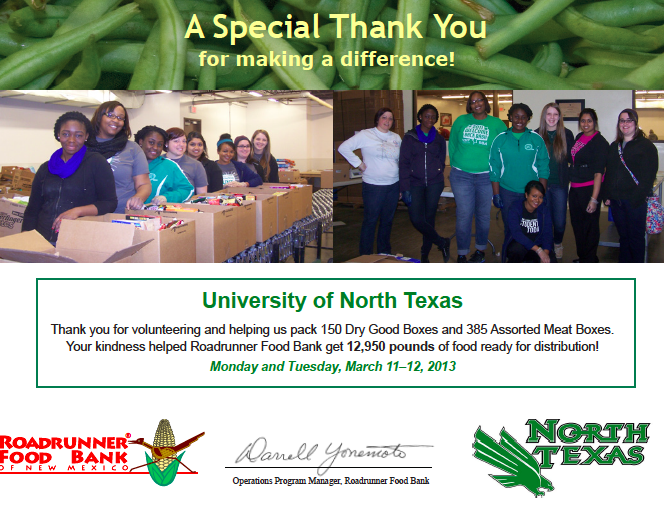
Over the course of the week, our #asbABQ13 group talked about how we spend money, not waste food, and take for granted our comforts of living. It was pretty impressive to learn that our few days of efforts helped so much. Earlier this week, I received a message from the Roadrunner Food Bank thanking us for our efforts:

Screen Shot 2013-03-23 at 10.23.50 AM

To continue the spirit of giving back, the #asbABQ13 group plans to collect donations that will all go directly to the Roadrunner Food Bank. We learned that dollar donations can go a long way to fill the nutritional needs for the food distribution center. If you have $5-20 to spare, PLEASE consider contributing to our Student Launcher site: http://StudentLauncher.org/9cab

It was an eventful week of service with many new experiences, group projects, and delightful interactions. I am looking forward to seeing how this ASB trip impacts everyone now that we are back on campus. My plan is to continue being involved on and around campus beyond this service trip, and, of course, staying in touch with this amazing group of students: