Professional Development, Training & Development

The 2015 #et4online Conference Preview

#et4online bannerThe Online Learning Consortium (formerly Sloan Consortium), MERLOT, and our Emerging Technologies steering committee wanted to give you a sneak peak of what lies ahead at #et4online, so we hung out to share details about the upcoming conference being held April 22-24, 2015 in Dallas, Texas.

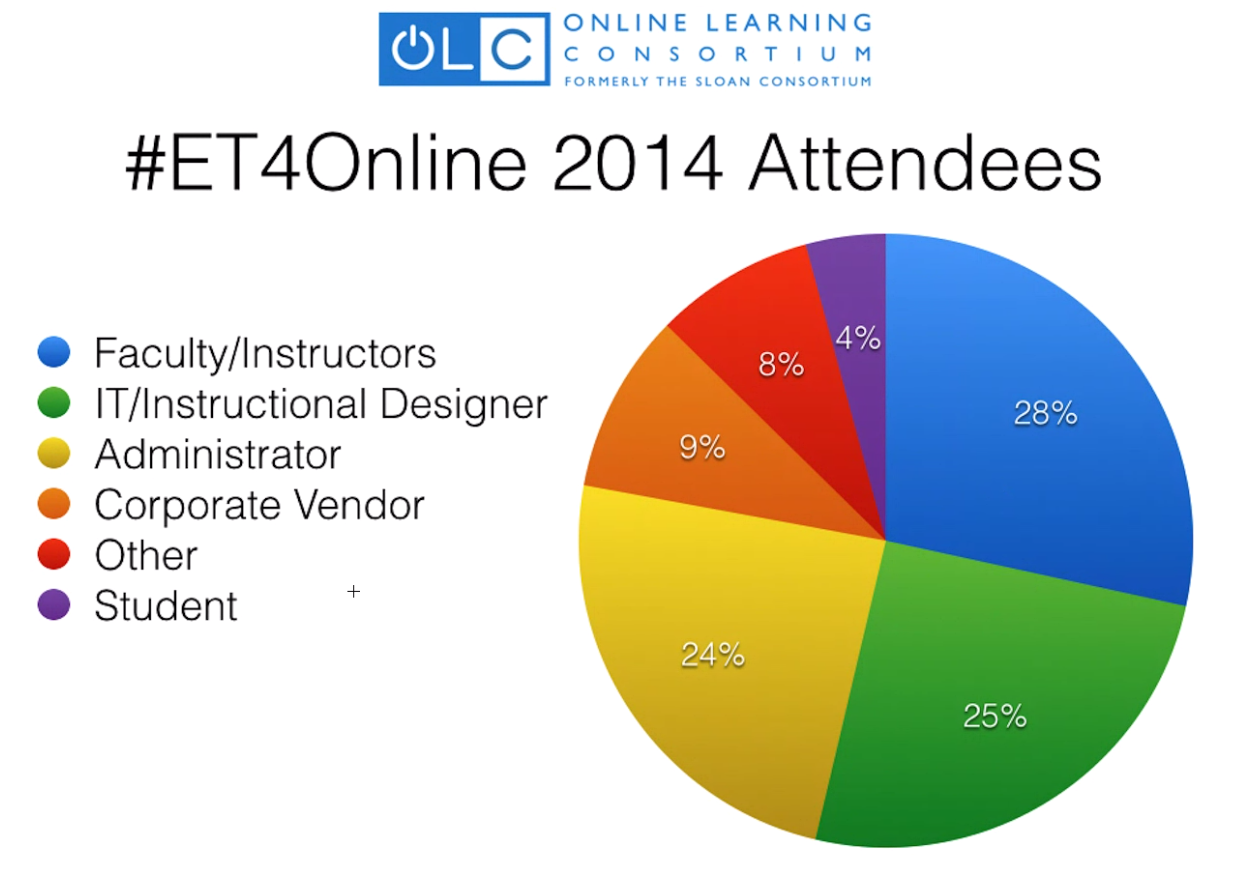
Who attends #et4online? (you might ask)

Who attends #et4online

Image c/o @brocansky

6 Reasons Why You Should Join Us for #et4online

Or hear what the #et4online Steering Committee Members have to say in today’s Google+ Hangout ON AIR (recorded):
Michelle Pacansky-Brock Conference Chair – @brocansky
Jason Rhode, Assistant Conference Chair – @jasonrhode
Jane Moore, MERLOT Program Chair – @janepmoore
Laura Pasquini, OLC Program Chair – @laurapasquini

Here are just a few of the MANY highlights for the #et4online program that we shared:

Interested in attending (virtual or on site)? Register TODAY! Early bird pricing ends on February 25, 2015. I hope to welcome a few of you to Dallas in April. Do you have questions about the conference or program? Want to know great places to find BBQ in Dallas? Want to get involved and volunteer? You know where to find me. I’d be happy to answer any/all questions. Hope to see you soon!

Professional Development, SAchat, Training

Twitter for Professional Development… Make it Part of Your PD Plan. #SAchallenge

In the field of learning and performance, there are a number of ways to train and develop employees. A number of professional organizations and educational institutions are interested in supporting online learning communities to enhance learning and development for “the workforce of tomorrow.” This often results in going to where the communities are already active online, i.e. social media. A number of social spaces, including blogs, videos, microblogs, and photo sharing websites, have been repurposed for training and development by the community. One of the largest areas for professional development has been on Twitter with users aggregating around a hashtag to form a community. In higher education, a number of Twitter-based communities of practice are emerging as the “combination of improved facility and user flexibility has created an environment in which networks and communities, albeit of a restricted kind, can flourish (Lewis & Rush, 2013).
sachallenge

It is no wonder why we see The #SAChat January Twitter Challenge #SAchallenge appear with the start of the new year. Although I’ve been loosely off the social grid for the holidays, I tuned back in to find January #SAChallenge prompts posted to get connected and involved on Twitter:

During the month of January, we will be tweeting out various challenges and ideas of ways you can engage on Twitter – starting with basic how-tos and moving towards looking at different ways to engage through the medium. Each weekday will bring at least one “challenge” – something you can do to either learn more about using Twitter or to refresh yourself and make you think about using it differently, especially within the #SAChat community. We’ll be posting the challenges here if you miss one and want to catch up.

I applaud the @The_ SA_Blog community managers for facilitating the #sachallenge.  To best support learning and development, The SA Collective L-Team are actively supporting their online subscribers and cultivating the #SAchat hashtag, by utilizing these key community management skills:

  • Listen. It might be a great space to broadcast and disseminate content – but that’s not how you hold a conversation. What do people what to talk about, not just receive? What is the online community engaged in? What are the conversations about online? Take a minute to read and learn from others online.
  • Participate. You need to be a community member, too. Try to join conversations as a peer contributor, not a facilitator. Contribute useful ideas, articles, research, and more. Your online community will want you to be actively sharing online like others in their learning community.
  • Include. Let others help find and create content, guide conversation, start new discussions. It’s a change for many of us in the field who what to “lead” the professional development experience but will pay off in a more vibrant, sustainable community. Encourage members of the community to be the active voice.

I think Twitter is a key component of my own learning and development, and I often encourage others (i.e. students, professionals, faculty, etc) to set up their own Twitter handle [HOW TO: Set Up a Twitter Account], and/or follow along with the community hashtag. I am also more than happy to connect and chat with those of you who reach out to me on Twitter (a.k.a. @laurapasquini), or by any other means if you want to to talk about Twitter or professional development. Although the #SAchat hashtag focusses on the Student Affairs arena there are a number of other higher education and discipline-based Twitter communities to follow.   

Dubbed the Twitter Queen by @hglez9

Photo mashup credit goes out to @hglez9

That being said, I also caution using Twitter as the only means for learning and development. As an avid Twitter user, who has learned a great deal from tweeting over the past few years, I have a healthy skepticism that Twitter is the “best” platform for delivering professional development. Apparently, I am not alone. Audrey Watters recently asked this question in her blog post “Is Twitter the Best Option for Online Professional Development?” and identified both its benefits and challenges. Twitter has created opportunities for conversation, research, collaboration, and support; however I have also witnessed spam bots, self-promoting followers, bullying, disciplinary implications in academia, and other not-so-nice things.  I was reminded by Audrey that “there is a fragility to our ability to connect and share online. Some of that fragility comes when we opt to rely on for-profit companies to run the infrastructure. We do not own the conversations on Twitter. We have limited control over our data and the content we create and share there.” That is not to say you should not participate and engage – but don’t let Twitter be the ONLY only means for your PD.

In my opinion, I think Twitter can augment, not replace, learning and development. Let Twitter be one part of your professional development plan for 2015, and then ask yourself what do you want to learn? Think about what goals you are setting for yourself first, and then consider the spaces you want to engage in this year. Always put your PD goals ahead of the platform, and then go searching for where you want to engage this year. You might also consider searching out training and development opportunities at your institution, at your professional associations, with trade/professional journals, by reading new literature & books, through research projects, signing up for a course/seminar/webinar, by conducting an informational interview, by reaching out to others in your network, and always by discussing your goals with mentors and peers from the field. Perhaps you might even take the time to reflect on these training experiences when you return to/start some “bloggery” (Thanks for the term, Bryan) to process your learning and development. Good luck with your PD goals for 2015! Let me know if or how I can help.

References:

Lewis, B., & Rush, D.  (2013). Experience of developing Twitter-based communities of practice in higher education. Research in Learning Technology, 21. Retrieved from http://www.researchinlearningtechnology.net/index.php/rlt/article/view/18598 doi: http://dx.doi.org/10.3402/rlt.v21i0.18598.

Watters, A. (2014, December 17). Is Twitter the best option for online professional development? Hack Education. Retrieved from http://hackeducation.com/2014/12/17/twitter-professional-development/.
Learning Technologies, Professional Development

The Technology Test Kitchen & #et4online CFP Deadline

The Technology Test Kitchen (TTK) was developed at the Online Learning Consortium‘s #blend14 event, and recently enhanced at #aln14.

What the heck is the TTK?

  1. A makerspace for sharing innovative tools and new media
  2. An open collaborative environment for hands-on exploration
  3. An engaging way to connect with your colleagues over emerging technology

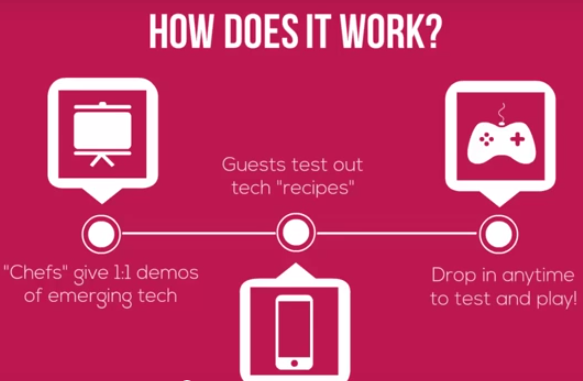
how it works

The TTK ideas was created to bring faculty, instructional designers, researchers, and conferences participants together to get a hands-on experience with a variety of learning technologies. In the Test Kitchen, there are a number of “chefs” (volunteers who love applying media to learning) who are typically available to talk about design, discuss a “recipe” (a quick how-to guide for a platform, e.g. PDF Recipe Book from #blend14 is posted HERE), utilize apps, brainstorm curriculum strategies, introduce new media (hardware & software), and provide 1:1, hands-on sharing with learning technologies.

To learn more, check out this AMAZING video created by Angela Gunder (a.k.a. @adesinamedia):

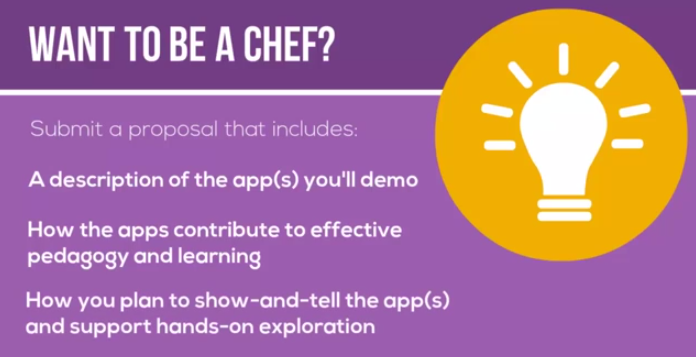
For the 2015 #et4online conference, the TTK will be looking for chefs, like YOU, to actively work in the kitchen and demonstrate how to apply media to pedagogical practice.

CFP for Chefs

Interested in applying? Check out the Call for Proposals today for the TTK or any other program track. We would LOVE to review your proposal. The CFP closes on December 1, 2014.

Conference, Professional Development

Have Conferences, Will Travel – Fall 2014 Edition

With the start of the academic semester comes a series of conferences. I’m grateful for the conference survival guides and other helpful conference hacks shared by my PLN. Due to limited travel funds and time, I had to decline a few conferences; however I will be sure to follow along the Twitter backchannel (I am looking at you #HEWeb14 and #SMSociety14).

In considering the cost of professional development at many conferences, I have learned to get more involved to help fund this sort of travel.

jure

Image c/o @jure

Here are a few ways to get involved and learn how to fund your own conference travel with your professional affiliations:

  • Volunteer at the conference – check-in desk, hospitality, and more! Ask to volunteer!
  • Apply to present a Pre-Conference workshop – often you are eligible for comped registration and/or bonus honorarium to travel.
  • Get involved with conference planning – join the conference steering committee or planning group. It gets you networked and often offers a discount for registration and/or accommodations
  • Get invited – See if invites are available for featured talks, workshops or edu sessions. Tap into your network and share what you are working on.
  • Stay with a friend – I have housed and been housed at a number of conference locations just to avoid the steep hotel costs. Bunk up, or find a local off the conference beat.
  • Apply for a travel grant – This might be at your own institution, through the professional organization, or other entity.
  • See what’s local – You will be surprised to learn a number of different conferences, workshops, and other P.D. that is happening in your own neck of the woods OR online. 🙂
  • Present virtually! – Limited travel? See if the conference offers virtual papers, workshops or posters and submit your CFP! If you’re in the #edtech realm, you will likely find this a popular option to travel.

Here is my quick conference list for the Fall 2014 term:

Where are you traveling this academic term? Will our conference travel cross paths? How have you creatively spread your travel funds? Please share. 🙂

Professional Development, Training & Development

Are you going to #blend14? Join the Unconference session (#unblend14) & More in the Rocky Mountains!

The @SloanConsortium 2014 Blended Learning Conference and Workshop (a.k.a. #blend14) is less than a month away! I am excited to be attending and facilitating a workshop in the rocky mountains (Denver, CO) this July.  As blended learning models for curriculum and program development increase in post-secondary education, learners and instructors are being more invested in different mode and models for education. Last year, I found the mix of programs, discussions, and people at #blend13 very refreshing.  If you have interests in design, development, or research in hybrid and blending learning environments than this might just be the conference and workshop for you!

blend14 banner

For those you who ARE attending #blend14, let me entice you to join in the UN-conference session.  This year, I will be helping to host the Blended Unconference (#unblend14) with Jessica Knott (@jlknott) and Patrice T (@Profpatrice). Unconferences are great opportunities to interact, discussion, and dig into topics that YOU are most interested in. As an a-typical session, the unconference is guided by participants who attend, and are flexible to the needs and wants of the group. It will be YOU who takes control of the agenda, content, and conversation. We will help by providing a basic infrastructure to keep things organized and moving, but this is the opportunity to really make the conference YOUR OWN. Typically unconference sessions introduce a topic or issue, and discussion, debate and ideas ensue.

Should I Attend the Unconference?

Yes!  Well, we think so. If you answer yes to any of the following, the unconference session is JUST for you:

  • Do you sometimes find yourself thinking “I wish they had covered X,Y, Z more deeply” in regular conference sessions?
  • Do you wish you had the chance to ask further questions or expand upon session content?
  • Are you looking for ways to get involved & meet others at #blend14?
  • Did someone ask the perfect question during your presentation & now you want to talk to them further?
  • Do you like interacting with colleagues to expand on ideas, share techniques, debate current trends, or collaborate on research?

Come to the Unconference Sessions on July 9:

  • 1:30 PM – Gather in the Unconference room and review the topics and votes; select top topics
  • 1:45 – 2:45 PM- Break into groups and discuss the top three topics.
  • 2:45 – 3:00 PM – Short break
  • 3:00 – 3:15 PM – Reconvene and revisit the topics and votes
  • 3:15 to 4:15 PM – Break into groups and discuss the next three highest voted topics. (Again, the individuals who submitted the topics will facilitate each of these three groups, with a scribe assigned for note-taking and organizational purposes.)

SIGN UP and submit YOUR UNCONFERENCE TOPIC for #unblend14:

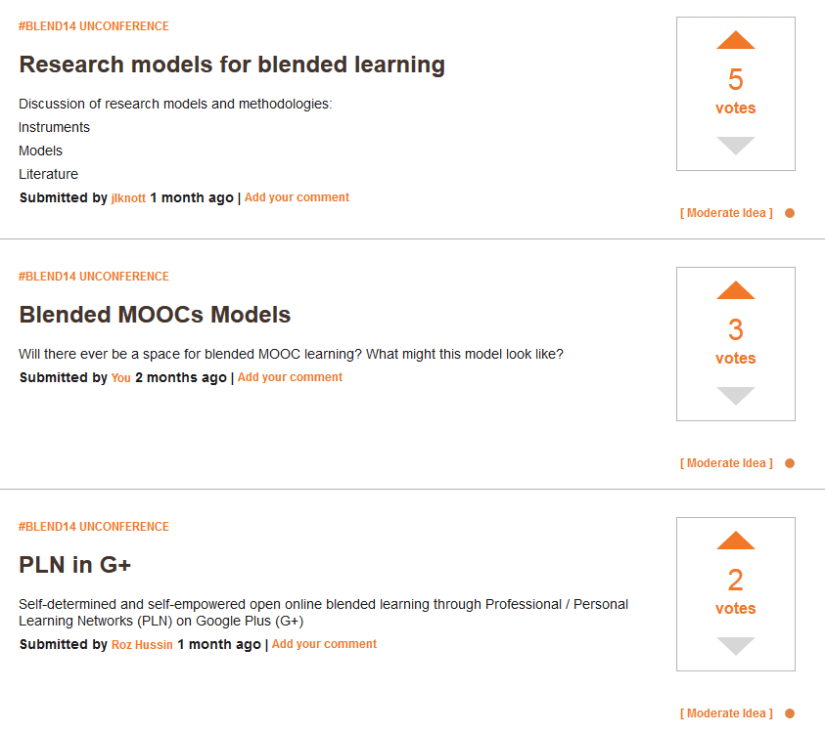
Check out and VOTE ON the current Unconference Topics on Ideascale:

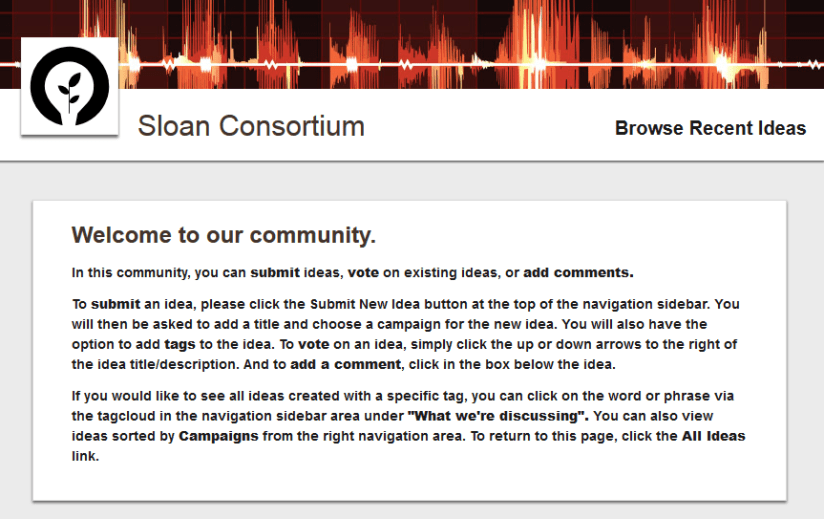
About the Sloan Community on IdeascaleA few ideas to vote onIn other #blend14 news, I will be a “Chef” in the “Technology Test Kitchen.” This NEW addition to the conference will provide participants an opportunity to gain hands-on experience with different tools and technologies they want to use back on campus. Bring your own device (BYOD), and let’s getting developing with audio and/or video, collaborative platforms, communication tools, or presentation resources that YOU want to learn more about.

Are you planning to be in Denver for #blend14? Want to learn more about the #unblend14 Unconference or Test Kitchen? Drop me a line. 🙂