#AcWri, Learning Technologies, LPQuarterly, OpenAccess

The @LPQuarterly – Year Two, An Editor’s View, and Volume Two

It is my second year editing and working with the Learning and Performance (a.k.a. @LPQuarterly) here at the University of North Texas.

The Learning and Performance Quarterly (ISSN 2166-3564) is a peer-reviewed, open access journal from the Center for Knowledge Solutions at the University of North Texas. The journal takes a broad look at current developments and research that involves innovative learning, training, human resource development, and performance management across academic and professional disciplines.

Creating an open access, academic writing space from scratch is a bit like a “start up” – it takes a lot of time, investment, tears, creativity, stress, and collaboration (not in any particular order). In being an open educator and seeing academic channels open for scholarly publications, It was only fitting that our agraphia writing/research group from the Department of Learning Technologies consider developing an interdisciplinary, online space for scholars, practioners, and researchers to publish in our field. In coming from the University of Toronto, I knew that the Faculty of Information Quarterly (FIQ) was a student-led, peer review project — so I figured that our talented group could do the same thing.

lpq_logo_enhanced

After reading Karina Quinn’s (a.k.a. @riotk ) blog post, “How to start an Open Access journal,” I thought I could have helped to co-author that post. 🙂 I shared some similar stories and a deep respect for her experiences in open access publishing. So, with that, I thought I would share a few of my lessons learned (from Fall 2011) about the academic publishing process:

  • It takes time to build a journal. TIME!
  • You will have to always CHECK your journal email for communication updates from authors, reviewers, editors and then some. This SHOULD be separate from your personal and work e-mail to keep your life organized, and if your editorial board needs access to the journal email.
  • You can NEVER have enough quality peer reviewers on your roster. Search them out. Invite them. Mentor/support them. Grade and evaluate them with your editorial team.
  • Surround yourself with many talents on your editorial team – think of copyediting, layout, recruitment, and more!
  • Find great scholars and researchers to publish – help to build your street cred and raise the bar for your journal content.
  • Communicate & Market – share what you are doing with different professional associations, student groups, conferences, research listservs, social media outlets, and then some. I started bringing flyers and cards for the journal to places I would go to invite potential authors/researchers, copy editors and most of all peer reviewers.
  • Connect to your friendly neighborhood librarian for advice, indexing, database set up, and then some. They have some GREAT experiences & ideas.
  • Sharpen your editing TOOLS – read books, review websites, watch tutorials, learn about publishing guidelines, school yourself in APA 6th,  talk to other editors, peer review in for other academic journals, and more!
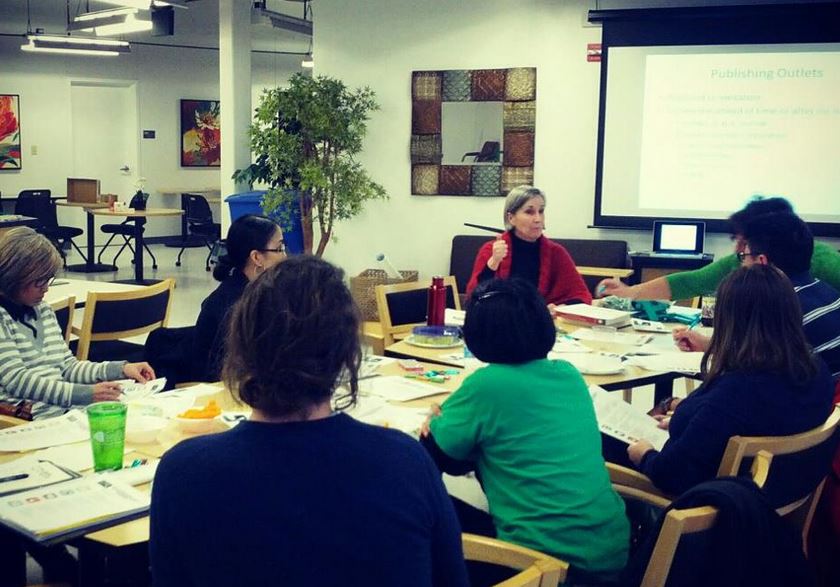
  • Offer developmental writing workshops and opportunities for graduate students and junior scholars, e.g. HOW TO: Effectively Review, Submit & Publish Your Academic Manuscript. . This is a great space for learning, and provides them with opportunities to inquire about academic writing. Also, find experienced scholars and faculty who can share their publication experiences – the good, the rejected, and then some!
  • You will learn new tech skills: read “how to” for the Open Journal System (OJS), linking to EBSCOhost databases, and meta data fun times!
  • Consider how your virtual team will function, meet, and connect on a regular basis to publish issues.
  • Identify a workflow and easy to use spaces for archiving meeting notes, recruitment/marketing material, and communication for your editorial team.
  • Understand your institutional policies for publishing if you are a university. Our university is Open Access, and I’m proud to say that our Provost just signed the latest SPARC agreement to for Fair Access to Science and Technology Research Act (FASTR) bill. What will it mean for an open access publication at YOUR campus?
  • Build in transition and mentoring into your role as an editor. Look for peer reviewers who might be great copy-editors, and consider your change in role as an editor.  I am currently working with our Assistant Editor, Tekeisha Zimmerman, this year who will take on the main editor role for 2014.
  • Never doubt the power of your network. Talk up what you’re doing in person at conferences, when you meet researchers, and get SOCIAL online. We share our call for papers and information about writing on Twitter (@LPQuarterly), our LPQ Facebook Page, and on LinkedIn Groups that are relevant to LPQ.
PUblishing

With the support of the LPQ editorial team, I have been able to work with a number of brilliant contributing authors, peer reviewers, and readers within the fields of education (K-12 and higher ed), learning technology, human resource development, human computer interaction, knowledge management, training and development assessment, and performance management systems. We are currently seeking manuscript submissions for the following categories:

  • Research Articles – Qualitative/Quantitative
  • Concept/Theory Papers
  • Case Studies
  • Book or Media Reviews
  • Invited Articles

If you are interested in submitting an article, the 2013 call for papers is OPEN. Please submit your manuscripts ONLINE today!

For more information or questions, please contact the Learning and Performance Quarterly Editors:
Laura A. Pasquini, Editor
Tekeisha Zimmerman, Assistant Editor
Dr. Jeff M. Allen, Managing Editor
~~~~~~~~~~~~~~~~~~~~~~~~~

On behalf of the editorial LP Quarterly team, we invite you to read the current issue, or visit the archives for your research and learning.

Here is the most recent issue,Learning and Performance Quarterly, Vol 2, No 1 (2013) that is…

HOT-OFF-THE-PRESSES

Table of Contents
http://www.sageperformance.com/ojs/index.php/LPQ/issue/view/7

Editorial
——–
Transforming Teaching, Knowledge Management & Performance Measurement
Systems
Laura A. Pasquini,      Tekeisha Zimmerman,     Jeff M. Allen

Invited Articles
——–
Traditional Teaching or Innovative Teaching via Technology?
Victor C.X. Wang,       Patricia Cranton

Concept/Theory Paper
——–
A Conceptual Model for Community of Practice and Its Implications for Human
Resource Development Practice
Hee Sung Lee,   Jeong Rok Oh

Performance Measurement Systems and Culture:  An Integrative Literature
Review
Shelby Danks

Book Review
——–
A Year Up: How a Pioneering Program Teaches Young Adults Real Skills for
Real Jobs with Real Success
Michael F. Koslosk
Learning Technologies, Professional Development, Reflections

What Was In The Mix for #Blend13

Last week seems so far away, but not forgotten. Much of my time and social streams had a great mix of conversation in and around around #blend13 – The Sloan C Blended Learning Conference & Workshop. Thanks to the fabulous #blend Conference Chair, Tanya Joosten (@tjoosten), I was fortunate to be invited to present a workshop (or two) and get acquainted with the fine city of Milwaukee over the Summerfest weekend. #MKEwhawhat. Here’s my blogged mix tape of highlights and happenings from #blend13.mixtape

Not only did I fall in love with the city life in MKE, but I was alsoable to attend the 10th annual conference on the topic of blended learning to gain some insight to the history and impact as to where we are going in the field. As educational demands and challenges increase, there has been a great shift to personalized, digital pedagogy. Blended learning has helped to reshape roles for both the instructor and learner to create opportunities for deeper learning and sharing.

Untitled

During my workshop, I asked participants to share what blended learning meant in ONE WORD. A challenging task, as this learning pedagogy and model means so much to so many people. Here are the responses from my session. I learned how blended learning appears to have a number of similarities and differences depending on the academic institution, and the type of characteristics most suited for instructors and our students in blended learning environments.
Untitled#Blend13 connected me to a number of educators,  in both K-12 and higher education, who were using blending learning for curriculum engagement. Blended Learning has encouraged more collaboration and connection to open, shared learning resources. A number of faculty and instructors are finding value in enhancing their subject matter, and the student data on learning acquisition is proving its value. A number of instructors are finding opportunities to mentor and learn in their own personal learning networks, which are strengthening the profession and allowing for growth in education.

#BlendedLearning Word Cloud

Beyond interpreting the blended learning, seeing other models, and discussing effective practices for blending – a larger conversation and discussion thread that was prevalent was around MOOCs. Although I feel as this “hot topic” is appearing in most educational conferences, it was interesting to understand how MOOCs impact blended learning environments, and if they are distinguished from the blend pedagogy.

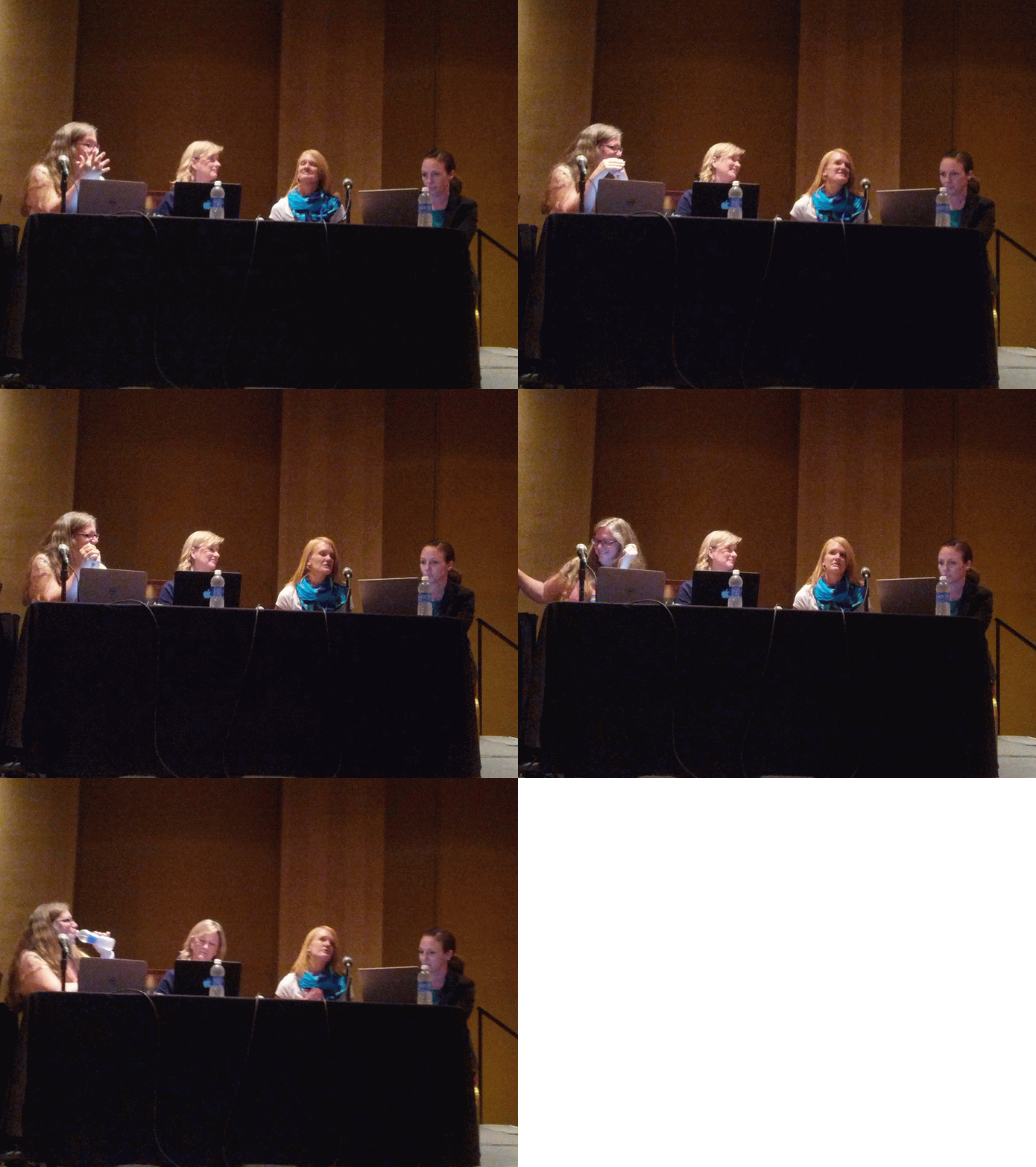
During the Using MOOCs for Blended Learning panel (#BLmooc), the discussion evolved around the impact (or lack there of) massively open online courses (MOOCs) have within higher education. The debate focused on how campuses should consider wider, strategic solutions for blended learning and the challenges/opportunities MOOCs provide for the learning process, students, open content, and various learning methods.

IMG_20130708_140836-MOTION

Thanks for sharing your thoughts on #BlendedLearning  and #MOOCs  at #Blend13  Karen, Shari, Amy & Tanya. 

There was talk about openness, content, delivery, and more. What struck me was the continued debate or talk about dualism between closed and open methods for delivery and content, which I think was shared in Andy’s tweet/blog post:

The last session I attended was the Unconference Session Around Researching MOOCs with George @Veletsianoshttp://tinyurl.com/moocresearch

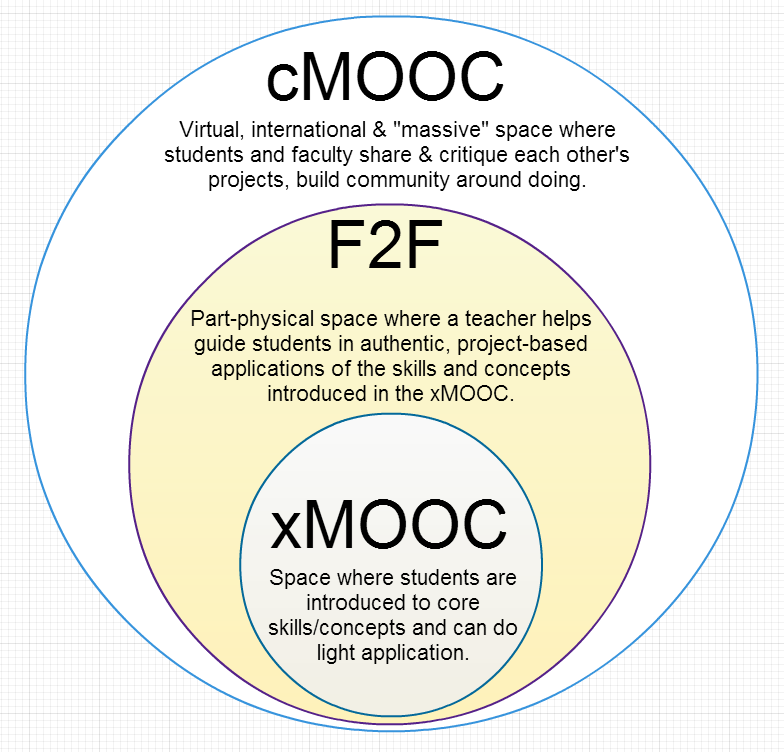
There is a number of interesting research questions, methods and more included in the Google Doc — and if you want to connect with any researcher, their contact information is also included. One article I found interesting from Mike Caufield (@holden ) was the x-MOOC  vs. c-MOOC debate shared via his Educause article. I wonder how many institutions consider the space or place their move to MOOC is going, and what sort of learning framework (if any) they place these models.

xmooc is a chewy center

Image c/o @holden in this article 


Last, but certainly not least, I was grateful for connecting with my #PLN of amazing colleagues that I am able to share with on a daily basis on different social media spaces. Who would have thought that this was my first time meeting Dr. Alec Couros (@courosa) in person — it feels like we go back for ages.  With a jam-packed, engaging keynote – I am glad that Alec and others took “notes” on Twitter. We also learned that when you let two Canadians loose in Milwaukee, there is bound to be some havoc. Highlights of our fun with the #blend13 crew (in no particular order) results in collaborative marketing campaigns for MKE, free-style karaoke, BACON love, killer dance moves, great conversations, photo-bombing, and general good times.

Untitled

Name the trouble makers who photo-bombed my #selfie.

Until we meet again #blend13 friends… keep it smooth.

Learning Technologies

Happy Digital Learning Day! #DLDay – Top 10 Learning Web Tools of 2012

Happy Digital Learning Day (#DLDay)!

digital-learning2 (1)

To celebrate digital learning day today, I thought it would be a good idea to share my belated Top 10 Learning Web Tools list from 2012. As I have read other lists (here and here), I have been meaning to share useful tools that have helped me learn this last year. You may have heard me say “it’s not the tool” but rather how you use the tool – so I thought I would share my top tools that I have put to use for my own productivity and learning.

  1. Twitter – This is my active stream of information that allows me to track on conversations either via search, hashtags or through my Twitter lists. I value Twitter to find information, learn about news/trends, collect articles, read blog posts, and, most importantly, engage with peers on a daily basis. My evolving personal learning network (PLN) is definitely at the top of my learning list.
  2. Google Docs/Drive I have found Google Drive EXTREMELY useful in 2012, as I am often seen with my Chromebook in tow. Daily I can be found using Google Drive, as I typically take notes during a lecture/meeting, brainstorm storm agenda items, crowdsource ideas, collect information (via a Google forms), or store resources i.e. PDFs, presentations, and database files.
  3. Dropbox – Not all of my collaborators of research, work and writing use Google Docs, so I tend use Dropbox as my “go to” cloud storage and sharing with MS Word. I often move in between spaces and devices (mobile, PC, Chromebook, & Mac) both on campus and at home, so Dropbox is easy enough to save and return to any working projects or assignments. As a frequent flyer for with an edu account, I have accrued 23.22 GB of space through referrals, use, and a Dropbox quest. My Dropbox allows for easy work flow, specifically for storing conference presentations, collecting articles for a literature review, archiving tweets through IFTTT, downloading my mobile photos, holding my lesson plans, and editing manuscripts with co-authors.
  4. Google Search – When in doubt…Let Me Google That For You. I would say that Google is typically used as my initial search for information, news, and quick finds probably because I am often working in Google Drive (see #2) and using Google Chrome (see #7). I have learned benefits of refining my power searching skills, and also not having this as my only outlet for knowledge acquisition.
  5. Google Scholar Although I increasingly use the UNT Libraries – Find Online Articles Search more often these days, I can say that Google Scholar has been a helpful tool for finding data, collecting statistics, locating peer-reviewed journal articles, collecting my literature review materials, and retrieving other scholarly resources.
  6. Google + Hangouts The reason I value Google Plus is for the Hangouts. Both for a meeting space or “On Air” live recording, this forum has proven well for meetings, conference calls, presentations, demonstrations, peer-review process, and general catch up with colleagues. I do still use Skype; I have a greater preference for using a video conference space that has live notes, free group (up to 10) calls, connection to my Google Drive, and, of course, the ability to infuse ridiculous Google Effects when meetings run on too long. Side note: I  am curious to see what happens with the Google Plus Communities. I have recently been invited to a few, and I can see some potential with this feature in Google Plus.
  7. Google Chrome As a mobile learner and avid Chromebook-er, I would say that Google Chrome is a user-friendly web browser for productivity and workflow. I appreciate the streamline interface, search ability, extensions  and applications from the Chrome Web Store {which compliments my Android phone apps as well}. Also, it is quite compatible with Google Drive, Google + Hangouts, and easily transferable from my office to home computing life.
  8. WordPress I may have been exhausted from reflecting during my Masters’ program; however I think that having my own space and place for reflection has helped me in 2012. For a fellow researcher, I candidly explained why I blog and more about my blogging history; however I used my blog more this year to document my doctoral progress and process my own educational experiences. Thanks for being an easy space to draft, publish, and share these thoughts, WordPress.
  9. Delicious Although I use Scoopit, Storify, and Paper.li a great deal, I can say that Delicious is still my top curation tool. Since 2007, I have been collecting and organizing resource into my delicious account. When I share a URL on Twitter it automatically archive the link to my delicious account via packrati.us. This is great to return back to my tags and stacks to find notes, information, statistics, or articles that I can use for presentations and publications. Also I appreciate others in my Delicious network who stayed loyal to this tool (even after a few changes) and socially bookmark useful resources.
  10. Flickr This social photo sharing site has provided me with a lot of inspiration and ideas. Whether I have used creative common-licensed images for presentations and blog posts, or just as a tool to document my own PhD adventures, I appreciate being a member of the Flickr community. I often capture a photo of a presentation slide, make a note from class, or document an image on the go to house them on Flickr for future reference and referral.

For 2013, I plan on taking Jane Hart’s (@C4LPT10 Tools Challenge to find out how to use new tools to help for my own professional learning, research, and development as an educator/trainer. For those of you who want to join in the fun, check out the Top 100 Tools for Learning 2012 for inspiration to explore. Happy learning!

#phdchat, Learning Technologies

CFP: Emerging Technologies for Online Learning Conference #et4online

The 6th Annual International Symposium for Emerging Technologies for Online Learning (#et4online) from April 9-11, 2013 (Planet Hollywood Resort – Las Vegas, Nevada) wants YOU to submit a conference proposal. Proposals are DUE by 11 pm CDT on December 10, 2012

The Emerging Technologies for Online Learning International Symposium, a joint Symposium of Sloan Consortium and MERLOT, is designed to bring together individuals interested in the review and evaluation of emerging technologies’ impact on online teaching and learning.

The 2013 Emerging Technologies Symposium chairs know technology for learning is shifting quickly:

“New discoveries in technology happen rapidly and far too frequently. It is difficult to keep up with every new release or innovation.  Advances in technology often become the vehicle for new ways to learn or enhance learner opportunities in our classrooms. As educators we progress forward, gaze back, and aim to bring the best of old and new to create an optimal environment to our students. However daunting this mission is, we tackle the problems and learn best from those who are already building the bridges and taking on the tasks we want to try. The field is advanced by those who share, scrutinize, and study. We invite you to contribute to the progress by presenting and attending this year’s symposium and encouraging your colleagues to join our efforts.” 

The #et4online steering committee is interested in interactive sessions that engage and inform participants for the following areas:

  • Higher Education and K-12 Faculty
  • Future professors and graduate students
  • Educational technology leaders
  • Students
  • Instructional designers
  • Instructional technologists
  • Academic administrators

Sessions can be targeted to all attendees and or specified (novice, intermediate, or expert) levels of proficiency. The committee would like to see a wide range of involvement from various presenters/facilitators – this includes proposed sessions from graduate students TOO!

The #et4online symposium will accept presentations that offer attendees “real solutions,” pioneering practices, and future trends, specifically submissions which emphasize evidence-based practice and the impact of topic tracks on teaching practices and student learning outcomes using a range of research methodologies (e.g. case study, longitudinal comparisons, within group comparisons, quasi-experimental, etc.) and rigorous approaches to the analysis of supporting data, qualitative or quantitative. Here are the #et4online symposium tracks and research areas:

Here is the presenter FAQs and Webinar Recording from 11/29  to help you with your proposal submission: 5 Tips on How to Submit a Successful Conference Proposal

There will be a wide range of emerging technologies for online learning trends, talks, sharing, and more! What happens at #et4online in Vegas will NOT stay in Vegas. And that’s a good thing! Follow @et4online for more updates as well!

#phdchat, ATPI, Learning Technologies, LPQ, Reflections

LT Forum Interview – About My PhD Experience So Far…

The LT Forum is a place for students, staff and faculty in the Department of Learning Technologies at the University of North Texas to share news, announcements and updates. Here is an interview I did for them over the summer, that I forgot to cross-post here. Thanks to for inviting me to share my thoughts Jenny Wakefield.

« on: June 02, 2012, 01:24:32 PM »

We have many talented doctoral students in The Department of Learning Technologies. Our hope is to be able to interview and showcase these PhD learners here in the LT Forum as each reaches milestones through-out their journey towards their graduation. Reading about other students’ successes may boost that extra energy needed for others to push themselves forward and learning about challenges may help guide others. We also want to spotlight our students so that new learners come join our team and travel with us in the Learning Technologies – a great place to be! [Jenny Wakefield.]Our third interview is with Laura Pasquini, Doctoral Student in the APTI program:

Laura Pasquini – PhD Learner in ATPI

JW: Tell me a little bit about what made you decide to enroll in the ATPI program and pursue a PhD/EdD. (When did you enroll? How long have you been working towards your exam and course completion?)

LP: In looking for a graduate program that suited my scholar-practitioner interests in higher education, I thought that the Department of Learning Technologies at UNT was best suited for my talents and interests. After completing a course in Fall 2009. I decided to join the ATPI program in Spring 2010, as I liked the interdisciplinary approach and learning model that was built into the curriculum. As an ATPI doctoral student approaching completion, I appreciate the ability to study in the field of applied technology, human resource management, organizational change/theory, and educational research while connecting with faculty and leaders in the field. The end of 2012 marks the end of my course work and movement into being a PhD candidate. I am fortunate to be one of the first ATPI doctoral students to complete the NEW ATPI portfolio (instead of the comprehensive exam) by November, and after my last ATTD class with Dr. Nimon this Fall I will be ready to propose my doctoral dissertation and move on to being a doctoral candidate. The tentative plan is to be complete the ATPI doctoral program and graduate around May 2014.

JW: Who is your major professor?

LP: Dr. Jeff Allen is my major professor. It has been great collaborating and learning from one another. I appreciate the ability to work with and contribute to research, publications, and opportunities in the LT department. He has been a great faculty advisor who knows how to challenge and support my professional/academic needs.

JW: What has been the most challenging parts of your studies so far?

LP: Balance. I am a student, staff, and instructor at the University of North Texas. My role as an Academic Counselor/Instructor with the Office for Exploring Majors, Undergraduate Studies supports undecided students with their major/career choices and academic journey; whereas I am often found on campus, late in class, or researching/writing for another project. Besides working on courses, I have found great values in collaborating with other authors on publications, connecting in the field with other educators, and meeting corporate leaders. Besides working on courses, I have been busy with contributing to professional associations and journals with research, publications, and presentations. This year I have taken on the role as the editor for the Learning and Performance Quarterly (LPQ) which is a student-led, blind peer-review open-access online journal. We just published our first issue on May 22, 2012 and I’m looking forward to working with our reviewers and editors on the second issue over the summer.

JW: Tell us a little bit about your journey so far. What are challenges you’ve had to overcome? Have you had any pleasant surprises, aha-moments you’d like to share?

LP: I am originally from Toronto/Niagara Falls, Canada, so it took me a little while to adjust to the climate and the ways of Texas. I have been fortunate to meet some hospitable friends and colleagues who have helped my transition to the Lone Star state. So far I have really enjoyed my PhD journey. I have appreciated the projects, classes, discussions, and, most importantly, the connections with peers from UNT and in the learning technology field. I think that learning is an ongoing process, and developing as a researcher and academic is a continual experience. I have learned to celebrate the accomplishments and milestones along the way, and to be open to any feedback and new ideas I am exposed to along the way.

JW: What presentations have you attended/presented at? Tell us a little bit about one of them. Anything in particular that comes to mind? Advice for others?

LP: I have been fortunate to present research, papers, and theoretical sessions at a variety of professional associations and conferences over the last few years. Some have been collaborative and others have been a great learning experience where I have engaged with participants in meaningful discussions about shared research experiences.

LP: Over the last year I have been fortunate to be asked to share ideas and thoughts around connected learning and social practices for professionals as an invited speaker a few conferences/meetings. Last fall I was invited to talk to the University of Hawaii System Advising group at their annual workshop in Honolulu, HI about “Why Advising Networks Matter” and how holistic, community models of connected advising practices best support our learners. I just returned from Helena, MT where I was invited to be the opening keynote speaker for the Mountain MoodleMoot. During this talk I shared strategies for developing learning curriculum and ideas to support social learning with Digital Pedagogy to Engage. Both talks offered me opportunities to share my research ideas and practical experiences with social, connected learning; but more importantly it allowed me to connect with colleagues to discuss how these ideas can be applied to provide solutions for issues in education.

JW: What publications and/or creative works have you published?

LP: In collaborating with a few authors from our campus and other locations in the US, I have experience publishing book chapters, monograph chapters, and conference proceedings around topics in technology for advising, collaborative learning, and innovative practices for performance and learning. I am currently working on a few manuscripts for peer-reviewed journals. If you want to see my publications, I have current publications shared on my Mendeley account. Besides formal publications, I am often reflecting and sharing thoughts about my research on my blog or podcasting with the BreakDrink.com Student Affairs and Higher Education community on the Campus Technology Connection podcast.

JW: Have you decided on your dissertation topic and if so what was it? If so, what made you decide on this topic?

LP: I am currently culling through my literature review and narrowing my dissertation topic – which should be finalized over the break in coursework this summer. My current research thread and interests are in the areas of collaborative learning environments and personal learning networks, specifically how these networks and environments impact learning, training, and development in organizations. What interested me in these topics was personal experience connecting and learning in both formal and informal learning networks – specifically with peer-to-peer learning and mentoring in professional organizations. I hope to share some insights and values to how alternative forms of learning, training, and mentoring can impact professional development and career growth.

JW: Have you been studying full-time or also been working? How do you feel about combining PhD studies and working full-time (if you did)? What are things to potentially keep in mind?

LP: As I shared above, I have been working full-time as well as working on my doctoral studies, research, and publications. I will say that it is quite busy and challenging; however with some effective time management and organization it is not impossible to accomplish your academic goals. I am grateful to have supportive peers, colleagues, faculty, and family who continue to motivate and push me along my PhD journey. Although it is not impossible, I will say that it takes a great amount of energy, effort, and time to commit to doctoral research and academic professional development.

JW: Any recommendations you would like to share with the rest of us on the journey towards a PhD/Ed.D? 

LP: Stay the course. It seems like a long journey to the end of the PhD/Ed.D, but I think that there are some valuable experiences and rewards along the way. Embrace the challenges and opportunities that you have as a doctoral student beyond the course/program requirements. You can help shape your degree and academic experience, so be sure to make the most of it by getting involved, getting connected, and embrace new learning experiences that you stumble upon along the way.

JW: Anything else you would like to add?

LP: Thanks for asking me to share my thoughts about the Learning Technologies department and ATPI doctoral program. For those of you who want to follow along my PhD journey, I can often be found tweeting or reflecting on my blog. Get connected and share your experiences with me: http://about.me/laurapasquini