AcAdv, ACPA, ACPAdigital, Blended Learning, Higher Education, Learning, Learning Technologies, Online Learning, Professional Development

Academic Support In A Digital Age

Although you might not advise or support students in an online degree program, there are increasing efforts for teaching and learning technology. Learning delivery and design does impact how we support our students, and we mediate much of our work in higher education using digital tools and platforms. That being said, any adoption of technology should be led with informed decisions on modifying pedagogical methods (Bates, 2015), which is directly related to our advising models and programs we offer in the post-secondary.

Our students want the same flexibility, access, and online support they often receive from instruction and other services they use. When learning with technology, our students are accustomed to having access to student support or other features alongside their online/blended coursework; however, the digital student success side is frequently an afterthought for these technology determinations. We need to have more student success and academic advising programs consider the best technology to provide advising content and service delivery (Steele, 2015) for a more learner-centered approach.

digital DNA

Digital DNA by Adriana Varella and Nilton Malz 

Whether you are leveraging technology to optimize your student support services or your campus is transitioning to either a blended or online learning model, there is both a need and desire to improve technology for academic advisors and student support practices in higher education (Pasquini & Steele, 2015). During your planning, it will be critical for your institution to ask the following questions before selecting technology-mediated environments for advising and learner support: 

  • What technologies is your institution currently utilizing for academic advising or student support?
  • How does your division or unit on campus decide on the most appropriate mode of technology delivery? [Will this be a campus-wide decision?]
  • What factors should be determined when designing technology in advising program and/or student support functional area?
  • What other strategies and structural support might benefit your campus in preparing  staff as they support learners digitally?  (e.g. training, skill development, etc.)

Join me as I discuss this further next Wednesday, September 14th from 12-1 pm EDT for the ACPA Commission for Academic Support in Higher Education (CASHE) Presents Webinar: “Selecting Technology for Advising and Supporting Your Students.” During this online event, I will be sharing a few evidence-based ideas and practical resources to help your advising team address these questions. This webinar will introduce your campus planning group to a few strategies and structures as they select technology for advising and student support. Sign up for this FREE webinar sponsored by ACPA CASHE here: http://goo.gl/tR8THa 

References

Bates, A. W., (2015). Chapter 9: Modes of delivery. In Guidelines for designing teaching and learning for a digital age. Open Text BC.

Pasquini, L. A., & Steele, G. (2016). Technology in academic advising: Perceptions and practices in higher education. figshare. Retrieved from https://dx.doi.org/10.6084/m9.figshare.3053569.v7

Steele, G. (2015). Using Technology for Intentional Student Evaluation and Program AssessmentNACADA Clearinghouse of Academic Advising Resources. 

#3Wedu, Podcast

The #3Wedu Podcast No. 8: Happy #HigherEd New Year!

Today is the last day of August. With this and labor day weekend just ahead, it really feels like the end of summer. Now it’s back to school time! I would say summer flew by — but really, that would be a lie. I think I made the most of the summer to work on research projects, write a manuscript or two with the fantastic #AcWriSummer group, teach a couple of classes online, visualize publications, and stoke the fire for grant & research ahead! Of course, I took a break to enjoy lake life, hiking, and road trips (See #GirlsGoneEast on Instagram).

In higher education, I have always viewed each semester as a “fresh start” in our academic cycle. With the fall semester here, this term, in particular, brings about new beginnings for many students, staff, and faculty on campus. In the first week of our academic semester, I enjoy reading about my students’ hopes, dreams, and aspirations they share on my student information forms. It often makes me sit back and think about what I want to get out of the course or work ahead in the term as well.

happy-new-year-1063797_1280

Image by cocoparisienne  available under under Creative Commons license.

Hopes. Dreams. Aspirations. This is our topic for The #3Wedu Podcast, as shared by Nori on The #3Wedu Blog. Join us TODAY (8/31) as we reflect on previous milestones, thank our mentors, and recap past learning experiences. Then share with us what YOU want to do in the new school year, as we ponder our own #highered new year goals.

Grab your favorite grape soda, and raise your glass for The #3Wedu Podcast: Episode No.8 today, Wednesday, August 31st, 2016 at 3 pm PST // 5 pm CDT // 6pm EST:

#AcWri, #AcWriSummer

My Lessons Learned from #AcWriSummer 2016

Earlier this summer, I proposed to form a “writing posse” that would encourage support and accountability…and keep my own writing progress in check. Little did I know how important this would be! I am SO very grateful for my scholarly peers who accepted this team challenge, lCatherineCaroline & Patrice. These colleagues were also invested in working on a specific writing project, and they were all willing to join me on this 8-week experiment we’ve called #AcWriSummer 2016.

acwrisummer16

We started using chapters of the book, Writing Your Journal Article in 12 Weeks, to guide our writing process; however, we ended up branching out to figure out what we could accomplish or support over the summer.  I sincerely thank these ladies for their willingness to contribute in our online weekly meetings, tweets for motivation/support, and general advice for editing of manuscripts and resources to develop our academic writing practice.

Here’s what I have learned from #AcWriSummer 2016:

  • Accountability for academic writing is good thing – regular, structured check-ins or checkpoints for the writing process as you draft a manuscript
  • Apparently, holidays take away from my writing habit (I stopped tracking my writing time/progress after Canada Day)
  • Creating a habit of writing is key – always schedule writing chunks early & often on your calendar (block out time)!
  • Laying the foundation of a manuscript helps your writing — outline your paper structure 
  • Focusing and targeting your manuscript for the publication outlet you want is critical! Wr
  • Drafting a solid abstract that will get read and cited — keep in mind this might be all other scholars read and use, so be explicit about your study & findings here
  • Research the empirical literature WELL!  (see resources below or read my #AcWriSummer Week 3 post)
  • What I write is not always what others read — be clear in your arguments and findings
  • Attack & conquer editing with peers to tighten drafts – Google docs are great for a 1st review of a draft
  • Consider what your writing process is and if it needs to be changed (or is it working)
  • Ask a colleague/peer for help if and when you get stuck on something in your writing
  • Solicit for ideas for elements of how to improve and enhance your manuscript from an outside perspective
  • Helpful reads and tips for writing
  • Collaborative team attacks for editing sections of a manuscript
  • Reminders incremental academic writing is still progress
  • Social experience with both peer learning and care – academic writing does not have to be a solo endeavor
  • Sharing of resources, reads, and tips to support writing (see below); however, you really need to figure out what will work best for YOU in your academic writing practice.

Interested in supporting your own #acwri practice? Here are a few great resources our #AcWriSummer group curated during the last couple of months:

Now that our “formal” #AcWriSummer 2016 curriculum is over, it is time to get these drafts finished.  I will need some #ShutUpAndWrite time before I can properly enjoy any holiday time that remains in August. At least I have my motivation for getting my #acrwisummer projects done. Happy writing, y’all!

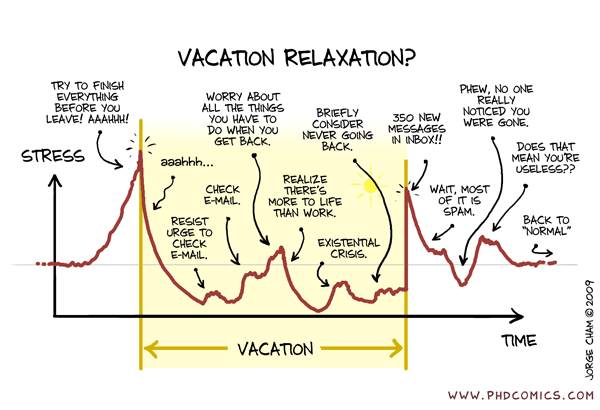
phd092809s

Image c/o PhD Comics

#3Wedu, Career, Podcast, Professional Development

The #3Wedu Podcast No.7: Job Start Up in Higher Ed

TODAY, Wednesday, July 13th at 3 pm PST//5 pm CST//6 PM EST the #3Wedu Podcasters will discuss issues around getting started and establishing yourself in a new position in higher ed. In previous #3Wedu podcast episodes, we’ve discussed issues that a number of women face as they move throughout their career, including (but not limited to): the double bind, importance of supporting one another, mentoring, the value of care work, and removing organizational barriers for women. This next podcast we dig into the following questions, not in any particular order:

  • What are the things you should do just before and after you start a new job? This may include salary negotiations, benefits, culture and fit.
  • How should you plan your professional development funding? Suggestions and ideas for opportunities for learning and growth in your career.
  • Do you agree with this study or think we have to be “warm” to advance in your career?: To Seem Confident Women Have to be Seen as Warm 
  • We were thrilled to have Mary Niemiec as our special guest for our “Wine Box” rant, rave & review.

Flickr photo c/o lamenta3

Join us TONIGHT with the following show notes http://bit.ly/3wedu7  and by tuning into the LIVE broadcast here:

This blog post is cross-posted at EdTechIsGorgeous and The #3Wedu Podcast blog.

MOOC, Online Learning, publication, Research

How Do Online Learners Overcome Challenges in MOOCs? [New Publication]

In analyzing recent MOOC research, a number of studies explore the vast amount of data collected by digital learning platforms to understand learning behaviors in these scaled classes. What we don’t know much about is:

  • How online learners resolve the problems
  • How students online persist in a course
  • The strategies MOOC students use to overcome challenges

In a new publication, The Life Between Big Data Log Events: Learners’ Strategies to Overcome Challenges in MOOCs, George Veletsianos, Justin Reich, and I share what we learned from talking to 92 MOOC students ages 21 to 81 enrolled in 4 different courses from North America, South America, Europe, Africa, Asia, and Australia. The whole paper is free and available for your reading pleasure at the new open access education journal, AERA Open, and check out the research findings presented in this short video summary created by moi:

During these interviews, we learned that there is so much more going on beyond the screen, tracking logs, and platform learning analytics. Learners shared how they engaging in the online course and activities in three domains:

  1. Describing their designated workstations and study methods for learning
  2. Utilizing online and outside resources beyond the learning platform
  3. Engaging with social networks both inside and outside the online course

Read more here:

Veletsianos, G., Reich, J., & Pasquini, L. A. (2016). The life between big data log events: Learners’ strategies to overcome challenges in MOOCs. AERA Open, 2(3); 1–10. doi: 10.1177/2332858416657002