Higher Education, nacada, Professional Development, Training

Passing the Torch: Leadership Transition in Our Professional Organizations

In many professional organizations and associations (both formal and informal), leadership positions are fluid and change frequently. Whether it is an elected position, scheduled appointment, or a professional move, it is important to consider how your organization manages leadership succession and transition to sustain the association.

Passing the Torch

In thinking about transitioning out of my current role with NACADA, I was asked to share my experiences and resources* for incoming leaders for in the association. I figured I might as well share a few of these ideas with others who might be transitioning or transferring of roles in their professional organizations as well:

I. Build Your Professional Posse – No leader can do it alone, nor should they. Surround yourself with some great people who share similar interests and passions in your professional area. You know who they are – you have met them at a conference, attended one of their presentations, connected with them online, or heard about the great work they are doing – so reach out and get these members involved.

  • Recruit members at annual conferences/meetings in-person and online. We used a shared Google Form to invite others, e.g. the  #AdvTech Technology in Advising Commission Sign-up for 2012-13

  • Pass on and share the names, contact information (email, phone numbers, Twitter handles, etc)

  • Find out HOW members want to be involved with your group. Be open to suggestions and areas of interest that you have not thought about.


II. Take Note — Document, Organize & Archive – Be sure to keep notes, capture screenshots, record meetings, and file take notes, take screenshots, record online, and file information in an organized way throughout your elected/appointed term.

  • Save and file emails into folders from the professional association, members, and more – you never know when you will need to refer back to them

  • Organize information by projects, deadlines, and responsibilities

  • Store and save your files in an accessible space for your group to review

  • My “go to” spaces of organization for NACADA included:


III. Mentor While You Lead – Succession planning does not have to start at the beginning or end of your elected/appointed term. Consider involving members in your professional organization early and often.

  • Encourage point people for sub-groups, committees, or projects

  • Recommend collaboration within and outside your specific group

  • Involve participants in activities, presentations, research and development with your interest/commission area (psst you should not do it alone).


IV. Meet with Your Members – You will want to organize a regular meeting schedule with your committee, group or advisory board. Inquire about these at the start of each academic semester or quarter, and try to keep them on a regular schedule. Save the date(s) in advance.

  • Determine when you can meet. Try using a Doodle to sort out your meeting schedule.

  • Find the best space to “meet” for your group as they may not be anywhere near one another geographically:

    • Conference Call? There are a few free ones like http://www.freeconferencecall.com/ out there

    • Professional Association or institutional online web conferencing available? NACADA uses the Adobe Connect platform

    • I also am a fan of Google Plus Hangouts – free group video chat for 10 people and the ability to have IM chat and shared documents from Google Drive and/or screen sharing capability

  • Put out your agenda a week in advance to remind others of meeting, where/how you are meeting, and to give time to prepare/read over meeting information

    • I use Google Docs for shared agendas to encourage members to add discussion topics, questions, or updates


V. Create a Communication Plan – Consider making a communication plan for your professional group. This will help you understand the how, where, when and why for communication. This will also help you to disseminate information, seek out information, ask questions, and engage the members of your professional group.

  • Survey your group to find out WHERE they want to stay connected and informed. This can be at an annual conference/meeting or online. {We asked at the annual meeting, and on the digital sign-up sheet.}

  • Create welcome messages for email, Facebook or other networks to tailor and respond to interested members ASAP, for e.g.

Hello ________________,

Great to hear that you are interested in getting involved in the NACADA Technology in Advising Commission (#AdvTech)! Our #AdvTech Commission would love to have you join in the fun. To help identify your interests for involvement in the commission, please complete the NACADA Technology in Advising Commission Sign-up for 2012-13 {insert URL}

Also, be sure to connect to our commission  Facebook Group: {insert URL} There are a number of great conversations, questions and opportunities to share resources in this space. Finally, we do have an option to sign up to the commission listserv and information on the NACADA Technology in Advising Commission web page

Looking forward to getting you connected and involved soon!

Best,

Laura Pasquini

NACADA Technology in Advising Commission Chair 2011-2013

  • Get SOCIAL (media) – find an online, connected space that works for your group. Our group was interested in a moderated/closed Facebook Group; however I have seen Google Plus Communities, organizational listservs, Facebook Pages, LinkedIn groups (e.g. Advising Veterans), or hashtags on Twitter (e.g. #firstgen) to bring professional groups together. Just be sure to keep up with the conversation in whatever space you choose to use.

  • Be open for members to reach out to you for questions, ideas, suggestions, and getting involved. I often connected with members via email, Skype, on the phone, Google Plus, or another social network. Keep the conversation going, and consider hosting “office hours” or regular ways to connect with you.
  • Think outside the communication box. Consider offering different means for sharing member information and updates. We tried out the NACADA Tech Talks of 2012, and after the NACADA 2010 conference members of our group initiated the the #AcAdv Chat weekly Twitter conversations.


*There are a number of different tools and online resources to help with professional organization workflow. I am just sharing the specific ones I used with my NACADA Technology in Advising Commission the past couple of years. Figure out your purpose, then find the appropriate tool that will work for you.

Open Education, OpenAccess

Open Education: Why #OER Needs to Be Our Business and Policy

A couple weeks ago, I attended the WCET hosted webinar on our campus – Open Education: The Business & Policy Case for #OER presented by the Director of global learning at Creative Commons,  Cable Green (@cgreen).

Wait – what the heck is OER?

I did take a few notes (a.k.a. Tweets) and thought I would share my thoughts from the session – and general thoughts for OER materials.

avatar
{Irony: Not all of the OER Commons is CC licensed}

The real issue is about sharing and making a case for open policy on campus that fits a “business model” in higher education. This webinar addressed concerns and practices to implement open access policy that is good for business. Currently, many educational institutions do not value  or support “open” as an option. I am fortunate to work at a university that supports the open access movement and encourages sharing of scholarly research and publications. I have been thinking about my role as an open educator for a while, and what it means for my research, publications, editing, teaching, and learner engagement.

In reviewing the UNT institutional OER involvement, I know there is some progress for resources, but like many campuses, we have a way to go. It would be great to see more departments, faculty, and units participate in sharing resources and joining the #OER movement.  By swapping educational resources and encouraging remixing of ideas, we might be able to create more opportunities for collaboration  to enhance our learner experiences, including:

  • faculty mentoring
  • new ways instructional design development
  • program evaluation
  • cross-training of staff and faculty
  • student innovation/involvement
  • affordable learning materials e.g. http://opencourselibrary.org/
  • interdisciplinary learning commons
  • building capacity within your institution

If you’re at a publicly funded institution, your educational resources should be openly licensed – this just makes sense. Does your institution encourage and promote Open Access? Do you share Open Educational Resources at your school? Please share how you are #OER.

Collaboration, Reflections, Social Media

Why Understanding Differences and Coming Together Matter

To say that this past week has been eventful, would be putting it mildly. If you were under a rock or disconnected from any media, then let me do a brief re-cap of a few events that occurred:

During the week’s happenings, many were tuned into the news and social media streams. An even larger percentage of people expressed their thoughts, feelings, and concerns in various social media outlets. As events unfolded in different geographic locations, it was amazing to see people come together to show support for one another. The power of the community and lending a hand has been seen widely in these shared spaces. For example, the #RunForBoston initiative and the Americans for Mariage Equality equal signs could not be missed. Social media affords individuals to get involved, speak up, and share their thoughts.  Both our mobile and connected technologies have the power to make our world smaller and unite a community.

Unfortunately, there is a double-edged sword for this social sharing. With the increase in open, public dialogue comes harsh comments and demonstrations of disrespect. I learned that few often considered other perspectives as social/media streams shared a number of incorrect and inappropriate assumptions, outbursts, accusations, and opinions. It saddened me a bit, and I often stepped away from the screen.

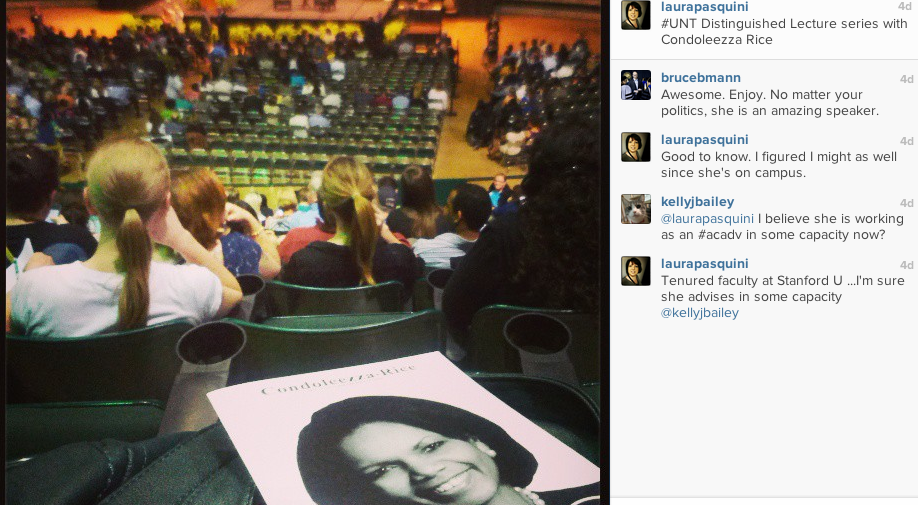
On Tuesday (4/16), I attended the Condoleezza Rice Distinguished Lecture hosted at UNT. My friend @brucebmann said it best when responding to this photo “No matter your politics, she is an amazing speaker.”

Screen Shot 2013-04-20 at 2.46.31 PMThis comment, and listening to the talk, made me think about my own perspectives and bias. How often do we challenge ourselves to think in a new way? How can listening to another perspective better inform our decisions? How is it possible to bring groups in conflict together?  I think it is possible, and I know that I am not alone.

Although “victory” has been seen this week, I don’t think that these events are really over. I challenge more of you to think about your influence and impact in social [media or not] spaces. What you say, tweet, blog, post, etc. influence the dialogue and community. It is easy to get [digital] high fives from friends and followers; however have you considered extending your reach to those you might not agree with? When is the last time you chatted with someone about the issues from this week who thinks differently than you do? Step away from the screen, and get to it.

Professional Development, Reflections, Training

Supporting Student Success at #UFTL13

UFTL13

I was able Last week UNT hosted the annual University Forum on Teaching & Learning:

UNT’s University Forum on Teaching & Learning (UFTL) is a one-day annual event that enables faculty, graduate teaching fellows, and staff involved in supporting teaching and learning to share ideas and practices that motivate learners, promote critical thinking skills, engage in real-world problems, and better prepare students for life and work in the 21st century.

This year’s #UFTL13 focus,  “Supporting Student Success,” helped initiate the conversation and help our campus understand how to support our students. It also shed some light on what success is and what it REALLY looks like for our learners.  In moving beyond the dirty R-word (retention),  it is critical to think how the meaning of the word success varies for our students. Our planning of “good” teaching and learning practices may need to extend beyond a course credit, a classroom setting, or a syllabus requirement for our students to be truly successful.

During the morning round table discussions, we chatted about reaching students beyond our state mandates or the general push to graduation, and thought more about how to connect with our learners to better understand their needs and purpose for being at the university. It was clear that success means many things to many different people. Our small group identified different things that signify success (in general) including promotion, failure, self-discovery, overcoming challenges, and such. The key issue we had in talking about “success” for learning is the divergent goals that formal education require specifically in terms of assessment, evaluation formats, and individual competency reviews.

Later in the morning Dr. Cassandre G. Alvarado, from UT Austin, asked “What is student success really?” in her keynote address. In Dr. Alvarado’s opening statements, she shared how higher education is broken with the “universal problem” being = too many students are not successful. [I will get into the “broken higher education” discussion in a future blog post- note this for now].

First we talked about the definition of success, brainstormed a few ideas, and chatted about how we might need to redefine success in our classroom and on our campus. Here is what success meant to our small group and from the speaker’s point of view:

  • effecting people in a positive way
  • being an inspiration
  • impacting others around you
  • having a goal, working hard & making sacrifices to work towards that goal
  • passion for what you are doing or how you are working with others

BIG IDEA: Success is more than content knowledge.

enjoy-your-success

 Key Goals for Success & to Be Successful shared by Dr. Alvarado in her keynote:

1. Perseverance  “Nearly every man who develops an idea works at it up to the point where it looks impossible, and then gets discouraged. That’s not the place to be discouraged.” ~ Thomas Edison

  • We need to share with our students our struggle so they can learn
  • Model for our students our own struggles
  • Reward effort as well as correctness, e.g. rewarding effort on homework and tests, using innovative assessment methods produced almost triple gains

2. Community –  “My model for business is the Beatles. Total is the sum of the parts… Great things in business are never done by one person. They’re done by a team of people.” ~ Steve Jobs, 2003

  • Community happens inside and outside of the classroom
  • Is about understanding our role
  • Is more than just friends, e.g. Creation of learning communities increase ention through Drop, Fail & Withdrawal rates stayed the same; cluster of courses

3. Imagination – “The value of an idea lies in the using of it.” Thomas Edison

  • Discovery is imagination
  • Ask students to solve problems that don’t yet exist not ones that have already been solved
  • “See yourself on the other side.” Dr. Marcy Haag’s mantra 4 breaking a board in a Taekwondo class and she shares this for learning/perseverance

Finally, I was asked to join a student, staff, and faculty panel (I fit a couple of these roles) to talk more about student success at UNT. Here are the questions posed to the #UFTL13 panel:

  • How do you define student success? Can you share an example of or tell a story about student success at UNT. (This could be a personal story, one of a colleague, classmate, friend, etc.)
  • From your perspective, what do students need to experience success at UNT?  Do you have any examples to share?
  • What types of partnerships make student success a reality at UNT?  Do you have any personal experience with partnerships?
  • From your perspective, what can staff/instructors/students do to enhance student success?

Of course, I took a few notes and tweeted during the panel, so here are a few themes that emerged from the our responses:

#UFTL13 Student Success Panel Responses

How do you define student success on your campus? What student success stories can you share? Think about it, and let me know.

EdTech, PhD, Professional Development, Reflections

#et4online What Happens In Vegas, Should be Blogged

Much to my surprise, my first visit to Sin City was less about the bright lights, gambling, or trouble I could cause…and more about innovative ideas and collective sharing for learning technologies. This is what happens when you attend the 6th Annual International Symposium on Emerging Technologies for Online Learning (#et4online).

Waiting for my flight to #et4online

In returning from the #et4online conference, I think that there are a number of great conversations, thoughts, and questions I am left with. So, fortunately for my readers, what happens at an #et4online conference in Las Vegas, will NOT stay in Vegas.

Here are a few #et4online conference highlights, notes & tweets (I am not alone – as I know @tjoosten does this as well):

  1. Location Location Location – Kudos for the Planet Hollywood site. Easy to get around, wifi access was great, it was the middle of the strip & close to some great restaurants, and, most importantly, Rex Manning from Empire Records looked over me while I sleep. What more could a gal want?
  2. #EdTechCareer Forum Round Tables – This was the 1st year to start this initiative; however we had a decent turn out and more importantly conversation with our facilitators @amcollier @veletsianos@tjoosten, @whitneykilgore, Kevin Grazino & Rachel Salas-Didier. Thank you to the emerging scholars and career-seekers who stopped by to talk about direction in the field, finding passion, planning for career applications, and more around the job search and career development we have in the #edtech field.
  3. Keynote: What’s That Coming Over the Hill? Digital Futures, Emerging Cultures, New Learning c/o @timbuckteeth This chat had a malay of ideas and experiences for connected learning and pedagogy. Unfortunately Steve had to return back to #PELC13 back in Plymouth, otherwise it would have been great to pick his brain about e-learning more.  Here are a few notes myself & others took via Twitter from his talk.
  4. Plenary: Seven Tales of Learning Online with Emerging Technologies with @veletsianos I like how George shared his learning experiences as a student, researcher, and instructor to help us look critically and realistically at how we are using emerging technologies in education. Here are a few collected tweets from the talk.
  5. The Launch Pad: What a great way to show case Ed Tech start ups, and provide an space in the conference to discuss how educators/developers can work together and collaborate to pilot these initiatives. It was great to connect with Lida & Scott from @Ginkgotree after our BreakDrink.com podcast last October to demo the product. Great to hang out & hopefully we’ll connect again in MI soon!
  6. Discussion & Dialogues of Education Is and Is Not – Specifically what is broken or needs to be fixed, and the reality of this statement. I appreciate how George Veletsianos engages in this more on his blog post, and chat with Amy Collier encouraged me more to think about the change, challenges, and issues being labeled in higher education and for online learning.
  7. #UNet4online: Open Space Technology – These sessions were threaded throughout the conference program and facilitated by Jennifer Ross (@jar) to encourage conversations and idea-swapping for online learning. I was able to attend one on April 10th and the final one on April 11th. I appreciated the  free space to challenge, ask questions, brainstorm, and share ideas/practices with peers. Shout out to the #unet4online tweeps: @amcollier ,@rasebastian, @veletsianos@KavuBob, @jleung81, @g4m, @johnrturnerhpt, @jar@hollyrae, @desertjul & @markjwlee who joined in on various unconference conversations. We were able to  talk about valuable ideas for learning including distributed flip educational models (not.a.MOOC),  higher education organizational design/culture, and ownership in education. Want to learn more? Check out the fantastic post on the (f)unconference from Amy Collier or my rough Google doc notes.
  8. Getting Social  – For me, this is why you attend a conference. I love connecting with others and learning how they are working with students, researching ideas, and just having some great banter. I am glad I got some quality time with @amcollier, catch up time with @tjoosten & @veletsianos, and hang time with new friends, such as @jar @dwicksspu & @kavubob. For those of you who were social [media] online – it was nice to connect via the #et4online hashtag. Let’s continue the conversation.

Screen Shot 2013-04-16 at 11.53.16 PM

Thanks to David Wicks (@dwicksspu) for inviting me to join the #et4online conference steering committee. I look forward to 2014 #et4online planning in Dallas, TX. Giddy up! For those of you who are going to Summerfest & #Blend13 – I will see you in July. 🙂