Higher Education, Social Media

Gathering #SocialMedia Guidelines from Higher Education #SoMe #edusomedia #highered

Grey of Social Media

When discussing social media guidance in higher education, there seems to be a lot of grey areas. Social media use is a relevant topic on many college and university campuses. Over the course of the next few months, my plan is to review social media guidelines to sort out the grey, and identify more black and white ideas about social media guidance.

To pursue my dissertation research, I am currently gathering ANY and ALL Social Media Guidelines from Higher Education Institutions from ANY and ALL COUNTRIES. If you currently attend, work, teach, or know of any a post-secondary institution that provides guidance for social media, then I need your help! Please search your institutional website for “social media” guidelines. Keep in mind, your higher education institutional “guidance” for social media may also be labeled as: guidelines, policy, tips, rules, beliefs, regulations, strategy, or take on another name. If you are aware of any websites, documents, or artifacts that guide social media in higher education, please COMPLETE THIS FORM.

 Please consider contributing to help advance social media guidance and use at our post-secondary education institutions: 

Submit a Social Media Guideline & Policy Document

The following website was created to gather and build a social media guideline database and share information about this research:

http://socialmediaguidance.wordpress.com/

If you have questions, concerns, or want to get more involved in this social media guideline project, please feel free to CONTACT ME. Thank you!

PhD, Reflections

#sxswEDU: Thoughts, Reflections & Then Some…

Time sure flies when you’re conferencing, volunteering and travelling… so my thoughts on South By South West Edu (#sxswEDU), are delayed by exactly 2 weeks. My bad.

Due to my love of Austin and enjoyment of SXSW, I thought SXSW Edu would be a great conference to engage with other educators and expand professionally. There were a number of things I liked – such as being on public transit, new perspectives on learning, and connecting with tweeps (Shout out to: @tjoosten, @gsiemens, @veletsianos@audreywatters & more #iamEDU friends!). I also appreciated the lively banter our Social Media in Higher Ed (#smHE) panel had on the topic, and the great follow up conversations with other instructors, practitioners, and researchers. 

Essentially, I got what I wanted out of the #sxswEDu conference – connect, social, interact and learn. I sort of expected something else from this conference, specifically with regards to the education (K-12 and Higher Ed) involvement. I was a bit disappointed to see that the Panel Picker selected more sessions with industry, rather than any educators. It was odd. I was not alone in noticing the tensions were felt between the industry and educationWhy were the instructors, teachers, principals, faculty, higher education professionals, and educational administrators not sitting in these #sxswEDU seats?

Let's get ready to MOOC-off! Where art thou @gsiemens?

Although the education presence was not the “sage on the stage” approach, I am glad I was present to listen to what industry and technology leaders think the “future of learning” will be. I know that many of these sessions were challenged and talked about outside the formal #sxswEDU program, and I was curious as to how other educators interpreted the conference message(s). 

One thing that was very noticeable = the repetitive rhetoric being shared from room to room. To mix it up I, jokingly, initiated the  #SXSWedu Terms to Know, Use, Love & Hate Google doc to note the key words, terms or phrases I heard at the conference. Some might say I was being jaded (*cough* Siemens *cough*), but really I was just having fun with the common language of the conference. After curating this list, I decided to create a game (…which had multiple players, I might add): 

#sxswEDU BINGO Card #3

Note: Another suggestion was to draft a blog post with the complete list of terms. I decided to respectfully decline said challenge; however I will stay alert to the language and context of these words. It’s not a bad idea to keep your ears open and listen every once in a while… Thanks for reminding me of that #sxswEDU.

Higher Education, Social Media

Guiding Social Media at Our Institutions [ARTICLE]

Remember last fall when Tanya Joosten (@tjoosten), Lindsey Harness (@LindseyHarness) and I asked for your input on how your institution guides social media? No? Too long ago to remember? 🙂 Well regardless, we appreciated those who could respond as it helped us gather information on what we are (or are not) doing to direct social media use in higher education.

The results from the research are in, and published! Here is the recently published, peer-reviewed article for the Society for College and University Planning (SCUP).

Access the article in PDF form here.

This article expands on Chapter 6 from Social Media for Educators to understand how higher education is guiding social media use. Through our open-ended questions, we learned more about how institutions are supporting and guiding social media. Often we see social media used a broadcast medium and there has also been a shift to designate new roles or responsibilities to support its use on campus.

Thanks to the SCUP Change-Disruption Mojo for featuring some of the findings as this week’s topic, specifically to Alexandria Stankovich (@thinkstank) for sharing both sides of the issue:

  • Concerns: monitoring online behavior, identity thief, privacy, FERPA/FIPPA, maintaining university image, control, ownership, required trainings

  • Benefits: interaction and engagement beyond the formal learning environment

Want to learn more about the research and/or article findings?

Key takeaways:

  • Social media is often used as a “broadcast channel”
  • We should engage and develop a culture through the use of social media tools
  • Institutions need fluid access to information regardless of the technology
  • Simplicity principle to build capacity for the social web
  • We need to develop models of effective practice for LEARNING!
  • Trust the faculty you hire – they have some great ideas
  • Recognize that learners are MORE than sponges
  • Match technology with task & building digital literacy opportunities
  • Is social media in your strategic plan? Is social media or technologies part of your learning outcomes on campus? THIS is where your efforts need to be
  • Institutional encouragement is needed for collaboration ON YOUR CAMPUS to identify how to best guide social media models & effective practices
“The pedagogical benefit of social media use beyond its application as a motivational technique continues to be unaddressed by many universities.”

This study was just the tip of the iceberg. There is definitely more research on learning, social media use, and higher education to be done. Time to get at it! Back to the dissertation proposal grind…

Reference:

Joosten, T., Pasquini, L. A., & Harness, L. (2013). Guiding social media at our institutions. Society for College and University Planners – Integrated Planning for Higher Education, 41(2), 1-11.

PhD, Professional Development, Reflections, SocioTech

Finding a Research “Home” with #SocioTech at #iConf13

As a College of Information student, the learning technology department compliments a number of research areas emphasized within our iSchool and at the 2013 iConference. Andrew Miller (@findandrew), Leila Mills, Mark Evans and I proudly represented UNT as one of the 12 finalists for the Social Media Expo hosted by FUSE Labs of Microsoft Research at the iConference this year. After conducting our ethnographic study on the Denton Local Food System (LFS), we submitted a research paper, video, poster, and created an online space for the LFS community to share information, house knowledge and connect to local happenings within the community at FeedDenton.org.
#iConf13 Social Media Expo Finalists
  Social Media Expo poster @ 2013 iConference (#iConf13) with @findandrew

What I enjoyed most about attending the conference was the refreshing opportunities to engage about research methodology and conceptual frameworks that apply to my scholarly interests. It felt like I was coming “home” when talking shop with various academics and graduate students during the conference. The best part might have been the pre-conference session:  Sociotechnical Systems Research workshop (#CNFWSP2). This is where I was able to connect to other #sociotech researchers, and learn more about areas of inquiry coming out of the iSchools and various disciplines.

The pre-conference was a full day of fun that housed various speakers, discussions, and sharing of directions in sociotechnical research, including

  • critical study and comparative study
  • considerations for multi-scale ethnographic research
  • artifacts that change communication in organizations
  • impacts of human and non-human delegation
  • shifts from visible to invisible networks (part of ANT)
  • organization as a constant communication
  • sustainable information practices
  • action-based research for informatics improvement
  • participation, community resilience, plurality, design

Later in the day, Steve Sawyer, conducted a master class to present various sociotechnical systems (STS) perspectives, which drew upon theories from Actor-Network to social construction. Everything is relational as new forms of social organization is occurring with new technical arrangements all around us. We talked about #sociotech in practice, specifically how to situate the phenomena (conceptual & empirical framing) and conceptualize sociotechnical systems (identify characteristics of the social, technical and interactions) by looking at this STS conceptual space mapping from Steve.

Untitled
This post is just the tip of the iceberg, as I have a number of notes, ideas, references, and research peers to turn to thanks to this workshop. I was not surprised to run into some of the #sociotech usual suspects in #iConf13 sessions such local communities, learning environments, or ethnographic studies of online communities. I appreciated the comments and dialogues brought to both the paper and notes sessions (I preferred the workshop space in the notes session better), and I am motivated to dig back into my own research and dissertation grind.

Want to read more about the 2013 iConference proceedings or connect to a few sociotechs? Here you go:


Reference:

Miller, A. J., Pasquini, L. A., Mills, L. A., & Evans, M. (2013). Towards a methodology of virtually augmenting a knowledge sharing community of practice: A case study of the local food system of Denton, Texas. iConference 2013 Proceedings (pp. 1095-1101). doi:10.9776/13527


Higher Education, Social Media, StudentAffairs

Reflecting on Values & Identity from #Dalton13

Over the past few days at the 2013 Dalton Institute, I have been encouraged to think about the cross-section of how our cultural norms, use of technology, and institutional practices intersect to support students. Educational reform for higher education is not new; however it was refreshing to have a group of graduate students, faculty, scholars, and practitioners to be part of a thoughtful collective to think deeper about these challenges.

Although the institute’s focus was self-promotion, social media, and student development, it was great to hear a number of conversations emerge about the disruptive forces and potential opportunities to embrace change in Student Affairs. The philosophical narratives and analysis of technology’s impact on identity was enriched by listening to personal perspectives and such varied experiences.

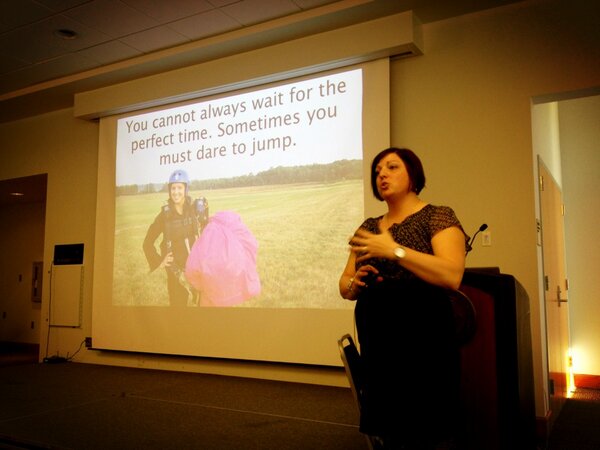
Dare to Jump

Photo c/o @DaltonInstitute {Thanks @vanessaballer!}

As the final keynote of the institute, I gave my “triple threat” perspective as a student, instructor, and professional in higher education. My goal was to share ideas and practices to develop a richer learning experiences; specifically ones that I have valued as an active scholar. So, doing my best to follow the amazing #dalton13 featured speakers – I shared my own narrative, critiques, and insights on how emerging technology can support and challenge student development. I gave some tangible examples and ideas of how to move beyond the gadget, application, or “next big tech thing” by considering ways educators can be actively pushing their learners. I talked about everything from exploration to collaboration, specifically by empowering students to be part of the solution to our institutional challenges.

My #Dalton13 Keynote – Notes & Then Some! (thanks for the photos & tweets #dalton13 backchannel!)

I appreciated the conversations (although some were far too brief!) around identity and student values that  I had with a number of #Dalton13 attendees, especially the FSU HESA graduate students. Although a number of ideas were shared at the institute, I am still left thinking and reflecting about these key questions:

  • How are student values demonstrated in a digital environment?
  • Can educators have an impact on the character development of learners?
  • Is student development really impacted by technology? How so?
  • Does there need to be a shift in how we support our student population on campus?
  • How can our graduate programs do a better job of challenging and supporting scholar-practitioners with “self-promotion” questions?
  • Will higher education cultural norms and institutional practices be changed, or will we be left behind?